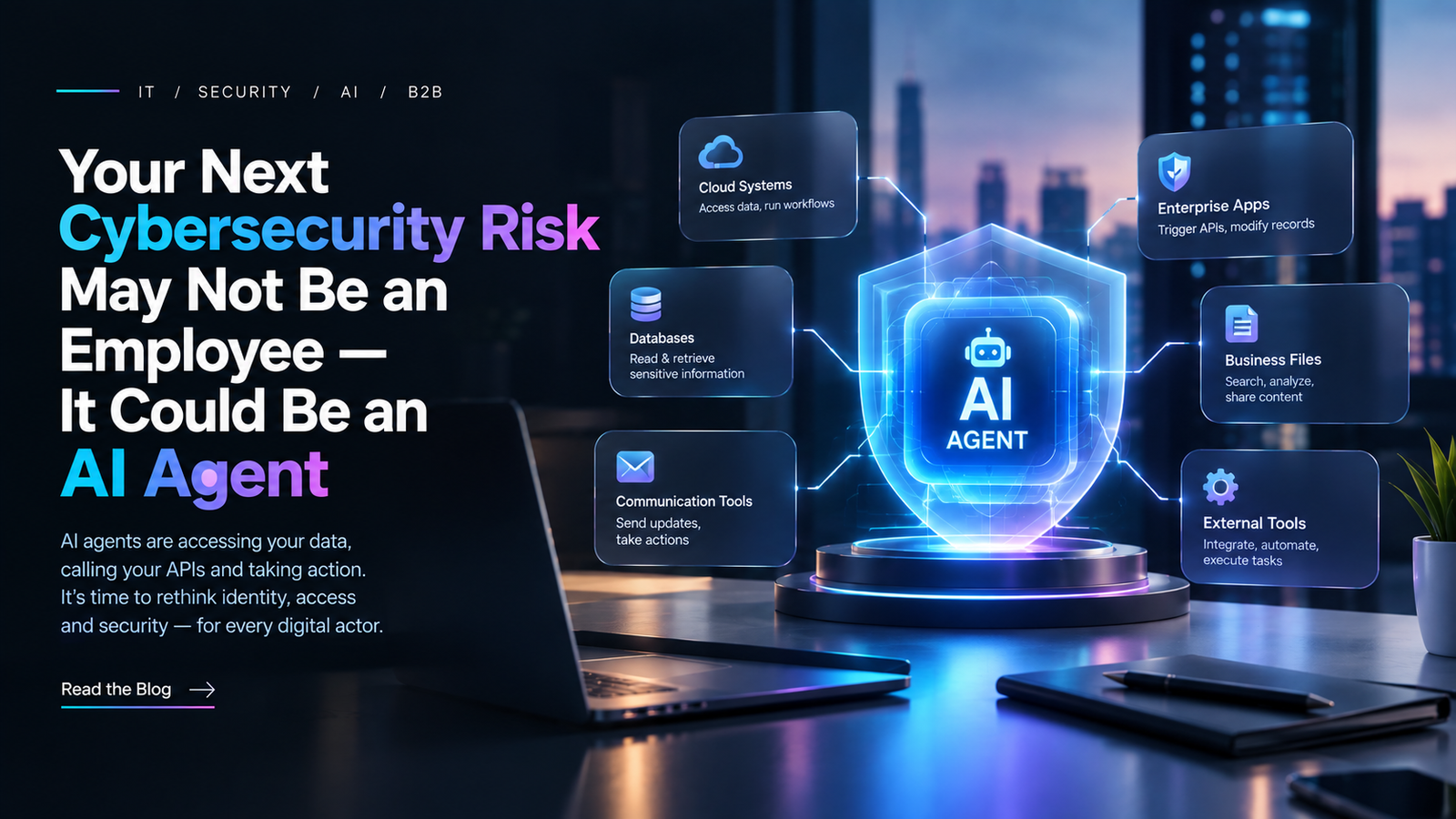
AI is moving beyond generating text, analyzing information, and answering questions. Increasingly, organizations are deploying AI agents that can interact with enterprise applications, access information, call APIs, execute workflows, and take actions with limited human intervention. This shift creates significant opportunities for automation, but it also introduces a new dimension of cybersecurity risk.
Traditional enterprise security models were largely designed around people, applications, devices, and service accounts. AI agent security requires organizations to consider another category of digital actor: an autonomous or semi-autonomous system capable of making decisions and taking actions across multiple services.
The key question is no longer simply, “Who has access?” Enterprises increasingly need to ask: Which AI agent has access, on whose behalf, to which resources, for what purpose, and what actions is it permitted to take? As AI agents become embedded in business processes, answering those questions will become an important part of enterprise security architecture.
Why AI Agents Create a New Enterprise Security Challenge
A conventional application generally follows predefined programming logic. Although applications can contain vulnerabilities and unexpected behaviours, their execution paths are usually determined by code written by developers.
AI agents introduce another layer of complexity.
An agent can receive a goal, interpret available information, select tools, call APIs, evaluate results, and decide what action to take next. Instead of following one fixed sequence, it can dynamically chain multiple operations together.
For example, an internal IT agent might:
- Receive a request from an employee.
- Search an internal knowledge base.
- Check information in an identity system.
- Query a ticketing platform.
- Determine what action is required.
- Update a ticket.
- Trigger another workflow.
Each individual operation might appear relatively harmless. The security risk emerges when these capabilities are combined.
An agent with excessive permissions could potentially move between systems in ways that were never intended during its original deployment. This makes AI agent security fundamentally connected to identity, authorization, data protection, and operational monitoring.
1. Give Every AI Agent a Clear Identity
One of the most important principles of AI agent security is knowing exactly which agent is performing an action.
Historically, enterprises have relied heavily on service accounts and application identities. These identities can work well for software with predictable and narrowly defined behaviour. Agentic systems, however, may dynamically decide which tools and resources to use.
Treating an AI agent as an identifiable and accountable entity can make security controls much easier to enforce.
An enterprise AI agent should have clearly defined information such as:
- A unique identity.
- An accountable owner.
- A defined business purpose.
- Associated applications and models.
- Approved data sources.
- Authorized tools and APIs.
- Defined permission boundaries.
- Appropriate logging and audit requirements.
This also creates an important operational benefit. When an unusual action occurs, security teams should be able to determine whether it originated from a human user, application, automation workflow, or specific AI agent.
Why agent identity matters
Without distinct identities, AI activity can become mixed into ordinary application or service-account activity. That makes it harder to determine what happened during an investigation.
A dedicated agent identity provides a foundation for authorization, monitoring, incident response, and lifecycle management.
2. Apply Least Privilege to AI Agents
The principle of least privilege becomes particularly important when designing AI agent security.
An agent should not receive broad access simply because it might eventually need that access. Instead, permissions should be based on the agent’s actual business function.
Consider an AI agent designed to help employees with IT support. It might need permission to read ticket information and create or update support tickets. It probably does not need unrestricted access to payroll systems, financial databases, or executive documents.
A practical permission model could separate agents according to their capabilities:
| Agent capability | Example access |
|---|---|
| Read-only | Knowledge bases, approved documents |
| Limited workflow | Create or update service tickets |
| Sensitive data access | Specific authorized records |
| Administrative | Restricted infrastructure operations |
| High-impact action | Approval required before execution |
The goal is to ensure that compromising or misconfiguring one agent does not automatically provide access to an organization’s wider environment.
Practical least-privilege controls
Organizations can establish:
- Narrow API permissions.
- Role-based access control.
- Resource-specific authorization.
- Read/write separation.
- Time-limited privileges.
- Approval requirements for sensitive actions.
- Regular access reviews.
The broader principle is straightforward: give an AI agent only the authority required to complete its assigned task.
3. Control the Tools AI Agents Can Use
AI agents become powerful largely because they can interact with tools.
Those tools might include APIs, databases, cloud platforms, ticketing systems, collaboration applications, code repositories, or enterprise SaaS platforms.
This creates another important dimension of AI agent security: tool governance.
An organization should understand not only what data an agent can access, but also what actions its connected tools allow it to perform.
For example, there is a significant difference between an agent that can:
- Read a customer record.
- Modify a customer record.
- Delete a customer record.
- Export thousands of customer records.
- Trigger a downstream workflow.
All of these may involve the same underlying system, but they represent very different levels of risk.
Establish tool boundaries
Security teams should define:
- Which tools an agent can access.
- Which functions within those tools are permitted.
- Which data the functions can access.
- Which actions require human approval.
- Which actions should be blocked completely.
This approach turns tool access into an explicit security boundary rather than an implementation detail.
4. Protect Enterprise Data From Unintended Exposure
AI agents can become another interface to existing enterprise data.
Imagine an organization connects an AI assistant to internal documents, customer records, financial information, HR systems, and operational databases. If permissions are poorly configured, the agent could potentially expose information through a natural-language interface.
The problem does not necessarily require a malicious user.
An employee might ask an apparently legitimate question. The agent could retrieve information from a connected source and include confidential information in its response because the underlying authorization model was too broad.
This demonstrates an important point about enterprise AI security: connecting an AI system to existing data does not automatically make that data appropriately governed.
Organizations need to evaluate:
- What information the agent can retrieve.
- Which users can invoke the agent.
- Whether the agent respects underlying user permissions.
- Whether sensitive data can appear in responses.
- Where agent inputs and outputs are stored.
- How data is transmitted between connected systems.
- Whether sensitive actions require additional authorization.
Data access should therefore be designed as part of the agent architecture from the beginning.
5. Build Rich Monitoring and Auditability
Traditional application logs may tell security teams that an API call occurred. With AI agents, that may not be enough.
Effective AI agent security requires organizations to understand the context surrounding an action.
For example, an investigation may need to establish:
Which user initiated the request?
Which agent processed it?
Which tools did the agent invoke?
What resources did it access?
Which permissions were used?
What actions followed?
This richer context can help security teams reconstruct an agent’s activity when something unexpected occurs.
What should enterprises monitor?
Depending on the application, organizations may want to capture:
- Agent identity.
- User or application initiating the request.
- Timestamp and session information.
- Tools invoked.
- APIs called.
- Resources accessed.
- Actions performed.
- Authorization decisions.
- Approval events.
- Errors and unusual behaviour.
Monitoring should also support the organization’s broader security operations and incident-response processes.
An agent that can take meaningful business actions should not operate as an opaque black box from the perspective of security operations.
6. Establish Human Approval for High-Impact Actions
Not every AI action needs human approval.
An agent that summarizes a support ticket may be able to operate independently. An agent that permanently deletes customer information or changes critical infrastructure configuration represents a very different risk.
This is where organizations can introduce risk-based autonomy.
Low-risk activities can potentially be automated, while higher-impact operations can require explicit approval.
For example:
Low risk
AI agent → Read documentation → Generate recommendation
Moderate risk
AI agent → Create support ticket → Update non-sensitive information
High risk
AI agent → Change production configuration → Human approval → Execute
This model allows organizations to benefit from automation without giving agents unrestricted authority.
Define action boundaries
Before deploying an agent, technology teams should identify:
- What the agent may do automatically.
- What requires confirmation.
- What requires approval from a specific role.
- What actions are prohibited.
- What happens if the agent encounters an unexpected condition.
These boundaries become increasingly important as organizations delegate more operational work to AI.
7. Create an Enterprise AI Agent Inventory
Organizations have spent decades building inventories of servers, applications, devices, cloud resources, and service accounts.
AI agents introduce another asset category.
A mature AI agent security program should therefore maintain an inventory that answers basic questions about every deployed agent.
An AI agent inventory should identify:
- Who owns the agent?
- What business process does it support?
- Which model or models does it use?
- What systems can it access?
- Which APIs and tools are connected?
- What data does it process?
- What permissions does it have?
- What actions can it perform?
- When were its permissions last reviewed?
- What happens when its owner or supporting team changes?
This is particularly important in large enterprises where different departments may independently experiment with AI.
An agent created as a small departmental automation can eventually become connected to critical systems. Without centralized visibility, security teams may not even know that the agent exists.
AI Agents Are Also Becoming Part of Cybersecurity
The risks associated with AI agents should not obscure their potential value.
The same capabilities that create new attack surfaces can also help security teams manage increasingly complex environments.
AI agents can potentially assist with activities such as:
- Security alert investigation.
- Log analysis.
- Incident triage.
- Repetitive IT operations.
- Threat investigation.
- Security documentation.
- Service-desk automation.
- Developer support.
- Workflow coordination.
This creates an interesting shift: organizations are not simply defending against AI. They are also beginning to use AI as part of their defensive infrastructure.
The challenge is ensuring that security-focused agents are governed by the same principles applied to other enterprise agents: clear identity, limited permissions, controlled tools, monitoring, and defined action boundaries.
Designing a Practical AI Agent Security Framework
Organizations do not necessarily need to redesign their entire security architecture before experimenting with AI agents. They can begin by applying established security principles to the new agentic environment.
A practical framework can focus on five areas:
Identity
Give every production AI agent a recognizable and accountable identity.
Access
Apply least privilege and role-based authorization to data, applications, and tools.
Actions
Separate low-risk automated actions from high-impact operations requiring approval.
Visibility
Log and monitor agent activity so security teams can reconstruct important events.
Governance
Maintain ownership, inventories, permission reviews, lifecycle processes, and documented business purposes.
These controls can evolve as an organization’s use of AI becomes more sophisticated.
The Business Impact of Weak AI Agent Security
Weak controls around AI agents can create more than a technical cybersecurity problem.
For enterprises, security failures can affect:
- Customer trust.
- Confidential business information.
- Regulatory obligations.
- Operational continuity.
- Intellectual property.
- Financial systems.
- Employee information.
- Incident-response costs.
There is also a governance challenge. If an organization cannot determine why an AI agent performed an action, who authorized it, or which permissions allowed it, accountability becomes difficult.
That is why AI agent security should be considered an enterprise architecture issue rather than simply an AI development concern.
Security, IT, data, compliance, and business teams all have a role to play in determining how much autonomy an agent should receive.
Building Security Into the Agentic Enterprise
The transition from AI assistants to AI agents represents a meaningful change in how enterprises use software.
An assistant primarily provides information. An agent can increasingly act on that information.
That difference changes the security equation.
As organizations give AI systems access to more applications and workflows, they need to rethink traditional assumptions about identities and permissions. The question is no longer simply whether an employee or application can access a resource. Organizations must also understand what an AI agent can do with that access and whether its actions remain within clearly defined boundaries.
The most effective approach is not to treat AI agents as inherently unsafe or to prevent organizations from using them. Instead, enterprises can design security controls that match the level of autonomy and access each agent receives.
Conclusion
AI agent security is becoming an important part of modern enterprise cybersecurity because AI systems are moving from passive information providers to active participants in business workflows.
The fundamental security principles remain familiar: identity, least privilege, authorization, monitoring, governance, and accountability. What changes is the nature of the actor applying those principles. An AI agent can interpret goals, select tools, access multiple systems, and execute actions without a human explicitly approving every step.
For IT and security leaders, the priority should therefore be to establish clear boundaries before expanding agent autonomy. Every agent should have an identifiable owner, appropriate permissions, controlled tools, meaningful auditability, and clearly defined limits on what it can do.
The future of enterprise AI will not be determined only by how capable agents become. It will also depend on whether organizations can build the security architecture necessary to make increasingly autonomous digital workers visible, controlled, and accountable.
As AI becomes more deeply integrated into enterprise operations, securing the agent may become just as important as securing the application, user, device, or API behind it.
Frequently Asked Questions
1. What is AI agent security?
AI agent security refers to the practices used to protect AI agents, their identities, connected tools, data, APIs, and actions. It includes access control, least privilege, monitoring, governance, and safeguards around autonomous actions.
2. Why are AI agents a cybersecurity risk?
AI agents can interact with multiple enterprise systems and make decisions about which tools to use. If they receive excessive permissions or are poorly monitored, an error, compromised workflow, or unintended action could affect multiple systems.
3. How is AI agent security different from traditional application security?
Traditional application security primarily focuses on vulnerabilities, application permissions, infrastructure, and predefined application behaviour. AI agent security also needs to address dynamic decision-making, tool selection, agent identity, action boundaries, and autonomous workflows.
4. What is least privilege for an AI agent?
Least privilege means giving an AI agent only the permissions necessary to perform its assigned function. An agent responsible for creating IT tickets, for example, should not automatically receive administrative access to unrelated enterprise systems.
5. Should AI agents have their own identities?
For production enterprise deployments, distinct and accountable agent identities can help organizations enforce authorization, monitor activity, investigate incidents, and manage the agent throughout its lifecycle.
6. How can companies monitor AI agent activity?
Organizations can log information such as the initiating user or application, agent identity, tools invoked, APIs called, resources accessed, authorization decisions, actions performed, and relevant approval events.
7. Should humans approve AI agent actions?
Human approval can be appropriate for high-impact or irreversible actions. Lower-risk activities may be automated, while actions involving sensitive data, financial systems, production infrastructure, or irreversible changes can use approval gates.
8. What should an enterprise AI agent inventory contain?
An inventory can include each agent’s owner, purpose, model, connected applications, APIs, tools, data sources, permissions, permitted actions, and permission-review history.
9. Can AI agents also improve cybersecurity?
Yes. AI agents can potentially assist with security alert investigation, log analysis, incident triage, threat investigation, IT operations, and other repetitive security workflows. These agents still require appropriate identity, access, monitoring, and governance controls.