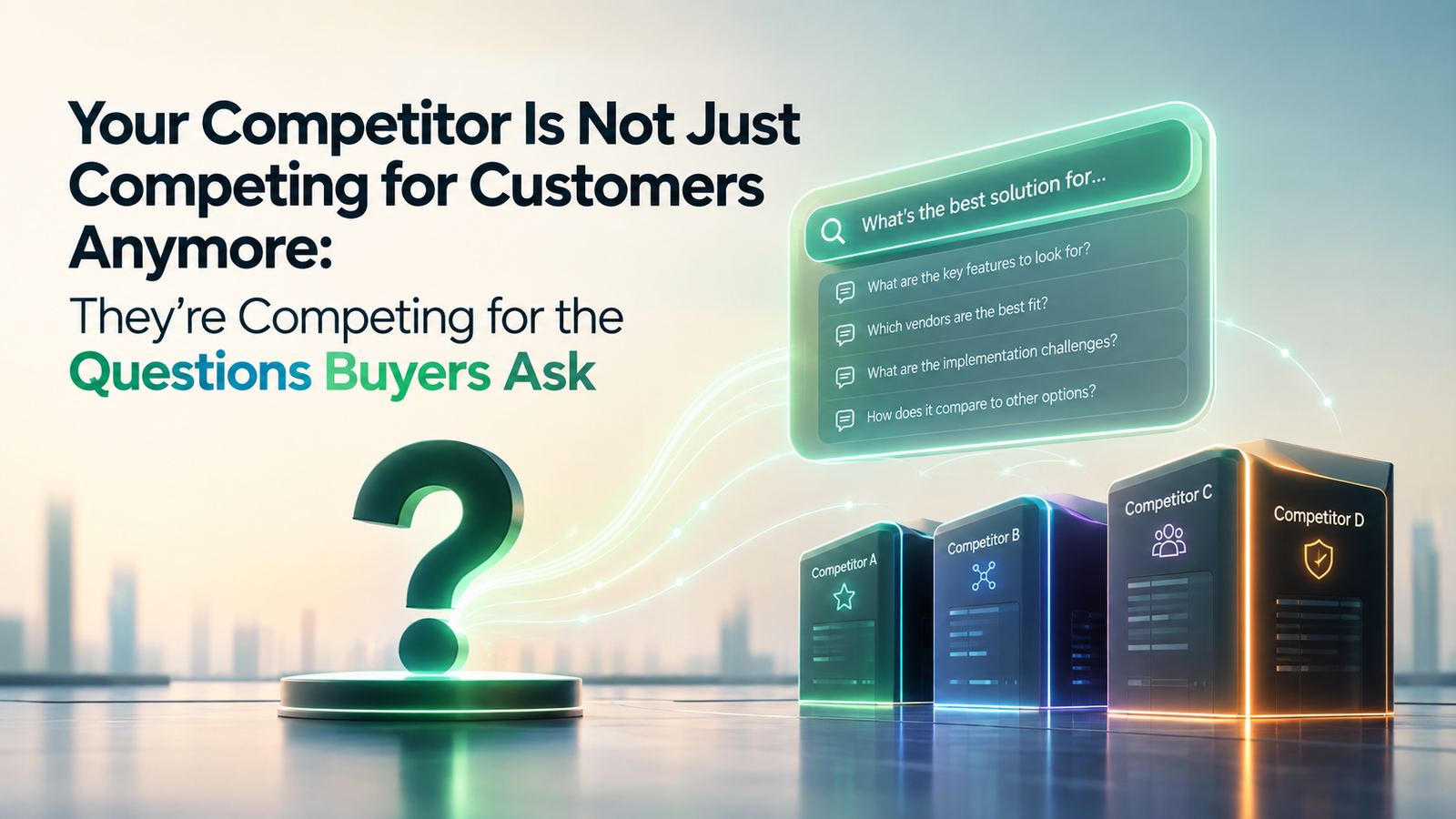

The B2B buyer journey is changing. Companies are no longer competing only for customers, market share, search rankings, sales conversations, or contracts. Increasingly, they are competing for something that happens much earlier: the questions buyers ask while trying to understand a problem.
For years, B2B competition was largely measured at the end of the buying process. Which vendor made the shortlist? Which company won the sales conversation? Which product offered the strongest value proposition? But digital research and AI-assisted tools are moving competitive influence further upstream. Buyers can now investigate problems, compare approaches, explore risks, and understand technology categories before they ever identify the vendors they want to evaluate.
That makes the modern B2B buyer journey more than a path toward a purchase. It is also a process through which buyers build their understanding of a market. The companies that become useful during that process have an opportunity to become familiar before a formal vendor evaluation even begins.
The B2B Buyer Journey Starts Before Buyers Search for Vendors
Most B2B buyers do not begin with the question, “Which company should we buy from?”
They usually begin with a problem.
A business may want to reduce customer acquisition costs, improve sales forecasting, automate workflows, protect sensitive data, modernize its infrastructure, increase employee productivity, or solve a specific operational challenge.
At this point, the buyer may not have a shortlist. They may not even know which technology category can solve the problem. Their immediate objective is simply to understand what is happening and what options exist.
That makes the early research stage of the B2B buyer journey particularly important.
A buyer might move through questions such as:
- What is the best way to solve this problem?
- What technologies or approaches are available?
- What capabilities should we look for?
- What are the trade-offs between different approaches?
- What risks should we consider?
- Which vendors support our requirements?
- How difficult is implementation?
- What alternatives should we evaluate?
Every one of these questions represents a potential opportunity for a company to provide useful information.
The competitive battle therefore begins before the buyer starts comparing vendors. It begins when the buyer is forming an understanding of the problem itself.
AI Is Expanding the B2B Buying Journey
AI-assisted research is adding another layer to this shift.
Instead of manually searching through dozens of pages, buyers can increasingly ask detailed questions and receive synthesized information. They can begin with a broad question, ask follow-up questions, challenge an assumption, request comparisons, and explore increasingly specific requirements.
This creates a more conversational and contextual B2B buyer journey.
Traditional search still matters, but the research experience is becoming less dependent on a buyer entering one carefully constructed query and clicking through individual results. Buyers can instead develop a research path based on the answers they receive.
That changes what companies need to think about.
The objective is no longer simply to rank for a collection of keywords. Companies also need to build a body of useful, understandable, and credible knowledge around the questions their buyers are likely to ask.
From Keyword Visibility to Knowledge Visibility
A company may rank well for its product category but remain largely absent from the broader questions buyers ask before reaching that category.
For example, an enterprise software company might optimize extensively for searches related to its platform. But its potential customers may initially be asking:
- How should we evaluate enterprise software?
- What implementation challenges should we expect?
- How should we compare deployment models?
- What security questions should we ask?
- How do we calculate total cost?
- What integration issues should we anticipate?
- How can we build an internal business case?
These questions sit earlier in the B2B buyer journey.
Answering them does not mean abandoning product-focused content. It means expanding the content strategy so the company can be useful before a buyer is ready to evaluate a specific product.
The Competitive Advantage Is Moving Toward Useful Knowledge
Many B2B companies still create content primarily around what they want to communicate.
They publish product announcements, feature updates, company news, capability pages, executive commentary, and articles explaining why their solution is different.
That content has a role. But it does not always address the uncertainty that exists at the beginning of the buyer journey.
A stronger B2B content strategy begins with the buyer’s questions.
Consider:
- What is the buyer trying to understand?
- What decision are they trying to make?
- What alternatives are they comparing?
- What risks are they trying to avoid?
- What assumptions might they have about the problem?
- What evidence would make them more confident?
- What questions will their technical team ask?
- What will finance want to understand?
- What will procurement challenge?
- What will executives need to justify internally?
These questions create a much richer content strategy.
Instead of producing ten articles explaining why a platform is innovative, an enterprise technology company could create a connected knowledge base covering the decisions its buyers actually face.
That could include implementation considerations, integration requirements, deployment options, security questions, evaluation frameworks, total-cost considerations, and internal business-case development.
The result is more than content marketing.
It becomes part of the buyer’s research process.
7 Ways Companies Can Compete for the Questions Buyers Ask
1. Map the Questions Across the B2B Buyer Journey
The first step is to stop viewing the buyer journey as a simple progression from awareness to consideration to purchase.
Instead, map the questions buyers ask at each stage.
At the beginning, buyers may ask problem-oriented questions. Later, they may ask solution-oriented questions. Eventually, they ask vendor, implementation, commercial, and risk-related questions.
A useful question map can include:
- Problem-definition questions
- Solution and technology questions
- Evaluation questions
- Integration and implementation questions
- Security and compliance questions
- Cost and business-case questions
- Vendor comparison questions
- Procurement and risk questions
This gives marketing and content teams a framework for creating information that reflects the actual B2B buying journey.
2. Build Content Around Buyer Uncertainty
The strongest content opportunities often exist where buyers feel uncertain.
A buyer may understand the business problem but not know which approach to take. They may understand the technology but not know how difficult implementation will be. They may have shortlisted vendors but still need evidence to justify a decision internally.
Content should help reduce that uncertainty.
For example, instead of writing only about the benefits of a technology platform, a company could explain how buyers should evaluate competing approaches and what trade-offs they should consider.
That approach is more educational and more useful.
It also creates an opportunity for the company to demonstrate expertise without turning every interaction into a sales pitch.
3. Create Content for Multiple B2B Stakeholders
The B2B buyer journey rarely belongs to one person.
Different stakeholders can enter the research process at different times and ask very different questions.
A technical leader may care about architecture, integrations, security, and scalability. A business leader may focus on outcomes and strategic relevance. Finance may want economic justification. Procurement may focus on commercial terms and risk.
A strong content ecosystem should account for these different information needs.
| Stakeholder | Questions they may ask |
|---|---|
| Technical leaders | How does it integrate? Is the architecture suitable? |
| Business leaders | What business problem does it solve? |
| Finance | What is the economic case? |
| Operations | What does implementation involve? |
| Security teams | What risks and controls should be evaluated? |
| Procurement | What commercial and vendor risks should we consider? |
| Executives | How does this support broader business priorities? |
The goal is not to create disconnected content for every stakeholder.
It is to maintain a consistent underlying narrative while providing the evidence and level of detail each audience needs.
4. Compete Beyond the Corporate Website
A company’s website is only one part of the modern B2B information environment.
Buyers can encounter a company through customer reviews, industry publications, analyst research, professional communities, events, interviews, social platforms, partner content, podcasts, conference presentations, and independent comparisons.
This means competitive positioning increasingly exists outside owned channels.
A company may have strong messaging on its website but limited visibility in the environments where its buyers actually exchange information.
The practical question is therefore not:
“Which channels should we dominate?”
It is:
“Where do our buyers ask questions, validate information, and form opinions?”
Depending on the market, those environments may include:
- Industry publications
- Technical communities
- Professional networks
- Review platforms
- Events and conferences
- Analyst research
- Social platforms
- Partner ecosystems
- Independent industry discussions
The objective is meaningful participation, not simply maximum channel presence.
5. Use Thought Leadership to Shape the Buying Conversation
Thought leadership becomes more valuable when it helps buyers understand a difficult problem.
Generic statements about innovation rarely give buyers enough information to make better decisions.
Useful thought leadership can introduce:
- Evaluation frameworks
- Decision criteria
- Industry terminology
- Trade-off analysis
- Implementation considerations
- Risk questions
- Strategic perspectives
- Practical approaches to complex problems
This type of content can influence how buyers think about the category without directly telling them what decision to make.
For example, one company might consistently explain the importance of implementation speed, while another may focus heavily on flexibility and integration.
Over time, these perspectives can contribute to the criteria buyers use when evaluating solutions.
The company is not controlling the decision. It is contributing to the conversation around the decision.
That distinction matters.
6. Turn Competitive Intelligence Into Question Intelligence
Traditional competitive intelligence often tracks competitor pricing, product launches, acquisitions, hiring, messaging, partnerships, and customer announcements.
Those activities remain relevant.
But B2B marketers can add another dimension: What questions is the competitor trying to own?
Look for recurring themes across a competitor’s content and communication.
For example:
- Which buyer problems do they discuss repeatedly?
- Which evaluation criteria do they emphasize?
- Which technology categories do they attempt to define?
- Which questions do their executives answer publicly?
- Which topics appear repeatedly across their content?
- Which stages of the buyer journey do they address?
- Where are they providing detailed education?
- Where are they largely absent?
This creates a more useful view of competitive positioning.
It can also reveal content gaps.
If a competitor is highly visible around one buyer question but provides little useful information around another important issue, that gap may create an opportunity for your company to contribute genuine expertise.
The objective should not be to copy the competitor.
It should be to understand the information landscape and determine where your expertise can provide greater value.
7. Make Your Digital Knowledge Easy to Understand
As AI systems increasingly help buyers research companies and technology categories, clarity becomes even more important.
Companies cannot assume that buyers will understand their positioning simply because the information exists somewhere on their website.
The digital footprint needs to be coherent.
That means reviewing whether:
- Product terminology is consistent.
- Older content still reflects current positioning.
- Different channels communicate compatible messages.
- Technical concepts are clearly explained.
- Important capabilities are supported with useful evidence.
- Content clearly connects problems with potential approaches.
- Buyers can easily understand who the solution is designed for.
If a company’s website says one thing, its social channels communicate something different, old articles use outdated terminology, and third-party sources describe the company differently, the buyer has to work harder to understand the offering.
A competitor does not always need a better product message.
Sometimes it simply needs to be easier to understand.
Why Clarity Is Becoming a Competitive Advantage
Complex B2B technology markets create information overload.
Buyers may encounter dozens of vendors, multiple technology approaches, competing terminology, conflicting opinions, and large amounts of technical information.
In that environment, clarity reduces friction.
The company that clearly explains the problem, available approaches, trade-offs, risks, and evaluation criteria can become useful before the buyer is ready to purchase.
That usefulness can create familiarity.
Familiarity can lead to consideration.
Consideration can create opportunities for evaluation.
This does not mean useful content guarantees a sale. B2B purchasing decisions remain influenced by many factors, including product capabilities, commercial considerations, implementation requirements, organizational priorities, and stakeholder preferences.
But becoming part of the research process gives a company an opportunity to participate earlier in the B2B buyer journey.
The B2B Buyer Journey Is Becoming a Multi-Question Journey
One of the biggest changes in B2B buying is that the journey is no longer necessarily a predictable sequence.
A buyer may start with a business problem, move into technical research, return to business requirements, investigate implementation, compare vendors, and then revisit the original problem with new information.
Different stakeholders may follow different paths.
One person might discover a company through technical content. Another might encounter it through an industry publication. A third might hear about it through a professional network.
By the time the buying committee comes together, each person may already have developed a different understanding of the market.
That makes consistency important.
But consistency does not mean saying the same thing everywhere.
The core narrative should remain coherent while the information adapts to the needs of different audiences.
Technical buyers need technical evidence.
Business buyers need outcomes and strategic context.
Financial stakeholders need economic justification.
Operational teams need implementation clarity.
Executives need strategic relevance.
Procurement teams need commercial and risk information.
The companies that can provide useful answers across these perspectives have more opportunities to remain part of the conversation.
How B2B Marketers Should Rethink Content Strategy
The shift toward question-driven research does not mean abandoning SEO, product marketing, demand generation, or lead generation.
It means connecting them.
A modern B2B content strategy can be organized around the questions that emerge throughout the buyer journey.
Instead of asking only:
“What keywords should we rank for?”
Marketing teams can also ask:
“What does our buyer need to understand before they are ready to evaluate us?”
That question can lead to a broader content ecosystem.
For example:
Early-stage content:
Explains problems, trends, concepts, terminology, and potential approaches.
Mid-stage content:
Explores evaluation criteria, trade-offs, frameworks, implementation considerations, and technology options.
Late-stage content:
Addresses vendor comparisons, technical requirements, security, pricing considerations, business cases, and procurement questions.
This approach creates a connected information experience rather than a collection of unrelated articles.
From Capturing Demand to Understanding Demand
For B2B marketers, this represents an important strategic shift.
Traditional demand generation often focuses on capturing demand that already exists.
Search for a solution. Click an advertisement. Download an asset. Request a demo. Enter a sales process.
But buyers often spend considerable time researching before they reach those actions.
During that period, they are forming their understanding of the market.
Companies therefore have an opportunity to contribute to that understanding through useful expertise.
That does not mean manufacturing demand or manipulating buyers.
It means answering questions buyers are already asking.
The distinction is important.
A company that publishes generic claims about why its product is the future gives a buyer very little to work with.
A company that explains how to evaluate competing approaches, what risks to consider, and which questions to ask vendors provides something practical.
That content may not immediately generate a lead.
But it can become part of the buyer’s research process.
And that is increasingly where competitive positioning begins.
The Future of B2B Competition Is Also a Competition for Attention and Answers
The future of B2B competition will not be determined solely by who has the largest sales organization, biggest advertising budget, or most visible product.
Those factors can continue to matter.
But the competitive environment is expanding.
Companies are competing for attention before buyers know exactly what they want.
They are competing for visibility before buyers have created a shortlist.
They are competing for credibility before the first sales conversation.
And increasingly, they are competing for the questions buyers ask.
The central challenge for B2B companies is therefore changing.
Instead of asking only:
“How do we convince buyers to choose us?”
Companies should also ask:
“What questions do we want buyers to associate with our expertise, and are we providing the most useful answers when they ask them?”
By the time a buyer begins comparing vendors, the competitive process may already be well underway.
Conclusion
The modern B2B buyer journey begins long before a buyer visits a product page or speaks with sales. It begins with curiosity, uncertainty, and questions.
AI-assisted research is making those early information moments increasingly important. Buyers can explore complex problems conversationally, investigate different approaches, compare criteria, and build their understanding before they ever create a formal vendor shortlist.
That creates a new dimension of B2B competition.
Companies are not simply competing to win customers. They are competing to become useful during the research process that shapes how customers understand their problems and evaluate potential solutions.
The response is not to produce more content for the sake of producing more content. It is to build a coherent body of useful knowledge around the questions buyers actually ask.