Business Technology Complexity is becoming an increasingly important challenge for modern organisations. Businesses have access to more digital solutions than ever before, from customer relationship management (CRM) platforms and project management applications to artificial intelligence (AI), automated workflows, cloud infrastructure, and advanced analytics. These technologies are designed to improve productivity, simplify operations, and help organisations make better decisions. Yet, despite continuous investments in digital tools, many employees still find themselves spending more time managing applications than completing their actual responsibilities. This growing Business Technology Complexity makes it increasingly difficult for organisations to achieve the productivity improvements they expect from their digital investments.
Almost every department now operates with its own collection of software, communication platforms, and business applications. Marketing teams manage campaigns through dedicated platforms, sales departments rely on CRM systems, HR teams use employee management solutions, and finance departments depend on specialised accounting software. While each application may solve an individual problem, the overall technology environment can become difficult to manage when these systems do not communicate effectively. As businesses continue adopting new digital solutions, Business Technology Complexity becomes a significant concern for IT leaders who must maintain operational efficiency across multiple platforms.
This creates a growing contradiction in modern business operations: organisations are adopting more technology to make work easier, but everyday activities are becoming increasingly complicated. Employees frequently switch between applications, repeat administrative tasks, search for information across disconnected systems, and wait for approvals that involve multiple platforms. The problem is not necessarily a lack of technology. In many cases, it is the growing Business Technology Complexity created by disconnected tools, inefficient workflows, and poorly coordinated technology investments. Understanding Business Technology Complexity is the first step towards building a more connected, simplified, and efficient digital workplace.
1. Why Business Technology Complexity Is Increasing Across Organisations
One of the biggest reasons behind increasing Business Technology Complexity is the way organisations purchase and implement technology. When a department identifies an operational challenge, the immediate response is often to introduce another application specifically designed to solve it.
For example, a marketing department may adopt one platform for campaign management, another for email automation, and a separate solution for analytics. Meanwhile, the sales team uses its own CRM, communication software, and reporting tools. HR introduces employee management systems, while finance operates through accounting and expense management applications.
Initially, these investments appear reasonable because each solution addresses a specific requirement. However, over time, individual technology decisions can create a fragmented digital environment where departments operate through disconnected systems. As organisations expand their digital capabilities, Business Technology Complexity can become harder to control. New departments, additional software subscriptions, and changing operational requirements introduce more dependencies between applications. Without proper technology planning, these dependencies can make even straightforward business activities difficult to coordinate.
The consequences often become visible in everyday operations:
- Duplicate data entry: Employees enter identical information into multiple applications because systems are not properly integrated.
- Disconnected information: Important business updates remain within departmental platforms instead of reaching the employees who need them.
- Inconsistent reporting: Different departments generate reports using separate data sources, making it difficult to establish a consistent view of business performance.
- Increased administrative work: Employees spend additional time managing passwords, permissions, notifications, and application-related tasks.
- Higher technology costs: Organisations continue paying for overlapping software subscriptions and features that provide limited additional value.
Consider a B2B organisation where the sales team updates customer information in a CRM, while the marketing team maintains a separate database for campaign activities. When a prospect becomes a qualified lead, employees may need to transfer information manually between systems. If an important detail is missed, both departments could end up working with incomplete or outdated information.
This is where Business Technology Complexity starts affecting more than IT operations. It influences customer experiences, internal collaboration, reporting accuracy, and overall business productivity. Managing Business Technology Complexity requires organisations to look beyond individual software purchases and evaluate how their entire technology environment supports daily business activities. Without a coordinated approach, even well-designed applications can contribute to unnecessary operational challenges.
2. Adding More Software Does Not Always Improve Business Efficiency
Another major contributor to Business Technology Complexity is the assumption that every operational challenge requires a new software solution.
Businesses regularly introduce applications to address individual problems without examining whether their existing technology can already perform the required functions. As a result, the technology stack gradually expands, even when the actual business requirements remain relatively unchanged.
For example, an organisation may already have a project management platform with built-in task assignments, notifications, and approval workflows. However, a department might introduce another application specifically for tracking internal requests. Although the new solution may offer additional features, employees now have another platform to manage, another set of notifications to monitor, and another source of information to maintain. This is one of the most common examples of Business Technology Complexity in growing enterprises. Instead of improving productivity, overlapping applications can increase software management responsibilities and make routine business activities more difficult.
The same situation can occur with communication tools, document management systems, customer databases, and reporting applications.
Understanding the hidden cost of application overload
The financial cost of additional software is relatively easy to identify through subscription fees. However, the operational cost is often more difficult to measure.
Every additional application can introduce:
- More time spent switching between different interfaces.
- Additional employee training requirements.
- Greater complexity in managing user access and permissions.
- More integration and maintenance responsibilities for IT teams.
- Increased risks of inconsistent data and duplicated workflows.
Another challenge associated with Business Technology Complexity is the lack of visibility into software utilisation. Organisations may continue investing in applications without understanding whether employees actively use them or whether existing platforms already provide similar capabilities. A structured application review can help businesses reduce unnecessary spending while simplifying their technology environment.
Organisations should therefore evaluate new technology investments based on their overall business impact rather than simply comparing feature lists.
Before purchasing another application, decision-makers should ask:
- Can an existing platform solve the problem?
- Does the new solution introduce genuinely useful capabilities?
- Can it integrate with the organisation’s existing systems?
- Will employees need to maintain additional records or workflows?
- Does the expected business benefit justify the implementation and maintenance effort?
The objective should be to build a connected and manageable technology environment rather than continuously increasing the number of applications.
3. Automating Inefficient Processes Can Create More Problems
Business process automation is an important part of digital transformation, but automation alone cannot guarantee operational efficiency.
Many organisations introduce automated workflows to reduce repetitive work without first examining whether the underlying processes are designed correctly. This can create another layer of Business Technology Complexity because inefficient activities become embedded within automated systems.
For instance, imagine an employee submitting a purchase request that requires approval from five different managers, even though only two approvals are necessary based on the organisation’s procurement policy.
Automating all five approval stages may reduce some manual effort, but it does not address the unnecessary steps responsible for delaying the process.
Similarly, if employees must enter customer information into several disconnected applications, automating data entry without fixing the integration problem may simply make an inefficient process run faster. To overcome Business Technology Complexity, businesses should first identify process inefficiencies before introducing automation. A simplified workflow allows technology to deliver meaningful improvements without adding unnecessary operational layers.
Improve the process before introducing automation
Organisations should evaluate their workflows before investing in additional automation solutions.
A practical approach includes:
- Identify unnecessary activities: Examine each process and determine whether every step contributes to a meaningful business outcome.
- Reduce approval layers: Remove redundant approval requirements wherever organisational policies permit.
- Standardise information collection: Avoid asking employees to provide identical information multiple times.
- Connect existing systems: Ensure that information moves between relevant applications without unnecessary manual intervention.
- Automate repetitive tasks: Introduce automation after simplifying the workflow and establishing clear responsibilities.
For example, a B2B sales organisation can improve its lead management process by connecting its marketing automation platform with its CRM. When a prospect completes a form or meets predefined qualification requirements, relevant information can be transferred automatically to the sales system. When organisations approach Business Technology Complexity strategically, automation becomes an opportunity to simplify operations rather than introduce another layer of software. The focus should remain on removing repetitive activities, improving information flow, and ensuring that automated workflows support clearly defined business objectives.
This reduces repetitive administrative work and helps sales representatives focus on prospect engagement instead of manually updating records.
The important lesson is that successful automation should eliminate unnecessary work, not simply digitise existing complexity.
4. Too Many Applications Are Reducing Employee Productivity
One of the most overlooked effects of Business Technology Complexity is constant context switching.
Business Technology Complexity also affects how employees organise their working day. When important information is distributed across several applications, employees must remember where conversations, documents, and task updates are stored. Reducing this complexity through standardised platforms and connected workflows can improve the overall digital employee experience.
Modern employees rarely work within a single application throughout the day. An employee might begin the morning checking emails, move to a project management platform, respond to messages in a collaboration application, update customer information in a CRM, attend a video meeting, and then return to the original assignment.
Every application requires attention, and frequent notifications create additional interruptions.
Although digital tools are intended to improve communication and collaboration, excessive application usage can fragment concentration and make it harder for employees to complete activities that require sustained attention.

How application overload affects daily work
The relationship between employee productivity and Business Technology Complexity is particularly important in enterprise environments where employees depend on several applications to complete routine responsibilities. Reducing unnecessary digital interactions can help create a more focused working environment.
The impact extends beyond the time employees spend opening and closing applications.
- Reduced concentration: Frequent notifications interrupt employees while they are completing important assignments.
- Delayed communication: Important updates can become difficult to locate when conversations are distributed across multiple platforms.
- Information overload: Employees receive more messages and alerts than they can reasonably prioritise.
- Task duplication: Different teams may unknowingly work on the same activities because information is scattered across applications.
- Lower visibility: Managers may struggle to understand project progress when updates are distributed across different systems.
Consider an IT operations team managing service requests through email, internal messaging, spreadsheets, and a separate ticketing platform. An employee might report an issue through one channel, receive an update through another, and find the final resolution documented somewhere else.
Without clear communication standards, employees spend valuable time searching for information instead of resolving the actual issue.
Establish clear rules for workplace technology
Businesses can reduce this problem by defining how employees should use their digital tools.
For example:
- Use a designated platform for project-related discussions.
- Maintain official task updates within the project management system.
- Keep customer interactions and relevant history within the CRM.
- Use email for formal communication that requires a documented record.
- Establish reasonable expectations for notifications and response times.
A well-managed digital workplace should make information easier to access, not force employees to monitor multiple applications continuously.
5. Poor Technology Integration Creates Operational Bottlenecks
Technology integration is one of the most important factors in controlling Business Technology Complexity.
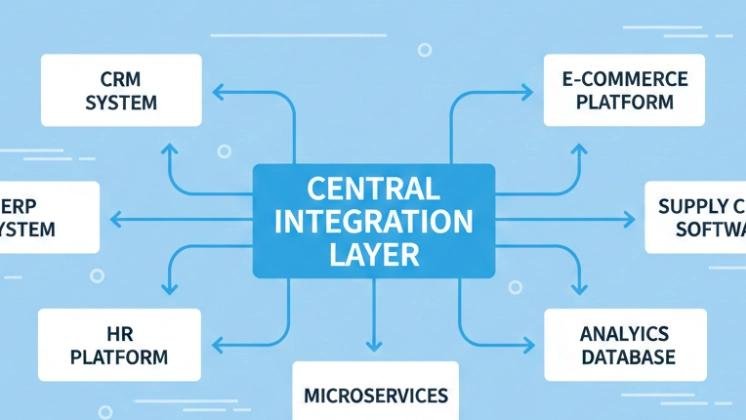
Even when organisations invest in high-quality enterprise applications, the benefits can remain limited if those systems operate independently. A business may have advanced CRM software, an efficient ERP platform, and sophisticated HR management tools, but disconnected information can prevent employees from using these solutions effectively.
When systems cannot exchange information reliably, employees often become the connection between applications. They download reports, copy information, update spreadsheets, and manually transfer records from one platform to another. Effective integration is essential for reducing Business Technology Complexity because it allows enterprise applications to exchange information without requiring employees to coordinate every activity manually.
These activities introduce delays and create opportunities for human error.
Practical examples of disconnected enterprise systems
CRM and marketing automation integration
When CRM and marketing platforms operate independently, sales representatives may not have complete visibility into a prospect’s marketing interactions. Connecting these systems can help teams access relevant engagement information and coordinate follow-up activities.
ERP and finance integration
When enterprise resource planning and financial systems do not share information effectively, finance teams may need to reconcile records manually. Proper integration can improve the flow of relevant operational and financial information.
HR and payroll integration
Employee information changes, such as department transfers or salary updates, may need to be reflected across multiple systems. Connected HR and payroll workflows can reduce repetitive administrative work and inconsistencies.
IT service management and employee platforms
Connecting IT service management tools with employee directories and identity management systems can help streamline access requests, employee onboarding, and support activities.
Build an integrated technology environment
Businesses do not necessarily need to replace every existing application to improve integration.
Depending on their requirements, organisations can explore:
- Application Programming Interfaces (APIs) for communication between software platforms.
- Integration Platform as a Service (iPaaS) solutions for connecting cloud applications.
- Workflow automation platforms for coordinating repetitive activities.
- Centralised identity and access management for managing employee permissions.
- Data integration solutions for improving consistency across reporting systems.
For enterprise IT teams, reducing Business Technology Complexity requires a clear understanding of application dependencies and data movement. Integration strategies should ensure that important information reaches the right systems securely and consistently, without introducing unnecessary maintenance responsibilities or additional operational risks.
The right approach depends on the organisation’s existing infrastructure, security requirements, application architecture, and operational needs.
The goal is to make systems work together so employees can access reliable information without unnecessary manual intervention.
6. Lack of Employee Training Makes Technology More Complicated
Purchasing advanced technology and ensuring employees can use it effectively are two very different things.
Many organisations invest in sophisticated software but provide limited training, assuming that employees will understand the available features through regular usage. In reality, insufficient training can increase Business Technology Complexity because employees develop individual workarounds instead of following consistent processes.
For example, a company may introduce an advanced CRM platform with automated reporting, lead management, and workflow capabilities. However, if employees are unfamiliar with these features, they may continue maintaining separate spreadsheets and manually tracking customer interactions.
This creates two sources of information: the official business application and employee-managed records. Addressing Business Technology Complexity also means ensuring employees understand how to use existing applications correctly. Better training and consistent usage guidelines can reduce workarounds and improve technology adoption.
Over time, inconsistencies become more difficult to resolve, and management loses confidence in the information available within the system.
Make technology adoption part of the implementation strategy
Successful technology adoption requires more than distributing login credentials.
Organisations should establish a structured approach that includes:
- Role-based training: Provide guidance based on the actual responsibilities of different employees.
- Practical demonstrations: Show employees how technology supports their daily activities through realistic business scenarios.
- Clear documentation: Maintain accessible instructions for frequently performed tasks and common issues.
- Ongoing support: Provide employees with a reliable way to ask questions and resolve application-related challenges.
- Regular feedback: Understand which features are useful and where employees continue experiencing difficulties.
Employee education is an important part of controlling Business Technology Complexity because technology adoption depends on how confidently people use available systems. When employees understand the purpose of each application and follow consistent procedures, organisations can reduce unnecessary workarounds and improve the value of their technology investments.
IT teams should also work closely with department managers to identify opportunities for improving software adoption.
When employees understand how systems connect with their responsibilities, technology becomes an operational advantage rather than another administrative requirement.
7. Simplifying Business Technology Requires Continuous Evaluation
Reducing Business Technology Complexity should not be treated as a one-time IT project. As organisations grow, their business requirements, workforce structures, security needs, and technology environments continue to change. A continuous review of Business Technology Complexity helps organisations identify unnecessary applications, overlapping capabilities, disconnected workflows, and opportunities to improve their existing technology investments.
A software platform that was useful during an organisation’s early growth stages may become unnecessary after the business introduces a more comprehensive enterprise solution. Similarly, two departments may eventually adopt overlapping applications that provide similar capabilities.
Without regular evaluation, these changes can create an unnecessarily complicated technology stack.
Conduct regular technology stack assessments
Business leaders and IT teams should periodically review the applications, infrastructure, and services currently used across the organisation.
An effective technology assessment should examine:
1. Application usage
Identify which applications are actively used, which have limited adoption, and which are no longer required.
2. Feature duplication
Review whether multiple applications provide similar capabilities, particularly across project management, communication, reporting, and document management.
Regular technology assessments provide a practical way to identify Business Technology Complexity before it becomes a larger operational problem. By examining application usage, integration performance, subscription costs, and employee feedback, IT leaders can make informed decisions about which systems to retain, improve, consolidate, or replace.
3. Integration requirements
Identify disconnected systems that require manual data transfers or create operational bottlenecks.
4. Employee experience
Gather feedback from employees to understand which tools make their work easier and which create unnecessary difficulties.
5. Security and access management
Evaluate application permissions, user accounts, access requirements, and the security implications of maintaining multiple platforms.
6. Total cost of ownership
Consider subscription fees alongside implementation, integration, maintenance, training, and ongoing support requirements.
Establish measurable improvement objectives
Rather than measuring digital transformation through the number of applications implemented, businesses should focus on operational outcomes.
Useful indicators include:
- Reduction in manual data entry.
- Fewer unnecessary approval stages.
- Improved application adoption.
- Reduced duplicate software subscriptions.
- Faster access to business information.
- Fewer repetitive administrative activities.
- Better consistency across enterprise reporting.
These indicators help organisations understand whether their technology investments are actually improving business operations.
8. The Role of Business Leaders in Reducing Technology Complexity
Technology management is no longer exclusively an IT responsibility. Decisions about software adoption, automation, application integration, and digital workplace processes directly affect business performance. Business leaders must treat Business Technology Complexity as an organisational challenge rather than an isolated IT issue. Their involvement helps ensure that technology decisions support long-term business objectives and operational efficiency.
CIOs, CTOs, department heads, and operational leaders must therefore work together to ensure technology investments support organisational objectives.
For example, before introducing a new customer management platform, business leaders should understand how it will affect existing sales workflows, marketing activities, reporting requirements, and customer data management.
Similarly, before implementing an enterprise automation solution, decision-makers should examine whether the processes being automated are necessary, standardised, and clearly defined.
Build a business-led technology strategy
A practical technology governance strategy should focus on several priorities:
- Align technology with business objectives: Every major technology investment should address a clearly identified operational or strategic requirement.
- Encourage cross-department collaboration: Involve employees from different departments when evaluating systems that affect shared workflows.
- Establish application ownership: Define who manages each platform, its users, integrations, and ongoing requirements.
- Create technology standards: Establish guidelines for software procurement, information sharing, security, and application usage.
- Review performance regularly: Evaluate whether existing solutions continue delivering meaningful business value.
This approach helps prevent individual departments from making isolated technology decisions that create organisation-wide challenges.
Ultimately, effective technology governance is about ensuring that every system has a clear purpose and contributes to a connected business environment.
A business-led approach to Business Technology Complexity also encourages better coordination between IT, finance, operations, HR, and other departments. Instead of making isolated software decisions, teams can evaluate technology investments based on shared organisational requirements and their impact on business performance.
Managing Business Technology Complexity for Long-Term Business Efficiency
Reducing Business Technology Complexity requires a consistent approach to application management, process optimisation, and enterprise technology integration. Organisations should regularly evaluate whether their existing systems simplify daily operations or introduce additional administrative responsibilities.
By addressing Business Technology Complexity through better technology governance, connected applications, and employee-focused implementation strategies, businesses can create a more efficient digital environment that supports sustainable growth.
Conclusion
Business Technology Complexity is not simply the result of having too many applications. It often develops when organisations introduce new tools without considering how those tools affect existing systems, employee workflows, information management, and overall business operations.
Modern businesses need technology, but technology alone cannot guarantee efficiency. Disconnected applications, unnecessary approval processes, excessive notifications, poor integration, and insufficient employee training can turn digital investments into additional administrative responsibilities.
The solution is to take a more strategic approach to enterprise technology management. Organisations should simplify processes before automating them, connect applications that need to share information, eliminate overlapping software, improve employee training, and regularly evaluate whether their technology stack supports actual business requirements.
The real value of digital transformation should be measured by how effectively technology helps people work, collaborate, and make decisions. Businesses do not necessarily need more applications to become more productive. They need systems that communicate effectively, processes that make sense, and technology that supports employees without creating unnecessary obstacles.
Sometimes, the biggest improvement comes from introducing a new digital capability. At other times, it comes from removing unnecessary applications, eliminating redundant approval steps, or connecting systems that should have been working together from the beginning.
The most effective technology environment is not necessarily the one with the most software. It is the one where employees can focus on their work because the technology behind it simply works.
Frequently Asked Questions
1. What is Business Technology Complexity?
Business Technology Complexity refers to the challenges organisations experience when managing multiple applications, disconnected systems, overlapping software solutions, and complicated digital workflows. It can increase administrative work, reduce employee productivity, and make business operations more difficult to manage.
2. Why are businesses becoming more dependent on technology but less efficient?
Businesses often adopt separate applications to address individual departmental requirements without considering how those solutions interact. This can result in disconnected information, duplicate data entry, excessive notifications, and complicated workflows that reduce the overall benefits of technology investments.
3. How can organisations reduce Business Technology Complexity?
Organisations can reduce technology complexity by auditing existing applications, eliminating overlapping software, integrating disconnected systems, simplifying business processes, improving employee training, and establishing clear technology governance policies.
4. Does adding more automation always improve business efficiency?
No. Automation does not automatically eliminate inefficiencies. If an organisation automates an unnecessarily complicated process, it may simply reproduce the same problems faster. Businesses should simplify workflows, remove redundant activities, and establish clear processes before implementing automation.
5. What is the importance of system integration in enterprise operations?
System integration allows different business applications to exchange information and coordinate activities. It reduces manual data transfers, improves information consistency, supports cross-department collaboration, and helps employees access relevant information more efficiently.
6. How does application overload affect employee productivity?
Application overload can increase context switching, interrupt concentration, create information overload, and make it difficult for employees to locate important updates. Clear application usage policies and better integration can help reduce these challenges.
7. What should businesses consider before purchasing new enterprise software?
Businesses should evaluate the problem being addressed, existing software capabilities, integration requirements, employee usability, security considerations, implementation costs, and long-term maintenance requirements before purchasing additional enterprise software.
8. How can IT leaders improve technology adoption across an organisation?
IT leaders can improve adoption through role-based training, practical demonstrations, accessible documentation, ongoing technical support, and regular employee feedback. They should also ensure that technology solutions align with actual departmental workflows.
9. What is technology stack optimization?
Technology stack optimization is the process of reviewing and improving the applications, platforms, infrastructure, and services used by an organisation. It focuses on eliminating unnecessary tools, reducing overlapping capabilities, improving integrations, controlling costs, and ensuring technology supports business objectives.
10. What is the ultimate goal of digital transformation?
The ultimate goal of digital transformation is to improve how an organisation operates through effective use of technology. This includes simplifying workflows, improving collaboration, making information more accessible, supporting better decisions, and creating more efficient experiences for employees and customers.
11. What are the biggest causes of Business Technology Complexity?
The biggest causes of Business Technology Complexity include disconnected business applications, overlapping software solutions, inefficient workflows, excessive automation, poor system integration, and insufficient employee training. These challenges make it difficult for organisations to manage information and complete routine activities efficiently.
12. How can CIOs manage Business Technology Complexity effectively?
CIOs can manage Business Technology Complexity by reviewing the existing technology stack, eliminating redundant applications, improving enterprise system integration, simplifying workflows, establishing technology governance policies, and ensuring employees receive appropriate training. Regular technology assessments also help maintain operational efficiency.