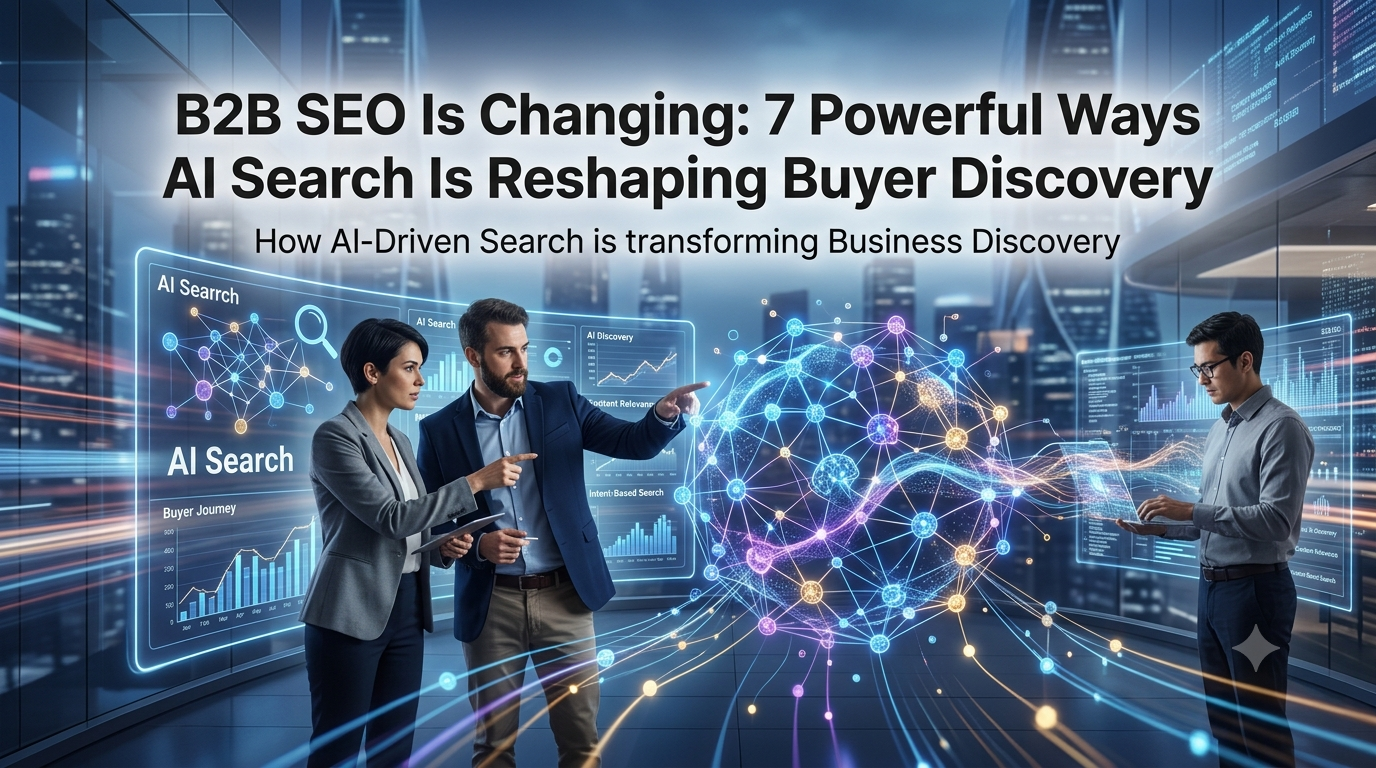
B2B SEO is changing as buyers increasingly use AI-powered tools to research problems, compare solutions, understand vendors, and build shortlists before speaking with a sales team. Traditional search engines remain important, but the way people discover and consume information is becoming more conversational and answer-driven.
For years, B2B companies built their search strategies around ranking webpages for specific keywords. A buyer searched for something such as “best CRM for enterprise companies,” scanned search results, opened several websites, compared information, and eventually contacted vendors. AI search is changing parts of this journey by giving users synthesized answers instead of simply presenting a list of links.
This creates a new challenge for B2B companies: visibility is no longer only about ranking a webpage. It is increasingly about whether your company’s expertise, information, products, and evidence can be understood and surfaced by AI systems. That does not mean traditional SEO is disappearing. Instead, B2B businesses need to think beyond rankings and build content that works for both human buyers and AI-mediated discovery.
How B2B SEO Is Changing in the AI Search Era –
Traditional SEO focuses heavily on helping search engines understand and rank individual webpages. AI-powered search introduces another layer: systems may interpret information from multiple sources and generate a conversational response to a user’s question.
For B2B marketers, this changes the objective from simply asking “How do we rank?” to also asking “How do we become a useful source of information in the answer?”
A B2B buyer may now ask an AI assistant:
“What should a mid-sized manufacturing company consider before choosing an ERP platform?”
Instead of receiving ten blue links, the buyer may receive a structured explanation covering implementation, integrations, security, pricing considerations, industry requirements, and potential vendors.
That means B2B companies need content that can contribute useful information to these conversations.
Key changes include:
- Search is becoming more conversational.
- Buyers can ask complex questions rather than short keyword queries.
- Information may be consumed without a website visit.
- Buyers can use AI to compare multiple vendors faster.
- Content quality and contextual relevance become increasingly important.
- Brand visibility can extend beyond traditional search rankings.
The important point is that AI search does not eliminate SEO. It expands what B2B SEO needs to accomplish.
B2B Buyers Are Moving From Keywords to Questions –
Traditional keyword research often starts with phrases such as:
- “CRM software”
- “B2B marketing automation”
- “ERP software”
- “cybersecurity platform”
But real B2B buying decisions are rarely that simple.
A decision-maker may actually want answers to questions such as:
- Which CRM works best with our existing technology stack?
- What security requirements should we evaluate?
- How difficult is implementation?
- What hidden costs should we consider?
- Which solution is suitable for a company with multiple locations?
- What should procurement ask vendors before signing a contract?
AI search makes these longer, contextual questions easier to ask.
What this means for B2B content –
Instead of creating separate articles for every small keyword variation, businesses should build content around real buyer problems and decision-making questions.
For example, a cybersecurity company could move beyond:
“What is endpoint security?”
and develop resources such as:
“How Should a 500-Employee Company Evaluate an Endpoint Security Platform?”
The second topic is closer to a real commercial decision and provides opportunities to demonstrate expertise.
Rankings Are No Longer the Only Measure of B2B Visibility –
A page ranking on the first page of Google can still generate valuable traffic. However, AI-generated answers can change how users interact with search results.
A buyer might receive enough information from an AI-generated response to narrow their options before visiting any vendor website.
This creates an important distinction between:
Website visibility — whether someone visits your website.
and
Information visibility — whether your company’s expertise or content contributes to the buyer’s understanding of a topic.
For B2B marketers, both matter.
A useful AI-era search strategy should therefore consider:
- Organic rankings
- Branded searches
- Mentions across reputable industry publications
- Original research
- Expert-led content
- Product and solution information
- Third-party references
- Customer evidence
- Structured website information
The goal is not to chase every mention. The goal is to build a credible digital information footprint around the problems your company solves.
B2B SEO Needs More First-Hand Expertise –
Generic content is becoming increasingly difficult to differentiate.
A basic article explaining “What is cloud computing?” can be produced by countless websites. A detailed article based on an organization’s actual implementation experience is much harder to replicate.
This makes first-hand expertise particularly valuable for B2B companies.
What does first-hand expertise look like?
It can include:
- Lessons from customer implementations
- Original research
- Industry benchmarks
- Product experiments
- Technical documentation
- Expert interviews
- Case studies
- Implementation checklists
- Common mistakes observed by practitioners
- Detailed comparisons
- Data generated from your own operations
For example, instead of publishing another generic article about supply-chain automation, a logistics technology company could publish:
“7 Supply-Chain Bottlenecks We Found Across 50 Customer Workflows—and How Companies Addressed Them.”
The value comes from the company’s proximity to the problem.
That type of information can make content more useful to human readers while also giving AI systems more substantive material to interpret.
The B2B Buyer Journey Is Becoming More Self-Service –
B2B purchasing has traditionally involved sales representatives, product demonstrations, meetings, proposals, procurement teams, and multiple stakeholders.
But much of the early research process can now happen digitally.
A potential customer can use AI tools to:
- Understand a business problem.
- Learn industry terminology.
- Identify potential solution categories.
- Build a vendor shortlist.
- Compare capabilities.
- Identify questions to ask suppliers.
- Prepare for a sales conversation.
This means a B2B company’s content increasingly needs to support the buyer before the sales team enters the conversation.
Content should answer different stages of the buying journey –
Problem awareness
- What problem are we experiencing?
- Why does it matter?
- What causes it?
Solution research
- What solutions exist?
- What approaches are available?
- What are the advantages and limitations?
Vendor evaluation
- What should we compare?
- What questions should we ask suppliers?
- What technical requirements matter?
Purchase decision
- What implementation challenges should we expect?
- What does integration involve?
- How should we measure success?
A strong B2B content strategy should address all four stages rather than producing only top-of-funnel educational articles.
B2B Content Needs to Become More Machine-Readable –
AI systems need to understand the information presented on a website.
This makes clarity and organization important.
A page that clearly explains what a company does, who it serves, what products it offers, which industries it supports, and what evidence supports its claims is easier for both humans and machines to interpret.
Practical areas B2B companies should improve –
- Clear page titles and headings
- Descriptive product pages
- Logical internal linking
- Well-organized FAQs
- Author and expert information
- Clear company information
- Structured product information
- Accessible technical documentation
- Consistent terminology
- Evidence supporting important claims
This doesn’t mean writing content specifically for machines.
Rather, content that is structured clearly for humans is often easier for machines to interpret as well.
Comparison Content Could Become More Important –
B2B buyers rarely want to know only what a product does.
They often want to understand how different options compare.
For example:
“CRM software” is a broad topic.
But:
“Cloud CRM vs. On-Premise CRM: Which Model Fits a Regulated Enterprise?”
is much closer to a purchasing decision.
B2B companies can create useful comparison resources around:
- Product categories
- Implementation approaches
- Technology architectures
- Pricing models
- Deployment options
- Integration methods
- Security considerations
- Build vs. buy decisions
- Internal vs. outsourced operations
The key is to make comparisons genuinely useful rather than turning them into disguised promotional pages.
A good comparison should explain where each option fits, what trade-offs exist, and what factors a buyer should evaluate.
Brand Authority Matters Beyond Your Own Website –
One of the biggest changes in AI-mediated search is that buyers don’t necessarily rely on one company’s website for information.
They may encounter information from:
- Industry publications
- Analyst reports
- Professional communities
- Customer reviews
- Research organizations
- News websites
- Vendor websites
- Technical documentation
This makes B2B SEO increasingly connected to broader digital authority and reputation.
Publishing excellent content on your own website is important, but companies should also consider how their expertise appears across the wider information ecosystem.
A stronger B2B visibility strategy can include –
- Original industry research
- Expert commentary
- Industry partnerships
- Technical contributions
- Customer success stories
- Thought leadership
- Conference participation
- Relevant media coverage
- High-quality third-party references
The objective isn’t simply to generate backlinks. It is to create a consistent and credible presence around the topics your business understands.
How B2B Companies Can Adapt Their SEO Strategy –
The shift toward AI search doesn’t require companies to abandon their existing SEO programs.
Instead, businesses can expand their approach.
Start with buyer questions –
Talk to sales, customer success, product, and support teams.
Identify the questions customers repeatedly ask before purchasing.
Those questions can become high-value content topics.
Build topic depth –
Instead of publishing dozens of unrelated articles, develop comprehensive coverage around important business problems.
For example, a cloud security company could build a content ecosystem around:
- Cloud security fundamentals
- Cloud security architecture
- Compliance considerations
- Security assessment
- Vendor evaluation
- Implementation
- Monitoring
- Incident response
Add original information –
Ask:
“What can we say that a hundred other companies cannot?”
That could be proprietary research, implementation lessons, expert opinions, customer data, technical experiments, or industry analysis.
Make commercial pages informative –
Product and service pages shouldn’t only say what a product does.
They should help buyers understand:
- Who the product is designed for
- Which problems it solves
- How implementation works
- What integrations are available
- What alternatives exist
- What outcomes customers can expect
- What questions buyers should consider
Measure more than organic traffic –
Traffic remains useful, but B2B organizations should also monitor indicators such as:
- Qualified organic leads
- Branded search growth
- Content-assisted conversions
- Engagement from target accounts
- Product-page visibility
- Sales conversations influenced by content
- Mentions across relevant industry sources
The metrics should ultimately connect content visibility to business outcomes.
What AI Search Cannot Replace in B2B –
It would be a mistake to assume that AI search makes traditional websites, SEO, or human sales conversations irrelevant.
B2B purchases can involve significant financial, technical, legal, security, and operational considerations.
A buyer may use AI to understand the market but still need:
- Technical validation
- Product demonstrations
- Security reviews
- Procurement approval
- Legal review Future of B2B SEO: From Ranking Pages to Becoming a Trusted
- Customer references
- Implementation planning
- Human conversations
AI can accelerate research, but complex B2B purchasing still involves organizational decision-making.
That means the winning content strategy isn’t AI instead of people.
It is AI-assisted discovery followed by credible, human-centered buying experiences.
The Future of B2B SEO: From Ranking Pages to Becoming a Trusted Source –
The biggest change may be conceptual.
Traditional SEO asks:
“What keyword should we rank for?”
Modern B2B SEO should increasingly ask:
“What does our target buyer need to know before making this decision, and how can we become one of the most useful sources for that information?”
That shift changes content production.
Instead of creating content simply because a keyword has search volume, companies can create content because customers genuinely need the answer.
Instead of optimizing only individual pages, marketers can build connected knowledge around an industry problem.
Instead of chasing traffic alone, organizations can focus on becoming a recognizable source of expertise.
And instead of assuming the buyer will discover the company through a traditional search result, marketers need to consider the entire information journey.
Conclusion –
B2B SEO is not disappearing because of AI search—it is becoming broader and more strategic.
As buyers use AI to research vendors, understand complex technologies, compare solutions, and prepare for purchasing decisions, B2B companies need to rethink what search visibility means.
The companies best positioned for this environment will not necessarily be the ones producing the most content. They will be the ones producing useful, credible, specific, experience-driven information that answers real buyer questions.
The future of B2B search is therefore less about publishing another article for another keyword and more about building a body of knowledge that buyers—and the systems helping them research—can understand and trust.