B2B Data Intelligence is becoming less about collecting more information and more about understanding what the information actually means.
For years, becoming data-driven was a central ambition for modern B2B organizations. Companies invested in CRM platforms, marketing automation, analytics tools, intent data, customer intelligence systems, dashboards, attribution platforms, website analytics, sales intelligence databases, and increasingly sophisticated AI technologies. The underlying promise was simple: if businesses could collect more information about buyers, accounts, campaigns, sales activities, and market behavior, they could make better decisions.
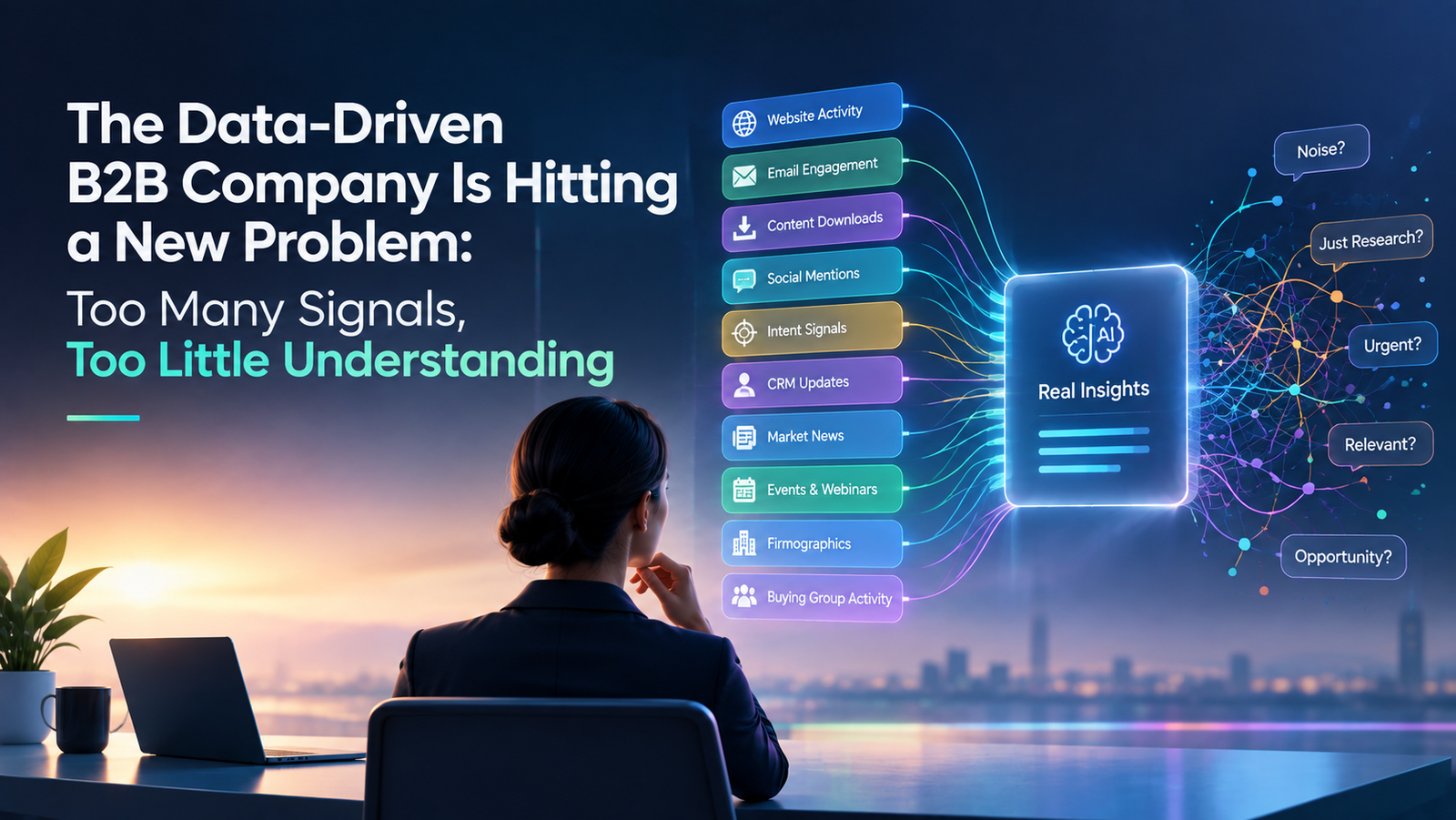
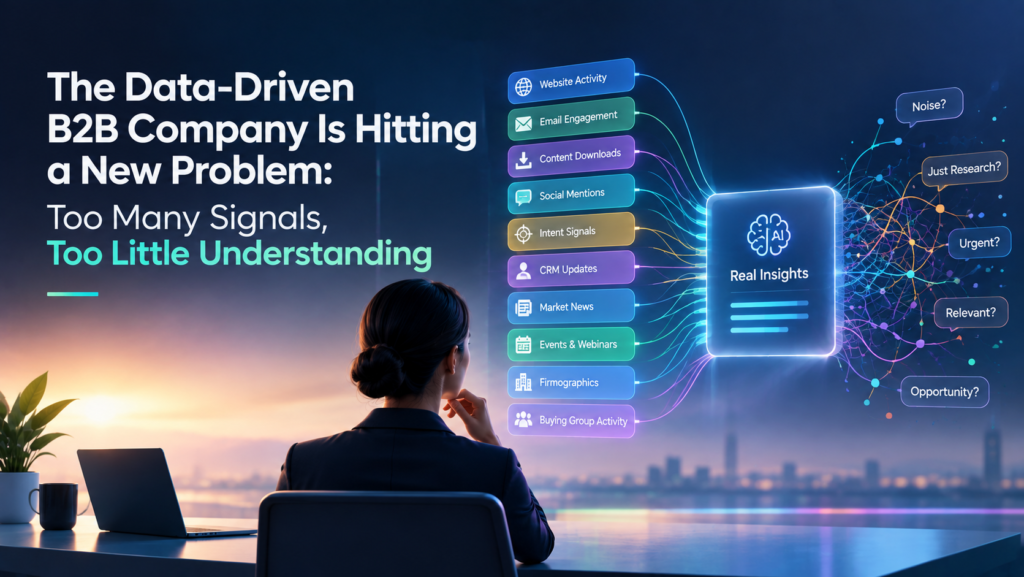
But many organizations are now encountering an unexpected problem. The challenge is no longer simply finding enough information. It is determining which information matters, how different signals relate to one another, and what action those signals should influence. Pasted markdown
This is where B2B Data Intelligence becomes increasingly important: helping organizations move from data collection to contextual understanding. By connecting buyer behavior, account activity, business changes, and engagement patterns, B2B Data Intelligence can help teams distinguish meaningful signals from routine activity.
This is where B2B Data Intelligence becomes increasingly important: helping organizations move from data collection to contextual understanding.
1. B2B Data Intelligence Must Separate Signals From Noise
A major challenge for modern B2B organizations is that almost every buyer interaction can be measured.
A prospect visiting a pricing page might indicate serious purchase interest. It might also mean they are simply researching a market. A company hiring aggressively could indicate expansion, or it could simply be replacing employees. A sudden increase in website traffic might indicate growing demand, but it could also result from an unrelated campaign, automated traffic, or a temporary event.
The data itself is not necessarily wrong. The challenge is interpretation. Effective B2B Data Intelligence does not simply collect these signals. It evaluates them in context, helping organizations understand whether an individual event represents genuine business relevance or simply another piece of digital activity.
B2B Data Intelligence therefore needs to distinguish between an event occurring and an event being meaningful.
Organizations should increasingly ask:
- Is this signal unusual compared with previous behavior?
- Does it connect with other signals?
- Is the behavior associated with a relevant business problem?
- Are multiple stakeholders showing related activity?
- Has something changed within the account?
- What evidence supports the interpretation?
A single signal may be weak. Several connected signals can create a much stronger contextual picture.
2. Buyer Journeys Require Context, Not Just Tracking
B2B buying journeys are becoming increasingly difficult to interpret because buyers rarely follow a simple, linear path.
A buyer might discover an educational article through search, investigate a competitor several days later, watch a product video, participate in an industry community, attend an event, return to a vendor website, and eventually speak with a salesperson.
Traditional analytics can treat these as separate activities.
The buyer may experience them as one continuous research process.
This distinction matters because activity without context can easily be misunderstood. A collection of disconnected events does not necessarily reveal the underlying business need. B2B Data Intelligence helps address this problem by bringing related activities together and examining them as part of a broader account or buying journey.
B2B Data Intelligence can help organizations move beyond questions such as “Did this person engage?” toward more useful questions:
What changed?
Instead of looking at engagement as an isolated event, teams can examine whether behavior has changed compared with an account’s previous pattern.
Why might it matter?
A new combination of research activity, stakeholder engagement, organizational change, or technology adoption may provide context that a single activity cannot.
What should happen next?
The purpose of interpreting data should ultimately be to support a business decision rather than simply create another report.
3. B2B Data Intelligence Turns Data Into Decision Support
There is an important difference between data and intelligence. B2B Data Intelligence sits between raw data and business decision-making. Its purpose is not simply to make more information available, but to make information more understandable and relevant.
Data records what happened.
Intelligence attempts to interpret what happened in a way that can support a decision.
For example, a CRM might show that an account interacted with six pieces of content. That is data.
Understanding that engagement increased following a leadership change and a new strategic initiative begins to provide a different level of insight. It introduces context that could help a sales or marketing team investigate whether the account’s needs have changed.
This distinction has significant implications for enterprise technology teams.
Useful B2B Data Intelligence should help answer questions such as:
- What changed at this account?
- When did the change occur?
- Which stakeholders appear to be involved?
- What business problem could the change create?
- What evidence supports that interpretation?
- What information is still missing?
- What could be a sensible next step?
In this context, B2B Data Intelligence becomes a decision-support layer that connects evidence, context, and business priorities.
The objective is not to remove human judgment. Instead, it is to reduce the amount of raw information humans must process before applying that judgment. Pasted markdown
4. Sales Teams Need Better Explanations, Not More Information
Sales representatives already have access to enormous amounts of information.
Depending on the organization, a salesperson may have access to:
- CRM histories
- Contact information
- Email activity
- Meeting notes
- Intent signals
- Product usage information
- Competitive intelligence
- Website activity
- Account-level engagement data
Adding another signal or another dashboard does not automatically improve prioritization. This is one of the areas where B2B Data Intelligence can make a practical difference. Rather than asking salespeople to interpret dozens of independent signals, B2B Data Intelligence can organize those signals around changes, relationships, and relevant account context.
In fact, more information can make prioritization harder.
A salesperson does not necessarily need to know every activity associated with an account. They need to understand which changes could indicate that a meaningful business conversation is worth exploring now.
This is why the evolution of B2B Data Intelligence may increasingly involve better explanations rather than larger lists.
Instead of simply saying that an account has a high score, an intelligent system should ideally provide the context behind that assessment.
For example, it could surface:
What changed → Why it may matter → Evidence supporting the interpretation → What remains uncertain
That approach gives sales teams information they can investigate rather than simply another number to trust.
5. Marketing Analytics Must Connect Engagement With Business Context
Marketing organizations face a similar information challenge.
Modern campaigns can produce an extensive collection of metrics, including impressions, clicks, downloads, engagement rates, form submissions, conversion rates, cost per lead, account engagement, and pipeline-related measurements.
These metrics can be useful, but more metrics do not automatically produce better decisions. B2B Data Intelligence can help marketing teams move beyond campaign-level measurement by connecting engagement with account behavior, stakeholder activity, and broader business context.
A campaign may generate strong engagement without necessarily changing buying behavior. Another campaign may produce relatively modest traffic while influencing a small number of strategically important accounts.
Without sufficient context, marketing teams can end up optimizing what is easiest to measure rather than what is most meaningful to the business. Pasted markdown
B2B Data Intelligence can shift the focus toward questions such as:
- Which buyer problems appear to be increasing in importance?
- Which accounts are demonstrating meaningful behavioral changes?
- Is engagement coming from one person or multiple stakeholders?
- Does content engagement align with other account signals?
- Are marketing activities contributing to a broader buying pattern?
When implemented effectively, B2B Data Intelligence gives marketing teams a more complete view of why engagement may be changing rather than simply showing that engagement has changed.
This creates a more contextual approach to marketing analytics.
6. Data Integration Is Also an Interpretation Problem
Connecting systems is often treated primarily as a technical challenge.
Organizations integrate CRM platforms, marketing automation systems, analytics tools, intent providers, customer intelligence platforms, and other data sources to create a more comprehensive view of the customer.
But integration alone does not create intelligence. This is a critical distinction for B2B Data Intelligence. Bringing information together creates a larger dataset, but B2B Data Intelligence requires an additional layer that determines how those signals should be interpreted.
Different platforms may define engagement differently. One system might identify a contact as engaged after an email interaction. Another might classify an account as showing intent based on external research behavior. A third might generate a score based on website activity, while another uses predictive modeling.
When these systems operate independently, organizations can end up with several versions of reality.
The technical challenge is connecting the information.
The business challenge is understanding how the signals relate to one another.
Effective B2B Data Intelligence therefore requires more than moving information into one location. Organizations also need a framework for determining:
- Which signals matter
- How signals interact
- Which changes are significant
- What business context should influence interpretation
- Which decisions should be affected by the resulting insight
Integration is valuable, but interpretation is what turns integrated data into decision support.
7. The Future of B2B Data Intelligence Is About Detecting Meaningful Change
Perhaps the most important shift is moving from measuring activity to identifying change.
Activity is abundant.
Meaningful change is comparatively rare.
Thousands of companies may visit a website every month. But only some may demonstrate a significant change in behavior. A company that suddenly begins researching a category that previously appeared irrelevant may deserve closer attention than a company that has consistently visited a website without progressing.
The same principle can apply to buying groups.
A single stakeholder repeatedly engaging with content represents one type of pattern. Multiple stakeholders from the same organization becoming engaged may represent something different.
The question therefore becomes less:
“What is this buyer doing?”
And more:
“What has changed about this buyer or account?”
That shift creates an important connection between analytics and action. If nothing meaningful has changed, additional outreach may simply create more noise. If something has changed, the organization can investigate why and determine whether it creates a reason for a new conversation. Pasted markdown
How AI Can Strengthen B2B Data Intelligence
AI has an increasingly important role to play in helping organizations process large volumes of signals.
However, its most useful application may not simply be generating another dashboard or summarizing another report.
AI can potentially help organizations:
- Identify unusual changes in account behavior
- Connect related signals across different systems
- Cluster large amounts of information
- Summarize account activity
- Detect patterns at scale
- Highlight accounts that warrant closer attention
- Provide evidence behind an interpretation
- Surface uncertainty alongside confidence
The objective should be to help people process information more effectively rather than replace human judgment.
Human expertise remains important because the same pattern can mean different things in different circumstances.
A sudden increase in activity could represent an opportunity, a false signal, or a temporary event. An intelligent system should therefore make its reasoning easier to inspect rather than simply presenting an unexplained score. Pasted markdown
Why Business Context Matters in B2B Data Intelligence
A signal is not inherently meaningful in isolation.
Its significance depends on the environment in which it occurs.
A website visit from an enterprise account may have a different meaning from a visit by a small business. A job change could be significant in one organization and less relevant in another. A new technology implementation might create urgency for one industry while having little relevance in another.
This means signal interpretation cannot be separated from business context.
Organizations should increasingly consider:
- Company characteristics
- Industry environment
- Account history
- Stakeholder involvement
- Organizational changes
- Technology adoption
- Previous behavioral patterns
- The specific business problem being investigated
The same signal can mean different things under different circumstances.
That is why B2B Data Intelligence should be treated as contextual rather than absolute. Pasted markdown
What the Next Generation of B2B Dashboards Could Look Like
The traditional response to information overload has often been to create more dashboards, more charts, and more metrics.
But the future may require the opposite.
Instead of adding more information, organizations may need dashboards that provide fewer but more meaningful explanations.
A sales leader may not need twenty metrics associated with an account. They may need to understand:
- What changed?
- Why might it matter?
- What evidence supports the interpretation?
- What remains uncertain?
- What should the team investigate next?
Marketing leaders may similarly benefit from understanding which buyer problems are becoming more important and whether their content is appearing in those conversations, rather than simply receiving another campaign performance table.
This represents a fundamentally different philosophy of analytics.
The goal is not to measure everything.
The goal is to help organizations understand what deserves attention.
Building a More Contextual B2B Data Strategy
Organizations dealing with signal overload do not necessarily need another data source.
They may need a stronger framework for interpreting the information they already have.
A contextual B2B Data Intelligence strategy can focus on several principles:
Prioritize change over volume
Not every interaction deserves equal attention. Focus on meaningful changes in behavior rather than simply counting activity.
Connect related signals
A single data point may be weak. Multiple related signals can provide stronger context when interpreted together.
Explain the reasoning
If an AI system or analytical model identifies an account as important, teams should be able to understand the evidence behind that assessment.
Communicate uncertainty
Predictive scores should not automatically be treated as facts. Teams need to understand what the available data can and cannot establish.
Keep humans involved
AI can process information at scale, but business context and judgment remain important when interpreting what a pattern means.
These principles can help organizations move from activity-based engagement toward context-based engagement.
The Strategic Value of Understanding What Changed
The central challenge facing data-driven B2B organizations is not a lack of information.
It is the growing distance between information and understanding.
Companies can collect website behavior, engagement data, intent signals, organizational information, campaign metrics, CRM activity, and other forms of business intelligence. But collecting these signals does not automatically answer the questions that matter.
The real value comes from understanding relationships between signals.
A meaningful shift in behavior may matter more than a large volume of routine activity. Multiple stakeholders showing related behavior may matter more than repeated engagement from one individual. A change connected to a relevant business context may deserve more attention than a high score without an explanation.
This is where B2B Data Intelligence becomes strategically important.
It provides a framework for moving beyond the question of how much data an organization has toward the more important question of how effectively it can interpret that data.
Conclusion
The modern B2B organization does not necessarily have an information problem. It has an interpretation problem.
More dashboards, more alerts, and more data sources cannot solve that challenge on their own. Organizations need systems and processes capable of identifying meaningful changes, connecting related signals, explaining why those changes matter, and helping people make decisions without overwhelming them. Pasted markdown
The next competitive advantage in B2B data may therefore come less from collecting the largest number of signals and more from distinguishing important signals from background noise.
In an environment where almost every buyer interaction can be measured, attention, interpretation, and understanding become increasingly valuable resources.
The future of data-driven B2B will not simply be defined by how much a company knows about its buyers. It will be defined by how well the organization understands what that knowledge actually means.
Frequently Asked Questions
1. What is B2B Data Intelligence?
B2B Data Intelligence is the process of turning large volumes of business, buyer, account, and engagement data into contextual insights that can support better decisions. It focuses on understanding which signals matter, how they relate, and what they may mean.
2. Why is B2B data becoming difficult to interpret?
B2B organizations now collect information from CRM systems, marketing platforms, websites, intent providers, analytics tools, customer intelligence systems, and other sources. The resulting volume of signals can make it difficult to distinguish meaningful patterns from routine activity.
3. What is the difference between data and intelligence?
Data records events or activities. Intelligence adds interpretation and context that can help support a decision. For example, knowing that an account viewed several pieces of content is data, while understanding how that behavior relates to other account changes can provide greater intelligence.
4. Why is signal quality more important than signal quantity?
Not every signal is equally meaningful. A single website visit may provide limited information, while several related changes involving multiple stakeholders and relevant business activity may create a stronger contextual picture.
5. How can AI support B2B Data Intelligence?
AI can help identify patterns, detect anomalies, connect related signals, summarize activity, and process large amounts of information. Its role can be to reduce the amount of raw information people need to process before applying human judgment.
6. Why is business context important when interpreting buyer signals?
The meaning of a signal can vary depending on the company, industry, account history, stakeholders, and business circumstances. A behavior that is important for one organization may have little significance for another.
7. How can sales teams benefit from better B2B Data Intelligence?
Sales teams can use contextual intelligence to focus on meaningful changes rather than attempting to process every account activity. The objective is to provide better explanations about what changed, why it may matter, and what evidence supports the interpretation.
8. Does more data always lead to better B2B decisions?
No. More data can increase complexity and make prioritization more difficult. The value comes from identifying meaningful signals, connecting them with relevant context, and translating them into useful decision support.
9. What should B2B dashboards prioritize?
Rather than simply adding more metrics, dashboards can prioritize meaningful changes, relevant context, supporting evidence, uncertainty, and actionable explanations. The goal is to help decision-makers understand what deserves attention.
10. What is the biggest shift in B2B data strategy?
One of the most important shifts is moving from asking only what the buyer is doing to asking what has changed about the buyer or account. This helps connect analytics with decisions and can move organizations from activity-based engagement toward context-based engagement.