

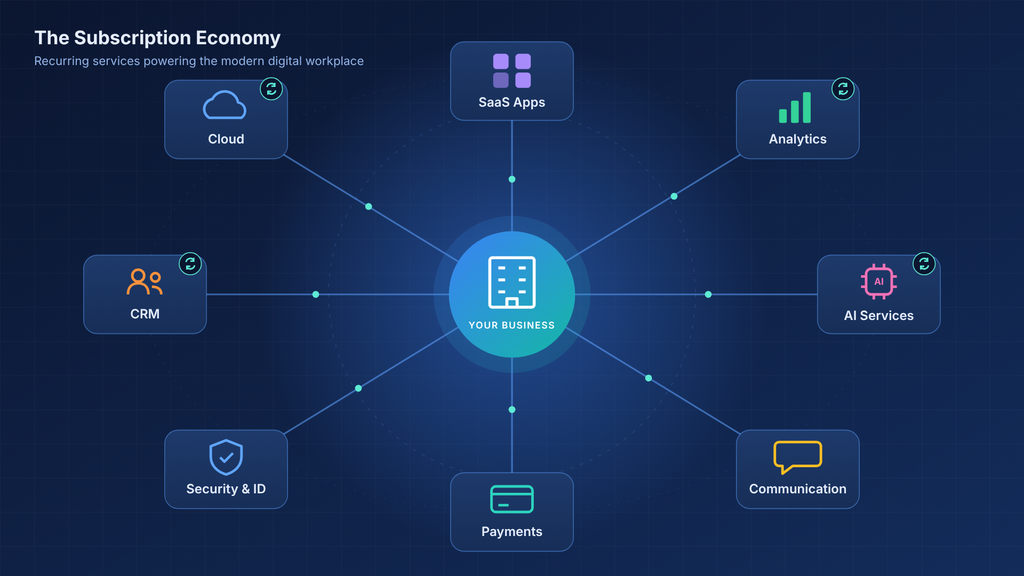
The subscription economy has transformed the way modern businesses operate, invest in technology, and build their digital capabilities. From cloud computing platforms and software-as-a-service (SaaS) applications to outsourced IT infrastructure and artificial intelligence tools, companies increasingly rely on recurring subscriptions instead of purchasing and maintaining every resource themselves. This approach makes sophisticated technology more accessible, reduces upfront investment, and allows organisations to adapt their technology stack as business requirements change.
However, the growing dependence on subscription-based services raises an important question: are companies renting the tools they need to operate, or are they gradually surrendering control over their long-term business capabilities? Although the subscription economy offers flexibility and convenience, it can also introduce hidden costs, vendor dependency, data portability challenges, and operational risks that become apparent only when a service no longer meets expectations.
For enterprise organisations, understanding the subscription economy is no longer simply a matter of managing software licences. It is a strategic responsibility that affects financial planning, operational continuity, data governance, cybersecurity, and business resilience. Companies need to evaluate not only what a subscription delivers today but also how easily they could adapt if prices increase, service terms change, or a critical provider becomes unavailable.
The Hidden Risks of the Subscription Economy
At first glance, the subscription economy appears to offer a straightforward business advantage. Organisations can access advanced software, infrastructure, and specialised services without making substantial upfront investments. Instead of purchasing expensive equipment or developing every application internally, companies can pay for the capabilities they need and scale their usage as requirements evolve.
However, convenience can gradually create dependency. When critical workflows rely on external platforms, organisations must accept that providers influence important aspects of their technology environment, including pricing, product availability, support arrangements, and service updates.
The challenge is not that subscriptions are inherently harmful. The real concern is that companies may adopt them without fully evaluating their long-term financial and operational implications.
Several risks deserve particular attention:
- Unexpected cost increases: Subscription prices, usage charges, premium features, and renewal terms can change over time.
- Vendor lock-in: Switching providers may require considerable time, money, employee training, and data migration.
- Operational disruptions: An outage affecting one provider can interrupt multiple interconnected business processes.
- Reduced flexibility: Businesses may have limited control over product changes, feature availability, and service conditions.
- Knowledge dependency: Employees may become reliant on particular applications without understanding the underlying processes.
- Data portability challenges: Information stored in proprietary systems may be difficult to transfer into alternative platforms.
For organisations embracing the subscription economy, identifying these risks early is essential. A technology solution should support business objectives without creating unnecessary barriers to future decisions.
1. Understand the Growing Cost of Multiple Subscriptions
One of the most overlooked challenges of the subscription economy is the gradual accumulation of recurring expenses. A software platform may appear affordable when a single department evaluates its monthly fee. However, the financial picture changes when several teams independently subscribe to different tools that provide similar capabilities.
For example, a marketing department might use one platform for campaign management, another for analytics, and a third for customer communication. Meanwhile, the sales team may subscribe to separate tools for contact management, reporting, and outreach. The IT department may also purchase overlapping applications to support integration, security, or productivity.
Each subscription may have a legitimate purpose, but the combined expenditure can become difficult to track.
Additional costs can include unused licences, premium upgrades, storage consumption, API usage, integration services, implementation expenses, and employee training. Because these charges are often distributed across departments, senior management may not have a complete picture of the organisation’s total technology spending.
How Businesses Can Manage Subscription Costs
A structured approach to subscription management helps organisations identify unnecessary expenditure while preserving useful capabilities.
- Maintain a central subscription inventory: Record software subscriptions, renewal dates, licence quantities, business owners, and recurring costs.
- Identify overlapping tools: Review whether multiple departments are paying for similar functionality.
- Audit licence utilisation: Determine whether employees actively use the features and licences assigned to them.
- Calculate total cost of ownership: Include implementation, integration, support, training, and migration expenses rather than focusing only on subscription fees.
- Review renewals regularly: Evaluate the business value of each service before approving another contract period.
The subscription economy does not automatically make technology more expensive. However, without appropriate oversight, recurring payments can become a significant and poorly understood operating commitment.
For enterprise leaders, the objective should be to ensure that every subscription delivers measurable value and supports a clearly defined business requirement.
2. Reduce Vendor Lock-In and Protect Data Portability
Vendor lock-in is one of the most important long-term risks associated with the subscription economy. It occurs when an organisation becomes so dependent on a particular provider that switching to an alternative becomes difficult, expensive, or operationally disruptive.
Consider a business that has used the same customer relationship management platform for several years. Its sales team has built workflows around the application, management relies on its reports, and customer communication histories are stored within its database. Other business applications may also be integrated with the platform.
Although the company may retain ownership of its customer information, moving that information elsewhere could involve considerable effort. Data formats may differ, historical records might not transfer cleanly, and proprietary features may have no direct equivalent in another system.
As the organisation becomes more dependent on the platform, the practical cost of leaving it can increase.
Why Data Portability Matters
Data portability is the ability to retrieve and transfer information from one service into another usable environment. It gives businesses greater flexibility when evaluating new providers, changing technology strategies, or responding to contractual disagreements.
Before adopting a subscription-based platform, businesses should evaluate:
- Export capabilities: Can the organisation retrieve all relevant records in a usable format?
- Integration flexibility: Does the service support documented APIs and established integration methods?
- Migration support: Does the provider offer practical assistance when transferring information?
- Contractual rights: Are data access, ownership, retention, and deletion clearly defined?
- Exit procedures: Can the organisation retrieve its information and discontinue the service without unreasonable disruption?
These considerations are particularly important for customer records, financial information, operational documentation, and other business-critical data.
Organisations should also test their data export processes instead of assuming that a documented export option will work as expected. A successful export should preserve the information and relationships needed to continue business operations.
A resilient subscription economy strategy treats the ability to leave a provider as an important part of the original purchasing decision.
3. Strengthen Operational Resilience Against Service Disruptions
The subscription economy has changed how organisations experience technology failures. In a traditional environment, a hardware problem might affect a particular office or department. In a highly connected digital environment, an issue with one external provider can interrupt several business functions simultaneously.
For example, an outage affecting a communication platform can delay internal coordination. Problems with a CRM application can prevent sales representatives from accessing customer information or updating opportunities. Payment processing disruptions can interrupt transactions, while authentication failures may prevent employees from accessing several applications even when those applications are functioning normally.
The consequences depend on the role of the affected service, the duration of the disruption, and the organisation’s ability to continue working through alternative processes.
A temporary outage during a major customer delivery, reporting deadline, or sales event can create consequences that continue long after the provider restores service.
Building a Practical Continuity Plan
Businesses do not necessarily need backup providers for every subscription. Instead, they should identify which services are essential and determine what happens if those services become unavailable.
A practical continuity strategy includes:
- Identify critical services: Classify platforms according to their importance to revenue, customer service, compliance, and daily operations.
- Map system dependencies: Understand which applications depend on shared identity services, databases, integrations, or infrastructure.
- Define recovery procedures: Establish clear responsibilities and steps for responding to service interruptions.
- Maintain appropriate backups: Protect critical information through suitable backup and recovery arrangements.
- Test fallback processes: Confirm that employees can carry out essential activities when a platform is unavailable.
- Evaluate recovery commitments: Review contractual availability commitments, support arrangements, and recovery responsibilities.
For highly critical services, an organisation might maintain an alternative provider, a secondary operating environment, or a documented manual process. The right approach depends on the cost of downtime and the resources available to manage the risk.
The subscription economy can improve operational efficiency, but resilience requires businesses to plan for the possibility that external services will occasionally fail.
4. Retain Control Over Long-Term Technology Decisions
Subscription-based services give providers considerable influence over how their products evolve. Providers determine many aspects of the customer experience, including product updates, pricing structures, support arrangements, feature availability, and service conditions.
A feature that one department relies on might be discontinued. A provider may move a useful capability into a more expensive subscription tier. Alternatively, a product update could change an established workflow or introduce new technical requirements.
When these changes occur, the organisation may need to modify its processes, pay for a different service level, or migrate to another platform.
This creates an important distinction between having access to a technology capability and having control over how that capability develops.
Evaluate Providers Beyond Their Current Features
A platform that meets today’s requirements may not necessarily remain suitable as the business grows. Organisations should assess the provider’s ability to support their long-term technology strategy.
Important considerations include:
- Business stability: Evaluate whether the provider can reasonably support the organisation’s requirements over the expected contract period.
- Product direction: Understand how planned product changes could affect existing workflows and integrations.
- Support quality: Review support arrangements, escalation procedures, and the availability of assistance for critical issues.
- Pricing transparency: Examine renewal terms, usage limits, and conditions that could increase future expenditure.
- Contractual flexibility: Understand termination rights, renewal obligations, and the process for resolving service issues.
Procurement teams should work with IT, finance, legal, and business stakeholders to evaluate these factors before committing to a platform.
The goal is not to eliminate provider influence. It is to ensure that the organisation understands the limits of its control and retains realistic alternatives when its requirements change.
5. Preserve Internal Knowledge and Business Process Ownership
Another overlooked risk of the subscription economy is the gradual loss of internal process knowledge. Employees can become so familiar with a particular application that they learn how to operate its interface without fully understanding the business process behind it.
For instance, a marketing team may know how to generate campaign reports using a specific dashboard but struggle to reproduce the analysis if the application becomes unavailable. A finance team may rely on automated workflows without maintaining sufficient documentation about the checks required to validate the results.
Similarly, a sales team might depend on automated reminders and communication histories without having a reliable alternative for managing customer relationships during an outage.
Automation and specialised software can improve productivity, but organisations should not allow essential knowledge to become inaccessible when a platform changes.
How to Preserve Business Knowledge
Companies can reduce this dependency by treating process documentation and employee knowledge as important business assets.
- Document critical workflows: Record the essential steps involved in important operational activities.
- Assign process ownership: Ensure that someone is responsible for understanding and maintaining each critical business process.
- Maintain operational documentation: Keep relevant instructions, data definitions, reporting procedures, and integration details accessible.
- Cross-train employees: Reduce dependence on a single employee who understands a particular application or workflow.
- Review automated outputs: Ensure that employees understand the purpose of important checks and can identify unexpected results.
- Test alternative procedures: Confirm that essential work can continue when a particular application is unavailable.
These practices do not mean that employees must abandon automation or become technical experts. Instead, they help businesses retain enough knowledge to evaluate systems, resolve problems, and make informed decisions.
A sustainable subscription economy depends on combining external technology capabilities with internal organisational expertise.
6. Manage the Emerging Risks of AI Subscriptions
Artificial intelligence introduces another layer of dependency into the subscription economy. Businesses increasingly use externally hosted AI services for research, customer support, content creation, software development, analytics, and other operational activities.
These tools can help organisations improve productivity and access capabilities that would otherwise require substantial development effort. However, incorporating an external AI service into an important workflow can also create new operational, financial, and governance considerations.
A provider may change its pricing, introduce usage limits, modify a model’s behaviour, or discontinue a service. An application built around a particular model may produce different results after an update, requiring changes to prompts, integrations, testing procedures, and internal workflows.
Organisations must also consider how sensitive information is handled and whether the provider’s data protection terms are appropriate for the intended use.
Build a Flexible AI Technology Strategy
Businesses can benefit from AI subscriptions while reducing unnecessary dependence on any single provider.
Key practices include:
- Identify critical AI use cases: Determine which workflows depend on AI and what would happen if the service became unavailable.
- Evaluate data handling: Review applicable privacy terms, retention policies, access controls, and restrictions on sensitive information.
- Monitor model changes: Test important workflows when providers update models, interfaces, or usage conditions.
- Separate core business logic: Where practical, design integrations so that business processes are not unnecessarily tied to one provider’s proprietary implementation.
- Define fallback procedures: Establish alternative tools or manual processes for essential activities.
- Maintain human oversight: Apply appropriate review and accountability to AI-assisted decisions where accuracy, confidentiality, or business consequences matter.
For example, a customer support team using an AI assistant might establish a procedure for handling enquiries manually if the service becomes unavailable. A software development team might test whether its essential workflows can continue with an alternative model or established development tools.
The subscription economy is likely to remain an important part of enterprise AI adoption. The priority should be to make AI dependency deliberate, measurable, and manageable rather than treating continued access to a particular service as guaranteed.
7. Establish a Company-Wide Subscription Management Strategy
Reducing subscription-related risks does not require organisations to abandon cloud services or develop every technology capability internally. For many businesses, subscriptions remain a practical way to access specialised software, infrastructure, and expertise.
The more effective approach is to establish a consistent framework for evaluating, purchasing, monitoring, and eventually retiring subscription-based services.
Without central oversight, departments may independently approve applications, create overlapping technology environments, and introduce dependencies that are difficult for IT and finance teams to identify.
A company-wide strategy helps organisations balance the benefits of external services with financial discipline, operational resilience, and long-term flexibility.
A Practical Subscription Management Framework
Step 1: Create a central inventory
Maintain a record of subscriptions, providers, contract owners, costs, renewal dates, licence quantities, and business purposes. Include services purchased directly by departments as well as those managed by central IT.
Step 2: Assess business criticality
Classify services according to their operational importance. A tool used occasionally for a nonessential task may require a different level of oversight from a platform that supports customer transactions or employee authentication.
Step 3: Review financial commitments
Evaluate recurring costs, licence utilisation, overlapping features, usage-based charges, and the total cost of ownership. Review upcoming renewals early enough to compare alternatives.
Step 4: Evaluate contractual and data risks
Examine data portability, service availability commitments, termination procedures, support conditions, and price adjustment terms. Confirm that the organisation understands its rights and responsibilities.
Step 5: Map technical dependencies
Document integrations and shared services that could affect multiple applications. Identify situations where a single provider supports several critical business functions.
Step 6: Test continuity arrangements
Verify that backups, recovery procedures, and fallback workflows are usable. Testing helps reveal practical difficulties that may not be apparent from documentation alone.
Step 7: Review and improve continuously
Reassess subscriptions as business requirements change. Retire services that no longer deliver sufficient value and update risk assessments when providers, contracts, or workflows change.

The Business Case for Balancing Ownership and Access
The subscription economy encourages organisations to reconsider the traditional distinction between owning technology and accessing it as a service. Neither approach is universally better. The appropriate decision depends on the organisation’s capabilities, financial priorities, security requirements, and tolerance for operational risk.
Owning and managing technology internally can provide greater control over certain systems, configurations, and operational decisions. However, ownership also introduces responsibilities such as maintenance, upgrades, infrastructure management, staffing, and ongoing investment.
Subscription-based services can reduce these responsibilities and provide access to specialised capabilities, but they also introduce contractual dependencies and limit control over some aspects of the technology environment.
A balanced strategy evaluates both models according to business needs.
For example, an organisation might use subscription-based collaboration tools while maintaining independent backups of critical business information. It might rely on a cloud-based CRM system while documenting data exports and maintaining a practical migration plan. A company could use a hosted AI service while retaining human review and alternative procedures for essential decisions.
The central question is not whether the organisation should own or rent every technology asset. It is whether the selected arrangement supports business objectives without creating unacceptable long-term dependencies.
Conclusion
The subscription economy has fundamentally changed how organisations access technology, manage costs, and deliver business services. Cloud platforms, SaaS applications, managed services, and externally hosted AI capabilities allow companies to adopt sophisticated tools without building every capability internally. These benefits can improve flexibility, support innovation, and reduce the burden of managing complex technology environments.
However, convenience should not replace strategic oversight. Subscription costs can accumulate across departments, proprietary platforms can make data migration difficult, service interruptions can affect interconnected operations, and provider decisions can influence the organisation’s future technology choices. Businesses can also become dependent on applications in ways that weaken internal process knowledge and reduce their ability to respond to unexpected changes.
A resilient subscription economy strategy addresses these risks through practical governance. Organisations should maintain a clear inventory of subscriptions, review total costs, assess provider contracts, protect data portability, document critical workflows, and test continuity arrangements. AI subscriptions and other emerging services should receive the same careful evaluation as established enterprise platforms.
Ultimately, the goal is not to own everything or rent everything. It is to make deliberate decisions about which capabilities should be accessed externally, which knowledge and assets must remain under organisational control, and what safeguards are necessary to preserve operational flexibility.
Every subscription should be evaluated not only by what it enables today but also by the choices it preserves for tomorrow. In a business environment increasingly shaped by interconnected digital services, long-term resilience depends on understanding technology dependencies and maintaining the ability to adapt when providers, prices, or business requirements change.
Frequently Asked Questions
1. What is the subscription economy?
The subscription economy is a business model in which organisations and individuals access products, software, infrastructure, and services through recurring payments rather than purchasing them outright. In technology, it commonly includes SaaS applications, cloud computing, managed IT services, and subscription-based AI tools.
2. Why is the subscription economy important for businesses?
The subscription economy allows businesses to access sophisticated technology without making substantial upfront investments. It can support scalability, flexibility, and faster adoption of new capabilities. However, organisations must also manage recurring expenses, provider dependency, data portability, and service continuity.
3. What are the biggest risks of subscription-based business technology?
The primary risks include rising subscription costs, vendor lock-in, data migration difficulties, service outages, changing contractual terms, and dependence on external providers. Organisations may also lose important internal process knowledge if employees rely too heavily on specific applications.
4. How can companies reduce SaaS subscription costs?
Companies can reduce SaaS subscription costs by maintaining a central software inventory, identifying overlapping tools, reviewing unused licences, monitoring usage-based charges, and evaluating the total cost of ownership. Reviewing contracts before renewal also helps businesses determine whether a subscription continues to provide sufficient value.
5. What is vendor lock-in, and how does it affect the subscription economy?
Vendor lock-in occurs when switching from one provider to another becomes difficult or expensive because of proprietary technology, data formats, integrations, contractual conditions, or established workflows. It can limit an organisation’s flexibility and increase the cost of changing technology providers.
6. How can businesses protect their data when using subscription-based services?
Businesses should review data ownership and export terms, understand retention and deletion policies, evaluate available integration methods, and maintain appropriate backups. They should also test data exports and migration procedures to confirm that important information can be retrieved and used outside the original platform.
7. How does the subscription economy affect business continuity?
The subscription economy can create dependencies between multiple business applications and external providers. If a critical service becomes unavailable, the disruption may affect several departments simultaneously. Businesses can reduce this risk by identifying critical services, mapping dependencies, testing recovery procedures, and establishing appropriate fallback arrangements.
8. What risks should businesses consider when subscribing to AI services?
Businesses should consider model changes, pricing adjustments, usage restrictions, service availability, data privacy, and the reliability of AI-generated outputs. They should also establish appropriate human oversight, test important workflows after updates, and maintain alternative procedures for essential activities.
9. Should businesses own their technology or use subscription services?
The right approach depends on the business’s operational requirements, available resources, security obligations, and need for control. Subscription services can provide flexibility and access to specialised capabilities, while internally managed systems may offer greater control over certain functions. Many organisations benefit from a balanced approach that combines external services with clear governance, data portability, and continuity planning.
10. How can a business build a sustainable subscription economy strategy?
A sustainable strategy includes a central subscription inventory, regular financial reviews, provider and contract assessments, data portability safeguards, documented business processes, and tested recovery arrangements. Organisations should reassess these measures as their technology requirements and provider relationships evolve.