
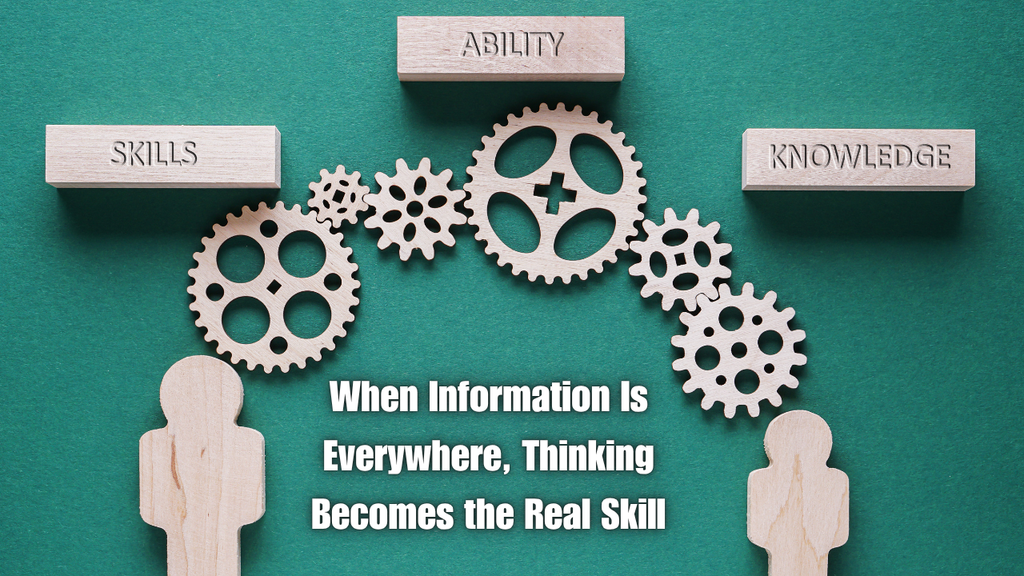
Critical Thinking in the Age of AI is becoming an essential capability for businesses that want to turn information into meaningful insights and better decisions. As artificial intelligence transforms how employees research, analyse data, and solve problems, organisations need more than fast access to information. They need professionals who can evaluate evidence, question assumptions, and determine which insights are relevant to their business objectives.
In today’s digital workplace, employees can access industry reports, consult online knowledge bases, and generate AI-powered recommendations within minutes. However, the availability of information does not automatically translate into better understanding. Critical Thinking in the Age of AI helps professionals distinguish reliable evidence from misleading conclusions and identify whether a recommendation addresses the actual business problem.
This is where critical thinking becomes especially valuable. As AI tools accelerate information discovery and content generation, the ability to question assumptions, evaluate evidence, recognise missing context, and make sound judgements becomes increasingly important. For modern enterprises, the challenge is no longer simply finding answers. It is knowing which answers deserve confidence and which insights should influence action.
Why Critical Thinking in the Age of AI Matters for Modern Businesses –
Information abundance has changed the nature of professional expertise. Employees no longer need to rely exclusively on personal experience or traditional research methods to explore a new subject. They can access industry reports, consult digital knowledge bases, analyse business data, and use AI assistants to investigate potential solutions.
However, the availability of information creates a new responsibility: evaluating its relevance and reliability. A polished report can contain outdated assumptions, an impressive statistic can lack the necessary context, and an AI-generated recommendation can overlook organisational constraints.
For businesses, these limitations can influence decisions involving marketing investments, technology adoption, customer retention, operational efficiency, and long-term strategy.
Consider a company evaluating a new enterprise software platform. An initial search might reveal detailed product comparisons, positive customer reviews, feature lists, and AI-generated recommendations. Yet none of these sources independently establishes whether the platform is suitable for the organisation’s security requirements, existing infrastructure, budget, or future needs.
Effective critical thinking helps teams move beyond surface-level information and assess what matters in their specific circumstances.
Key questions include:
- Is the information supported by credible and current evidence?
- Does the source address our industry, customers, and business environment?
- What assumptions are influencing the recommendation?
- What important risks or alternative explanations have not been considered?
- What additional evidence would materially change the decision?
When employees consistently ask these questions, information becomes a foundation for reasoning rather than a substitute for it.
7 Powerful Ways to Strengthen Critical Thinking in the Age of AI
Businesses can develop stronger critical-thinking capabilities by embedding structured reasoning into everyday work. The objective is not to make every decision slower or more complicated. It is to help employees identify the right problem, evaluate available evidence, and make decisions with an appropriate level of confidence.
Ask Better Questions Before Searching for Answers –
One of the most effective ways to improve problem-solving is to define the problem before searching for solutions.
When employees encounter a challenge, they may immediately look for examples, industry best practices, or recommendations from AI tools. This can be useful when the problem is familiar and clearly understood. However, complex business challenges often have multiple possible causes, and the first apparent explanation may not be the correct one.
For example, declining customer retention might prompt a marketing team to recommend loyalty programmes, personalised campaigns, or promotional discounts. Although these approaches may be appropriate in some situations, they do not establish why customers are leaving.
The underlying issue could involve poor onboarding, product limitations, delayed technical support, unsuitable pricing, or a mismatch between sales promises and the customer experience.
A stronger approach begins by investigating the problem itself.
Employees can ask:
- What exactly has changed, and when did the change begin?
- Which customers, processes, or business units are affected?
- What evidence supports each possible explanation?
- Which assumptions have not yet been tested?
- What information would help distinguish between competing explanations?
Business application: Before deploying a new solution, require teams to document the problem statement, likely causes, and evidence needed to validate their assumptions. This reduces the risk of investing in solutions that address symptoms rather than root causes.
Evaluate Information Sources Instead of Trusting Presentation –
Modern digital platforms can make information appear authoritative even when its accuracy or relevance is uncertain. Professional formatting, confident language, detailed charts, and comprehensive-looking reports can influence how readers judge credibility.
Critical thinking requires employees to separate presentation quality from evidence quality.
An industry report, for instance, might describe rapid market growth but focus on a customer segment that differs significantly from the company’s target audience. A widely shared marketing trend may reflect consumer behaviour in another region rather than the company’s actual market.
Similarly, AI-generated content may present an explanation fluently without providing sufficient evidence for every claim.
Employees should therefore evaluate both the source and the context in which information was produced.
Useful practices include:
- Checking the original source of important claims rather than relying exclusively on summaries.
- Reviewing publication dates, research methods, and the scope of the evidence.
- Comparing findings across independent, credible sources.
- Distinguishing verified facts from interpretations, predictions, and opinions.
- Identifying limitations that could affect how the findings apply to a business decision.
Business application: During market research, vendor selection, and strategic planning, teams should document the evidence supporting their conclusions and flag any material gaps. This makes recommendations easier to review and challenge constructively.
Use AI as a Thinking Partner, Not an Unquestionable Authority –
Artificial intelligence can make research and analysis more efficient. Employees can use AI tools to summarise long documents, compare strategic options, generate hypotheses, explore unfamiliar topics, and identify potential risks.
However, the usefulness of an AI-generated response depends on the quality of the prompt, the context supplied, and the evaluation that follows.
A request such as “Recommend the best marketing strategy for our company” provides little information about the target audience, budget, competitive environment, business objectives, or success criteria. The resulting answer may be well structured but too generic to support an actual business decision.
A more effective approach uses AI to explore possibilities and challenge initial assumptions.
For example, a team could ask an AI assistant to:
- Identify several plausible explanations for declining customer engagement.
- Compare the advantages, limitations, and risks of different marketing approaches.
- Highlight assumptions that require validation.
- Suggest what additional data would help distinguish between competing hypotheses.
- Identify potential weaknesses in an existing business proposal.
The team should then verify material claims, assess the recommendations against internal evidence, and consider relevant business constraints before acting.
Business application: Establish review practices for AI-assisted research and decision-making. Employees should understand when human verification is necessary, which information must remain confidential, and how organisational policies govern AI usage.
The goal is to combine AI’s ability to process information with human judgement, contextual understanding, and accountability.
Distinguish Productive Research from Information Overload –
Access to more information can create the illusion of progress. Reading another report, opening another browser tab, comparing another software platform, or generating another AI summary may feel productive because each activity produces something tangible.
However, additional research does not always improve a decision.
Teams can spend excessive time gathering competitor information without agreeing on evaluation criteria, comparing software solutions without defining essential requirements, or reviewing market forecasts without determining which risks they are willing to accept.
This can delay decisions without meaningfully reducing uncertainty.
Critical thinking helps organisations determine when enough evidence has been collected to move forward responsibly.
A practical approach involves defining three things before starting research:
- The decision: What action or business choice must be made?
- The critical uncertainties: Which unanswered questions could change that choice?
- The evidence threshold: What information is necessary to proceed with reasonable confidence?
Once these questions are answered, additional research should focus on information that could materially influence the decision.
This does not mean ignoring important risks or rushing into poorly supported choices. It means directing research effort towards questions that have genuine decision-making value.
Business application: For technology procurement, teams can establish weighted evaluation criteria before comparing vendors. This helps prevent endless comparisons and keeps attention on the requirements that matter most to the organisation.
Encourage Evidence-Based Reasoning Across Teams –
Strong decision-making depends on more than individual intelligence. It also requires a workplace environment where employees can question assumptions, present alternative explanations, and acknowledge uncertainty without unnecessary fear of criticism.
In some organisations, employees may feel pressure to provide immediate answers or support a senior leader’s preferred position. Such environments can discourage thoughtful investigation and make weak assumptions harder to identify.
Businesses can strengthen critical thinking by making the reasoning behind decisions visible.
For important recommendations, teams can document:
- The verified facts that support the proposal.
- The assumptions that have not yet been confirmed.
- The alternative options considered.
- The risks and trade-offs associated with each option.
- The evidence that would justify revisiting the decision.
Managers should also encourage constructive disagreement. Challenging an idea should focus on improving the decision rather than questioning the competence or intentions of the person proposing it.
Leaders can reinforce this culture by explaining their reasoning, acknowledging uncertainty, and revising their views when credible new evidence emerges.
Business application: During strategy reviews and project planning, ask employees to explain why they recommend a particular course of action and what could make their recommendation incorrect. This encourages more transparent reasoning and helps teams identify weaknesses before committing resources.
Connect Information to Business Context and Practical Outcomes –
Information becomes valuable when it helps people understand a situation and choose an appropriate course of action.
An employee might understand a technology trend, repeat an industry statistic, or explain a software feature accurately. However, applying that knowledge requires additional reasoning about organisational objectives, customer needs, financial constraints, operational risks, and implementation requirements.
For example, an enterprise may consider introducing AI-powered automation to improve operational efficiency. The technology may offer useful capabilities, but the business case depends on factors such as process complexity, data quality, integration requirements, employee readiness, governance, and the cost of implementation.
A critical-thinking approach evaluates these factors together rather than treating the technology itself as the solution.
Teams should consider:
- Which specific business problem is the technology expected to solve?
- How will success be measured?
- What process changes will be required?
- Which operational, security, or compliance risks need attention?
- What evidence will demonstrate whether the investment is delivering value?
Business application: Before approving a technology initiative, ask project teams to connect their recommendations to measurable business objectives and explain the assumptions behind the expected outcomes.
This helps decision-makers distinguish between an interesting technological capability and an investment that is appropriate for their organisation.
Build Continuous Learning into Everyday Decision-Making –
Critical thinking is not a one-time training outcome. It develops through repeated practice, reflection, and the willingness to learn from decisions that produce unexpected results.
Even well-reasoned decisions can lead to disappointing outcomes because markets change, assumptions prove inaccurate, or external conditions develop in unexpected ways. What matters is whether the organisation can identify what happened and use that understanding to improve future decisions.
Businesses can encourage this process through structured decision reviews.
After completing an important project or initiative, teams can examine:
- Which assumptions turned out to be correct?
- Which evidence proved more or less useful than expected?
- What risks were overlooked?
- Where did the original reasoning differ from the actual outcome?
- What should be changed in future decisions?
These reviews should focus on learning rather than assigning blame. If employees believe that acknowledging a mistake will automatically damage their reputation, they may be less willing to share information that could help the organisation improve.
Business application: Incorporate decision reviews into project completion, AI implementation, product launches, and strategic planning. Over time, the resulting lessons can improve internal processes and help teams make more informed choices in unfamiliar situations.
The Role of Critical Thinking in Enterprise AI Adoption –
AI adoption is not simply a technology implementation challenge. It also requires organisations to reconsider how employees discover information, evaluate recommendations, and make decisions.
AI systems can generate content and analysis quickly, but the speed of output does not guarantee the quality of the resulting business decision. Enterprises must consider whether employees understand the limitations of AI-generated information and whether appropriate review processes exist.
Critical thinking provides an important foundation for responsible and effective AI adoption.
Human Judgement and AI Capabilities Must Work Together –
AI can assist with repetitive analysis, information synthesis, and the exploration of possible solutions. Human judgement remains essential when employees must interpret ambiguous situations, weigh competing priorities, understand stakeholder needs, or make decisions involving significant consequences.
Organisations can improve this collaboration by clearly defining the role of AI in different workflows.
For example, AI may help prepare a preliminary vendor comparison, while procurement specialists validate the information, security teams assess technical risks, and business leaders evaluate strategic fit.
This division of responsibilities allows AI to support decision-making without removing the need for human oversight.
Develop AI Literacy Alongside Critical Thinking –
AI literacy involves understanding how AI tools work at a practical level, what they can do well, where their limitations may arise, and how to use them responsibly.
When combined with critical thinking, AI literacy helps employees assess generated content rather than accepting it at face value.
Businesses can support this development through training that covers:
- Evaluating AI-generated claims and verifying important information.
- Writing prompts that provide relevant business context.
- Recognising uncertainty, unsupported conclusions, and missing evidence.
- Protecting confidential information and following organisational AI policies.
- Identifying when a decision requires expert review or human approval.
These practices are particularly relevant in enterprise environments where technology decisions can affect customers, employees, financial performance, and regulatory obligations.
How Organisations Can Measure Critical Thinking Development –
Critical thinking can be difficult to measure through conventional knowledge tests alone. Employees may understand a framework in theory but struggle to apply it to an unfamiliar business problem.
Organisations should therefore evaluate how employees use evidence, explain their reasoning, and respond to uncertainty in realistic work situations.
A practical assessment approach can include the following indicators:
| Assessment area | What to look for |
|---|---|
| Problem definition | Can the employee distinguish the underlying problem from its symptoms? |
| Evidence evaluation | Can the employee assess source credibility, relevance, and limitations? |
| Analytical reasoning | Can the employee compare alternative explanations and identify assumptions? |
| AI judgement | Can the employee verify AI-generated information and recognise its limitations? |
| Decision quality | Can the employee explain the rationale, risks, and trade-offs behind a recommendation? |
| Adaptability | Can the employee revise a conclusion when new evidence becomes available? |
These indicators can be incorporated into professional development programmes, leadership assessments, scenario-based exercises, and project reviews.
The emphasis should be on the quality of the reasoning process, not simply whether an employee reaches a preferred answer. In complex situations, more than one decision may be defensible if the reasoning is sound and the relevant trade-offs are understood.
Organisations can also review real project outcomes to identify recurring decision-making challenges. Such reviews should account for the uncertainty and external factors involved rather than assuming that every unsuccessful outcome reflects poor reasoning.
Conclusion –
Critical Thinking in the Age of AI is becoming a defining capability for professionals and organisations navigating an increasingly information-rich business environment. Search engines, digital knowledge platforms, and AI tools have made it easier to access information, generate explanations, and explore potential solutions. However, the ability to obtain an answer is not the same as the ability to determine whether that answer is accurate, relevant, or useful.
For businesses, the real opportunity lies in developing employees who can question assumptions, evaluate evidence, identify the underlying causes of problems, and connect information to practical decisions. These capabilities become especially important when organisations adopt AI tools, evaluate new technologies, respond to changing customer expectations, or make strategic choices under uncertainty.
Frequently Asked Questions
Critical thinking in the age of AI is the ability to evaluate information, question assumptions, verify claims, and make reasoned decisions while using AI and other digital tools. It involves assessing the reliability of information and determining whether an answer is appropriate for a specific situation.
Critical thinking helps employees solve problems more effectively, identify risks, evaluate competing options, and make informed decisions. It is particularly valuable when employees face unfamiliar situations, incomplete information, or recommendations that require contextual judgement.
AI can support critical thinking by helping employees explore alternatives, summarise complex information, and identify potential explanations. However, overreliance on AI-generated answers may discourage independent evaluation. Employees should verify important claims, examine assumptions, and apply their own judgement before acting.
Businesses can improve critical thinking through scenario-based training, evidence-based decision reviews, structured problem-solving exercises, and a workplace culture that encourages constructive questions. Managers can also ask employees to explain the reasoning and assumptions behind important recommendations.
Information gathering involves collecting facts, research, and other relevant material. Critical thinking involves evaluating that information, interpreting its significance, identifying limitations, and using it to reach a reasoned conclusion. Both are valuable, but collecting information alone does not guarantee sound decisions.