

Always-On Availability has become an unspoken expectation in modern workplaces, where employees are encouraged to respond quickly, attend meetings on demand, monitor notifications, and remain accessible throughout the working day. Although digital communication tools help businesses exchange information efficiently, the expectation of constant responsiveness can gradually undermine concentration, reduce productivity, and make complex work more difficult to complete.
For enterprise organizations, the challenge extends beyond managing emails and messages. Employees need uninterrupted time to analyse information, develop strategies, solve technical problems, create new ideas, and make informed decisions. When communication repeatedly interrupts these activities, employees may spend more time coordinating work than actually completing it. The organization can appear active and responsive while meaningful progress becomes increasingly difficult to measure. Managing Always-On Availability effectively requires businesses to protect employee concentration while maintaining the responsiveness that customers and colleagues expect.
Understanding the business cost of Always-On Availability is essential for leaders who want to improve operational efficiency without sacrificing collaboration or employee well-being. By establishing clearer communication expectations, protecting focused work, and evaluating performance through meaningful outcomes, businesses can create a digital workplace that supports both responsiveness and sustained productivity.
1. The Hidden Productivity Cost of Always-On Availability
Always-On Availability can make employees appear productive because messages are answered quickly, meetings are attended promptly, and project updates arrive throughout the day. However, visible activity does not necessarily translate into meaningful business results. An employee might spend hours responding to colleagues while struggling to complete a report, analyse a dataset, prepare a customer proposal, or resolve a complicated technical issue.
The underlying problem is that interruptions consume more than the time needed to acknowledge a message. When employees switch between unrelated tasks, they must reconstruct their previous train of thought and regain the context required to continue their work. This becomes particularly challenging for activities that require sustained reasoning, detailed analysis, or creative thinking.
Consider an enterprise IT engineer investigating a recurring infrastructure issue. While reviewing system logs and comparing performance patterns, the engineer receives several requests for project updates, meeting invitations, and routine approvals. Each interruption introduces another task into an already demanding workload. Even if every request takes only a few minutes, repeatedly changing context can delay the investigation and make it harder to identify the underlying cause.
The same problem affects marketing teams developing campaign strategies, financial analysts evaluating business performance, and product managers prioritising competing requirements.
The hidden costs of Always-On Availability often include:
- Fragmented concentration: Frequent interruptions make it harder to sustain attention on complex assignments.
- Longer task completion times: Employees repeatedly spend time recovering their context before continuing important work.
- Reduced work quality: Rushed transitions and divided attention can increase the likelihood of errors or incomplete analysis.
- Lower strategic capacity: Routine communication consumes time that could otherwise support planning, innovation, and improvement.
Businesses should therefore evaluate productivity by examining the quality and impact of completed work, not simply the volume of communication taking place. Always-On Availability can create unnecessary pressure on employees, making it harder to balance daily communication demands with meaningful work and long-term business goals.
2. Why Always-On Availability Is Mistaken for Employee Commitment
In many workplaces, fast responses have become an informal signal of dedication. Employees who reply to messages within seconds may be perceived as dependable, while colleagues who delay their responses to concentrate on demanding assignments can appear less engaged.
This perception creates a counterproductive incentive. Employees learn to monitor their communication channels continuously because they do not want to be viewed as unavailable. They may interrupt important work simply to acknowledge a routine message or provide an update that could easily wait.
Over time, Always-On Availability becomes part of workplace culture rather than a deliberate business requirement. Employees begin prioritising what others can immediately observe over the work that creates lasting value.
For example, a business analyst may need an uninterrupted period to identify patterns in customer behaviour. During that period, the analyst might produce no visible communication. Meanwhile, another employee may answer dozens of messages and appear more active. If management rewards responsiveness without considering outcomes, the organization risks valuing activity over expertise.
This distinction matters across enterprise functions because different roles require different working conditions.
- Research and analytics teams need time to examine evidence and validate conclusions.
- Software engineering teams benefit from sustained concentration when debugging, designing systems, or reviewing complex code.
- Marketing and strategy teams need space to develop ideas and assess customer needs.
- Leadership teams require uninterrupted time to evaluate risks, establish priorities, and consider long-term business objectives.
Always-On Availability should not become a universal performance expectation. Instead, managers should establish response standards that reflect the responsibilities of each role, the needs of customers, and the urgency of business operations. When Always-On Availability becomes a measure of employee commitment, organizations risk rewarding constant activity instead of meaningful contributions and measurable results.
3. Meetings, Calendar Overload, and the Loss of Deep Work
Meetings are essential for collaboration, decision-making, and resolving issues that require discussion. However, meeting overload can turn Always-On Availability into a scheduling problem that affects the entire organization.
A calendar filled with recurring check-ins, status updates, project reviews, and brainstorming sessions leaves employees with fewer opportunities to complete individual assignments. Even a short meeting can divide a productive morning into smaller periods that are unsuitable for demanding work.
The impact extends beyond the meeting itself. Employees may need time to prepare information, review documents, record decisions, and complete follow-up tasks. When several meetings are scheduled throughout the day, important assignments are frequently postponed until late afternoon, when energy and concentration may already be declining.
This can create a cycle in which employees attend meetings to discuss work, then struggle to find time to complete the work they discussed. Reducing unnecessary meetings is an important step toward controlling Always-On Availability and creating more opportunities for uninterrupted work.
How businesses can make meetings more effective
Organizations can reduce unnecessary disruption without eliminating valuable collaboration.
- Define a clear purpose: Every meeting should have an identifiable objective, such as making a decision, resolving a problem, or coordinating a critical activity.
- Invite essential participants: Avoid requiring employees to attend discussions that do not need their expertise or involvement.
- Use asynchronous updates: Share routine project progress through written summaries or collaboration platforms when a live discussion is unnecessary.
- Protect focus periods: Reserve uninterrupted calendar blocks for assignments that require sustained concentration.
- Document decisions: Record outcomes, owners, and deadlines to reduce repeated conversations and unnecessary follow-up meetings.
For example, a software delivery team might replace several daily status meetings with a shared project dashboard and a concise written update. Team members can review progress when convenient, while live discussions remain available for blockers, technical decisions, and urgent issues.
When implemented thoughtfully, these changes help organizations preserve collaboration while reducing the hidden cost of Always-On Availability.

4. How Always-On Availability Affects Business Decisions
Effective business decisions require employees to compare alternatives, challenge assumptions, evaluate risks, and consider potential consequences. These activities are difficult to perform well when attention is repeatedly redirected toward immediate requests.
Always-On Availability can encourage reactive decision-making because the most visible or recent request often receives attention first. An employee may respond immediately to a routine approval while postponing a strategic question that requires more careful evaluation.
This imbalance can affect managers and executives as well. Leaders who spend much of their day answering operational questions may have less time to examine emerging risks, review performance trends, or develop long-term plans.
The result is not necessarily an immediate operational failure. Instead, the organization may gradually lose opportunities to improve processes, anticipate customer needs, and identify problems before they become expensive.
The difference between reactive and proactive work
Reactive work addresses events that have already occurred. It includes responding to incidents, resolving customer issues, answering questions, and completing urgent approvals.
Proactive work focuses on preventing future problems and creating new value. It includes evaluating operational risks, improving infrastructure, redesigning workflows, identifying market opportunities, and developing new products.
Both types of work are necessary. The problem arises when constant communication leaves employees with insufficient time for proactive activities.
Businesses can address this imbalance by:
- Establishing protected time for strategic planning and complex analysis.
- Distinguishing genuine emergencies from routine requests.
- Creating documentation that reduces repeated questions and unnecessary approvals.
- Encouraging teams to resolve recurring problems rather than continually reacting to them.
- Evaluating whether communication demands are delaying important decisions.
For enterprise leaders, managing Always-On Availability is therefore not merely a matter of employee convenience. It is part of creating the conditions needed for sound judgment, operational resilience, and long-term competitiveness. Reducing Always-On Availability gives managers more opportunities to evaluate business risks, identify emerging challenges, and make informed strategic decisions.
5. The Impact of Constant Connectivity on Employee Well-Being
Always-On Availability can also make it difficult for employees to disconnect mentally from their responsibilities. When people feel expected to monitor messages throughout the day, they may continue thinking about pending requests even during lunch breaks or after finishing their scheduled work.
The concern is not that every after-hours message is harmful or that all employees should follow identical working schedules. Some business functions genuinely require extended coverage, and flexible communication can support distributed teams across different time zones.
The challenge arises when employees cannot distinguish between an urgent operational issue and a routine request because response expectations have never been clearly established.
Without reasonable boundaries, employees may feel pressure to check notifications repeatedly, remain alert to incoming requests, and respond outside normal working hours. Over time, insufficient opportunities for recovery can contribute to fatigue, frustration, and difficulty maintaining concentration.
These conditions can also affect collaboration. Employees who feel overwhelmed by communication demands may become less patient during discussions, less willing to take on additional responsibilities, or more likely to seek working environments with clearer expectations. Addressing Always-On Availability can help businesses establish healthier communication boundaries and create a more sustainable working environment for their employees.
Building healthier availability expectations
Organizations can improve employee well-being while maintaining appropriate service levels by:
- Defining normal response windows for routine communication.
- Establishing clear escalation procedures for genuine emergencies.
- Respecting working hours, leave, and agreed availability arrangements.
- Encouraging employees to use notification controls and scheduled communication checks.
- Training managers to distinguish responsiveness from commitment.
Leaders should also recognise that policies alone cannot change workplace culture. If employees are told to disconnect but continue receiving late-night requests that appear urgent, the practical expectation remains unchanged.
A healthier approach to Always-On Availability requires consistent leadership behaviour, realistic workloads, and communication practices that allow employees to recover their attention between demanding tasks.
6. Can AI and Automation Reduce Always-On Availability?
Enterprise communication tools have made it easier to contact colleagues, distribute updates, and coordinate work across departments. However, they have also reduced the effort required to create interruptions. A message can be sent instantly, a meeting can be scheduled in seconds, and automated systems can generate notifications whenever a project changes.
When every notification appears equally important, employees may feel compelled to monitor communication channels continuously.
Artificial intelligence and automation can help reduce this burden when they are implemented to improve information management rather than increase communication volume.
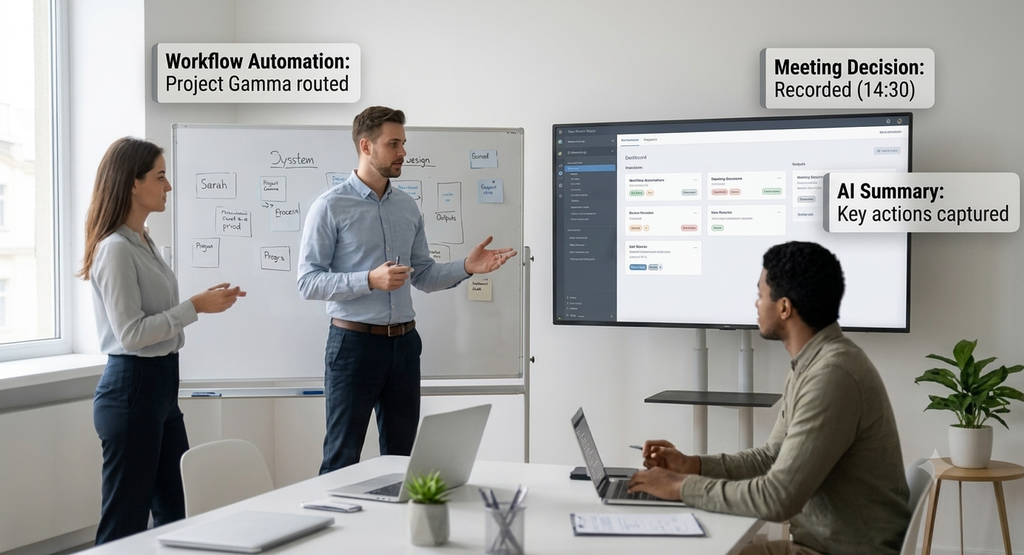
For example, AI-powered workplace assistants can summarise lengthy conversations, extract action items from discussions, draft routine responses, and help employees locate information across approved knowledge sources. Notification-management tools can group lower-priority updates, while workflow automation can route requests to the appropriate team without involving unnecessary participants.
These capabilities can reduce the manual effort required to process information. However, technology alone cannot eliminate Always-On Availability if the organization continues to expect immediate responses to every message. AI tools can support a healthier approach to Always-On Availability when automation reduces unnecessary communication rather than increasing message volume.
Practical enterprise use cases for AI
Intelligent message summarisation: An AI assistant can provide a concise summary of a lengthy project conversation so an employee can understand the key decisions without reading every message individually.
Automated workflow routing: Internal requests can be directed to the appropriate department or responsible person, reducing unnecessary interruptions to employees who are not involved.
Meeting summaries and action tracking: Approved AI meeting tools can help capture decisions, identify assigned tasks, and prepare follow-up summaries, reducing repetitive administrative work.
Knowledge management: AI-powered search can help employees find existing documentation, project information, and approved answers instead of repeatedly contacting colleagues for the same information.
Priority-based notifications: Communication systems can help distinguish critical alerts from routine updates, provided their rules are configured appropriately.
Businesses should introduce these capabilities with appropriate access controls, data protection, human oversight, and clear governance. Sensitive company information should only be processed through tools approved for the organization’s security and compliance requirements.
The objective is not to help employees answer an unlimited number of messages more quickly. It is to reduce unnecessary communication, improve access to information, and preserve attention for work that requires human judgment.
7. Seven Practical Ways to Reduce the Business Cost of Always-On Availability
Reducing Always-On Availability does not require businesses to abandon collaboration tools or make employees difficult to reach. The goal is to establish a more intentional relationship between communication, urgency, and individual responsibilities.
The following strategies provide a practical starting point for enterprise organizations.
1. Establish clear communication and response-time standards
Define expectations for different types of communication. For example, critical incidents may require immediate escalation, time-sensitive operational requests may need a response within an agreed window, and routine updates can usually wait until the recipient is available.
Publish these expectations in team guidelines so employees understand when a response is necessary and when it is reasonable to wait.
2. Introduce protected focus time
Encourage employees to reserve uninterrupted blocks for complex assignments. During these periods, non-essential notifications can be silenced and routine meetings avoided.
Protected focus time should be adapted to the operational needs of each department. Teams providing continuous customer or infrastructure support may need rotating coverage so that critical services remain accessible while other employees concentrate on individual work.
3. Reduce unnecessary meetings
Review recurring meetings regularly and determine whether they still serve a clear purpose. Replace informational discussions with written updates when possible, shorten meetings that do not require their full scheduled duration, and invite only essential participants.
This approach helps employees recover time for meaningful work without weakening collaboration.
4. Separate urgent communication from routine updates
Use agreed communication channels for different levels of urgency. A documented incident-escalation process can help distinguish a customer-impacting outage from an ordinary project question.
Employees should not have to monitor every application continuously to ensure they do not miss a genuine emergency.
5. Automate repetitive administrative work
Identify routine tasks that consume time without requiring significant human judgment. Examples include collecting status updates, distributing standard reports, routing requests, and summarising project discussions.
Automation can reduce administrative effort, but workflows should be reviewed to ensure that automation does not generate additional notifications or unnecessary approvals.
6. Measure performance through outcomes
Choose performance indicators that reflect the actual responsibilities of each role. Depending on the function, these may include project quality, customer outcomes, operational reliability, decision accuracy, delivery commitments, or the effectiveness of completed improvements.
Response time can remain an important measure where rapid assistance is central to the job. It should not automatically become the primary measure for every employee.
7. Model healthy communication behaviour through leadership
Managers should demonstrate the expectations they want their teams to follow. They can protect focus time, avoid unnecessary after-hours requests, communicate realistic deadlines, and explain when a matter genuinely requires immediate attention.
Leadership behaviour is especially important because employees often interpret managers’ communication habits as informal policy, even when official guidelines say otherwise. A structured approach to Always-On Availability helps organizations improve communication practices without compromising essential collaboration or operational continuity.
A simple implementation roadmap
Organizations can introduce these changes progressively rather than attempting to redesign every communication process at once.
| Phase | Recommended action | Intended outcome |
|---|---|---|
| Assess | Review meetings, notifications, communication volume, and workflow bottlenecks | Identify the main sources of interruption |
| Define | Establish response expectations and escalation rules | Reduce uncertainty about urgency |
| Pilot | Introduce focus blocks and improved meeting practices in selected teams | Test changes against real operational needs |
| Improve | Automate repetitive requests and simplify workflows | Reduce unnecessary communication effort |
| Evaluate | Review work quality, delivery, employee feedback, and service levels | Refine practices based on business outcomes |
The effectiveness of these initiatives should be assessed against a baseline and adjusted according to the organization’s needs. The objective is sustainable improvement, not a universal rule that every team must communicate in exactly the same way.
8. Rethinking Workplace Productivity for the Digital Enterprise
The long-term solution to Always-On Availability is to rethink what productivity means in a connected workplace. Communication is an important part of business operations, but it should support the completion of valuable work rather than become a substitute for it.
A modern enterprise needs to balance several priorities: rapid customer response, effective collaboration, operational continuity, thoughtful decision-making, and employee concentration. The appropriate balance will vary by function, but every team benefits from understanding which activities require immediate coordination and which require uninterrupted attention.
Managers can begin by examining how work actually happens. If employees repeatedly answer the same questions, better documentation may be more effective than faster messaging. If important projects are delayed by calendar overload, meeting redesign may offer greater benefits than asking employees to work longer hours. If routine requests interrupt critical tasks, clearer escalation rules and automated routing may help.
These improvements also require more meaningful performance measurement. An employee’s online status does not reveal the complexity of their work, and a busy calendar does not necessarily demonstrate progress. Performance discussions should consider the value of completed assignments, the quality of decisions, the reliability of delivery, and the working conditions that influence results.
Organizations should also avoid assuming that every interruption has the same effect. Some collaboration is essential, and spontaneous conversations can resolve problems quickly or generate useful ideas. The aim is to remove avoidable disruption while preserving communication that genuinely helps people work together.
When businesses treat attention as an important organizational resource, they can create more effective digital workplaces. Communication becomes more purposeful, meetings become more selective, and employees gain greater control over how they complete demanding assignments.
Conclusion
Always-On Availability may appear to be a sign of an efficient, connected workforce, but constant responsiveness can carry hidden costs. Repeated interruptions, unnecessary meetings, unclear communication expectations, and pressure to remain accessible can reduce concentration and make it harder for employees to complete complex work. These effects can influence decision quality, operational efficiency, employee well-being, and the organization’s ability to pursue long-term priorities.
Businesses do not need to choose between collaboration and concentration. By establishing clear response standards, protecting focus time, reducing unnecessary meetings, using AI thoughtfully, and measuring performance through meaningful outcomes, they can create a more balanced approach to workplace communication.
The most effective organizations will not necessarily be those whose employees respond to every message first. They will be those that understand when responsiveness matters, when collaboration adds value, and when uninterrupted attention is essential. Ultimately, addressing Always-On Availability allows businesses to balance timely communication with the focused effort required to deliver meaningful results.
Ultimately, reducing the business cost of Always-On Availability means making communication serve work rather than allowing communication to consume it. In an increasingly automated and connected enterprise, protecting employee attention can help organizations improve the quality of their decisions, strengthen productivity, and build a more sustainable working environment.
Frequently Asked Questions
1. What is Always-On Availability in the workplace?
Always-On Availability describes a workplace expectation that employees remain continuously accessible through email, messaging platforms, meetings, and other digital communication tools. It becomes a concern when employees feel pressured to respond immediately, even when a request is not urgent or they are completing important work.
2. How does Always-On Availability affect employee productivity?
Always-On Availability can fragment concentration, increase task-switching, and make it harder to complete complex assignments. Employees may spend substantial time answering messages and attending meetings while having less uninterrupted time for analysis, planning, writing, and problem-solving.
3. Why is constant availability expensive for businesses?
The business costs can include delayed projects, duplicated communication, unnecessary meetings, reduced work quality, slower strategic decision-making, and employee fatigue. These costs may be difficult to identify because conventional activity metrics do not always reveal the impact of interrupted concentration.
4. How can businesses reduce Always-On Availability without affecting collaboration?
Businesses can establish clear response-time expectations, distinguish emergencies from routine requests, introduce protected focus periods, reduce unnecessary meetings, and use asynchronous communication for updates that do not require immediate discussion. Critical escalation channels should remain available where operational requirements demand them.
5. Can AI help reduce workplace communication overload?
Yes. AI tools can summarise conversations, extract action items, route routine requests, support knowledge retrieval, and assist with meeting documentation. However, organizations also need clear communication policies; otherwise, automation may simply make it easier to generate and process more messages.
6. How can managers measure productivity without monitoring constant availability?
Managers can evaluate role-specific outcomes such as delivery quality, project completion, customer satisfaction, operational reliability, and the effectiveness of completed work. Response-time metrics may be appropriate for customer support and incident management, but they should not be applied identically to every role.
7. What is the difference between asynchronous communication and real-time communication?
Asynchronous communication allows employees to send and review information without requiring everyone to participate simultaneously. Examples include written project updates, shared documentation, and recorded decisions. Real-time communication, such as calls and live meetings, is useful when immediate coordination, discussion, or problem resolution is necessary.
8. Does reducing Always-On Availability mean employees should ignore messages?
No. The objective is to make responses more intentional, not to eliminate communication. Employees should follow agreed response windows and escalation procedures, remain accessible when their roles require it, and use protected focus periods for non-urgent work when operational needs permit.
9. How can businesses protect employee well-being while maintaining responsiveness?
Organizations can define reasonable working-hour expectations, create clear emergency procedures, respect agreed availability arrangements, distribute on-call responsibilities appropriately, and discourage unnecessary after-hours communication. Managers should reinforce these practices through their own behaviour.
10. What should an enterprise do first to address Always-On Availability?
Start by identifying the biggest sources of avoidable interruption. Review meeting schedules, communication patterns, repetitive requests, and workflow delays. Then pilot clearer response standards, protected focus time, and more purposeful meetings in a selected team. Evaluate the results and refine the approach before expanding it across the organization.