Introduction –
Project management bottlenecks are becoming increasingly visible as businesses adopt artificial intelligence (AI), automation, and digital productivity tools. Tasks that once required hours of manual effort can now be completed in minutes. AI can analyse information, draft reports, generate business communications, and support decision-making, while automation can handle repetitive activities across business systems. Yet, despite these advances, many organisations still struggle to deliver projects on time.
A marketing campaign can be prepared in a few hours but remain stuck in approvals for days. A sales proposal can be drafted quickly but wait for feedback from multiple departments. A technology upgrade can be technically ready but delayed because teams disagree on priorities or lack clarity about who has the authority to proceed. These situations reveal a fundamental challenge: making individual tasks faster does not automatically make an entire business faster.
The real issue often lies in the way work moves through an organisation. Unclear responsibilities, disconnected systems, excessive approvals, repeated discussions, and delayed decisions can prevent completed tasks from translating into completed projects. For businesses investing in AI and enterprise automation, understanding these project management bottlenecks is essential to achieving meaningful improvements in productivity, operational efficiency, and business outcomes.
Why Faster Tasks Do Not Always Mean Faster Projects –
Technology has dramatically improved the speed at which employees can perform individual activities. However, a project involves more than the completion of isolated tasks. It requires multiple activities to come together in the correct sequence, with the right people making decisions and providing information at the appropriate time.
Consider a product marketing campaign. AI may help a marketing team research its audience, prepare content, draft email campaigns, and develop a launch plan within hours. However, the campaign may still require product confirmation, sales feedback, leadership approval, and a compliance review before publication.
If each department responds at a different time, the project accumulates delays even though the actual content creation happens quickly.
The difference between task speed and project speed –
Task speed measures how quickly an individual activity is completed. Project speed reflects how long it takes to move from the initial request to the final outcome.
The distinction matters because a project can involve highly productive employees and still experience slow delivery.
Common causes include:
- Waiting time: Work sits idle while employees wait for feedback, approvals, or information.
- Dependencies: One activity cannot proceed until another team completes its contribution.
- Rework: Changes in requirements or conflicting feedback force teams to repeat completed work.
- Unclear ownership: Employees do not know who is responsible for making the next decision.
- Disconnected workflows: Information moves between emails, spreadsheets, messaging applications, and project management platforms without a consistent process.
The implication for business leaders is clear: improving productivity requires examining the complete workflow, not just the speed of individual employees.
Collaboration Is Valuable, but Excessive Coordination Slows Progress –
Cross-functional collaboration is essential in modern businesses. Marketing, sales, finance, legal, operations, and technology teams bring different perspectives that help organisations manage risk and make better decisions.
However, collaboration becomes inefficient when employees spend too much time coordinating the work instead of advancing it.
A project involving several departments may require only a handful of important decisions, yet those decisions can trigger multiple meetings, email exchanges, follow-up messages, and status updates. Meetings are postponed because one participant is unavailable, feedback arrives in separate documents, and employees wait for clarification before proceeding.
Everyone may appear busy, but the project makes little progress.
How coordination overhead develops –
Coordination overhead grows when the process for working together is more complicated than the work itself.
For example, a technology team may be ready to deploy a software update, but the business team has not confirmed its requirements. The business team may be waiting for a cost estimate, while finance is waiting for additional technical details. Without a clear owner responsible for resolving the dependency, each team continues working within its own priorities.
Businesses can reduce this friction by establishing:
- Clear ownership: Every deliverable has one accountable owner.
- Defined decision rights: Employees know which decisions they can make independently.
- Structured communication: Teams use agreed channels and shared documentation instead of duplicating updates.
- Time-bound reviews: Participants understand when feedback is expected.
- Escalation rules: Blocked tasks have a defined path for resolution.
The objective is not to eliminate collaboration. It is to ensure that collaboration produces decisions, removes obstacles, and moves work forward.
Technology Cannot Fix a Broken Workflow on Its Own –
Many organisations respond to slow project delivery by introducing new software. A project management platform may promise better visibility, workflow automation may reduce manual effort, and AI tools may help employees prepare information faster.
These investments can be valuable, but technology alone cannot resolve problems caused by poorly designed processes.
If managers continue requesting status updates through email, employees maintain separate spreadsheets, and approvals happen through informal conversations, a new project management platform may simply add another layer of administration.
Similarly, AI can generate a report quickly, but it cannot guarantee that the right decision-maker will review it promptly or that the organisation has established clear criteria for accepting its recommendations.
Why digital transformation sometimes adds complexity –
Technology implementations can create additional work when they reproduce existing inefficiencies in a digital environment.
Common warning signs include:
- Employees entering the same information into multiple systems.
- Automated notifications that generate more messages without resolving blockers.
- Approval workflows that preserve unnecessary management layers.
- AI-generated outputs that require extensive manual checking because review standards are unclear.
- Teams using different tools without a shared source of information.
Before automating a process, businesses should examine how that process actually works.
A practical workflow assessment should identify the steps involved, the people responsible for each step, the information required to proceed, and the decisions that create delays. Unnecessary activities should be removed before automation is introduced wherever possible.
The principle is simple: simplify the process first, then use technology to make the improved process more efficient.
Decision-Making Delays Are Major Project Management Bottlenecks –
Projects often slow down because employees cannot proceed without a decision, even when the required work is otherwise straightforward.
A team may have completed its research, prepared its recommendations, and identified the next action. However, progress stops because a manager has not approved the proposal or another department has not confirmed a requirement.
The delay can become more significant when routine decisions are escalated to senior leaders who are already managing competing priorities.
Although approval controls are necessary for financial, legal, security, and operational risks, applying the same approval process to every decision can create avoidable friction.
Give employees the authority to move work forward –
Effective decision-making requires a balance between appropriate oversight and operational autonomy.
Businesses should distinguish between decisions that require senior approval and those that can be made within predefined boundaries.
For example, a project manager might be authorised to adjust task assignments or approve minor changes within an agreed scope and budget. Changes that affect regulatory obligations, major expenditure, security, or strategic commitments could require a higher level of approval.
To improve decision-making:
- Define which roles can approve specific categories of work.
- Establish approval thresholds based on risk, cost, and business impact.
- Set reasonable response times for routine reviews.
- Identify a backup decision-maker when the primary approver is unavailable.
- Create escalation procedures for decisions that remain unresolved.
Clear decision rights help employees act confidently while preserving the controls that matter.
The result is a more predictable delivery process in which routine questions do not repeatedly interrupt progress.
Measure Project Outcomes, Not Just Employee Activity –
Another reason projects remain slow is that organisations sometimes measure activity instead of meaningful progress.
Employees may be evaluated by the number of tasks completed, meetings attended, messages answered, or reports produced. These measures can provide useful operational information, but they do not necessarily show whether the organisation is achieving its intended outcomes.
A team can produce numerous presentations and status reports while a critical project remains blocked by one unresolved decision.
When visible activity receives more attention than completed outcomes, employees may prioritise tasks that are easy to demonstrate rather than work that removes the biggest obstacle.
Use metrics that reveal the actual delivery process –
To understand project performance, businesses should examine the entire journey from the start of a request to the delivery of the final result.
Useful measures include:
- End-to-end cycle time: The total time between a project’s defined start and completion.
- Waiting time: How long work remains idle between activities or while awaiting decisions.
- Approval turnaround time: How long reviewers take to approve or return deliverables.
- Rework rate: How often completed work must be revised because of errors, changing requirements, or conflicting feedback.
- Blocked-task duration: How long critical tasks remain unable to progress.
- On-time delivery rate: The proportion of projects or milestones completed by their agreed deadlines.
These measures should be interpreted in context. For example, a longer cycle time may reflect necessary security reviews rather than inefficiency. The goal is to distinguish essential work from avoidable delay.
By tracking these indicators, leaders can identify where interventions will have the greatest impact instead of assuming that employees simply need to work harder.
Reduce Waiting Time Through Better Workflow Design –
One of the most effective ways to address project management bottlenecks is to examine waiting time as carefully as working time.
Suppose a task requires four hours of actual effort but takes six days to complete because it moves between departments for feedback and approval. Asking the employee to work faster is unlikely to solve the underlying problem.
The greater opportunity lies in reducing the time the task spends waiting.
Identify and remove unnecessary delays –
Start by mapping the workflow from the initial request to the final deliverable. For every stage, identify the responsible person, the expected duration, the information required, and the next step.
Then look for opportunities to simplify the process.
For instance, a business proposal may require reviews from sales, finance, and legal. If all three teams can review the same complete draft independently, their reviews may be able to happen in parallel rather than sequentially. However, if one review depends on the outcome of another, the sequence should remain.
Practical improvements include:
- Parallel reviews: Run independent activities simultaneously where appropriate.
- Standardised templates: Reduce the time required to prepare and review recurring deliverables.
- Defined service levels: Set expected turnaround times for approvals and feedback.
- Shared information: Maintain a reliable source for project documents, decisions, and requirements.
- Automated routing: Send requests to the correct reviewer based on established business rules.
- Exception-based escalation: Focus managerial attention on overdue, high-risk, or genuinely blocked work.
These changes do not always require major software investments. Often, a clear process and consistent operating rules can remove significant friction.
Use AI and Automation to Improve End-to-End Delivery –
AI is making the gap between task speed and project speed more visible.
When a business can generate content, analyse data, prepare recommendations, or write code much faster than before, internal delays become easier to recognise. Producing a report in minutes offers limited value if the organisation takes several days to approve its findings.
AI and automation can create meaningful business value when they support the entire workflow rather than isolated activities.
Where AI-powered workflow automation can help –
Consider several common enterprise use cases.
Marketing and content operations: AI can support content drafting, research, summarisation, and adaptation. Workflow automation can route deliverables to the appropriate reviewers and track approval status.
Sales operations: AI can assist with proposal preparation, account research, and meeting summaries. Automated workflows can help coordinate pricing reviews, approvals, and handovers between sales and delivery teams.
Finance and procurement: Automation can route invoices, collect required documentation, and flag exceptions. AI may assist with extracting information or summarising supporting documents, subject to appropriate verification and controls.
IT and product development: AI can support code generation, documentation, issue summarisation, and test preparation. Workflow improvements can help teams manage dependencies, reviews, and release approvals.
Customer support: AI can help categorise requests, summarise customer interactions, and prepare suggested responses. Automation can route complex or sensitive cases to the appropriate teams.
Balance automation with human judgment –
Not every activity should be automated, and faster output does not automatically mean better output.
AI-generated information may require verification. Sensitive decisions may need human oversight, and workflows involving legal, financial, security, or regulatory risks should retain suitable controls.
Businesses should therefore evaluate AI initiatives against measurable outcomes, such as reduced cycle time, fewer manual handovers, lower rework, or faster resolution of routine requests.
The strongest results are likely to come from combining appropriate technology with redesigned workflows, clear accountability, and sound decision-making.
How to Build a Faster Project Delivery Model –
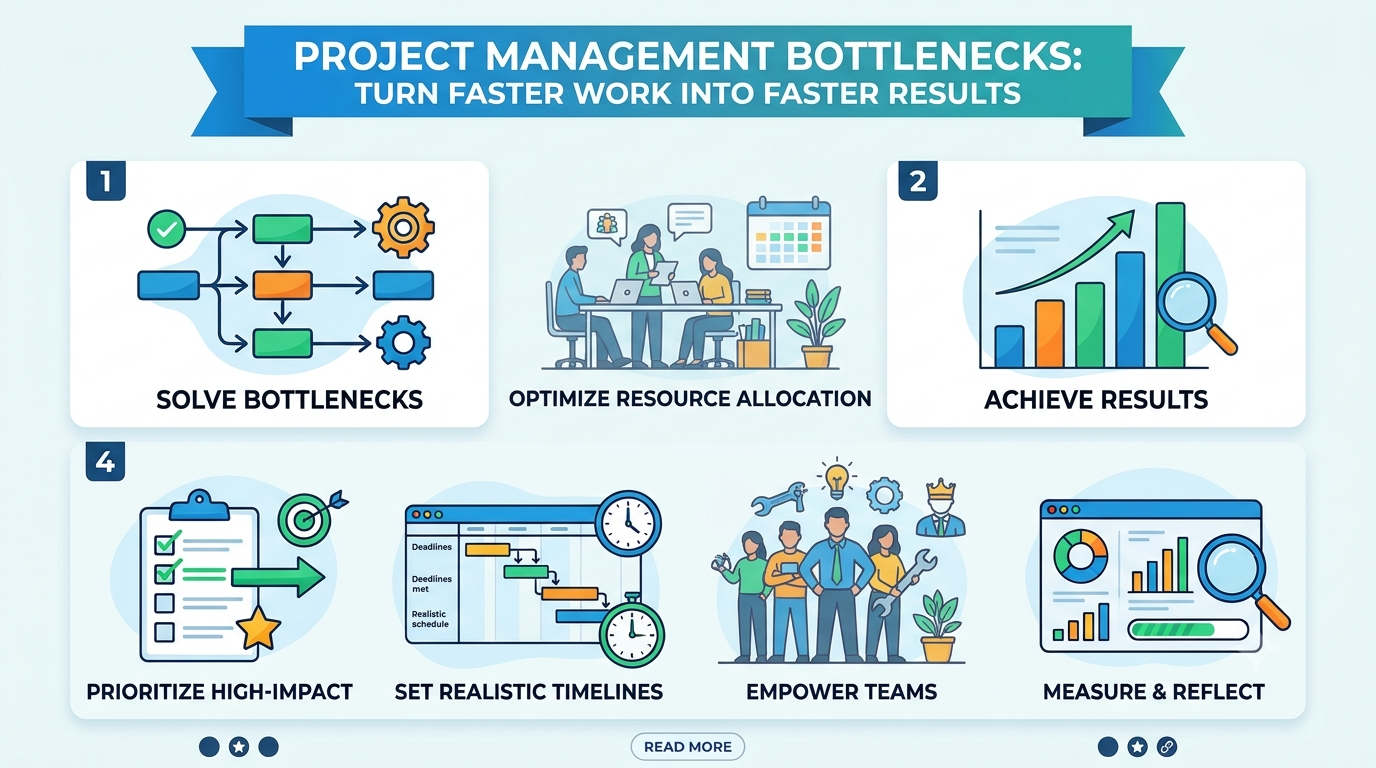
Addressing project management bottlenecks does not require an organisation to redesign every process at once. A focused approach can help businesses identify the most significant sources of delay and make improvements in a controlled manner.
A practical starting point is to select one important workflow, such as campaign approval, sales proposal development, procurement, or software release management.
A practical improvement framework –
Step 1: Map the current workflow. Document each stage, handover, approval, dependency, and responsible role. Include the time spent waiting between activities.
Step 2: Establish a baseline. Measure the current cycle time, approval turnaround, rework, and frequency of blocked tasks. Use actual observations rather than assumptions about where delays occur.
Step 3: Identify the primary bottleneck. Determine whether the largest delay comes from approvals, missing information, resource constraints, repeated revisions, or unclear ownership.
Step 4: Simplify the process. Remove redundant approvals, clarify responsibilities, standardise recurring work, and allow independent activities to proceed in parallel where appropriate.
Step 5: Apply technology selectively. Use AI, automation, and workflow platforms to address specific problems identified during the assessment.
Step 6: Measure the results. Compare performance against the baseline and check whether improvements in speed have affected quality, compliance, workload, or customer outcomes.
Step 7: Refine and expand. Address remaining obstacles and extend the improved approach to other workflows when the results justify it.
This approach helps organisations avoid automating inefficient processes or investing in tools without a clear business objective.
Conclusion –
Project management bottlenecks are not always caused by a lack of employee productivity or inadequate technology. In many organisations, the real challenge is the time work spends waiting for decisions, approvals, information, and coordination between teams.
AI and automation can accelerate individual tasks, but their value depends on the business processes surrounding them. If responsibilities remain unclear, approval chains remain unnecessarily complicated, and teams continue working through disconnected systems, faster execution will not necessarily produce faster delivery.
Businesses that want to improve project performance should focus on the complete workflow. They need to identify where work gets stuck, simplify unnecessary steps, establish clear decision rights, measure end-to-end outcomes, and introduce technology where it removes genuine friction.
Frequently Asked Questions
Project management bottlenecks are points in a workflow where work slows down or stops because of limited capacity, delayed decisions, excessive approvals, missing information, or dependencies between teams. They restrict the speed at which a project can progress, even when other activities are completed efficiently.
AI and automation can accelerate individual activities, but projects also depend on communication, decision-making, reviews, approvals, and coordination. If these processes remain inefficient, the time saved on task execution may be offset by delays elsewhere in the workflow.
Businesses can map the complete workflow, measure end-to-end cycle time, track waiting periods, review approval turnaround, and identify tasks that repeatedly become blocked. Analysing actual project data helps distinguish the primary causes of delay from symptoms such as missed deadlines.
AI can assist with research, content creation, document summarisation, data analysis, coding, and other tasks. When combined with well-designed workflows, automation can also support task routing, notifications, information transfer, and status tracking. Human oversight remains important for decisions requiring judgment, verification, or risk management.
Task productivity measures how efficiently an individual activity is completed. Project productivity considers how effectively the activities, people, and resources involved work together to deliver the final outcome. Improving task productivity does not necessarily improve project productivity if waiting time and dependencies remain unchanged.