Introduction
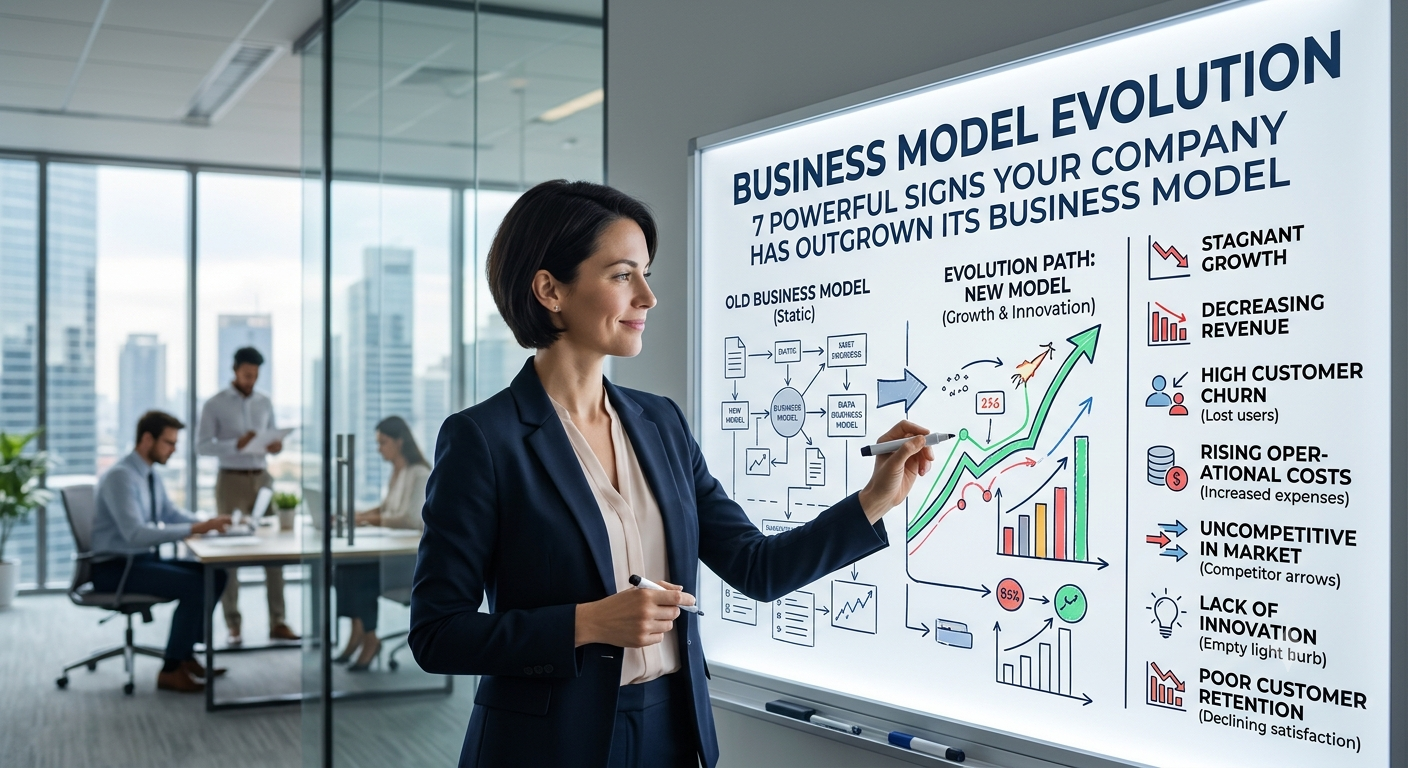
Business Model Evolution becomes essential when an organization reaches a stage where the strategies, processes, and operational structures responsible for its initial success can no longer support its future ambitions. Business growth is generally viewed as a positive achievement, driven by increasing revenue, expanding customer relationships, entering new markets, and building stronger teams. However, behind these achievements, businesses can face an unexpected challenge: the very business model that helped them succeed may eventually limit their ability to grow further.
Successful Business Model Evolution requires organizations to recognize when their traditional strategies are no longer aligned with changing market demands.
A company that once delivered exceptional customer experiences through personalized service may struggle to maintain the same quality as its customer base expands. Similarly, an organization built around affordable pricing may find it difficult to invest in innovation, advanced technology, or specialized services without reconsidering its commercial strategy. What worked effectively for a small, agile team may become inefficient when the organization operates across multiple departments, locations, and markets.
The real challenge is not simply increasing the size of a business. It is recognizing when its existing operating model, technology infrastructure, leadership approach, and customer strategy need to evolve. Companies that identify these changes early can prepare for sustainable growth, while those that continue relying on outdated practices may gradually lose their competitive advantage.
Organizational Structure Becomes a Barrier to Business Growth –
Business Model Evolution also involves redesigning organizational structures to support better collaboration, accountability, and operational scalability.
In the early stages of a business, decision-making is generally straightforward. Founders work closely with employees, communication happens directly, and responsibilities are relatively easy to understand. Small teams can respond quickly to customer requirements, experiment with new ideas, and adjust priorities without navigating multiple approval levels.
However, as an organization expands, this informal structure may become increasingly difficult to manage. New departments emerge, responsibilities overlap, communication becomes complicated, and senior leaders become involved in decisions that should be handled by individual teams.
Simply introducing additional management layers does not necessarily solve these problems. Organizations need to redesign their operating structures to support larger teams while maintaining accountability and operational flexibility.
Why Traditional Organizational Structures Stop Working –
Growing companies may experience several challenges:
- Slower decision-making: Multiple approval levels delay important business decisions.
- Unclear responsibilities: Overlapping roles create confusion between departments.
- Communication gaps: Information becomes difficult to share across larger teams.
- Reduced accountability: Employees may struggle to understand ownership of specific outcomes.
- Operational inefficiency: Processes designed for smaller teams become difficult to maintain.
For example, a technology company that initially managed customer projects through direct communication between developers and clients may eventually need dedicated project management, customer success, compliance, and quality assurance teams.
This transition requires more than hiring additional employees. It requires a scalable organizational model that defines responsibilities, improves collaboration, and supports consistent business performance.
Changing Customer Expectations Demand a New Business Approach –
Customer expectations frequently change as companies expand into new markets and serve different customer segments. A business that initially succeeds by serving small organizations may eventually attract larger enterprises with significantly different requirements.
Smaller customers may prioritize affordability, simplicity, and quick implementation. Enterprise customers, on the other hand, may expect customized solutions, advanced security, regulatory compliance, system integrations, and detailed performance reporting.
This creates a challenge for businesses that continue using the same products, pricing structures, and service delivery processes despite changing customer requirements.
An effective Business Model Evolution strategy ensures that products and services continue addressing the changing expectations of both existing and new customers.
Balancing Existing Customers with New Market Opportunities –
Business expansion should not come at the expense of existing customer relationships. Organizations need to understand how different customer segments define value and whether their current offerings can satisfy those expectations.
For example, a software company that initially provides a standard subscription product to small businesses may later receive requests from enterprise customers for:
- Custom integrations with existing enterprise systems.
- Advanced user access and administrative controls.
- Dedicated technical support and service agreements.
- Stronger data protection and compliance capabilities.
- Flexible pricing based on usage, users, or business requirements.
Meeting these expectations may require changes to product development, customer support, infrastructure, and commercial strategy.
The important consideration is that businesses should not automatically abandon their original customer segments when pursuing larger opportunities. Instead, they should evaluate whether different offerings or service models can address multiple customer needs without weakening the overall value proposition.
Continuous Business Model Evolution helps organizations maintain differentiation by adapting to emerging technologies, competitors, and customer requirements.
Outdated Technology Infrastructure Limits Operational Scalability –
Technology infrastructure plays a major role in determining how effectively a business can scale. Systems that work well for a small organization may become inefficient when the company expands its workforce, customer base, operational activities, and geographical presence.
For example, a business managing its internal reporting through spreadsheets and disconnected databases may initially operate without major difficulties. However, when multiple departments and locations begin generating large volumes of information, manual reporting can create delays, inconsistencies, and limited visibility.
Organizations sometimes respond by purchasing additional software and introducing automation without evaluating their underlying processes. This can create disconnected technology environments where employees must move between multiple platforms to complete routine activities.
Why Technology Modernization Matters –
A scalable technology environment should support business operations rather than introduce additional complexity.
Companies should evaluate whether their existing systems can support:
- System integration: Connecting business applications and enabling consistent information flow.
- Data management: Maintaining accurate, accessible, and reliable business information.
- Workflow automation: Reducing repetitive manual activities and improving process consistency.
- Operational visibility: Providing leadership with timely information for better decisions.
- Security and compliance: Supporting business requirements as infrastructure and operations expand.
The Role of Artificial Intelligence in Business Model Evolution –
Artificial intelligence creates opportunities for businesses to reconsider how work is performed and how value is delivered.
Rather than simply introducing AI tools into existing workflows, organizations should identify processes that could benefit from intelligent automation, improved data analysis, and faster decision-making.
For instance, an enterprise technology company could explore AI-assisted customer support, automated document processing, intelligent reporting, and predictive analysis.
However, successful adoption depends on suitable data infrastructure, integration capabilities, governance, and clearly defined business objectives.
The goal should not be to adopt technology because it is available. It should be to ensure that technology supports the organization’s next stage of growth.
Your Original Competitive Advantage Starts Losing Its Uniqueness –
Every successful business initially develops something that differentiates it from competitors. This may include affordable pricing, specialized expertise, faster service delivery, personalized customer experiences, or innovative products.
However, competitive advantages are rarely permanent.
As competitors observe successful business strategies, they may introduce similar products, adopt comparable technologies, and develop alternative customer experiences. Over time, what once made a company unique can become an ordinary market expectation.
This creates a challenge for established businesses because their existing revenue streams may continue performing well even as their long-term differentiation weakens.
Why Established Businesses Can Become Vulnerable –
Companies may gradually become too focused on maintaining their existing market position.
Common warning signs include:
- Continuing to invest in products without evaluating changing customer needs.
- Relying heavily on pricing strategies that competitors can easily replicate.
- Avoiding innovation because existing processes generate predictable revenue.
- Ignoring emerging competitors and alternative business models.
- Focusing on short-term performance instead of long-term differentiation.
For example, a company that originally gained customers through affordable software subscriptions may eventually face competitors offering more advanced automation, flexible integrations, and better user experiences.
Maintaining the original pricing advantage may no longer be sufficient.
Businesses need to continuously evaluate what makes their offerings valuable and identify new opportunities to strengthen their market position.
Competitive advantage should be treated as something that requires ongoing investment, not something established once and preserved indefinitely.
Leadership Mindsets Prevent Necessary Business Transformation –
Business transformation is not always limited by technology, financial resources, or market opportunities. Sometimes, the biggest obstacle is the leadership mindset.
Founders and senior executives often develop strong confidence in the strategies that helped establish their organizations. Their experience and decision-making abilities may have played a major role in achieving early success.
However, these strengths can become limitations when previous decisions are treated as permanent business principles.
Leaders may hesitate to change pricing structures, reconsider traditional processes, enter unfamiliar markets, or invest in new technologies because they believe existing methods are still effective.
This can create an organizational culture where employees avoid questioning established practices, even when they recognize operational problems.
How Leadership Can Support Business Model Evolution –
Successful transformation requires leaders to recognize that the conditions responsible for previous success may no longer exist.
Business leaders should:
- Encourage employees to challenge outdated processes and assumptions.
- Evaluate new business opportunities without relying exclusively on historical performance.
- Support technology investments that address clearly identified business requirements.
- Encourage collaboration between business, technology, and operational teams.
- Make strategic decisions based on changing customer and market expectations.
For example, a traditional service provider may have built its reputation through manual, personalized service delivery. As demand increases, leadership may need to explore automation and digital service channels while preserving the customer experience that originally differentiated the business.
The objective is not to reject the company’s history. It is to build on previous achievements while preparing the organization for future requirements.
Operational Complexity Increases Faster Than Business Efficiency –
Revenue growth does not automatically translate into operational efficiency.
As businesses expand, they often introduce new departments, locations, suppliers, products, and customer relationships. Each addition creates new operational requirements that must be coordinated effectively.
Without suitable processes, growing organizations can experience increasing administrative workloads, duplicated activities, inconsistent reporting, and unnecessary operational costs.
A company may generate more revenue while simultaneously becoming more difficult and expensive to manage.
Identifying Operational Bottlenecks –
Organizations should regularly examine whether their current processes remain appropriate for their scale.
Some common warning signs include:
- Employees repeatedly performing the same administrative tasks.
- Different departments maintaining separate versions of business information.
- Manual approvals delaying routine operational activities.
- Limited visibility into project progress and resource utilization.
- Increasing costs without corresponding improvements in productivity.
For example, an organization managing multiple client projects may initially rely on email communication and spreadsheets. As its project portfolio expands, it may need integrated project management, resource planning, financial reporting, and workflow management systems.
Introducing appropriate technology and standardized processes can improve operational visibility and reduce unnecessary complexity.
However, automation alone is not the solution. Businesses must first understand why existing processes are becoming inefficient and redesign them around their current operational requirements.
Innovation Becomes Difficult Within the Existing Business Model –
One of the most important signs that an organization has outgrown its business model is its declining ability to experiment and innovate.
Established businesses often prioritize activities that generate predictable revenue. This is understandable because maintaining existing customer relationships and delivering consistent services are essential to business stability.
However, excessive dependence on familiar products, processes, and customer segments can limit the organization’s ability to explore new opportunities.
Smaller competitors may experiment with alternative pricing models, emerging technologies, specialized services, or different customer experiences while established companies remain focused on protecting existing revenue streams.
Creating Space for Continuous Innovation –
Organizations do not necessarily need to replace their entire business models to encourage innovation.
Instead, they can introduce controlled experiments that allow teams to evaluate new ideas without disrupting existing operations.
For example:
- Test a new service offering with a limited customer group.
- Introduce an alternative pricing structure for a specific market segment.
- Automate selected workflows before implementing wider changes.
- Explore new technology partnerships to improve service delivery.
- Evaluate emerging customer requirements through pilot projects.
These initiatives allow businesses to understand what works before committing significant resources.
A successful innovation strategy should balance operational stability with the willingness to explore new approaches.
How Can Companies Successfully Evolve Their Business Models?
Recognizing the need for change is only the first step. Organizations must also develop a practical approach to business model transformation.
The most effective strategy is to treat business model evaluation as an ongoing management responsibility rather than something that happens only when revenue declines or competitors begin gaining market share.
Evaluate the Existing Business Model –
Start by examining the major components of the current business model, including customer segments, pricing, products, service delivery, technology, and organizational structure.
Identify which activities continue creating value and which are becoming inefficient or difficult to scale.
Understand Changing Customer Requirements –
Gather feedback from existing customers, sales teams, customer support departments, and business development teams.
Look for changing expectations related to service quality, technology integration, pricing, security, and delivery.
Review Technology and Infrastructure –
Evaluate whether existing platforms, applications, databases, and workflows can support future business requirements.
Prioritize integration, scalability, automation, data quality, and security rather than purchasing additional tools without a clear strategy.
Introduce Controlled Business Experiments –
Test new products, services, pricing models, and operational approaches on a smaller scale.
This helps organizations understand potential benefits, identify implementation challenges, and reduce the risks associated with large-scale transformation.
Align Leadership and Employees –
Business model evolution requires cooperation across departments.
Leadership should communicate why changes are necessary, define clear responsibilities, and encourage employees to participate in identifying opportunities for improvement.
Measure the Impact of Transformation –
Establish appropriate performance indicators to understand whether the new operating model is delivering the expected results.
Depending on the business, these may include:
- Customer retention and satisfaction.
- Operational costs and process efficiency.
- Revenue contribution from new offerings.
- Employee productivity and resource utilization.
- Technology adoption and system performance.
- Time required to deliver products or services.
Most importantly, organizations should avoid changing everything simply because growth has created new challenges. The objective is to preserve the elements that continue delivering value while redesigning the areas that restrict future progress.
Conclusion –
Business Model Evolution is not simply about changing how a company generates revenue. It involves reconsidering the organizational structures, customer strategies, technology infrastructure, leadership practices, and operational processes that support long-term success.
As businesses grow, the conditions that made them successful can gradually change. Customer expectations become more sophisticated, competitors introduce new approaches, technology creates different opportunities, and operational requirements become increasingly complex. Organizations that continue relying entirely on their original strategies may find themselves struggling to support the next stage of growth.
The most successful businesses understand that growth requires continuous adaptation. They regularly evaluate their existing models, recognize emerging limitations, experiment with new opportunities, and invest in the capabilities needed to remain competitive.
Frequently Asked Questions
It means the company’s existing strategies, processes, organizational structure, or revenue model can no longer effectively support its current size, customer requirements, or future growth ambitions. The business may need to redesign certain aspects of how it operates to remain competitive.
Common signs include slower decision-making, increasing operational costs, outdated technology, changing customer expectations, declining competitive differentiation, and difficulty introducing new products or services.
Business model evolution helps organizations adapt to changing market conditions, improve operational efficiency, meet new customer requirements, and identify additional growth opportunities. It also helps prevent outdated processes from becoming long-term barriers to business performance.
Technology enables businesses to improve operational efficiency, automate repetitive activities, integrate systems, manage data more effectively, and deliver better customer experiences. Modern technologies, including artificial intelligence, can also create opportunities to redesign existing business processes.
Leadership determines how effectively an organization recognizes the need for change and implements transformation. Business leaders must encourage innovation, question outdated assumptions, support technology investments, and align employees around long-term strategic objectives.