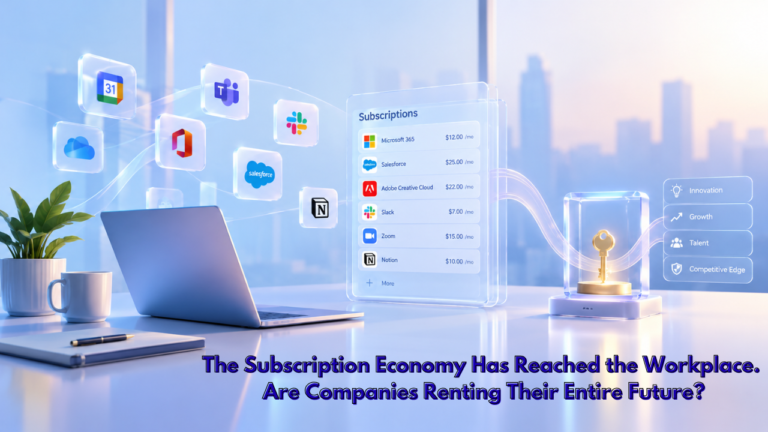
Self-Service Business Models are changing how businesses deliver value, compete for customers, and build long-term commercial relationships. For decades, companies have relied on customers paying for expertise, services, and capabilities they could not easily access or develop internally. Organizations hired marketing agencies to manage campaigns, consultants to solve complex business problems, software developers to build applications, and external specialists to handle operational activities. The value of service providers was closely connected to the complexity of their work and the difficulty customers faced in performing those activities independently. The growing adoption of Self-Service Business Models is reshaping how B2B organizations approach customer relationships, service delivery, and long-term business growth.
However, artificial intelligence (AI), automation, accessible software, and digital platforms are changing this traditional relationship. Customers who once depended on external providers are discovering that they can perform many activities internally using readily available technology. Small businesses can generate marketing content without hiring large agencies, sales teams can automate prospecting workflows, and organizations can develop internal applications using low-code and no-code platforms. Customers are no longer simply purchasing solutions from businesses; they are increasingly capable of creating those solutions themselves. The evolution of Self-Service Business Models is also changing how businesses evaluate outsourcing decisions, technology investments, and the role of external service providers.
This transformation presents an important challenge for B2B organizations. As customers gain access to tools and capabilities that were previously available mainly through specialized service providers, traditional business models face increasing pressure. Companies must reconsider what customers are actually paying for, which services remain valuable, and how they can differentiate themselves in an environment where execution is becoming easier and more affordable. The rise of Self-Service Business Models is not necessarily eliminating external service providers, but it is changing what customers expect from them.
1. Understanding the Rise of Self-Service Business Models
The traditional service economy was built around a relatively straightforward relationship: businesses provided expertise, infrastructure, and execution, while customers paid for access to those capabilities. Unlike traditional service delivery approaches, Self-Service Business Models give customers more flexibility to manage business activities using technology without depending entirely on external specialists.
This arrangement worked because developing specialized skills and maintaining the resources required to perform complex activities internally could be expensive and time-consuming.
Today, technology is reducing these barriers. Cloud platforms, AI-powered applications, automation tools, and subscription-based software are allowing organizations to perform activities that previously required dedicated teams or external specialists. This shift is creating new Self-Service Business Models in which customers have greater control over how they access, manage, and execute business processes. Modern Self-Service Business Models empower organizations to manage previously outsourced activities through accessible digital platforms, AI-powered applications, and automation tools. The growing adoption of Self-Service Business Models is encouraging B2B organizations to rethink service delivery, customer engagement, and the economics of outsourcing.
For example, a small organization can now build a professional website using a website builder, generate marketing content through AI tools, automate customer communication, and monitor business performance through analytics dashboards. These capabilities do not necessarily require a large internal technology department or an external agency.

What Is Driving This Transformation?
Several technological and commercial developments are accelerating the adoption of Self-Service Business Models:
- Artificial intelligence: AI applications help employees generate content, analyse information, summarize documents, and automate routine activities.
- Low-code and no-code platforms: These tools allow non-technical employees to build applications, workflows, and internal solutions with limited programming knowledge.
- Cloud-based software: Subscription platforms provide businesses with access to sophisticated capabilities without requiring extensive infrastructure investments.
- Workflow automation: Organizations can automate repetitive processes across marketing, sales, finance, customer support, and operations.
- Accessible business intelligence: Modern analytics platforms make it easier for teams to interpret business information and generate reports independently.
- These developments are accelerating Self-Service Business Models across industries by making advanced business capabilities more accessible to organizations of different sizes.
The important development is not that every customer has suddenly become an expert. Rather, technology is reducing the distance between having an idea and being able to execute it. As these capabilities become more accessible, customers increasingly expect greater independence, flexibility, and control.
2. Why Self-Service Business Models Matter for B2B Companies
The shift toward customer independence has particularly important implications for B2B organizations because many business services are built around activities that customers are now attempting to internalize. For B2B companies, Self-Service Business Models represent a major shift in how customers evaluate external expertise, operational services, and technology investments.
Marketing departments are experimenting with AI-generated campaigns, sales teams are developing automated outreach workflows, HR departments are adopting intelligent recruitment platforms, and finance teams are using software to simplify reporting and analysis.
These developments can reduce dependence on external providers, especially when the required activities involve repetitive processes, standardized outputs, or easily accessible information.
For service providers, the challenge is that customers may begin comparing outsourced services with the capabilities they can develop using their existing employees and technology. Businesses that understand Self-Service Business Models can identify which services customers prefer to manage internally and where external expertise continues to deliver significant value.
Business Functions Experiencing the Self-Service Shift
Some of the most visible changes are taking place across the following business functions:
- Marketing: Internal teams can generate blog content, social media posts, email campaigns, and basic promotional materials using AI-powered platforms.
- Sales: Sales professionals can automate prospect research, lead enrichment, outreach sequences, and CRM activities.
- Human resources: HR departments can use recruitment platforms to manage candidate screening, interview scheduling, and employee communication.
- IT operations: Internal teams can use cloud management platforms, automation tools, and low-code solutions to manage certain technical requirements.
- Finance: Businesses can simplify expense tracking, reporting, budgeting, and financial analysis through accessible software.
For example, a B2B company that previously outsourced all its marketing content production may now have an internal marketing employee using AI to generate initial drafts, create campaign variations, and prepare social media content.
The company may still require an external agency, but its expectations will change. Instead of paying primarily for content production, it may prioritize campaign strategy, audience research, creative direction, performance optimization, and measurable business outcomes.
This is where Self-Service Business Models begin changing the competitive relationship between suppliers and customers.
3. How AI and Automation Are Changing Customer Expectations
AI and automation are among the most important technologies accelerating Self-Service Business Models. They are making specialized capabilities more accessible while allowing employees to perform tasks that previously required dedicated technical or operational teams. AI-powered Self-Service Business Models are making it easier for organizations to access capabilities that previously required specialized employees, expensive infrastructure, or external technology partners.
However, the real impact extends beyond reducing the time required to complete individual activities. These technologies are changing customer expectations around pricing, service delivery, response times, and business value.
Customers increasingly expect technology-enabled service providers to deliver faster results, greater transparency, and solutions that integrate with their existing operations.
From Outsourced Execution to Internal Capabilities
One of the defining characteristics of modern Self-Service Business Models is the ability to combine human expertise with intelligent automation to improve operational efficiency.
Consider a company that needs to generate a regular volume of marketing content.
Traditionally, the organization might hire an external content agency to research topics, write articles, prepare social media posts, and manage publishing schedules.
With modern AI tools, the internal marketing team can now manage several initial production activities independently. Employees can generate topic ideas, create content outlines, prepare first drafts, and develop variations for different communication channels.
This changes the responsibilities of the external agency.
Rather than competing on the volume of content produced, the agency must demonstrate value through capabilities such as:
- Developing a comprehensive content strategy.
- Conducting industry and competitor research.
- Improving content quality and brand consistency.
- Building effective SEO strategies.
- Measuring campaign performance.
- Connecting content activities with business objectives.
The same transformation is visible in sales, HR, IT, and customer operations.
Why Customers Are Becoming More Selective
As Self-Service Business Models become more accessible, customers are evaluating external services differently.
They increasingly ask whether an outsourced activity is worth its cost when an internal employee can perform a similar task using existing software.
This creates several changes in purchasing behaviour:
- Customers compare outsourcing costs with internal technology investments.
- Procurement teams examine whether service activities can be standardized or automated.
- Business leaders prioritize measurable outcomes over the number of activities delivered.
- Internal departments expect external providers to offer specialized expertise rather than basic execution.
- Customers seek greater visibility and control over outsourced processes.
For B2B service providers, understanding these expectations is essential. Businesses that continue selling activities without demonstrating their broader commercial value may find it increasingly difficult to maintain customer loyalty and premium pricing.
4. The Hidden Challenge: Customers Can Replace Parts of Your Service
One of the biggest challenges created by Self-Service Business Models is the gradual commoditization of traditional services. As Self-Service Business Models become more accessible, traditional service providers must evaluate whether their existing offerings provide enough differentiation to justify continued outsourcing.
When customers discover that they can perform certain activities internally, they begin evaluating whether external providers are delivering enough additional value to justify their fees.
Even when an internal solution is not as sophisticated as a professional service, the perceived financial advantage may influence purchasing decisions.
This can create pricing pressure for businesses that depend heavily on standardized execution.
Understanding Which Services Are Becoming Commoditized
Not every service is equally vulnerable to customer self-service. Activities that are repetitive, predictable, and supported by accessible software are generally easier to internalize.
For example:
| Business activity | Traditional approach | Emerging self-service capability |
|---|---|---|
| Content creation | External content agency | AI-assisted internal content production |
| Lead generation | Outsourced prospecting | Automated prospect research and outreach |
| Website development | External development team | Website builders and no-code platforms |
| Data reporting | External analysts | Self-service analytics dashboards |
| Customer support | Dedicated support provider | AI chatbots and automated responses |
| Recruitment administration | External recruitment support | Automated applicant tracking systems |
This does not mean that external providers will disappear from these industries. It means that customers may no longer consider basic execution sufficient justification for a long-term commercial relationship.
The Risk of Competing Only on Price
When customers can perform part of a service internally, providers may respond by reducing prices to remain competitive.
However, continuous price reductions can create a difficult business situation:
- Customers begin questioning the cost of outsourced activities.
- Service providers reduce prices to retain existing accounts.
- Profit margins become increasingly difficult to maintain.
- Customers continue expecting better performance and additional services.
- Providers struggle to invest in innovation and specialized capabilities.
The solution is not necessarily to offer the same service at a lower price. Businesses need to identify which capabilities remain difficult for customers to reproduce and build their value propositions around those strengths.
5. Seven Strategies for Businesses to Stay Competitive
The rise of Self-Service Business Models does not mean that traditional service providers must abandon their existing business models. Instead, they need to evolve from performing individual tasks to delivering capabilities that create meaningful advantages for customers. Companies that adapt their Self-Service Business Models can create stronger customer relationships while developing new revenue opportunities and differentiated service offerings.
The following strategies can help B2B organizations remain relevant as customers become more technologically capable.
1. Move from Selling Activities to Delivering Outcomes
One of the most important changes is shifting the conversation from what a company does to what it helps customers achieve.
For example, a marketing agency should not position itself only as a provider of blog writing, email marketing, or social media management. It should demonstrate how its expertise supports lead generation, brand visibility, customer engagement, and business growth.
Similarly, an IT service provider should focus on operational reliability, security, system performance, and business continuity rather than simply selling technical support hours.
Customers may be able to perform individual activities independently, but achieving consistent business outcomes requires coordination, expertise, and accountability.
2. Develop Expertise That Customers Cannot Easily Replicate
Technology can make information and execution more accessible, but specialized knowledge and practical experience remain important differentiators.
Businesses should invest in developing expertise that helps customers make better decisions and solve complex problems.
This may include:
- Deep industry knowledge and regulatory understanding.
- Advanced technical architecture and integration capabilities.
- Specialized market and customer research.
- Complex problem-solving and strategic consulting.
- Experience managing large-scale enterprise projects.
The objective is to become a trusted source of expertise rather than another provider of easily replaceable services.
3. Build Technology-Enabled Service Offerings
Instead of treating AI and automation only as competitive threats, service providers should incorporate these technologies into their own offerings.
For example, a B2B marketing agency could combine strategic consulting with AI-assisted research, campaign automation, analytics, and performance reporting.
An IT consulting company could provide cloud infrastructure management alongside automated monitoring, security assessments, and predictive maintenance capabilities.
This approach allows businesses to improve efficiency while offering customers a more comprehensive service experience.
4. Introduce Hybrid Self-Service and Managed-Service Models
Not every customer wants to outsource every activity. Many organizations prefer to manage routine operations internally while relying on specialists for complex requirements.
Hybrid models can accommodate these preferences.
For example, a software company might provide customers with a self-service dashboard for routine account management while offering expert assistance for integrations, implementation, and advanced troubleshooting.
A marketing service provider could allow customers to manage content approvals and basic publishing while retaining responsibility for strategy, optimization, and performance analysis.
This approach gives customers greater control without eliminating the value of external expertise.
5. Focus on Data, Insights, and Strategic Decision-Making
Customers may have access to analytics platforms, but access to data does not automatically translate into better business decisions.
Businesses that can interpret complex information and translate it into actionable recommendations can create significant value.
For example, a sales technology provider may offer more than automated prospecting. It can help customers understand which customer segments offer the strongest opportunities, which outreach activities generate meaningful engagement, and where sales processes need improvement.
The value comes from connecting information with decisions and measurable business objectives.
6. Strengthen Customer Relationships Through Continuous Value
Traditional service relationships sometimes revolve around contracts, deliverables, and periodic project reviews.
However, Self-Service Business Models require providers to demonstrate value continuously.
Businesses should focus on becoming long-term partners who understand customer objectives and proactively identify opportunities for improvement.
Practical approaches include:
- Regular performance reviews and strategic discussions.
- Proactive recommendations based on customer data.
- Continuous service optimization.
- Knowledge sharing and employee training.
- Transparent reporting on business outcomes.
When customers recognize that a provider consistently contributes to their success, the relationship becomes more difficult to replace.
7. Use Customer Self-Service Behaviour to Identify New Opportunities
Customer independence can also provide valuable insights into unmet market needs.
If customers repeatedly attempt to perform certain activities themselves, businesses should investigate why those activities matter and what difficulties customers experience.
For example, if customers are building internal reporting workflows using multiple disconnected tools, a service provider may identify an opportunity to develop an integrated reporting platform.
Similarly, customers experimenting with AI-generated content may need specialized training, brand governance, content quality assurance, or enterprise AI implementation support.
Instead of viewing customer self-service as lost revenue, businesses can use it to identify new products, services, and revenue opportunities.
6. Turning Customer Independence into a Business Opportunity
The transition toward Self-Service Business Models creates opportunities for companies that are willing to rethink their commercial relationships.
Rather than trying to prevent customers from developing internal capabilities, service providers can help them become more effective.
This requires a different approach to product development, service delivery, and customer engagement.
Create Solutions That Complement Internal Teams
Businesses can develop offerings that work alongside customer capabilities rather than replacing them entirely.
For example:
- A software provider can offer advanced integrations and workflow customization.
- A consulting company can provide strategic guidance alongside customer-managed implementation.
- An IT service provider can manage complex infrastructure while customers handle routine administration.
- A marketing agency can offer specialized campaign strategy while customers manage basic content production.
- A data analytics company can provide advanced insights while customers use self-service dashboards for everyday reporting.
These approaches create a collaborative relationship in which both parties contribute different capabilities.
Develop Training, Advisory, and Implementation Services
As organizations adopt more technology, they also need help using it effectively.
A company may purchase an AI platform without understanding how to integrate it into existing processes. Another organization may adopt automation software without establishing appropriate governance, security, or monitoring procedures.
This creates demand for services that support successful technology adoption.
Businesses can expand their offerings through:
- Enterprise technology implementation.
- AI adoption and workflow consulting.
- Employee training and enablement.
- Digital transformation advisory.
- Security and governance assessments.
- Process redesign and optimization.
These services help customers make better use of their internal capabilities while maintaining a valuable role for external specialists.
7. The Future of B2B Services: Expertise Over Execution
The future of B2B services will increasingly depend on how businesses combine technology, specialized knowledge, and customer collaboration.
As Self-Service Business Models continue to evolve, routine execution will become less effective as a standalone competitive advantage. Customers will expect service providers to deliver capabilities that go beyond what readily available tools and internal employees can accomplish.
This does not mean execution will lose its importance. Reliable delivery will remain essential. However, customers will increasingly evaluate providers based on how effectively they connect execution with strategy, business outcomes, and long-term improvement.
Organizations that understand this shift can develop more sustainable business models.
What Will Differentiate Successful Service Providers?
Several capabilities are likely to remain central to competitive differentiation:
- Strategic expertise: Understanding customer challenges and identifying the right solutions.
- Technology integration: Connecting different systems, platforms, and workflows into effective business environments.
- Accountability: Taking responsibility for service quality, implementation, and measurable outcomes.
- Specialized knowledge: Applying industry experience that customers may not possess internally.
- Continuous innovation: Improving services as customer expectations and technologies evolve.
- Business alignment: Ensuring that technology investments support broader organizational objectives.
The strongest service providers will not necessarily be those that perform the highest volume of tasks. They will be those that help customers achieve results more efficiently, reliably, and consistently.
Self-Service Business Models – AI, automation, and customers becoming competitors
Conclusion
The rise of Self-Service Business Models is changing the traditional relationship between businesses and their customers. As AI, automation, and accessible digital platforms make business capabilities easier to develop internally, customers are becoming less dependent on external providers for routine activities. Ultimately, Self-Service Business Models will reward businesses that combine technological innovation, specialized expertise, and measurable customer value.
For B2B organizations, this transformation creates both challenges and opportunities. Companies that rely entirely on customers lacking the ability to perform certain tasks may experience increasing pricing pressure, reduced demand, and greater competition from internal teams. However, businesses that invest in specialized expertise, strategic guidance, technology integration, and measurable outcomes can strengthen their market position.
The objective should not be to compete against customers as they become more capable. Instead, businesses should evolve alongside them by offering capabilities that complement internal resources and solve more complex problems.
Ultimately, the future of Self-Service Business Models will be shaped by companies that understand an important distinction: customers may increasingly be able to perform the work themselves, but they will continue to value partners who help them achieve better results. The strongest businesses will be those that move beyond selling tasks and become essential contributors to customer success.
Self-Service Business Models – B2B digital transformation, AI automation, and the future of customer independence
Frequently Asked Questions
1. What are Self-Service Business Models?
Self-Service Business Models allow customers to access tools, platforms, and resources to perform activities independently rather than relying entirely on external service providers. Examples include website builders, AI content generation platforms, automated CRM systems, and self-service analytics tools.
2. Why are Self-Service Business Models becoming popular?
They are becoming popular because AI, automation, cloud computing, and accessible software are reducing the cost and complexity of performing business activities. Organizations can now manage many routine operations internally with fewer specialized resources.
3. How is AI changing traditional B2B service providers?
AI is automating several activities traditionally handled by external providers, including content creation, data analysis, customer communication, and prospect research. As a result, B2B service providers must increasingly focus on strategy, specialized expertise, integration, and measurable outcomes.
4. Are self-service business models a threat to service-based companies?
They can create challenges for companies that depend on repetitive or easily automated services. However, they also create opportunities for businesses to introduce new technology solutions, advisory services, managed services, and specialized consulting offerings.
5. How can B2B companies remain competitive as customers become more independent?
B2B companies can remain competitive by focusing on business outcomes, developing specialized expertise, adopting AI-powered technologies, offering hybrid service models, and building stronger customer relationships.
6. Which industries are most affected by customer self-service?
Marketing, sales, IT, HR, finance, customer support, and software development are among the areas experiencing significant changes. In these functions, automation and accessible digital platforms allow organizations to internalize activities previously handled by external providers.
7. What is the difference between self-service and managed services?
Self-service allows customers to manage activities independently using available tools and platforms. Managed services involve an external provider taking responsibility for specific operations, technical activities, or ongoing business processes. Hybrid models combine both approaches.
8. Can self-service business models create new revenue opportunities?
Yes. Businesses can generate new revenue through technology platforms, implementation services, employee training, strategic consulting, advanced analytics, and specialized integrations. Customer self-service behaviour can also reveal unmet needs that lead to new products and services.