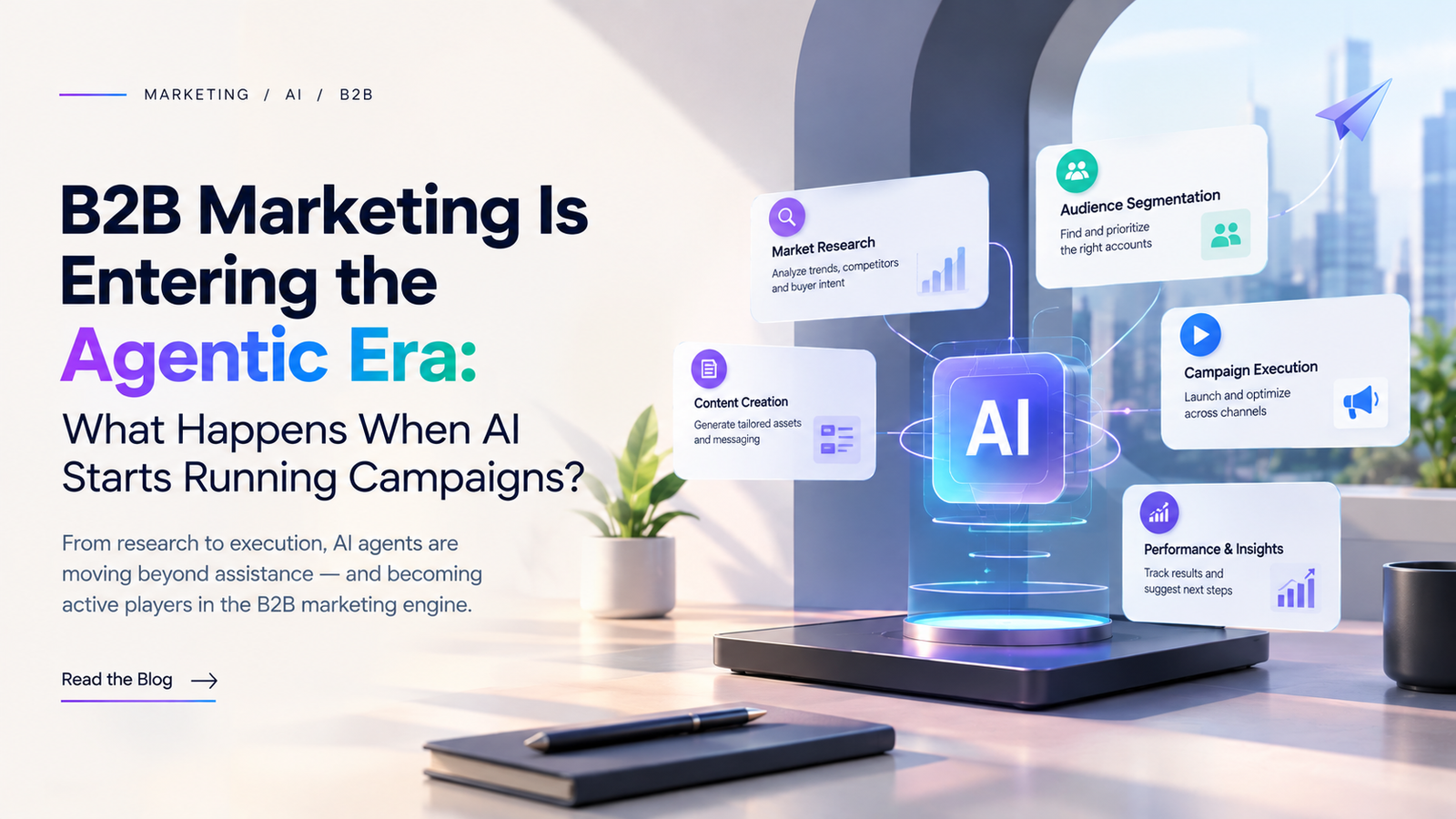
B2B marketing has already experienced several major waves of automation. Marketing automation platforms transformed email campaigns, CRM systems changed lead management, analytics improved reporting, and generative AI accelerated content production. But AI agents in B2B marketing introduce a potentially different model: instead of simply helping marketers complete individual tasks, AI systems can increasingly participate in broader marketing workflows.
This shift moves beyond asking AI to write an email, summarize research, or generate a social post. Agentic AI can potentially research markets, analyze customer signals, identify audiences, generate campaign variations, monitor performance, recommend changes, and interact with connected business systems. Google Cloud’s 2026 AI research describes the broader movement from chatbots toward agents capable of executing complex workflows, while enterprise activity is increasingly extending into marketing functions.
For B2B organizations, the important question is therefore not simply whether AI can produce marketing content faster. The bigger question is what happens when AI agents in B2B marketing become part of the operating layer behind research, creation, execution, measurement, and optimization.
AI Agents in B2B Marketing Are Changing Campaign Execution –
Traditional campaign execution has generally been human-led. A marketing team identifies an opportunity, defines its audience, develops positioning, creates campaign assets, launches the campaign, monitors results, and determines what should change.
AI can accelerate many of these activities. But agentic AI introduces the possibility of connecting them into a broader workflow.
Instead of treating every marketing task as an isolated activity, an AI agent could potentially work across connected systems and information sources to support a larger objective.
For example, a B2B marketing agent could help:
- Research emerging customer concerns
- Analyze existing campaign performance
- Identify potential content gaps
- Recommend campaign themes
- Generate initial campaign assets
- Monitor engagement signals
- Suggest campaign adjustments
- Connect insights across marketing systems
This represents an important evolution from AI-generated content to AI-assisted marketing operations.
The distinction matters because producing an individual asset and managing an interconnected campaign are fundamentally different activities. Agentic AI focuses on the workflow surrounding the asset, not simply the asset itself.
The Competitive Advantage Is Moving From Content Volume to Context –
Generative AI has made content production faster. That creates an obvious challenge for B2B marketers: if many organizations can produce polished content quickly, content volume becomes less meaningful as a competitive advantage.
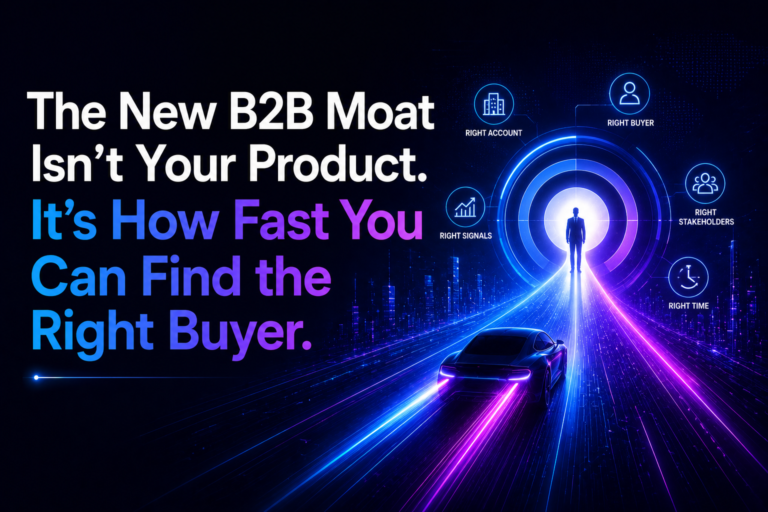
The differentiator increasingly becomes understanding.
A B2B marketing organization needs to understand:
- Who the buyer is
- What problem the buyer is experiencing
- What information influences the purchasing decision
- Which signals indicate genuine intent
- Which messages are relevant to the buyer
- What makes the company’s perspective credible
This is where agentic AI in marketing becomes particularly dependent on context.
An AI agent can generate marketing material quickly without understanding the business deeply. The result may be technically polished but strategically generic.
By contrast, an AI system working with relevant customer information, business objectives, product knowledge, market context, and strategic constraints has a stronger foundation for producing useful outputs.
The more accessible AI-generated content becomes, the more valuable proprietary knowledge and customer understanding become.
AI Agents Can Turn Marketing Into a Continuous Feedback Loop –
One of the most significant opportunities associated with AI agents in B2B marketing is the ability to accelerate experimentation.
Traditional campaigns often operate as defined projects. Teams spend significant time developing the campaign, launching it, collecting results, and reviewing performance.
Agentic workflows could make this process more continuous.
An AI agent could potentially help marketing teams:
- Test different messaging variations
- Analyze campaign performance
- Identify underperforming segments
- Surface emerging customer signals
- Recommend changes
- Adapt campaign assets
- Monitor results over time
This does not mean every marketing decision should be automated.
Instead, AI can potentially reduce the operational effort required to observe, test, and refine marketing activities.
That creates a different model of campaign management: rather than treating a campaign as something that is launched once and reviewed later, teams can increasingly think about campaigns as systems that continuously learn from new information.
AI Personalization Is Becoming More Contextual –
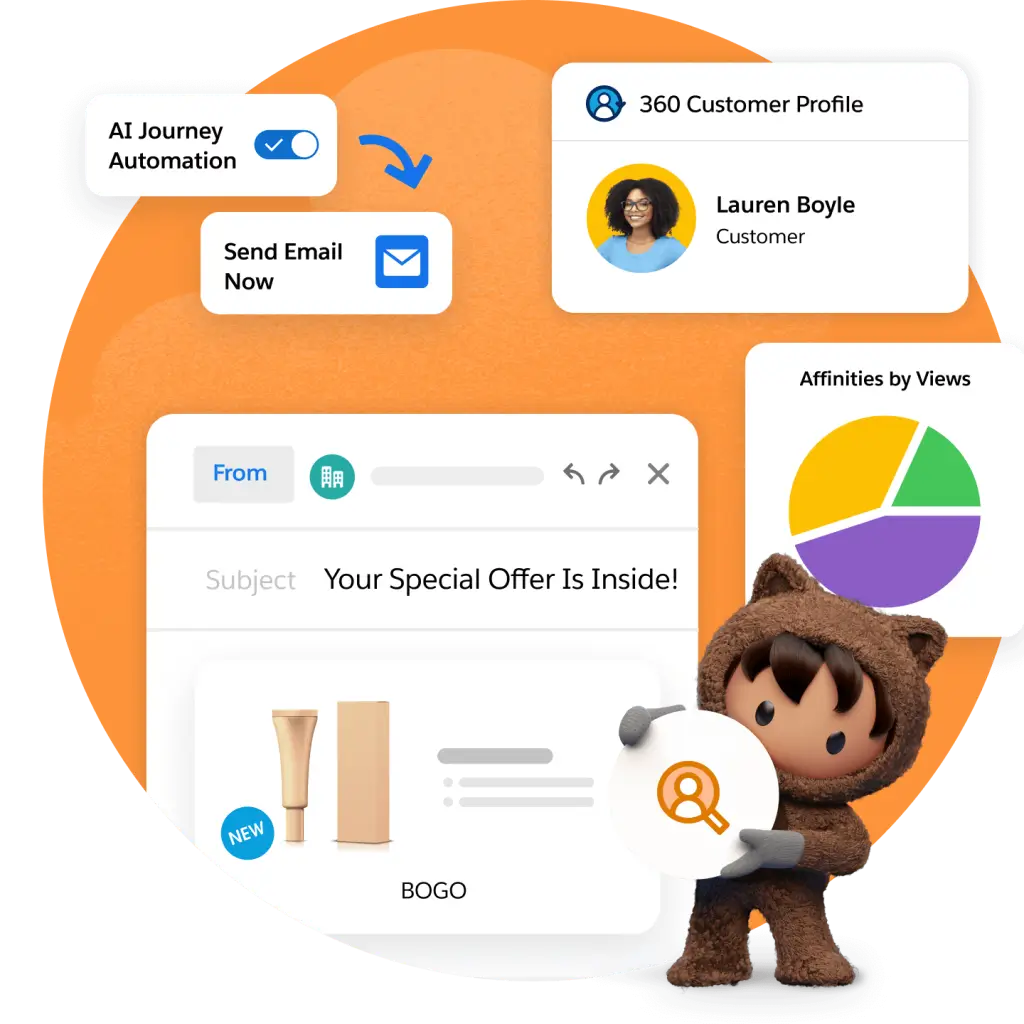
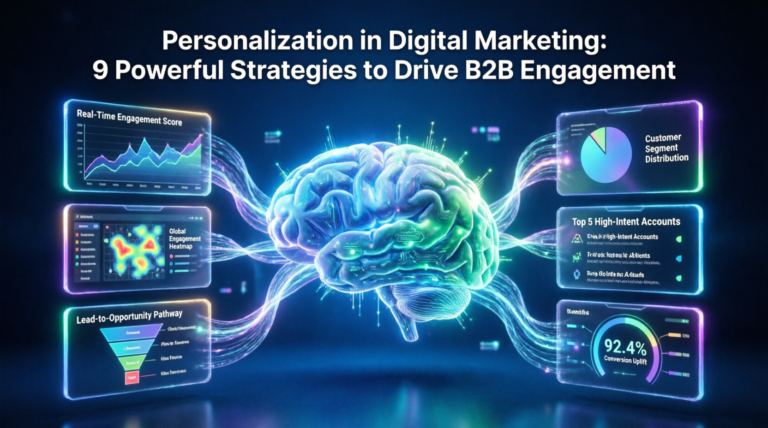
AI personalization is moving beyond basic recommendations based on past behavior. Today, AI can understand real-time context, intent, preferences, and user behavior to deliver more relevant experiences.
Instead of simply asking, “What does this user like?”, AI is learning to ask, “What does this user need right now?” This shift is making digital experiences more adaptive, timely, and personalized.
B2B personalization has traditionally included relatively simple techniques such as adding a prospect’s company name to an email or referencing a recent company announcement.
Agentic AI could potentially support deeper personalization by combining multiple business signals.
Consider a technology company evaluating a cybersecurity platform. Its needs may differ significantly depending on whether it is:
- Expanding into new markets
- Hiring security professionals
- Migrating infrastructure
- Responding to compliance requirements
- Addressing a recent security incident
The marketing message that makes sense for one situation may not be appropriate for another.
AI agents could potentially help marketers connect these signals and adapt messaging to the buyer’s context.
However, personalization also introduces an important boundary: useful relevance versus excessive data use.
A company wants customers to feel understood, not monitored. B2B organizations therefore need to consider how customer data is collected, interpreted, and applied when developing AI-powered personalization.
Human Oversight Still Matters in Agentic Marketing –
The rise of AI marketing automation does not eliminate the need for human judgment.
Marketing affects brand perception, customer trust, positioning, reputation, and commercial outcomes. These areas require more than optimization based on available data.
An AI system might identify a trend. A marketer still needs to determine whether that trend aligns with the brand.
An AI agent might generate a campaign. A human may need to evaluate whether the message is:
- Factually defensible
- Strategically relevant
- Appropriate for the audience
- Consistent with the brand
- Legally and commercially acceptable
There is also a difference between engagement and business value.
An AI system could optimize for clicks, impressions, or interactions. Those metrics do not necessarily indicate that a campaign is reaching the right buyers or contributing to meaningful business outcomes.
B2B organizations therefore need to connect AI optimization with the metrics that actually matter to their business.
The Marketer’s Role Is Evolving Toward Context Architecture –
As AI becomes more capable of executing marketing tasks, the marketer’s role can shift from producing individual assets toward designing the systems that guide those assets.
This makes internal knowledge increasingly important.
Marketers may need to provide AI systems with:
- Customer knowledge
- Product information
- Business objectives
- Brand positioning
- Market context
- Strategic constraints
- Campaign history
- Relevant performance information
This creates a new way of thinking about the marketer’s role: context architect.
An AI agent without meaningful context can produce generic marketing at remarkable speed.
An AI agent operating within a well-structured knowledge environment can potentially produce work that is more relevant to a specific audience, business objective, and customer situation.
The competitive advantage therefore shifts away from simply having access to AI and toward knowing how to give AI the context required to perform useful work.
What B2B Organizations Should Automate—and What They Shouldn’t –
The arrival of agentic AI does not mean every marketing activity should be handed to an autonomous system.
The more practical question is which activities benefit from AI assistance and where human involvement remains important.
Areas where AI assistance can be valuable –
Organizations can consider AI for activities such as:
- Market and customer research
- Data organization and analysis
- Content adaptation
- Campaign monitoring
- Performance analysis
- Repetitive campaign execution
- Identifying potential content opportunities
- Generating campaign variations
Areas requiring stronger human involvement –
Human judgment remains particularly important for:
- Brand strategy
- Positioning
- Customer empathy
- High-stakes decisions
- Ethical judgment
- Strategic prioritization
- Reputation-sensitive communications
The goal should not necessarily be maximum automation.
The goal is to create a marketing operating model where AI handles appropriate execution and analysis while marketers retain control over decisions that require context, judgment, and accountability.
What the Agentic Era Means for B2B Marketing Leaders –
The transition toward AI agents in B2B marketing changes the strategic question facing marketing leaders.
The question is no longer simply:
“How can we use AI to create more marketing content?”
It becomes:
“How should we redesign our marketing workflows when AI can participate in research, creation, execution, measurement, and optimization?”
That question requires organizations to look beyond individual AI tools.
Marketing leaders need to consider how AI connects with existing systems, how business knowledge is made available to AI, where human oversight belongs, and which outcomes should determine whether an AI initiative is successful.
The organizations that benefit from agentic marketing will not necessarily be the ones that automate the most.
They will be the organizations that understand where AI creates leverage, where context matters, and where human judgment remains essential.
Conclusion –
AI agents in B2B marketing represent a shift from AI as a creative assistant toward AI as a participant in marketing operations.
The opportunity extends beyond producing content faster. AI agents can potentially help organizations connect research, campaign development, execution, measurement, and optimization into more continuous workflows.
But greater automation does not automatically produce better marketing.
As AI makes content easier to create, differentiation increasingly depends on proprietary knowledge, customer understanding, business context, strategic judgment, and the ability to turn customer signals into meaningful experiences.
The future of B2B marketing is therefore unlikely to be about replacing marketers with AI. Instead, it will involve designing better systems in which AI-driven execution works alongside human strategy, proprietary knowledge, and customer understanding.
For marketing leaders, the competitive question is becoming less about how much content AI can produce and more about how intelligently an organization can connect AI to the context in which its customers actually make decisions.
Frequently Asked Questions
AI agents in B2B marketing are AI systems that can potentially participate in broader marketing workflows rather than performing only isolated tasks. Depending on their configuration, they may support research, content creation, campaign monitoring, analysis, and other connected activities.
Traditional marketing automation generally executes predefined workflows based on rules and triggers. Agentic AI can potentially analyze information, make recommendations, and participate in more complex workflows that involve multiple tasks and systems.
AI agents can potentially help teams research markets, analyze customer signals, generate campaign variations, monitor performance, identify opportunities, and support continuous campaign optimization.
AI agents are more likely to change how marketers work than eliminate the need for marketing expertise. Strategic positioning, customer understanding, brand decisions, ethical judgment, and high-stakes decisions continue to require human involvement.
Context helps AI systems understand the business objectives, customers, products, market conditions, brand positioning, and constraints surrounding a task. Without sufficient context, AI outputs can become generic or disconnected from business priorities.