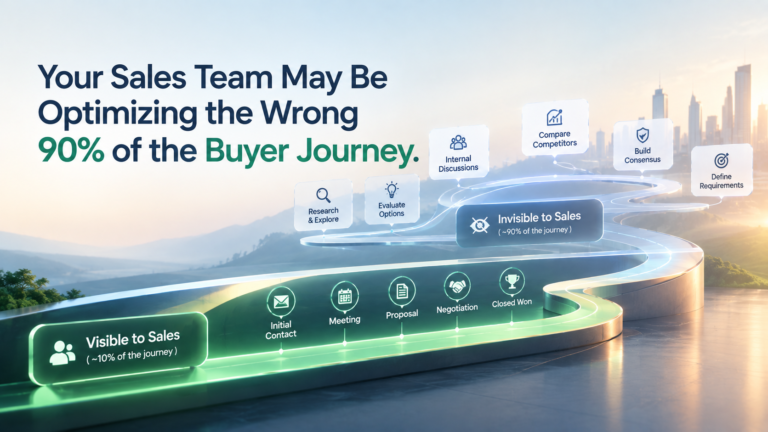


The B2B buyer journey is changing in a way that can make traditional sales metrics misleading. A company can discover that a prospect selected a competitor even though its sales team never had an opportunity to compete. There may have been no proposal, sales presentation, negotiation, objection, or formal evaluation. In some cases, the company was simply never included in the buyer’s consideration set.
This happens because competition increasingly begins before a buying process becomes visible. Buyers research independently, consult colleagues, read reviews, explore professional communities, attend events, consume expert content, and increasingly use AI-powered tools to understand markets and potential solutions. By the time a salesperson enters the conversation, several vendors may already have been considered, compared, or eliminated.
For B2B organizations, this creates a critical question: Who is influencing the buyer before your company knows the buying process has started? This shift makes understanding the B2B buyer journey before the sales opportunity becomes visible increasingly important for modern B2B organizations.
Understanding that invisible portion of the B2B buyer journey can reveal competitive threats that never appear in traditional pipeline reports—and opportunities to become part of the conversation much earlier. For B2B leaders, the practical takeaway is clear : the B2B buyer journey does not begin when a lead enters the CRM. It begins when a buyer starts looking for answers.
1. The B2B Buyer Journey Starts Before the Sales Opportunity
For decades, companies largely understood competition through visible opportunities. Sales teams identified prospects through CRM activity, inbound leads, RFPs, sales conversations, procurement discussions, proposals, and eventually closed-won or closed-lost outcomes.
That model assumes that the buying process becomes visible relatively early.
Modern B2B buyer behavior makes that assumption less reliable because the B2B buyer journey can begin long before a prospect enters the sales pipeline.
A prospect can spend weeks or months researching a business problem without contacting a vendor. They may first investigate the problem, learn about potential approaches, compare technologies, ask colleagues for recommendations, and search for implementation experiences.
Only later might they identify specific vendors.
This means the traditional sales pipeline captures only part of the buyer journey.
What buyers may do before contacting sales
Before a salesperson receives an inquiry, a buyer may:
- Search for information about a business problem.
- Read articles and technical resources.
- Watch product demonstrations or educational videos.
- Consult peers and professional communities.
- Review customer experiences and independent commentary.
- Attend webinars, conferences, or industry events.
- Compare different technology approaches.
- Ask AI systems to explain vendors or solutions.
- Develop internal evaluation criteria.
- Eliminate vendors without ever contacting them.
By the time the buyer becomes an identifiable opportunity, much of the competitive evaluation may already have happened.
That creates an information gap: the buyer may understand the competitive landscape while vendors have little visibility into the buyer’s research process.
2. Competitors Can Influence Buyers Without Entering Your Pipeline
One of the biggest limitations of traditional competitive analysis is that it often focuses on competitors appearing inside active opportunities, while much of the B2B buyer journey happens before those opportunities become visible.One of the biggest limitations of traditional competitive analysis is that it often focuses on competitors appearing inside active opportunities.
Sales teams naturally pay attention to vendors named by prospects. If a prospect says, “We’re also evaluating Company X,” Company X becomes a known competitor.
But what happens when Company X influenced the buyer weeks earlier?
Perhaps the buyer read five articles from that company. Maybe an executive watched its webinar. Perhaps an AI-generated research summary mentioned the company repeatedly. Or a colleague recommended its approach after encountering its content.
None of those interactions necessarily appear in the CRM.
Yet they can influence whether the company enters the buyer’s shortlist.
This distinction is important:
A competitor does not have to appear in a sales opportunity to influence the opportunity.
Visible versus invisible competition
Traditional competitive intelligence tends to focus on:
- Competitors named in opportunities
- Competitive losses
- RFP participants
- Pricing comparisons
- Product comparisons
- Sales objections
- Procurement evaluations
The broader B2B buyer journey also requires attention to:
- Search visibility
- Educational content
- Industry discussions
- Expert commentary
- Customer reviews
- Professional communities
- Events and webinars
- AI-assisted research
- Third-party recommendations
The second group can influence the first.
3. Content Is Becoming Part of Competitive Positioning
B2B companies have been producing content for years. Blogs, reports, webinars, newsletters, videos, social posts, case studies, and e-books are now standard components of many marketing programs.
The challenge is that buyers have access to enormous amounts of similar information.
AI has also made it easier to create generic content at scale. As content volume increases, simply publishing more does not necessarily create greater influence.
The strategic question is becoming:
Does your content help buyers understand something important before they are ready to buy?
The most valuable content often provides something difficult to replicate, such as:
- Original research
- Practical frameworks
- Technical explanations
- Customer insights
- Detailed implementation guidance
- Evidence-based analysis
- Industry-specific observations
- Clear explanations of complex problems
- Useful approaches to evaluating competing solutions
The objective is not simply to occupy more digital space. The objective is to become useful at different stages of the B2B buyer journey, particularly when prospects are still defining their problems and evaluating possible approaches.
It is to become useful within the conversations buyers are already having.
From product content to problem-solving content
Consider a company selling enterprise technology for a complex operational problem.
A product-focused approach might emphasize:
- Features
- Integrations
- Performance
- Pricing
- Product capabilities
Those topics matter, but they may not address what the buyer is researching at the beginning of the B2B buyer journey.
Early-stage questions may be very different:
- What is causing this problem?
- How are other organizations addressing it?
- What capabilities should we look for?
- What implementation risks should we consider?
- Should we build, buy, or integrate?
- How should we measure success?
- What mistakes should we avoid?
A company that answers those questions can become part of the buyer’s research process before the buyer is ready for a product conversation.
4. AI Is Expanding the Competitive Research Environment
AI is adding another layer to modern B2B buyer behavior.
Instead of conducting dozens of traditional searches, buyers can ask conversational systems to explain a market, compare technologies, summarize vendors, identify evaluation criteria, or outline implementation considerations.
The discovery journey can therefore begin with a question rather than a company name.
For example, a buyer may ask:
- “How do enterprises solve this operational problem?”
- “What should we consider when evaluating this technology?”
- “What are the common implementation challenges?”
- “What are the differences between these approaches?”
- “Which capabilities matter most for an enterprise deployment?”
This broadens the competitive environment. For B2B technology companies, this means the buyer journey can now involve AI-assisted research before the traditional B2B buyer journey becomes visible to marketing or sales teams.
Companies are no longer competing only for branded searches or product-specific keywords. They are also competing to become part of the information environment surrounding the buyer’s problem.
Why this matters for B2B technology companies
Technology companies often have extensive expertise inside their organizations. Engineers, product managers, consultants, architects, customer success teams, and executives may understand highly specific customer challenges.
The opportunity is to convert that expertise into useful, discoverable knowledge.
That can include:
- Technical explainers
- Architecture guides
- Research reports
- Industry frameworks
- Implementation guides
- Expert interviews
- Webinars
- Customer lessons
- Comparative educational content
The goal is not to manipulate AI systems or manufacture visibility. It is to build a substantial, credible information presence that genuinely helps people researching relevant problems.
5. Thought Leadership Can Shape the Evaluation Framework
Thought leadership is sometimes treated as executive branding or publishing opinions on social media.
Its deeper value is more practical: helping buyers understand something they did not previously understand.
Effective thought leadership can:
- Explain an emerging market shift.
- Challenge an outdated assumption.
- Identify a developing business pattern.
- Provide evidence around a difficult decision.
- Explain a complex technical issue.
- Offer a framework for evaluating different approaches.
- Highlight implementation risks that buyers may not have considered.
This matters because buyers do not evaluate technology in a vacuum.
They develop criteria.
If a buyer begins researching enterprise software and encounters useful material explaining security, integration, scalability, implementation, governance, and total cost considerations, those topics may become part of the buyer’s evaluation process.
The company providing that educational material is not necessarily controlling the buyer’s decision. But it is participating in the conversation through which the buyer develops an understanding of the problem.
Thought leadership should answer meaningful questions
Instead of asking only, “What should we publish this month?” marketing teams can ask:
- What questions are our buyers struggling to answer?
- Which misconceptions create poor purchasing decisions?
- What do customers wish they had known earlier?
- Which implementation issues are frequently underestimated?
- What complex topics can our experts explain better than generic content?
- Where is the industry conversation missing useful evidence?
These questions can lead to content that is more durable and valuable than generic promotional messaging.
6. Buyer Credibility Is Increasingly Distributed Across Many Sources
A B2B company can no longer assume that its website and sales materials are the complete representation of its brand.
Buyers can validate claims through many external sources.
They may examine:
- Customer reviews
- Industry publications
- Analyst commentary
- Professional communities
- Podcasts
- Events
- Social discussions
- Independent comparisons
- Technical documentation
- Customer experiences
- Peer recommendations
This creates what can be described as a distributed credibility environment.
A company tells buyers what it believes about itself. Other sources provide additional signals that buyers can use to evaluate those claims.
The implication for B2B brands
A strong digital presence is therefore broader than having an attractive website.
Companies should consider whether buyers can find credible evidence of expertise across the places where research happens.
That does not mean trying to control every conversation. It means making the underlying expertise, customer experience, documentation, and knowledge accessible enough that buyers can discover and validate it.
For technology companies, this can be particularly important when products involve complex implementations or significant organizational change. Understanding how AI influences the B2B buyer journey is therefore becoming an increasingly important part of modern demand generation.
7. Self-Directed Research Changes the Role of Sales
The traditional B2B model often positioned salespeople as important early sources of information.
Today, buyers can independently access:
- Product information
- Technical documentation
- Customer experiences
- Expert analysis
- Industry research
- Competitor comparisons
- Implementation guidance
- Pricing discussions
As a result, the first sales conversation may occur much later in the B2B buyer journey than traditional funnel models suggest.As a result, the first sales conversation may occur much later in the decision process.
The salesperson may not be introducing the category.
They may be entering after the buyer has already:
- Recognized a problem.
- Researched potential approaches.
- Established preliminary requirements.
- Identified possible vendors.
- Eliminated some alternatives.
- Developed initial preferences.
This changes what sales enablement needs to accomplish.
Sales teams need visibility not only into who the competitors are, but also into what buyers already know when they arrive.
That requires closer collaboration between marketing, sales, product marketing, customer success, and revenue operations.
Measuring the Invisible Part of the B2B Buyer Journey
If early-stage research is increasingly important, B2B organizations need to rethink measurement.
This does not mean abandoning pipeline metrics. Revenue, opportunities, conversion rates, win rates, and customer acquisition remain essential.
The issue is that these metrics do not necessarily explain why a buyer entered the pipeline with one set of vendors already in mind.
A broader measurement approach can examine signals such as:
- Which topics consistently attract relevant audiences?
- Which resources are referenced during sales conversations?
- What questions appear repeatedly in customer interactions?
- Which external sources influence later opportunities?
- Which competitors repeatedly appear in buyer discussions?
- What content is consumed before prospects convert?
- Where are buyers seeking information that the company does not currently provide?
The goal is not to create another vanity metric. The goal is to understand how the B2B buyer journey develops before the opportunity becomes visible in the CRM.
The goal is to understand how consideration develops before the opportunity becomes visible in the CRM.
Connecting marketing and sales intelligence
Sales can contribute information about what buyers say during active opportunities.
Marketing can analyze what buyers consume before conversion.
Product marketing can identify recurring questions about the category.
Customer success can identify concerns that appear during implementation.
Revenue operations can connect these signals to pipeline activity.
Together, these perspectives provide a more complete view of the B2B buyer journey.
How B2B Companies Can Respond
Understanding invisible competition is useful only if it changes how an organization operates.
The response does not need to be a massive transformation. Companies can begin by examining where buyers learn about the problems they eventually purchase solutions for.
1. Map the pre-pipeline buyer journey
Document the questions a buyer is likely to ask before they know which vendor to contact. Map the questions and research activities that define the B2B buyer journey before buyers know which vendor they want to contact.
Separate those questions into stages such as:
- Problem identification
- Education
- Solution exploration
- Evaluation
- Vendor comparison
- Purchase
- Implementation
This helps reveal information gaps that a traditional funnel may overlook.
2. Identify competitors outside the CRM
Do not rely exclusively on competitors named in sales opportunities.
Monitor the companies appearing consistently in:
- Search results
- Industry publications
- Events
- Professional communities
- Educational content
- Buyer discussions
- Third-party comparisons
The objective is to understand who is influencing the market, not simply who appears at the end of a sales cycle.
3. Build content around buyer questions
Analyze customer conversations, sales calls, support questions, product feedback, and industry discussions to identify recurring problems.
Then create resources that answer those questions directly.
4. Turn internal expertise into external knowledge
Enterprise organizations often have deep expertise that remains trapped inside meetings, presentations, customer calls, and internal documents.
Subject-matter experts can help transform that knowledge into:
- Research
- Guides
- Articles
- Technical content
- Webinars
- Frameworks
- Case studies
- Executive perspectives
5. Strengthen third-party credibility
Make it easy for buyers to validate your organization through credible external sources.
Customer experiences, independent commentary, industry participation, technical communities, and transparent documentation can all contribute to a broader understanding of the company.
6. Connect marketing intelligence with sales intelligence
Marketing should not operate with one view of competition while sales operates with another.
Create regular feedback loops between the teams so that:
- Marketing understands competitive objections.
- Sales understands early-stage content performance.
- Product marketing understands changing buyer questions.
- Leadership sees both visible and invisible competitive activity.
The Strategic Shift: From Pipeline Competition to Consideration Competition
The central lesson is that B2B competition does not begin when a salesperson receives a lead.
It can begin when a buyer first realizes they have a problem.
At that point, companies are competing for something more fundamental than a meeting: attention, understanding, credibility, and consideration.
A company that becomes a trusted source of information early in the journey may enter a later sales conversation with greater familiarity. Another company with a strong product may struggle to participate if buyers rarely encounter it during their research.
This does not mean early visibility guarantees commercial success. Product quality, pricing, customer experience, implementation, relationships, partnerships, and sales execution remain important.
It means those factors may never get evaluated if the company is excluded from consideration in the first place.
Conclusion
The modern B2B buyer journey increasingly happens outside the traditional sales funnel.
Buyers can research problems independently, compare approaches, consult peers, consume expert content, evaluate customer experiences, and use AI to understand markets before speaking with a salesperson. Consequently, a competitor can influence a future deal without ever appearing in your CRM as a competitor.
For B2B technology companies, this creates a broader definition of competitive intelligence. The question is no longer only, “Who are we competing against in active opportunities?” It is also, “Who is shaping the buyer’s understanding before the opportunity exists?”
Answering that question requires organizations to look beyond pipeline data and examine the wider information environment around their category.
The companies that invest in useful expertise, credible content, thought leadership, customer evidence, technical education, and strong buyer research experiences can become part of the conversation earlier. They can identify unanswered questions, understand where competitors are gaining visibility, and discover opportunities to differentiate before a formal evaluation begins.
The most important competitive battle may therefore happen before the sales team ever receives the lead.
Your competitor may not have won the deal in a sales meeting. They may have won consideration weeks earlier.
Frequently Asked Questions
1. What is the B2B buyer journey?
The B2B buyer journey is the process a business goes through from recognizing a problem or opportunity to researching potential approaches, evaluating vendors, making a purchase decision, and eventually implementing a solution. Increasingly, much of this process happens independently before a buyer contacts sales.
2. Why can competitors influence deals before entering the sales pipeline?
Competitors can influence buyers through educational content, search visibility, customer reviews, industry events, professional communities, recommendations, and AI-assisted research. These interactions can shape awareness and consideration before the buyer creates a formal sales opportunity.
3. How is AI changing B2B buyer behavior?
AI allows buyers to ask conversational questions about technologies, markets, vendors, implementation challenges, and evaluation criteria. This can make the research process more independent and increase the importance of being represented accurately and credibly across the information ecosystem surrounding a category.
4. Why is content important in the B2B buyer journey?
Content can help buyers understand problems, evaluate potential approaches, identify requirements, and research implementation considerations before they contact vendors. The most useful B2B content generally provides practical expertise rather than simply repeating product messaging.
5. What is invisible competition in B2B sales?
Invisible competition refers to competitive influence that happens before a vendor appears in a visible sales opportunity. A competitor may shape a buyer’s awareness, research, evaluation criteria, or shortlist without ever being recorded as a competitor in the CRM.
6. How can B2B companies identify competitors outside their pipeline?
Companies can monitor search results, industry publications, professional communities, events, customer discussions, third-party comparisons, educational content, and other sources buyers use during research. Sales conversations can then be combined with these broader market signals.
7. How should companies measure the B2B buyer journey?
Organizations can examine which topics attract relevant audiences, which resources are referenced during sales conversations, what questions prospects repeatedly ask, which external sources influence opportunities, and which competitors frequently appear in buyer discussions. These signals should complement—not replace—traditional pipeline metrics.
8. What type of content works best for early-stage B2B buyers?
Useful early-stage content typically addresses the buyer’s problem rather than immediately promoting a product. Examples include research, technical explainers, implementation guidance, evaluation frameworks, industry analysis, practical guides, and evidence-based thought leadership.
9. What does this mean for B2B sales and marketing alignment?
Sales and marketing need to share intelligence about both visible opportunities and earlier buyer research. Marketing can provide insight into content and market conversations, while sales can provide information about buyer questions, objections, competitors, and evaluation criteria emerging in active opportunities.