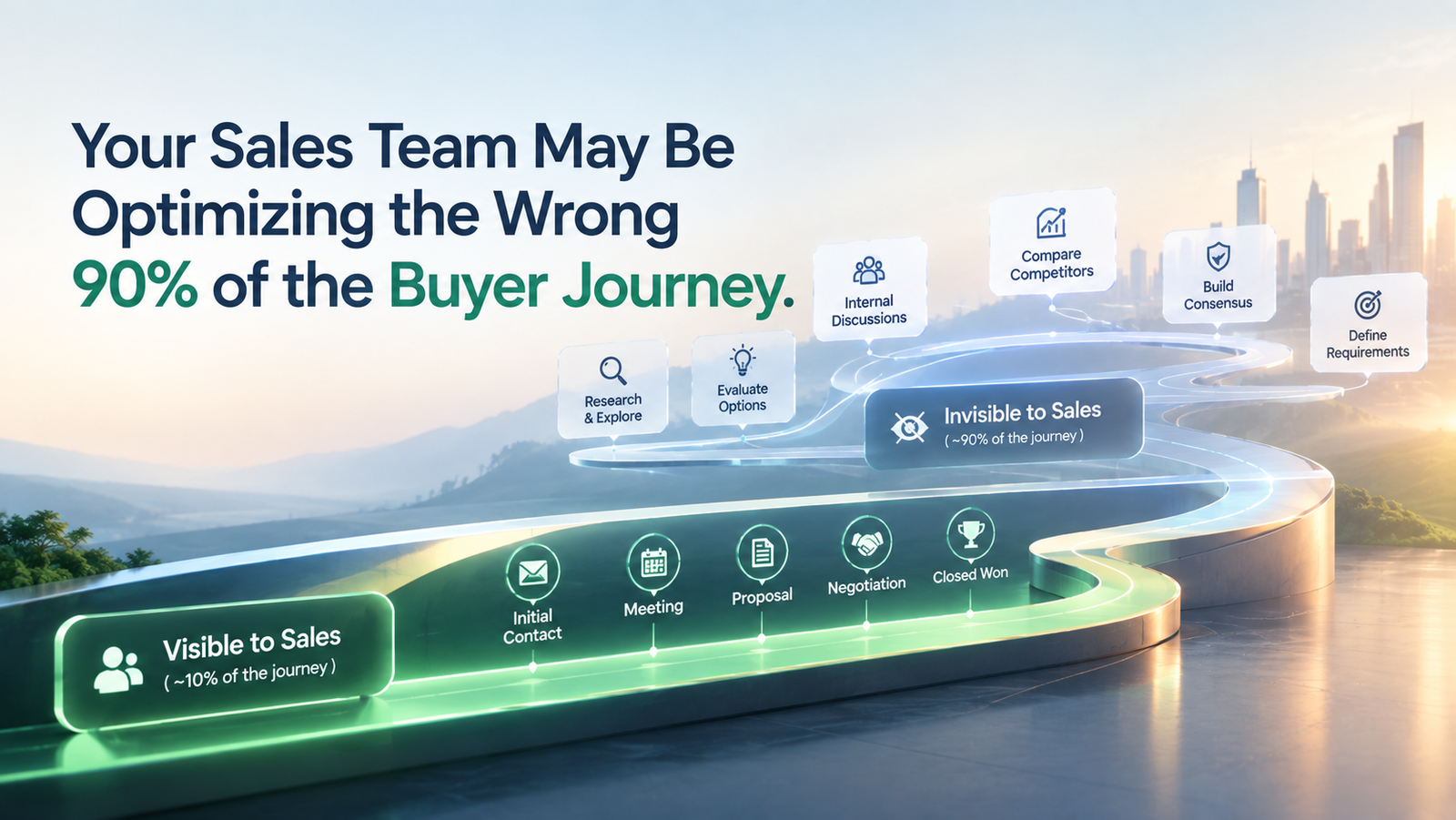
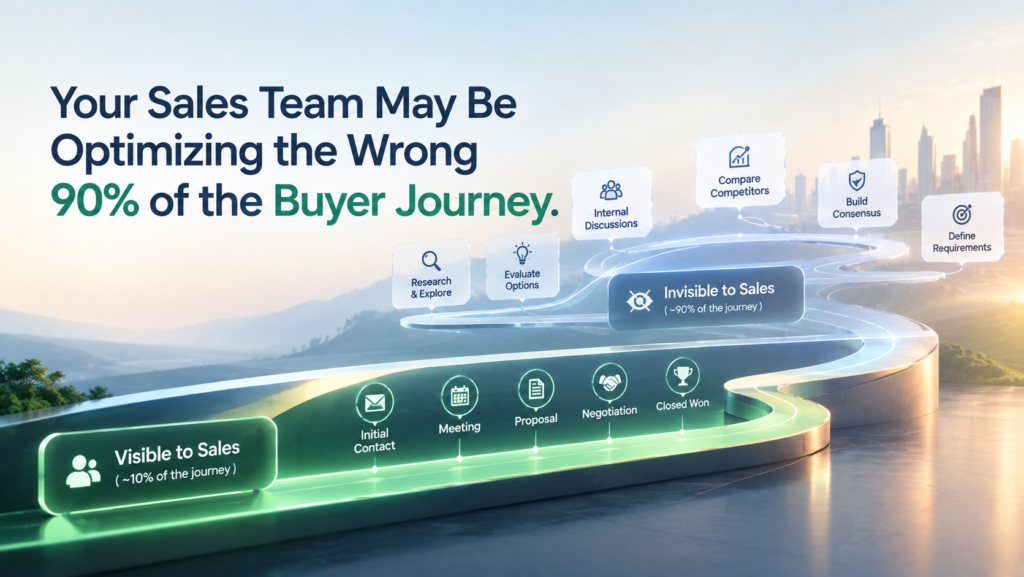
The Invisible B2B Buyer Journey is becoming one of the most important challenges for modern sales organizations. Sales teams have traditionally optimized the part of the buying process they can see: leads entering the CRM, qualification, meetings, opportunities, proposals, negotiations, and closed deals. But many of the decisions that determine whether a company eventually enters that pipeline happen before any of those events are recorded.
The Invisible B2B Buyer Journey has become more complex because B2B buyers can now research problems, compare vendors, read expert content, consult peers, watch product demonstrations, explore competitors, and use AI tools without directly engaging with a sales representative.
read expert content, consult peers, watch product demonstrations, explore competitors, and use AI tools without directly engaging with a sales representative. By the time a prospect fills out a form or requests a meeting, they may already have developed strong opinions about the problem, possible solutions, and vendors worth considering.
That creates a strategic gap. Companies can become highly efficient at managing visible pipeline activity while having limited understanding of what happened before the opportunity existed. The challenge is no longer simply converting leads faster. It is understanding the Invisible B2B Buyer Journey well enough to recognize meaningful buying signals before they become conventional sales opportunities.
What Is the Invisible B2B Buyer Journey?
The Invisible B2B Buyer Journey refers to the research, education, evaluation, and internal decision-making that occurs before a buyer becomes visible to a company’s sales organization.
It is not literally invisible. Rather, it is often invisible to traditional sales systems.
A CRM typically becomes most useful once a person or account has entered an identifiable sales process. Before that point, buyer activity can be fragmented across websites, content platforms, search engines, communities, events, peer conversations, third-party reviews, AI tools, and internal discussions.
A simplified journey might look like this:
Problem recognition → Independent research → Education → Solution exploration → Vendor comparison → Internal consensus → Sales engagement → Evaluation → Purchase
Traditional sales operations often have the greatest visibility from the final stages onward.
The earlier stages can contain important clues about:
- Which business problems are gaining importance
- What information buyers are looking for
- Which solutions they are investigating
- Which competitors they are encountering
- Whether multiple stakeholders are becoming involved
- Whether an account is moving from education toward evaluation
Understanding these signals can give organizations context that conventional lead-stage data cannot provide.
Why Traditional Sales Metrics Tell Only Part of the Story
Sales organizations have become exceptionally sophisticated at measuring visible activity, but the Invisible B2B Buyer Journey often remains outside traditional sales reporting.
They monitor response times, conversion rates, meeting volumes, opportunity creation, pipeline velocity, win rates, and sales-cycle duration. These metrics are valuable because they reveal what happens after prospects enter identifiable stages.
However, improving a downstream metric does not necessarily address an upstream problem.
For example, a company might reduce its average lead response time and improve meeting conversion. Those improvements can make the sales process more efficient. But they do not necessarily answer why certain accounts never become leads or why buyers choose to engage with competitors first.
This distinction matters because sales efficiency and buyer readiness are different things.
A sales team can be highly productive while spending significant effort on accounts that are not actively reassessing a relevant problem. Conversely, an account showing meaningful changes in research behavior may deserve attention even if it has not submitted a form.
The more useful questions become:
- Are the right accounts researching the problem?
- What changed in their behavior?
- Which business issue appears to be gaining urgency?
- Which stakeholders are becoming involved?
- Is the account researching categories or specific vendors?
- Has the account moved from education toward evaluation?
These questions shift the focus from activity volume to buyer context.
1. Buyers Are Researching Before They Talk to Sales
The modern B2B buyer does not necessarily begin with a vendor conversation, which is why understanding the Invisible B2B Buyer Journey has become increasingly important.
A buyer might first encounter a problem internally and spend time understanding it. They may search for explanations, read articles, attend webinars, ask colleagues, consult industry peers, review analyst material, watch demonstrations, or use an AI assistant to explore possible approaches.
At this stage, the buyer may not even have decided that a purchase is necessary.
This makes early-stage content strategically important.
A technology company that consistently helps buyers understand their problem can become associated with expertise before a formal buying process begins. Meanwhile, a company that appears only when the buyer is ready for a sales conversation may have less influence over the assumptions already formed.
The objective is not to turn every early research interaction into a sales opportunity. Instead, companies should use early signals to understand how accounts are thinking and where meaningful demand may be developing.
2. The Buyer Journey Belongs to a Buying Group, Not Just a Lead
One of the biggest limitations of lead-centric sales processes is the assumption that a single contact represents the buying journey.
Enterprise purchases are often influenced by multiple stakeholders.
A business leader might identify the problem. A technical team may investigate requirements. Finance may evaluate costs. Procurement may become involved later. Senior leadership may assess strategic implications.
Each participant can research independently.
This means a salesperson speaking with one contact may have incomplete visibility into the broader buying group.
Account-Level Signals Can Add Context
Instead of asking only whether an individual lead is active, organizations can examine patterns across an account.
For example, consider an enterprise where several employees begin engaging with content related to the same operational problem. One employee may not represent a meaningful signal by themselves. But activity involving several relevant roles can provide additional context about what is happening within the account.
Useful account-level indicators can include:
- Multiple stakeholders researching related topics
- Increasing engagement around a particular business problem
- New roles entering the research process
- Movement from educational content toward solution-oriented material
- Increased interest in specific capabilities or technologies
- Changes in engagement following a relevant business event
The purpose is not to assume that every signal means a purchase is imminent. It is to create a more informed picture of account behavior.
3. Buyer Intent Signals Need Context, Not Just Scores
Many B2B organizations use lead or account scoring to prioritize sales activity, but these systems do not always capture the full Invisible B2B Buyer Journey.
Scoring can be useful, but a score alone rarely explains why an account deserves attention.
Suppose an account receives a high score because several people downloaded content and visited a website. That number tells a salesperson something about activity, but not necessarily about intent.
A more useful intelligence layer could explain the context behind the activity:
Several people from the account are researching the same operational challenge, including individuals from business and technical functions, while engagement has shifted toward solution-oriented content.
That explanation is potentially more actionable than a numerical score by itself.
From “What Happened?” to “Why Does It Matter?”
Effective B2B sales intelligence should help answer three questions:
- What changed?
- Why might the change matter?
- What should the salesperson understand before engaging?
This is an important distinction between data collection and intelligence.
Data tells a sales team that something happened. Intelligence attempts to put that activity into a meaningful business context.
4. Marketing and Sales Can No Longer Operate as Separate Buyer-Journey Functions
The Invisible B2B Buyer Journey also challenges the traditional marketing-to-sales handoff.
Marketing is often responsible for awareness and demand generation. Sales then receives qualified leads and works to convert them into opportunities.
But the buyer does not necessarily experience the journey as a series of departmental handoffs.
A buyer can move between:
Education → internal discussion → competitor research → technical evaluation → education again → vendor research → sales conversation
The journey is not always linear.
Marketing therefore needs insight into what sales is learning from active conversations, while sales can benefit from understanding what marketing is observing across earlier-stage research behavior.
What Better Alignment Looks Like
Instead of treating marketing and sales as separate stages, organizations can align around shared questions:
- Which problems are buyers researching?
- Which accounts appear to be showing increased interest?
- Which roles are becoming involved?
- What objections are emerging?
- What information is missing from the buyer’s research process?
- Which competitor messages are appearing frequently?
- What triggers are associated with increased engagement?
This creates a common understanding of the buyer rather than simply improving the handoff between departments.
5. AI Can Help Turn Fragmented Signals Into Usable Sales Intelligence
The value is not simply automation. AI can help organizations make the Invisible B2B Buyer Journey easier to understand at scale.
Potential signals can exist across large volumes of structured and unstructured information. Manually reviewing every account, market development, content interaction, research pattern, and organizational change is difficult at scale.
AI can help organize this information.
An AI-enabled sales intelligence system could potentially:
- Summarize meaningful changes at an account
- Connect signals from multiple sources
- Identify emerging behavioral patterns
- Group related buyer activities around business problems
- Surface changes in stakeholder participation
- Help salespeople understand account context
- Reduce the amount of manual research required before outreach
The value is not simply automation.
The more important objective is better context at the moment of action.
A salesperson who sees only a high-priority account may still need to spend considerable time researching what is happening. A salesperson who receives a concise explanation of the relevant account changes can begin with a more informed understanding of the situation.
AI should therefore support judgment rather than replace it.
6. Sales Productivity Should Be Measured by Relevance, Not Only Activity
Traditional sales productivity metrics often emphasize volume:
- Calls made
- Emails sent
- Meetings booked
- Follow-ups completed
- Opportunities created
These metrics can be useful operational indicators, but they do not necessarily reveal whether sales activity is well timed.
Consider two salespeople.
One makes a large number of outreach attempts across accounts with limited evidence of active interest. Another focuses on fewer accounts where there are meaningful indications that the organization is researching a relevant problem.
The activity numbers may favor the first approach. But activity volume alone cannot establish the quality or timing of the underlying opportunities.
The Shift From Activity to Timing
Modern sales organizations can increasingly ask better questions about the Invisible B2B Buyer Journey:
“Why are we contacting this account now?”
rather than simply:
“How many accounts did we contact?”
Relevant context might include:
- A new business priority
- Increased research around a specific problem
- Additional stakeholders becoming involved
- Movement toward solution evaluation
- A significant organizational change
- Increasing interest in a particular technology category
This does not eliminate traditional sales metrics. Instead, it adds another dimension: the quality and timing of engagement.
7. The Real Opportunity Is Understanding What Happened Before the Lead
The most important shift may be conceptual: the Invisible B2B Buyer Journey should not be treated as a separate marketing problem, but as an important part of the overall revenue process.
A lead should not necessarily be viewed as the beginning of the buyer journey.
It can be viewed as the point where the buyer journey becomes visible to the vendor.
That distinction changes how organizations think about demand generation, sales intelligence, marketing attribution, account-based marketing, and revenue operations.
Instead of asking only:
“How do we convert this lead?”
organizations can also ask:
“What happened before this lead existed?”
That question can reveal a much broader set of factors:
- What initially created awareness?
- What problem triggered research?
- What information influenced the buyer?
- Which competitors appeared during evaluation?
- Which stakeholders joined the conversation?
- What caused the buyer to become ready for vendor engagement?
- Why did the account engage at this particular point?
These insights can improve not only sales execution but also messaging, content strategy, targeting, and demand generation.
Building a More Visible B2B Buyer Journey
Organizations do not need to monitor every digital interaction to understand the Invisible B2B Buyer Journey better.
The objective should be to identify meaningful signals, connect them to accounts and buying groups, and provide enough context for teams to act intelligently.
A practical framework can begin with four layers.
1. Capture
Collect relevant signals from the buyer journey and account environment.
2. Connect
Associate related activities with accounts, stakeholders, business problems, and buying stages where appropriate.
3. Interpret
Use rules, analytics, and AI to identify meaningful changes rather than simply accumulating activity data.
4. Activate
Give sales and marketing teams actionable context at the appropriate time.
This approach transforms buyer intelligence from a collection of disconnected events into a more coherent view of account behavior.
What B2B Organizations Should Rethink
The changing buyer journey does not mean CRM systems, lead scoring, sales automation, or pipeline management are becoming irrelevant. These systems remain essential for managing the visible commercial process.
The opportunity is to extend the organization’s field of vision.
Companies should consider whether they can answer questions such as:
- What are target accounts researching before they contact us?
- Which business problems are gaining attention?
- Are multiple stakeholders showing related behavior?
- How is buyer research changing over time?
- Where are competitors appearing in the journey?
- Which signals indicate movement toward evaluation?
- Can salespeople understand account context without performing hours of manual research?
The organizations that address these questions can move toward a more complete model of the B2B buying process—one that connects pre-engagement research with measurable sales activity.
Conclusion
The Invisible B2B Buyer Journey represents a fundamental challenge for organizations that have built their sales processes around what the CRM can see. Understanding the Invisible B2B Buyer Journey can help sales and marketing teams recognize important buyer signals before those signals become conventional opportunities.
By the time a buyer becomes a lead, much of the research and internal decision-making may already be underway. Buyers can educate themselves, compare alternatives, involve colleagues, evaluate vendors, and use digital and AI-powered resources without notifying the sales organization.
That does not make the traditional sales funnel obsolete. It means the funnel provides only a partial view of the buyer’s reality.
The next evolution of B2B sales intelligence is therefore not simply about generating more activity or automating more follow-ups. It is about understanding what changed before the buyer raised their hand, why that change matters, and how sales and marketing can respond with greater relevance.
The organizations that develop this broader perspective can move from simply responding to visible demand toward developing a deeper understanding of how demand forms in the first place.
Because when a buyer finally enters the CRM, the most important part of the story may have already happened.
Frequently Asked Questions
1. What is the Invisible B2B Buyer Journey?
The Invisible B2B Buyer Journey describes the research, education, evaluation, and internal decision-making that occurs before a buyer becomes visible to a company’s sales organization.
2. Why is the B2B buyer journey becoming harder for sales teams to observe?
Buyers can independently research problems, compare vendors, consume content, consult peers, attend digital events, and use AI tools without directly engaging with sales. These activities can occur outside traditional CRM workflows.
3. What are buyer intent signals?
Buyer intent signals are observable changes in behavior that may provide context about an organization’s interest in a business problem, solution category, or vendor. Individual signals should be interpreted in context rather than automatically treated as proof of purchase intent.
4. Why is account-level intelligence important in B2B sales?
B2B purchases often involve multiple stakeholders. Account-level intelligence can help sales teams understand patterns across different people and roles rather than relying entirely on the activity of a single lead.
5. How can AI improve B2B sales intelligence?
AI can help organize fragmented information, summarize account changes, identify patterns, connect signals, and provide salespeople with context before they engage with an account.
6. Does buyer intent data replace traditional lead scoring?
No. Buyer intent data and lead or account scoring can serve different purposes. Scoring can help prioritize activity, while contextual intelligence can help explain why an account may deserve attention.
7. How can sales and marketing collaborate around the invisible buyer journey?
Sales and marketing can establish shared visibility into buyer research, emerging business problems, stakeholder participation, competitor activity, content engagement, and other meaningful account signals.
8. What should sales teams measure beyond activity volume?
In addition to calls, emails, and meetings, organizations can examine engagement quality, account movement, stakeholder participation, timing, opportunity progression, and the context behind changes in buyer behavior.
9. How does AI change the B2B buyer journey?
AI makes it easier for buyers to research problems and potential solutions independently. It also gives B2B organizations new opportunities to analyze fragmented signals and provide sales teams with better account context.
10. What is the biggest lesson from the invisible buyer journey?
A sales opportunity is not necessarily the beginning of the buying process. It is often the point at which the Invisible B2B Buyer Journey becomes visible to the vendor.