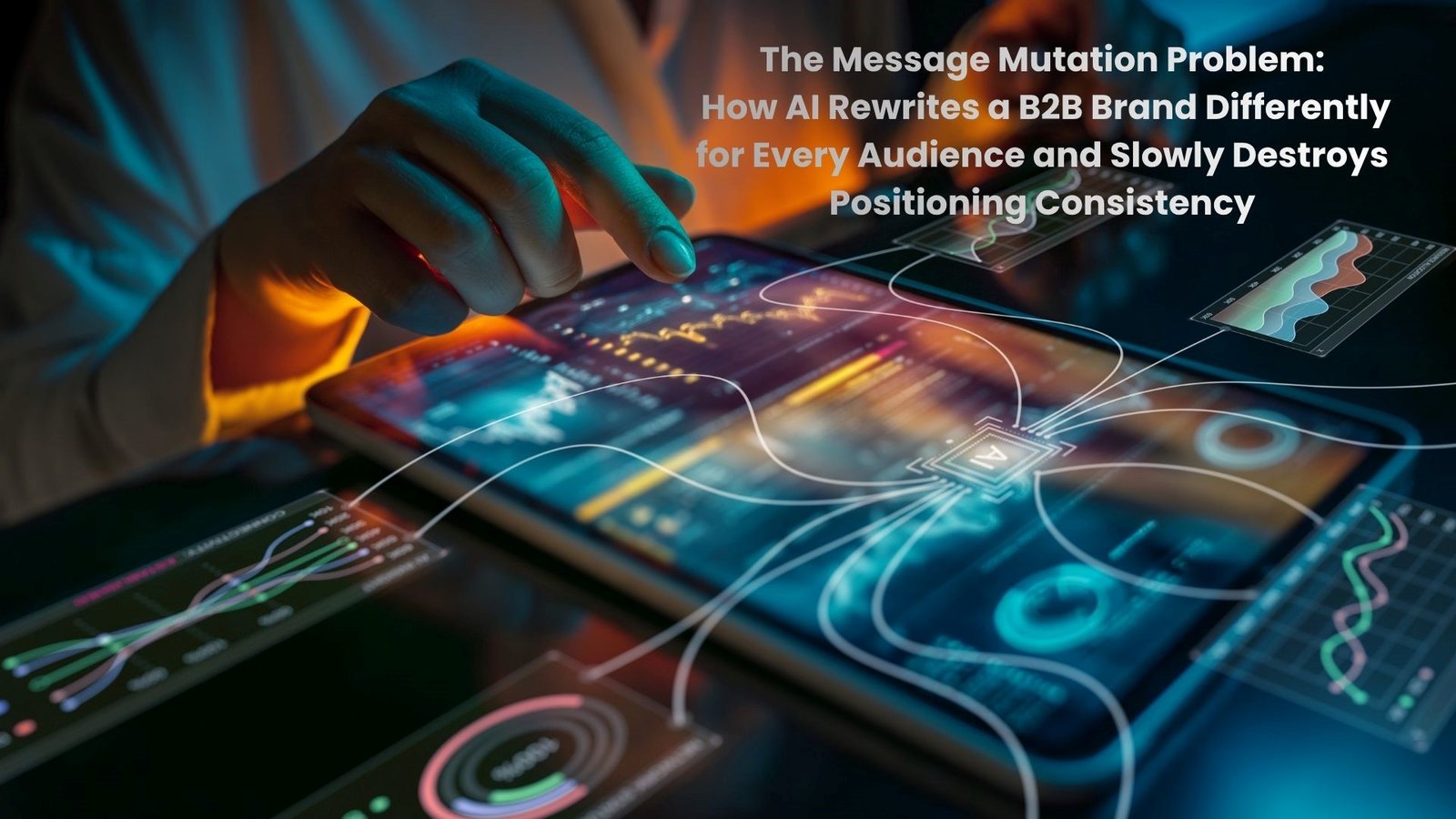

Artificial intelligence has transformed the way B2B companies create, distribute and personalise marketing communication. A single campaign can now generate dozens of email variations, industry-specific landing pages, executive posts, sales enablement documents, webinar scripts, product descriptions and account-based messages within minutes. AI can adapt language according to industry, company size, job role, buying stage, geography and customer intent, allowing brands to communicate with greater relevance than traditional one-size-fits-all marketing ever permitted. However, beneath this efficiency lies a strategic risk that many organisations have not yet fully recognised: the gradual mutation of the brand message. When every audience receives a slightly different version of what a company stands for, personalisation can begin to weaken positioning. The brand may remain visually consistent, but its meaning becomes fragmented across markets, platforms and buyer experiences.
In traditional B2B marketing, brand positioning was developed through carefully defined messaging frameworks. Companies established their value proposition, market category, differentiators, tone of voice, proof points and central promise before translating them into campaigns and content. Although the message might be adapted for different audiences, the underlying meaning generally remained stable. A technology company could speak differently to a chief information officer, a procurement leader and an operations manager, but each audience would still understand the same fundamental reason to choose the company. AI-powered content systems challenge this model because they are designed to optimise communication for specific contexts. They may prioritise technical efficiency for one audience, cost savings for another, risk reduction for a third and innovation for a fourth. Each message may perform well independently, but together they can create an unclear and inconsistent market identity.
The mutation often begins innocently. A marketing team asks an AI system to make a campaign more relevant to financial services companies. The system emphasises compliance, auditability and risk management. Another team asks it to adapt the same campaign for manufacturing businesses, so it focuses on operational efficiency, supply-chain visibility and production continuity. A third team targets fast-growing technology companies and highlights scalability, speed and innovation. These adaptations may appear sensible because each industry has different priorities. The problem arises when the original positioning is not strong enough to hold these variations together. Instead of expressing one central value through different industry-specific examples, the AI begins to create different reasons for the company’s existence. Over time, customers may encounter the same brand as a compliance specialist, an efficiency platform, an innovation partner or a cost-reduction solution, without understanding how these identities connect.
This is particularly dangerous in B2B markets because buying decisions are rarely based on a single interaction. A prospect may first encounter a company through a LinkedIn post, later read an AI-generated industry report, receive a personalised email from a sales representative, attend a webinar, visit the website and review a proposal. Each touchpoint may be generated or refined by a different AI workflow. If the systems are trained on different source materials or given different instructions, the company’s message can shift from one channel to another. The LinkedIn post may position the organisation as a strategic transformation partner. The email may describe it as a cost-saving service provider. The webinar may focus on automation, while the proposal emphasises operational support. None of these messages is necessarily incorrect, but the combined experience may feel disconnected. The buyer is left to construct the company’s identity independently.
AI does not create this problem alone. It magnifies weaknesses that already exist in the organisation’s messaging architecture. Many companies have multiple versions of their value proposition stored across presentations, websites, sales decks, product documents, campaign briefs and executive communication. These materials may have been created by different teams at different times and for different business priorities. When AI tools use this fragmented information as their source material, they do not automatically know which version is authoritative. They may combine an old positioning statement with a new product promise, use outdated terminology or amplify a minor feature until it appears to be the company’s primary differentiator. The result is not necessarily a factual error. It is a shift in emphasis that gradually changes how the market understands the brand.
The problem becomes more serious when marketing teams measure AI-generated content primarily through immediate performance indicators. If one message produces a higher click-through rate, another increases form submissions and a third generates more webinar registrations, AI systems may continue optimising toward those outcomes. Over time, the most engaging message may become the dominant message, even if it does not represent the company’s long-term strategic position. A B2B organisation that wants to be known for reliability and trust may discover that provocative claims about speed and disruption generate more attention. Its AI content engine may therefore produce increasingly aggressive messaging because the data rewards it. The company gains short-term engagement while gradually moving away from the identity it intended to build.
This creates a difference between message performance and brand coherence. A message can be effective in isolation but damaging in combination with other messages. For example, a campaign promising simplicity may attract prospects who want a low-effort solution, while another campaign emphasising advanced customisation attracts buyers seeking flexibility. If the company’s actual delivery model is complex and highly consultative, both messages may create unrealistic expectations. The sales team then has to explain why the supposedly simple solution requires extensive integration, or why a highly customisable product follows strict implementation limitations. AI may have optimised each message for a particular audience, but the business must eventually manage the consequences of these conflicting promises.
B2B positioning is especially vulnerable to mutation because the buying journey often involves multiple stakeholders with different definitions of value. A chief executive may want growth, a finance leader may prioritise predictability, an IT leader may focus on integration and security, and an operations leader may care about implementation speed. AI can create tailored messaging for each stakeholder, but the company must ensure that these messages lead toward a shared understanding of the solution. If each stakeholder receives a completely different narrative, internal alignment within the buying organisation may become more difficult. The executive may believe the vendor is offering strategic transformation, while the IT team believes it is purchasing a technical tool and finance expects a cost-reduction programme. The vendor may have successfully personalised its communication but failed to create a unified buying case.
Another source of message mutation is the growing use of generative AI by individual employees. Marketing teams may use approved platforms, but sales representatives, product managers, executives and customer-success teams often create their own content using separate tools. A salesperson may ask an AI assistant to rewrite a product description for a specific account. A customer-success manager may generate a renewal presentation. A senior executive may use AI to prepare a thought-leadership post. Each person may introduce subtle changes to the company’s language, positioning and claims. Over time, these variations can become part of the external brand experience. The company may have an official messaging guide, but the market encounters hundreds of unofficial interpretations of it.
This decentralisation also affects terminology. AI systems often favour language that is clear, persuasive and contextually relevant, but they may replace important category terms with more familiar or commercially attractive phrases. A company that deliberately positions itself within a specialised B2B category may find its messaging gradually shifting toward broad expressions such as “business growth platform,” “intelligent transformation partner” or “next-generation productivity solution.” These phrases may sound polished, but they can weaken differentiation because competitors can use the same language. The brand begins with a precise market position and ends with a collection of generic descriptions designed to fit different prompts. The language becomes smoother while the identity becomes less distinct.
There is also a risk that AI-generated personalisation may exaggerate differences between audiences. Marketing teams often assume that every segment needs a unique message. However, excessive adaptation can make the company appear opportunistic. If a brand describes itself as a technology innovator to one industry, a compliance specialist to another and a low-cost efficiency provider to a third, prospects may question whether the company has a genuine area of expertise. B2B buyers increasingly investigate vendors across multiple channels before engaging with sales teams. They may compare website pages, executive profiles, customer stories, analyst mentions and third-party reviews. If the company’s identity changes too significantly across these sources, the inconsistency can undermine credibility. Buyers may not know which version of the company is the most accurate.
The message mutation problem also has implications for search visibility and AI-generated discovery. As customers increasingly use AI systems to research vendors, the information presented about a company may depend on the language available across its digital footprint. If the company communicates inconsistent value propositions, AI-powered research tools may summarise it differently for different users. One buyer may receive a description focused on automation, while another sees the company as a data provider or consulting firm. This can influence which competitors are considered, what use cases the buyer associates with the company and whether the vendor appears relevant to the purchasing problem. A fragmented message does not merely confuse human audiences; it can also create fragmented machine-readable representations of the brand.
To address this risk, companies need to build a stronger distinction between core positioning and adaptive expression. The core positioning should define what must remain stable across every communication: the problem the company solves, the audience it serves, the value it creates, the category it belongs to, the evidence supporting its claims and the reason it is meaningfully different. Adaptive expression can then change the examples, terminology, proof points and emphasis according to the audience. For instance, a company may consistently position itself as a trusted B2B demand-generation partner while explaining that value through compliance for regulated industries, efficiency for lean teams, revenue visibility for finance leaders and scalability for growing businesses. The language changes, but the central identity remains intact.
This requires more than a conventional brand guideline document. Organisations need a structured messaging system that AI tools can interpret reliably. Such a system should include approved positioning statements, prohibited claims, preferred terminology, audience-specific proof points, product boundaries, evidence requirements and rules for adapting the message. It should clearly distinguish between permanent brand principles and temporary campaign language. AI systems should not be allowed to treat every previous piece of content as equally authoritative. They need access to a controlled source of truth, along with instructions about which information takes priority when conflicts appear. Without this governance, AI will continue to reproduce the inconsistencies already present in the organisation.
Conclusion
AI has made B2B marketing faster, more personalised and more scalable than ever. But greater content velocity does not automatically create stronger brand communication. Without a clear and governed messaging foundation, every new AI-generated variation can introduce another interpretation of what the company stands for.
The goal is not to eliminate personalisation. It is to ensure that personalisation changes how the brand speaks, not what the brand stands for. Companies need a clear source of truth for their positioning, terminology, value propositions, proof points and claims, while giving AI enough flexibility to adapt those elements to different audiences and buying contexts.