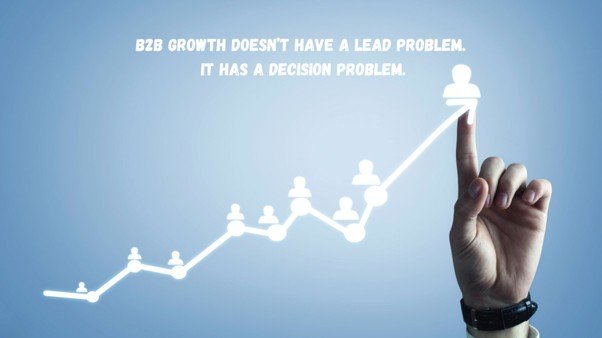
B2B growth is no longer simply a lead-generation challenge; it is increasingly a challenge of helping buyers make confident decisions. For years, B2B organizations have measured growth through familiar indicators such as traffic, leads, meetings, opportunities, and pipeline. When revenue slows, the instinct is often to increase activity: generate more leads, launch more campaigns, expand databases, add channels, and increase sales outreach.
That approach can work when insufficient demand is genuinely the problem. But it becomes less effective when the real bottleneck exists further down the buying journey. A business may have plenty of interested prospects and still struggle to convert them into customers because buyers are uncertain about the problem, the investment, the timing, the risks, or the internal implications of making a change.
The modern B2B growth challenge is therefore shifting. Companies need to understand not only how to generate demand, but also how to help that demand become a decision. The organizations that can reduce uncertainty, build confidence, create internal alignment, and demonstrate business value will be better positioned to turn buyer interest into sustainable revenue.
Why B2B Growth Is Becoming a Decision Problem
Finding organizations that could theoretically benefit from a product or service has become increasingly accessible. B2B databases can identify companies by industry, geography, size, revenue, technology environment, and other characteristics.
But identifying a potential customer is not the same as creating a buying decision.
A company may have a genuine problem but still decide not to act. The problem may not be considered urgent. The budget may be allocated elsewhere. Stakeholders may disagree about the right solution. An executive may question the return on investment. IT may be concerned about implementation. Procurement may introduce additional requirements.
Between problem recognition and purchase approval exists a complex decision process that traditional lead metrics often fail to capture.
A buyer may need to answer questions such as:
- Is this problem important enough to solve now?
- What happens if we do nothing?
- Why should we change our current approach?
- Why is this solution credible?
- Can we justify the investment?
- What risks could the organization face?
- Who needs to approve the decision?
- How difficult will implementation be?
- Which alternatives should we consider?
Generating another lead does not necessarily answer any of these questions.
The Difference Between Interest and Intent
Interest is relatively easy to observe. Someone downloads content, attends a webinar, visits a website, responds to an email, or speaks with a sales representative.
Intent is more complicated.
A prospect may be highly engaged with content while having no immediate intention to purchase. Conversely, an organization may be quietly evaluating solutions without generating the traditional engagement signals marketers expect.
This makes the quality of B2B growth intelligence increasingly important. Companies need to understand the context behind engagement, rather than treating every interaction as an equally meaningful indicator of buying readiness.
1. Stop Treating Lead Volume as the Definition of B2B Growth
Lead generation remains important. Without sufficient market awareness and demand, sales teams have fewer opportunities to pursue.
The problem occurs when lead volume becomes a substitute for understanding growth.
A company can increase the number of leads entering its funnel without improving its ability to convert those leads into revenue. More leads can even create additional operational complexity when sales teams have to spend time separating genuine opportunities from low-intent activity.
A more useful B2B growth model considers lead generation as one component of a larger system:
Awareness → Interest → Problem Recognition → Evaluation → Internal Alignment → Decision → Purchase → Adoption
Each stage introduces different challenges.
Marketing may be effective at creating awareness but weak at communicating business value. Sales may be effective at creating relationships but struggle to build consensus across buying committees. Product teams may have a compelling solution but fail to provide sufficient implementation confidence.
The goal is not to eliminate lead generation. It is to understand where the actual decision bottleneck exists.
2. Build Confidence, Not Just Awareness
Traditional marketing often focuses on making prospects aware of a company and its products.
But awareness answers a relatively simple question:
Does the buyer know we exist?
Confidence answers much harder questions:
- Does the buyer believe we understand their problem?
- Do they believe the solution can work in their environment?
- Can they explain the business value internally?
- Can they defend the investment?
- Do they understand the implementation requirements?
- Do they believe the risks are manageable?
This distinction is particularly important in B2B technology.
Enterprise purchases can affect multiple teams, budgets, workflows, systems, and business processes. The person who discovers a technology solution may not be the person who approves it.
Marketing content therefore needs to do more than attract attention. It should help different stakeholders understand why the decision makes sense.
What Confidence-Building Content Looks Like
Useful B2B content can address practical decision questions through:
- Business cases and ROI frameworks
- Implementation guidance
- Technical documentation
- Customer examples
- Product comparisons
- Security and compliance information
- Integration explanations
- Use-case-specific content
- Risk and objection handling
- Practical buying guides
The objective is not simply to produce more content. It is to produce content that removes specific sources of buyer uncertainty.
3. Make Personalization Contextual
B2B personalization has often focused on relatively superficial signals.
Using a prospect’s name, company, job title, industry, or recent announcement can make communication appear customized. But personalization becomes far more valuable when it reflects the buyer’s actual decision environment.
The important questions are not only:
Who is this person?
They are also:
What is this organization trying to accomplish?
Why does the problem matter now?
Who else is affected?
What could prevent the organization from moving forward?
What evidence would make the decision easier?
This represents a shift from message personalization to decision personalization.
Contextual Personalization in Practice
For example, an enterprise technology prospect may not need another generic message explaining that a platform improves productivity.
A more useful interaction might address:
- A business process the organization is trying to improve
- A technology environment that affects implementation
- A known operational challenge
- The stakeholders likely to be involved
- Potential integration considerations
- Evidence relevant to the organization’s use case
The personalization is valuable because it helps the buyer think through the decision—not simply because it makes the message sound more customized.
4. Measure the Quality of the Decision Environment
Traditional CRM stages can create the appearance of precision.
An opportunity might be classified as “proposal,” “evaluation,” or “negotiation,” but these labels do not always reveal what is actually happening inside the account.
Two opportunities with identical deal values and identical CRM stages can have dramatically different probabilities of closing.
One may have:
- Executive sponsorship
- A defined business problem
- Budget availability
- Multiple stakeholders aligned
- A clear implementation plan
- Agreement on evaluation criteria
Another may have only an enthusiastic individual contact.
Both may appear similar in a traditional pipeline report, but they represent very different decision environments.
Look Beyond Pipeline Stages
B2B growth teams should increasingly consider signals such as:
- Are the right stakeholders involved?
- Has the business problem been clearly defined?
- Is there a compelling reason to change?
- Has the financial case been established?
- Are technical concerns being addressed?
- Is executive support present?
- Are competing priorities understood?
- Has procurement become involved?
- Is there agreement on next steps?
These signals provide a richer understanding of decision readiness than opportunity stage alone.
5. Understand the Buying Committee
Significant B2B purchases rarely affect just one individual.
A single technology investment may involve business leadership, finance, IT, security, procurement, operations, legal, and end users. Each stakeholder can evaluate the same purchase differently.
One stakeholder may focus on business outcomes. Another may care about technical feasibility. Another may prioritize financial justification. Someone else may be responsible for implementation or risk management.
The initial sales contact is therefore only one part of the decision system.
Different Stakeholders Need Different Evidence
A strong B2B growth strategy recognizes that buying committees need different forms of confidence.
| Stakeholder | Typical Decision Concern |
|---|---|
| Executive | Business impact and strategic value |
| Finance | Investment and economic justification |
| IT | Integration, architecture, and feasibility |
| Security | Risk, security, and compliance |
| Operations | Implementation and workflow impact |
| Procurement | Commercial terms and vendor requirements |
| End Users | Usability and practical value |
The challenge is not simply to persuade every stakeholder with the same message.
It is to provide each stakeholder with the information they need to participate confidently in the decision.
6. Focus on Signals That Show Genuine Movement
B2B engagement data can become overwhelming.
Website visits, email opens, content downloads, event attendance, meetings, social interactions, and other activities can all generate signals. But individual interactions rarely explain the complete buying situation.
The more useful approach is to look for relationships between signals.
For example, a prospect downloading a white paper may indicate interest. But if the same account subsequently brings additional stakeholders into a conversation, begins a technical evaluation, discusses implementation requirements, and starts building a business case, the overall picture becomes much stronger.
The individual signals matter less than the pattern they create.
From Activity Data to Decision Intelligence
This shift means B2B organizations should ask:
What changed inside the account?
rather than only:
What activity did the prospect complete?
Potential indicators of movement can include:
- New stakeholders entering the conversation
- Changes in business priorities
- Increased executive involvement
- Evaluation of technical requirements
- Business-case development
- Budget discussions
- Procurement activity
- Agreement on implementation steps
No individual signal guarantees a purchase. But together, they can provide a better understanding of whether an account is moving toward a decision.
7. Use AI to Interpret Complexity, Not Just Generate More Outreach
AI has become increasingly relevant to B2B growth, but its value should not be limited to generating additional emails or sales messages.
One of the more important opportunities is using AI to interpret fragmented information.
B2B organizations generate enormous amounts of data across CRM platforms, marketing systems, customer-success tools, sales conversations, product interactions, and account research. Much of that information exists in disconnected systems.
AI can help organizations:
- Summarize account context
- Identify important changes
- Surface patterns across interactions
- Organize stakeholder information
- Highlight potential risks
- Connect engagement signals
- Help sales teams understand account history
- Make large amounts of information easier to interpret
The objective should not be to remove human judgment.
It should be to give decision-makers better information so they can apply judgment where it matters most.
AI Should Improve Decision Quality
There is an important difference between:
AI that creates more activity
and
AI that helps teams understand activity.
The first can increase volume.
The second can improve decision quality.
For B2B organizations dealing with complex enterprise sales cycles, that distinction can be significant.
8. Reduce Buyer Uncertainty Instead of Producing More Information
Modern B2B buyers have more ways to research independently than ever before.
They can investigate vendors through search, professional communities, peer networks, reviews, analyst material, social platforms, vendor content, and AI-assisted research.
As a result, simply producing more information does not necessarily create more value.
The real opportunity is to help buyers make sense of information.
A buyer does not necessarily need another claim that a product is innovative or industry-leading. They may need to understand whether it fits their environment, how difficult implementation will be, what risks exist, what outcomes are realistic, and how the investment can be justified internally.
The New Role of B2B Content
Effective content should help answer questions such as:
- Is this solution appropriate for our situation?
- How does it compare with other approaches?
- What does implementation involve?
- What resources will we need?
- What risks should we consider?
- How can we measure success?
- How can I explain this decision to other stakeholders?
In an information-rich environment, clarity becomes a competitive advantage.
9. Align Marketing, Sales, Product, and Customer Success Around the Decision
A company cannot consistently improve the buying experience if its internal teams have completely different views of the customer.
Marketing may believe the biggest problem is awareness.
Sales may believe the problem is targeting.
Product may believe the problem is functionality.
Customer success may believe the problem is adoption.
Leadership may believe the problem is pricing.
Each perspective may contain some truth. But if these teams do not share an understanding of the buyer’s decision process, they can end up optimizing separate parts of the customer journey.
Create a Shared View of the Customer Decision
A stronger B2B growth strategy connects teams around questions such as:
- What problem is the customer trying to solve?
- Why is the problem important?
- What triggers action?
- Which stakeholders become involved?
- What creates confidence?
- What creates hesitation?
- Which objections repeatedly slow deals?
- What evidence helps buyers move forward?
- What happens after the purchase?
This creates a common language across the revenue organization.
Instead of asking each department to optimize its own metrics independently, the organization can focus on improving the overall path from problem recognition to confident action.
What This Means for B2B Growth Strategy
The shift from leads to decisions does not mean companies should abandon traditional growth metrics.
Leads still matter.
Pipeline still matters.
Conversion still matters.
Revenue still matters.
The change is understanding these metrics as components of a broader system.
A healthy B2B growth strategy should connect demand generation with decision enablement.
That means asking not only:
How many opportunities did we create?
but also:
How many opportunities are becoming increasingly confident decisions?
This can lead to a more sophisticated set of management questions:
- Are we attracting the right accounts?
- Are buyers identifying meaningful problems?
- Are the right stakeholders becoming involved?
- Are we creating a compelling business case?
- Are objections being resolved?
- Is buyer confidence increasing?
- Are opportunities progressing because of genuine organizational movement?
- Are we reducing friction between evaluation and commitment?
These questions provide a more complete view of revenue performance.
The Future of B2B Growth Is About Reducing Decision Friction
B2B companies have spent decades developing increasingly sophisticated methods for generating demand.
The next competitive advantage may come from what happens after demand is created.
Buyers already have access to enormous amounts of information. They have more vendors to compare, more channels to research, and more stakeholders involved in important purchases.
The challenge is no longer simply getting attention.
It is helping an organization move from:
“This looks interesting.”
to:
“This makes sense for us.”
and ultimately:
“We are confident enough to act.”
That requires more than lead generation. It requires evidence, context, stakeholder alignment, business justification, risk reduction, and a clear understanding of the buyer’s decision process.
For B2B technology companies in particular, this creates an opportunity to rethink the role of marketing and sales. The best teams will not simply create more interactions. They will create better conditions for decisions.
Conclusion
B2B growth is evolving from a lead-generation challenge into a decision-making challenge.
Generating demand will always matter, but demand by itself does not create revenue. Buyers must determine whether a problem is important enough to solve, whether a solution is credible, whether the investment is justified, whether risks are manageable, and whether their organization is ready to act.
That means the strongest B2B growth strategies will look beyond lead counts and pipeline volume. They will focus on the quality of the decision environment behind those numbers.
The organizations that succeed will be those that understand what creates genuine movement inside an account, involve the right stakeholders, provide evidence that builds confidence, use technology and AI to interpret complex signals, and reduce uncertainty throughout the buying journey.
The fundamental question for B2B leaders is therefore changing.
It is no longer simply:
“How do we generate more demand?”
It is:
“How do we help the demand we generate become a confident decision?”
In a market where buyers have more information, more choices, and more ways to research independently, attention is increasingly abundant.
Confidence is the scarce resource.
And companies that learn how to build confidence at scale can create a more durable advantage than companies that simply generate more leads.
Frequently Asked Questions
1. What is B2B growth?
B2B growth is the process of increasing revenue and business value by attracting the right organizations, creating demand, converting opportunities, retaining customers, and expanding relationships. Modern B2B growth increasingly requires understanding how buyers make decisions, not just how many leads enter the funnel.
2. Why is B2B growth becoming a decision problem?
Many B2B companies can generate leads through digital marketing, events, outbound sales, content, and other channels. The harder challenge is converting buyer interest into organizational commitment. Multiple stakeholders, competing priorities, budget constraints, risk concerns, and complex evaluations can all delay a purchase.
3. Is lead generation still important for B2B growth?
Yes. Lead generation remains an important part of B2B growth. The key is not to treat lead volume as the complete definition of growth. Leads are inputs into a broader process that must ultimately create qualified opportunities and confident purchasing decisions.
4. How can B2B companies increase buyer confidence?
Companies can build buyer confidence by providing relevant evidence, clear business cases, implementation guidance, technical information, customer examples, risk explanations, and stakeholder-specific content. The goal is to answer the practical questions buyers need to resolve before committing.
5. What is a B2B buying committee?
A B2B buying committee is the group of stakeholders involved in evaluating, influencing, approving, purchasing, or implementing a business solution. Depending on the purchase, it can include executives, finance, IT, security, procurement, operations, and end users.
6. How should companies measure B2B buyer intent?
Buyer intent should be evaluated through multiple contextual signals rather than relying on one activity. Stakeholder engagement, business-case development, technical evaluation, executive involvement, budget discussions, procurement activity, and agreed next steps can provide useful indicators of decision progress.
7. How can AI support B2B growth?
AI can help B2B organizations interpret large volumes of account, customer, sales, and engagement information. It can summarize context, identify patterns, surface changes, organize information, and help teams understand which signals may indicate meaningful movement within an account.
8. What is the difference between awareness and buyer confidence?
Awareness means a potential buyer knows a company or solution exists. Confidence means the buyer believes the solution is relevant, credible, financially justifiable, feasible to implement, and sufficiently low-risk to recommend or approve internally.
9. How can marketing and sales work together to improve B2B growth?
Marketing and sales can align around the buyer’s decision process rather than focusing only on separate departmental metrics. Shared definitions of customer problems, buying triggers, stakeholder requirements, objections, evidence, and decision readiness can help both teams create a more consistent buying experience.