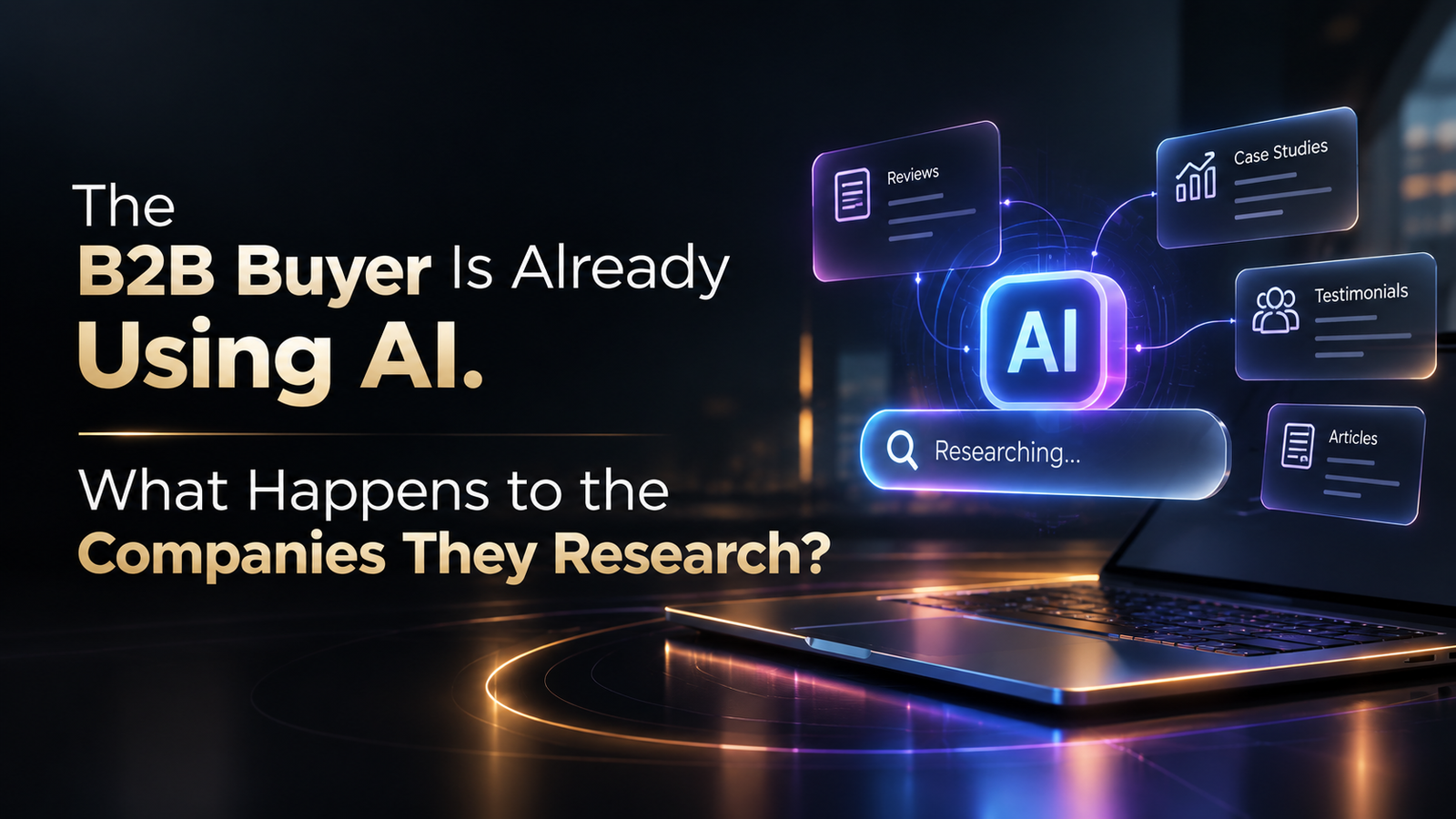
B2B buyers using AI are changing how companies discover, research, compare, and evaluate technology vendors. For years, B2B companies focused on being visible wherever buyers searched—through websites, search rankings, content, events, analyst reports, review platforms, and social media. The underlying assumption was straightforward: if buyers could find a company, that company had an opportunity to influence the buying decision.
In an AI-assisted B2B buying journey, visibility alone is no longer enough. Companies must make their expertise, products, customer outcomes, and differentiation easy to understand across websites, content, case studies, product documentation, and trusted third-party sources. A strong B2B AI strategy should therefore focus not only on generating content but also on creating consistent and credible information that AI systems and potential customers can interpret correctly.
The important shift is not simply that AI has become another research channel. It is that AI can influence the buyer’s understanding of a company before the buyer ever visits its website or speaks with its sales team. That creates a new challenge for B2B organizations: being discoverable is no longer enough. Companies also need to be understandable, credible, consistent, and supported by evidence.
B2B Buyers Using AI Are Changing the First Impression –
The rise of AI-assisted B2B buying also changes how companies should approach B2B marketing and sales. Buyers can use AI to research vendors, identify alternatives, prepare questions for sales meetings, and evaluate competing solutions. As a result, B2B companies need to provide useful information throughout the buying journey rather than depending on a salesperson to explain their value proposition for the first time.
As B2B buyers using AI become more comfortable with AI-assisted research, vendors have less control over the first stage of the buying conversation. Buyers can independently explore a company’s capabilities, competitors, use cases, and potential risks before deciding whether to engage directly.
A buyer can now ask an AI system questions such as:
- Which vendors solve this particular business problem?
- How do these companies compare?
- What are the alternatives?
- Which solution is better suited to an enterprise environment?
- What risks should we consider?
- What questions should we ask during a vendor evaluation?
This means the first impression of a company may happen outside its own digital properties.
A buyer may encounter an AI-generated description of a company before seeing its homepage. They may receive a comparison of several vendors before downloading a whitepaper. They may even enter a sales conversation with a clear opinion about a company based on research conducted with AI.
For B2B marketers, this changes the meaning of visibility.
The question is no longer simply:
“Can buyers find us?”
It is increasingly:
“What will buyers understand about us when they find us?”
AI Is Moving B2B Search From Information Retrieval to Interpretation –
Traditional search primarily helped buyers find information. AI-assisted research can help interpret that information.
That distinction is significant.
A search engine can provide a buyer with multiple vendor websites, articles, reviews, and reports. The buyer then has to interpret those sources and determine what matters.
An AI system can potentially help organize that information around the buyer’s question.
This creates a higher standard for B2B companies. Content cannot simply exist to attract clicks. It needs to clearly communicate expertise, context, differentiation, and evidence.
A company might publish hundreds of articles and still be difficult to understand.
Its website may contain detailed product information but fail to clearly explain which business problems the product solves. Its social channels may emphasize innovation while third-party sources focus on something completely different. Its sales team may position the company differently again.
For buyers using AI, these inconsistencies can become especially problematic.
Clarity becomes a competitive advantage :
B2B organizations should increasingly make sure their commercial information clearly answers:
- What does the company actually do?
- Which problems does it solve?
- Who is it designed for?
- What makes its approach different?
- What evidence supports its claims?
- Where does it fit within the broader market?
The goal is not to create content specifically for machines. The goal is to create information that is genuinely clear and useful enough for both human buyers and AI-assisted research.
The B2B Buyer Journey Is Becoming More Self-Directed –
AI does not only affect the beginning of the buying journey.
B2B buyers can use AI throughout the evaluation process to prepare questions, compare options, understand technical concepts, assess implementation considerations, and pressure-test decisions.
This reinforces a broader trend toward self-directed B2B research.
Buyers increasingly want to understand a problem independently before involving a salesperson. AI can make that independent research faster and easier.
As a result, sales representatives may meet buyers who already understand the basic category and have researched several potential vendors.
That does not make sales less important. It changes where sales can create value.
Sales Must Move Beyond Information Delivery –
If a buyer can already use AI to understand what a company does, repeating basic product information may provide limited value.
The salesperson’s role increasingly shifts toward:
- Applying information to the buyer’s specific situation
- Validating assumptions
- Explaining implementation considerations
- Addressing risks and objections
- Providing context that generic research cannot provide
- Helping stakeholders make confident decisions
This makes expertise more important, not less.
A buyer who has already completed extensive AI-assisted research may expect the salesperson to contribute something deeper than a standard product presentation.
The best sales conversations may therefore become less about explaining what the product is and more about demonstrating why and where it matters.
AI Is Raising the Standard for B2B Trust –
Trust has always been important in enterprise purchasing, but AI-assisted research changes how that trust can be established.
A buyer may arrive at a sales conversation with assumptions formed from websites, customer stories, analyst commentary, reviews, documentation, and AI-generated research.
If those sources tell a consistent story, the company has an advantage.
If they contradict one another, the buyer may become uncertain.
This makes the broader digital presence of a company increasingly important.
Evidence matters more than claims –
Companies can strengthen credibility through evidence such as:
- Detailed customer case studies
- Clear product documentation
- Practical implementation information
- Expert perspectives
- Relevant customer outcomes
- Independent industry coverage
- Consistent product and company information
Simply describing a company as “innovative,” “enterprise-ready,” or “industry-leading” is unlikely to be enough on its own.
The more buyers use AI to compare companies, the more important it becomes for organizations to provide information that supports the positioning they want to own.
Consistency Across Channels Is Becoming Critical –
One of the biggest challenges for large B2B organizations is not a lack of information. It is too much fragmented information.
A company’s website may describe its capabilities one way. Its sales team may use different positioning. Regional websites may contain older messaging. Social media may highlight another capability. Third-party profiles may contain outdated information.
In a traditional buying process, a salesperson could help connect those different pieces.
In an AI-assisted buying environment, the buyer may encounter those fragments independently.
That makes consistency a strategic asset.
Organizations should regularly evaluate whether their:
- Website
- Product pages
- Thought leadership
- Customer stories
- Documentation
- Analyst profiles
- Review profiles
- Social content
- Sales messaging
all communicate a coherent understanding of the business.
The goal is not to make every channel identical. Each channel should have its own purpose. But the fundamental positioning should remain consistent.
AI Is Changing What B2B Visibility Really Means –
Traditional B2B visibility was often measured through rankings, impressions, traffic, engagement, and leads.
Those metrics still matter, but AI-assisted discovery introduces another question:
How is your company represented when buyers ask AI about your category?
This creates a broader concept of visibility.
A company might rank well for a particular keyword but still fail to become part of the buyer’s consideration set.
Another company might have less traditional search visibility but have strong associations with a specific business problem, use case, or category.
The competitive question therefore moves beyond traffic.
It becomes a question of representation and relevance.
When a buyer asks an AI system to explain a market, compare vendors, or recommend potential solutions, what role does your company play in that explanation?
What B2B Companies Should Do Now –
The shift toward AI-assisted buying does not mean companies should abandon traditional SEO, websites, sales, or content marketing.
Instead, organizations should strengthen the foundations that make their information useful across both traditional and AI-assisted discovery.
A practical approach includes:
Build clearer positioning :
Make it immediately understandable what the company does, who it serves, and which problems it solves.
Create evidence-rich content :
Develop customer stories, implementation guidance, product documentation, research, and expert content that demonstrate rather than simply claim expertise.
Strengthen content around buyer questions :
Instead of producing content only around keywords, address the questions buyers actually ask during research and evaluation.
Audit information consistency :
Review major company and product information across owned and third-party channels and identify outdated or conflicting descriptions.
Give sales teams deeper context :
Equip sales representatives to address sophisticated buyers who may already have completed significant AI-assisted research.
Think beyond website traffic :
Measure whether content is helping buyers understand the company, evaluate its solution, and move confidently through the buying process.
The Bigger Opportunity for B2B Marketers
The rise of AI-assisted research may initially look like a threat to traditional B2B marketing.
It can also be an opportunity.
Companies that have spent years building expertise, customer evidence, useful content, and strong market positioning may benefit when buyers increasingly rely on systems that synthesize information.
But that advantage depends on coherence.
A company cannot assume that its expertise will automatically be represented accurately. It needs to make that expertise visible, understandable, and supported across the broader information ecosystem.
This is particularly important for challenger brands.
Smaller companies may not have the same brand recognition as established vendors, but they can build strong associations around specific problems, industries, or use cases. Their digital presence needs to make that expertise discoverable before a buyer ever responds to an outreach message.
Large enterprises face a different challenge. They may have an enormous amount of information, but acquisitions, product expansions, regional sites, and multiple business units can create fragmentation.
In both cases, clarity becomes a competitive asset.
What Happens When the Buyer Knows More Before the First Meeting?
The most important change may be psychological.
The first conversation between a buyer and a salesperson is no longer necessarily the first meaningful interaction between the buyer and the brand.
The buyer may already have:
- Researched the company
- Compared competitors
- Identified potential risks
- Formed an opinion about the category
- Developed questions
- Created an initial shortlist
AI can accelerate each of these activities.
That means the traditional idea of the “first impression” is becoming outdated.
The first impression may occur when a buyer asks an AI system a question. The next impression may come from a comparison. Another may come from a customer story or third-party source.
By the time the salesperson joins the process, the buyer may already have a narrative.
The salesperson’s job is then to strengthen that narrative, add context, challenge assumptions where necessary, and demonstrate value that independent research cannot provide.
Conclusion –
B2B buyers using AI are changing more than the way companies are discovered. They are changing how companies are understood.
The future of B2B marketing will not simply belong to organizations that publish the most content, rank for the most keywords, or automate the most outreach. It will increasingly favor companies whose expertise is clear, whose positioning is consistent, whose evidence is credible, and whose value can withstand independent scrutiny.
AI does not eliminate the need for websites, search, content marketing, sales teams, or customer stories. Instead, it changes the role those assets play in the buying journey.
Websites need to provide evidence. Content needs to demonstrate expertise. Sales teams need to provide context and decision support. Customer stories need to demonstrate real-world value. And the entire commercial presence of a company needs to tell a coherent story.
Frequently Asked Questions –
B2B buyers are using AI to research technology categories, compare vendors, identify alternatives, understand use cases, prepare questions, and support purchasing decisions.
AI can make parts of the research and evaluation process more self-directed. Buyers can gather and interpret information before engaging directly with vendors, changing when and how sales teams create value.
No. Traditional search remains important, but AI adds another layer of discovery and interpretation. B2B companies need to be discoverable through search while also making their expertise and positioning clear enough to be understood through AI-assisted research.
Content provides the information and evidence buyers—and the systems assisting them—can use to understand a company. High-quality content should demonstrate expertise, answer meaningful buyer questions, and support important claims.
Useful content can include customer case studies, product documentation, implementation guidance, expert analysis, research, comparison information, and practical resources addressing specific buyer concerns.