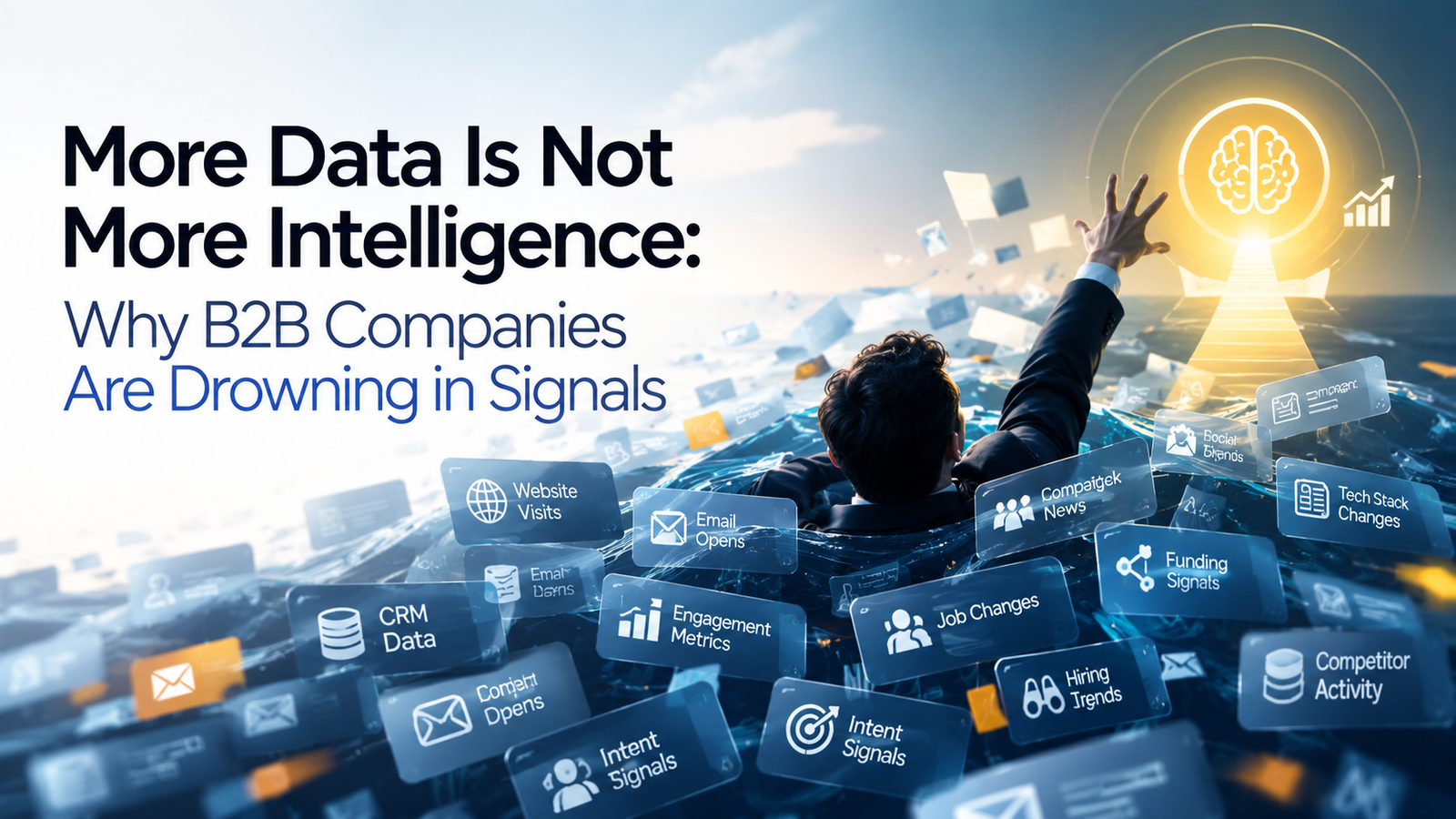
B2B companies have never had access to more information than they do today. Every interaction can generate a signal: a website visit, content download, email open, product page view, webinar registration, job posting, funding announcement, executive appointment, technology change, social engagement, search behaviour, or a shift in how an organization communicates its priorities.
On paper, this should make B2B growth easier. If companies can collect more information about their markets and potential customers, they should be able to make better decisions. Yet the opposite is often happening. Sales and marketing teams are surrounded by dashboards, CRM records, intent platforms, engagement reports, enrichment tools, analytics platforms, and automated alerts, while still struggling to answer a basic question: where should we focus our attention right now?
The problem is no longer a lack of data. The problem is understanding what that data actually means. This is where B2B Signal Intelligence becomes important. Instead of treating every activity as an isolated event, businesses can look at multiple signals together, add context, and identify which changes may actually deserve attention.
Data Is Everywhere. Intelligence Is Not.
The difference between data and intelligence is simple but important.
Data tells you that something happened. Intelligence helps you understand why it happened, whether it matters, and what you should do next.
A company visiting your website is data. Understanding that the same company has recently entered a new market, is hiring aggressively in a relevant function, has changed its technology stack, and is repeatedly researching a problem connected to your solution is much closer to intelligence.
The individual signals matter, but the context around them matters more.
Effective B2B Signal Intelligence should help teams move from collecting events to understanding patterns.
- Data: A company downloads a report.
- Signal: The company repeatedly engages with content around the same business problem.
- Context: The company is also undergoing a relevant organizational or strategic change.
- Intelligence: There may be a timely reason for sales to investigate the account.
The final conclusion still requires human judgment. But the quality of that judgment can improve when the salesperson starts with a more complete picture.
The Signal Overload Problem in B2B –
Imagine a sales team responsible for hundreds or thousands of accounts.
Every morning, the team could receive dozens of alerts about prospects visiting websites, interacting with content, changing roles, publishing announcements, or showing some form of digital activity.
These alerts are supposed to make salespeople more informed. Instead, they can create another layer of noise.
When everything is presented as important, nothing feels important.
Over time, salespeople may stop paying attention to alerts altogether or simply respond to whichever signal appears most recently. The technology has increased the amount of information available to the team without necessarily improving the team’s ability to make decisions.
This is the core of the signal overload problem.
The challenge is not collecting more signals. It is determining which signals are meaningful when viewed in context.
Why Individual B2B Intent Signals Can Be Misleading –
Signals do not exist in isolation. Business decisions happen within a larger context.
A company downloading a report could be conducting genuine research. It could also be an employee casually exploring an industry topic.
A senior executive visiting a product page might indicate interest. It could also be routine research.
A company hiring twenty salespeople might indicate an aggressive growth strategy. It could also simply be replacing an existing team.
The signal itself is not the conclusion. It is evidence.
That distinction matters because many B2B strategies can accidentally turn an activity into an assumption about demand.
Strong B2B Signal Intelligence should therefore help teams ask better questions:
- What changed?
- Is the change meaningful?
- What other signals support it?
- Does the account’s current situation make the signal more relevant?
- What should sales or marketing investigate next?
The goal is not to predict a purchase with certainty. It is to identify situations where further attention may be justified.
Why Adding More Data Does Not Always Solve the Problem –
The traditional response to limited information has been to collect more of it.
If ten signals are not enough, perhaps fifty will be.
If one database does not provide sufficient information, perhaps three more should be added. If one intent provider shows account activity, another provider can be added to provide additional coverage.
This sounds logical, but it can create diminishing returns.
More sources can produce more coverage, but they can also introduce:
- Duplicate information
- Conflicting data
- False positives
- Additional operational complexity
- More dashboards and alerts to manage
- Greater difficulty deciding what actually matters
Eventually, teams can spend more time managing information than using it.
The objective should not be to know everything about every company. That is neither practical nor necessary.
The objective is to identify the information that can materially improve a business decision.
How AI Can Turn Signals Into B2B Intelligence –
This is where AI can fundamentally change the role of data in B2B growth.
The most valuable application of AI is not simply summarizing another dashboard or automatically generating an email from a company description. It is helping organizations connect information that would otherwise remain fragmented.
An AI-powered system can potentially examine changes across multiple dimensions of an account, identify relationships between those changes, and surface patterns that would be difficult for an individual salesperson to identify manually.
Instead of giving teams thousands of disconnected data points, the goal is to surface a smaller number of meaningful insights.
That is a very different proposition from simply automating repetitive tasks.
From Alerts to Actionable Context –
Consider the difference between these two scenarios.
Scenario one:
A salesperson receives an alert saying that a company visited the website.
Scenario two:
The salesperson sees that the company has recently expanded into a new geography, is hiring for a function related to the company’s offering, has experienced a leadership change, has been researching a relevant category, and has shown increasing engagement with specific business content.
The second scenario does not guarantee that the company is ready to buy.
But it gives the salesperson something more valuable than a notification: a reason to investigate.
It creates a hypothesis about what may be happening inside the account.
The salesperson can then validate that hypothesis through additional research and conversation.
Technology is not replacing judgment. It is helping judgment start from a better-informed position.
B2B Signal Intelligence Can Improve Account Prioritization –
This also changes how sales and marketing teams should think about account prioritization.
For years, many organizations have relied heavily on static characteristics such as:
- Industry
- Revenue
- Employee count
- Geography
- Job title
- Company size
These attributes remain useful, but they primarily describe what a company is.
They do not necessarily tell you what is happening to that company right now.
A company can fit your ideal customer profile perfectly and still have no reason to engage with you this quarter.
Another company may not look like the obvious target based on static characteristics but could suddenly become highly relevant because of a strategic change.
The ability to recognize that difference can significantly change how efficiently sales and marketing resources are allocated.
From Static Targeting to Dynamic Understanding –
The future of B2B demand generation will require a shift from static targeting to dynamic understanding.
Markets are not static. Companies are not static. Buying priorities are not static.
A target account should not simply be a row in a CRM system that remains unchanged until someone manually updates it. It should be viewed as a moving business environment where new information can continually change the relevance of an account.
This is particularly important in complex B2B markets where purchasing decisions can take months and where the circumstances that create demand may emerge long before a formal buying process begins.
Dynamic account understanding can help teams recognize:
- Changes in company strategy
- Shifts in organizational priorities
- Relevant leadership changes
- Hiring patterns
- Technology changes
- Emerging areas of research and engagement
- Combinations of signals that deserve further investigation
The goal is not to react to every change.
It is to recognize the changes that may actually matter.
What B2B Companies Should Look for in Signal Intelligence –
As organizations evaluate AI-powered sales and marketing technologies, the important question should not simply be, “How much data does this platform provide?”
A better question is: “Can this technology help us understand what the data means?”
A useful B2B Signal Intelligence approach should help organizations move through a clear progression:
- Collect relevant signals across available sources.
- Connect related signals instead of treating every event independently.
- Add business context to understand why a change may matter.
- Prioritize meaningful accounts based on current circumstances.
- Give sales and marketing teams a reason to act.
- Keep human judgment in the loop to validate assumptions.
This changes the role of technology from another information layer into a decision-support system.
The Role of AI-Powered Demand Generation –
At Proffer.ai, this is the thinking behind the idea of an AI-powered demand generation engine.
The opportunity is not to add another source of data to an already crowded technology stack.
It is to make the information businesses already have, along with the signals they continue to generate, more actionable.
Demand generation should increasingly be about connecting the dots between market activity, company changes, buyer behaviour, and business context.
When those dots are connected intelligently, data stops being something teams simply collect and starts becoming something they can use to make better decisions.
This is particularly valuable for B2B organizations where sales teams cannot realistically investigate every account, every signal, and every market change manually.
AI can help narrow the field.
Human teams can then apply judgment where it matters most.
Conclusion –
B2B companies do not necessarily need more signals.
They need better ways to understand the signals they already have.
The companies that win in an increasingly data-rich environment will not necessarily be the ones with the largest databases or the most dashboards. They will be the ones that can separate meaningful signals from background noise, understand the context behind those signals, and act when that context changes.
That is the real difference between being data-rich and intelligence-driven.
Data can tell you what happened. B2B Signal Intelligence helps you understand what it could mean.
And in B2B, where timing, context, and relevance can determine whether a conversation happens at all, that difference can become a meaningful competitive advantage.
Frequently Asked Questions
B2B Signal Intelligence is the process of connecting and interpreting multiple business, account, buyer, and market signals to identify meaningful patterns and support better sales and marketing decisions.
Intent data typically identifies specific activities or behaviours that may indicate interest. B2B Signal Intelligence goes further by combining intent signals with other account and business context to help teams understand what those activities may mean.
More data can create duplicate information, conflicting signals, false positives, and alert fatigue. Without a way to prioritize and interpret the information, additional data can make decision-making more difficult rather than easier.
Yes. AI can help analyze multiple signals and identify patterns that may deserve attention. The resulting insight can help sales teams prioritize their research and conversations, while human judgment remains important for validating the opportunity.
Examples include website activity, content engagement, hiring activity, leadership changes, funding announcements, technology changes, market expansion, search behaviour, and changes in organizational priorities.Examples include website activity, content engagement, hiring activity, leadership changes, funding announcements, technology changes, market expansion, search behaviour, and changes in organizational priorities.