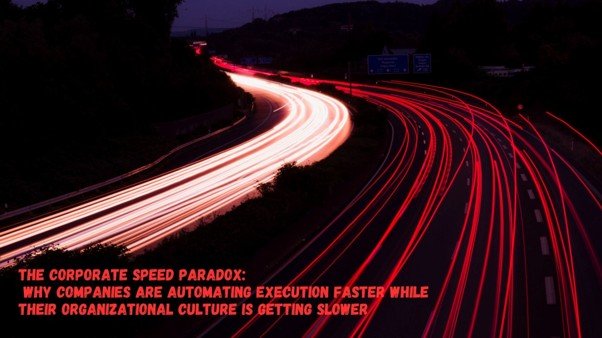
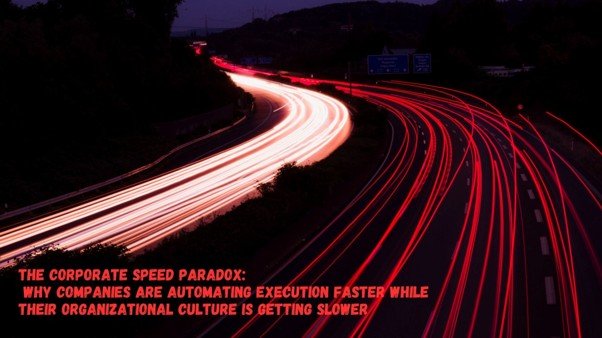
Modern enterprises have become remarkably good at making individual tasks happen faster. Software can automate approvals, AI can draft documents, workflows can trigger themselves, and data can move between systems with little human intervention. Employees can now complete routine activities in minutes that once required hours. Yet many organizations still struggle with a different kind of slowness: the Corporate Speed Paradox.
The Corporate Speed Paradox occurs when technology dramatically accelerates execution while the organization itself remains constrained by slow decisions, approval layers, departmental dependencies, and risk-averse behaviors. A company may have sophisticated automation and powerful AI capabilities while still taking days or weeks to turn an opportunity into action. This is the central challenge of the Corporate Speed Paradox: technological capability can advance faster than organizational decision-making.
This distinction between execution speed and organizational speed is at the heart of the Corporate Speed Paradox and is becoming increasingly important for B2B enterprises. Technology can accelerate individual activities, but competitive advantage depends on how quickly the entire organization can recognize change, make decisions, and respond. The next phase of digital transformation is therefore not simply about automating more work. It is about removing the organizational friction that prevents automated work from creating enterprise-level speed.
What Is the Corporate Speed Paradox?
The Corporate Speed Paradox describes the gap between how quickly technology enables individual tasks to be completed and how quickly an organization can actually make and execute decisions.
Consider a marketing team launching a new campaign. Modern marketing platforms can automate campaign creation, audience segmentation, personalization, reporting, and distribution. The technical execution may take minutes. But if the campaign still requires approval from marketing leadership, legal, finance, brand, sales, and other stakeholders, the overall process remains slow.
The same problem can occur across an enterprise:
- AI can create a proposal in seconds, but leadership may take weeks to approve it.
- Sales teams can identify customer opportunities instantly, but pricing exceptions may require multiple approvals.
- Product teams can develop updates quickly, but launches may depend on several internal stakeholders.
- Employees can generate detailed business analyses rapidly, but decisions may still wait for a scheduled management meeting.
The technology is fast. The organization is not.
That distinction matters because customers, competitors, and markets experience the organization as a single system. They do not see which internal department is causing a delay. They simply experience the company’s response time.
Why the Corporate Speed Paradox Matters for Enterprise Speed
Businesses often measure the parts of a workflow that are easiest to quantify. They track processing times, automation rates, response times, productivity, and task completion.
These metrics are useful, but they can hide a larger problem.
The more strategically important question is:
How much time passes between identifying an opportunity and actually acting on it?
That elapsed time represents organizational speed.
An enterprise might reduce a five-hour manual process to five minutes through automation. That sounds like a major improvement. But if the resulting output spends three days waiting for approvals, the organization has not achieved a comparable improvement in end-to-end speed.
The difference between task speed and organizational speed
Think of enterprise speed across three stages:
- Information — The organization identifies something that requires attention.
- Decision — Someone with appropriate authority determines what should happen.
- Action — The organization executes the decision.
Technology has become exceptionally effective at accelerating information processing and action. The middle stage—decision-making—often remains heavily dependent on people, hierarchy, meetings, and organizational processes.
That makes decision-making a critical source of enterprise friction.
1. Identify and Measure Decision Latency
One of the most powerful ways to address the Corporate Speed Paradox is to measure something many organizations overlook: decision latency.
Decision latency is the time between recognizing that a decision is required and actually making that decision.
Traditional operational metrics might tell a company how quickly an employee processes a request. Decision latency asks a different question: How long did the organization take to decide what to do?
Organizations should examine:
- How long important decisions typically remain unresolved
- Where decisions spend the most time waiting
- Which decisions require executive escalation
- How frequently meetings are required to resolve issues
- Which approvals consistently create delays
- How many decisions could be delegated without materially increasing risk
This creates visibility into organizational bottlenecks that conventional productivity metrics can miss. Measuring decision latency makes the Corporate Speed Paradox visible in operational terms. It shows whether an organization is genuinely becoming faster or simply completing individual tasks more efficiently.
2. Reduce Approval Bottlenecks in the Corporate Speed Paradox
Approval processes usually exist for good reasons.
Finance needs spending controls. Legal teams manage regulatory and contractual risk. Security teams protect systems and information. Brand teams maintain consistency. Executives need visibility into important strategic decisions.
The problem emerges when these controls accumulate without being periodically redesigned.
A process that originally required one approval may eventually require several because additional stakeholders were added after previous incidents or organizational changes. Each individual approval can appear reasonable while the entire chain becomes inefficient.
This creates a critical enterprise challenge: local optimization can produce system-wide slowness. Without this redesign, automation can continue accelerating individual tasks while the Corporate Speed Paradox remains embedded in the approval structure.
Review approval processes based on risk
Not every decision deserves the same level of scrutiny.
Organizations can classify decisions according to factors such as:
- Financial impact
- Reversibility
- Customer impact
- Security implications
- Legal or regulatory exposure
- Strategic importance
High-risk and difficult-to-reverse decisions may appropriately require multiple levels of review.
Lower-risk and reversible decisions can often move closer to the teams responsible for execution.
The objective is not to eliminate controls. It is to make sure the level of control matches the level of risk.
3. Use Decision Rights to Break the Corporate Speed Paradox
Technology cannot solve unclear authority.
If employees do not know who can approve an action, they will naturally escalate decisions. If managers are uncertain about their authority, they may escalate further. Eventually, senior executives become the final decision point for issues that should have been resolved much earlier.
This creates what can be called approval scarcity.
The organization has plenty of software, data, automation, and employee capacity—but too few people are authorized to make decisions. Clear decision rights are therefore one of the most practical ways to reduce the Corporate Speed Paradox without removing necessary management oversight.
Create clearer decision rights
Enterprise leaders should explicitly define:
- Who owns a decision
- Who provides input
- Who must approve it
- Which decisions can be delegated
- Which decisions require escalation
- When escalation is mandatory
Clear decision rights reduce ambiguity and prevent teams from turning every disagreement into another meeting.
The goal is not to remove leadership oversight. It is to ensure leadership attention is reserved for decisions where it creates the most value.
4. Design AI Around Decision Velocity, Not Just Productivity
Generative AI has made the Corporate Speed Paradox more visible. AI can dramatically reduce the time required to produce presentations, proposals, research summaries, emails, analyses, documentation, and other business content.
AI can dramatically reduce the time required to produce presentations, proposals, research summaries, emails, analyses, documentation, and other business content. AI agents can also potentially coordinate multiple steps in a workflow.
But faster content generation does not automatically produce faster business outcomes.
Imagine an AI system producing ten strategic recommendations overnight. If executives review those recommendations only during a monthly meeting, the organization’s decision cycle has barely changed.
In fact, AI can create a new bottleneck by increasing the volume of potential work faster than the organization can evaluate and approve it. This makes the Corporate Speed Paradox particularly important in the age of enterprise AI. As AI accelerates the creation of information and recommendations, organizations must also accelerate their ability to evaluate and act on them.
Use AI to compress the decision cycle
Enterprise AI strategies should therefore look beyond task automation.
AI can potentially help organizations:
- Summarize relevant information before a decision
- Identify exceptions requiring human judgment
- Prepare decision briefs
- Surface potential risks
- Compare available options
- Route decisions to the appropriate authority
- Automate routine decisions within defined boundaries
- Track decisions and follow-up actions
The important question is not simply:
“How much work can AI automate?”
A more strategic question is:
“How much time can AI remove from the path between information, decision, and action?”
5. Design Workflows Around Parallel Execution
Another source of organizational slowness is sequential work.
Department A completes its task. Then Department B begins. Then Department C reviews the output. Another team waits for a response before starting its own activity.
This creates unnecessary dependencies.
Modern technology makes it increasingly possible to redesign workflows so that multiple teams work simultaneously where appropriate.
For example, during a product launch:
- Product can finalize technical requirements.
- Marketing can prepare messaging.
- Sales can prepare enablement materials.
- Legal can review relevant claims.
- IT can prepare supporting systems.
Not every activity has to wait for the previous activity to finish.
Look for unnecessary dependencies
When reviewing a business process, ask:
- Does this task genuinely need to happen before the next task?
- Can two departments work simultaneously?
- Can information be shared earlier?
- Can an approval be replaced with a notification?
- Can a decision be made once rather than repeatedly?
- Can automation route exceptions instead of sending every case through the same workflow?
Removing unnecessary dependencies can create more organizational speed than simply making individual tasks faster.
6. Build a Culture That Rewards Intelligent Action
Organizational speed is not purely a process or technology problem. It is also a cultural issue.
Companies often unintentionally reward employees for avoiding mistakes more strongly than they reward them for making timely decisions.
In risk-sensitive environments, employees can learn that taking an unconventional action creates personal exposure while waiting for approval is safer.
That produces predictable behavior.
Employees escalate. Managers defer. Teams schedule meetings. Decisions remain unresolved.
Eventually, slowness becomes rational behavior for individuals even when it is harmful to the organization.
Make experimentation safer
One way to improve decision velocity is to distinguish between reversible and irreversible decisions.
A reversible decision can be tested, monitored, and changed if necessary. An irreversible or high-impact decision may deserve substantially more scrutiny.
This creates room for intelligent experimentation.
Instead of asking employees to eliminate risk, leadership can ask:
What is the smallest responsible action we can take to learn more?
That mindset allows organizations to move faster without treating every decision as consequence-free.
7. Treat Automation as an Opportunity to Redesign the Process
Automation should not simply make an existing process faster.
It should also trigger a more fundamental question:
Does this process still need to exist in its current form?
This is one of the most important implications of the Corporate Speed Paradox.
Automating a poorly designed process can preserve unnecessary approvals, redundant data entry, excessive handoffs, and outdated responsibilities. The organization ends up with a highly efficient version of an inefficient system.
Use automation projects to challenge old assumptions
Before automating a workflow, enterprise teams should ask:
- Why does this step exist?
- Who benefits from it?
- What risk does it actually control?
- Can the step be eliminated?
- Can it be combined with another step?
- Can the decision be delegated?
- Can technology replace the manual handoff?
- What happens if this step is removed entirely?
The best automation projects often involve process simplification before process automation.
The Corporate Speed Paradox in B2B Businesses
The implications are particularly significant for B2B organizations.
Modern buyers can research vendors, compare solutions, evaluate alternatives, and gather information without waiting for a traditional sales process to provide every detail. For B2B organizations, the Corporate Speed Paradox can directly affect how quickly prospects and customers experience value. Internal approval delays may be invisible to employees, but they become visible to customers through slower proposals, pricing decisions, technical responses, and contract processes.
That changes customer expectations.
A prospect may receive instant information from one vendor while waiting days for another. A buyer may find a competitor that can provide pricing guidance quickly while another organization requires several internal approvals.
The customer does not experience the company’s organizational chart.
They experience the response.
Where organizational speed affects the B2B customer experience
Organizational friction can appear in:
- Pricing approvals
- Contract negotiations
- Technical responses
- Security questionnaires
- Customized proposals
- Product configuration
- Proof-of-concept requests
- Procurement processes
- Customer escalations
- Implementation decisions
A company may have excellent technology and highly capable employees but still appear slow because its internal decision architecture creates delays.
This makes organizational speed an increasingly important component of the B2B customer experience.
Why Faster Technology Can Expose Slower Organizations
The Corporate Speed Paradox becomes even more visible when technology accelerates one part of the organization while another part remains slow. Technology creates an interesting feedback effect.
When one part of an organization becomes dramatically faster, the remaining slow parts become more visible.
Suppose an AI system reduces research time from hours to minutes. The employee can now produce analysis much faster. If leadership still takes several days to review it, the approval delay becomes more obvious.
Similarly, if sales intelligence identifies a customer opportunity immediately but pricing approval takes several days, the pricing process becomes the bottleneck.
This produces speed differentials across the organization.
The enterprise becomes a collection of fast and slow components rather than a consistently fast system—the organizational reality at the heart of the Corporate Speed Paradox.
The bottleneck moves
This is why digital transformation cannot be evaluated only by looking at individual automation wins.
Every improvement can move the bottleneck somewhere else.
A company might automate:
- Data collection
- Analysis
- Reporting
- Recommendation generation
But if decision approval remains manual, the bottleneck has simply moved to the approval stage.
The next improvement should therefore target the new constraint rather than continue optimizing processes that are already fast.
Should Every Business Decision Be Faster?
No.
The objective of organizational speed is not maximum speed.
Some decisions should be deliberately slow.
Financial commitments, major strategic decisions, security changes, legal matters, and other high-impact activities may require careful analysis and multiple levels of review.
The goal is to distinguish between valuable friction and accidental friction.
Necessary friction vs. unnecessary friction
Necessary friction protects the business from meaningful risk.
Unnecessary friction exists because of historical processes, unclear authority, outdated workflows, or organizational habits.
A mature enterprise should know the difference.
Some decisions may appropriately take hours. Others may require days. A smaller number may deserve weeks of analysis.
The strategic advantage comes from knowing which is which.
How Leaders Can Build a Faster Enterprise
Creating organizational speed requires more than telling teams to “move faster.” Leadership needs to redesign the conditions under which decisions are made.
A practical approach is to start with the organization’s most consequential workflows rather than attempting to transform everything simultaneously.
Start with high-value bottlenecks
Identify processes where delays directly affect:
- Revenue opportunities
- Customer experience
- Product launches
- Operational efficiency
- Competitive responsiveness
- Employee productivity
Then map the journey from information to decision to action.
Look for the moments where work waits rather than executes.
Ask five questions
For each major bottleneck, ask:
- Who owns the decision?
- Why does the approval exist?
- What risk does it control?
- Could the decision be delegated?
- Could technology remove the waiting time?
These questions help separate technology problems from organizational design problems.
From Task Automation to Enterprise Velocity
The next stage of enterprise automation will require a broader definition of productivity.
It is no longer enough to ask whether employees can complete individual tasks faster.
Organizations should also consider whether the business can move faster as a system.
That means connecting automation with:
- Clear decision rights
- Simplified workflows
- Appropriate delegation
- Parallel execution
- Risk-based approvals
- AI-assisted decision support
- Faster escalation paths
- Continuous process redesign
The result is not simply a faster employee or a faster software platform.
It is a faster organization.
Conclusion
The Corporate Speed Paradox reveals a fundamental challenge in modern digital transformation: technology can accelerate execution without accelerating the organization itself.
Enterprises can deploy AI, automate workflows, integrate systems, and dramatically reduce the time required to complete individual tasks. Yet if decisions continue to move through unnecessary approval layers, departments remain dependent on sequential handoffs, and employees are rewarded for avoiding action rather than exercising judgment, organizational speed will remain constrained.
The solution is not to eliminate every control or pursue speed at all costs. It is to redesign the relationship between technology, decision rights, processes, and organizational culture.
The fastest enterprise will not necessarily be the company with the most automation. It will be the company that can move efficiently from information to decision to action while applying the right amount of scrutiny to each situation.
Technology has already made execution faster. The next competitive advantage will come from making the organization itself capable of keeping up.
Frequently Asked Questions
1. What is the Corporate Speed Paradox?
The Corporate Speed Paradox describes the situation where technology makes individual tasks and workflows faster while organizational decision-making remains slow because of approvals, hierarchy, dependencies, and risk-averse processes.
2. Why does automation not always make companies faster?
Automation can accelerate individual activities without removing upstream or downstream bottlenecks. If an automated task still requires several approvals or waits for a management decision, overall organizational speed may remain unchanged.
3. What is decision latency?
Decision latency is the time between recognizing that a decision needs to be made and the point at which the organization actually makes that decision. High decision latency can become a major bottleneck in enterprise operations.
4. How does AI affect organizational speed?
AI can dramatically accelerate information processing, content creation, analysis, and workflow execution. However, its benefits can be limited when organizations lack the decision-making capacity or authority to act on AI-generated outputs quickly.
5. What is approval scarcity?
Approval scarcity occurs when too many decisions depend on a limited number of authorized decision-makers. Senior executives and managers can become bottlenecks when decisions that could be delegated continue flowing upward.
6. Should companies eliminate approval processes?
No. Approval processes can provide important financial, legal, security, and strategic controls. The goal is to remove unnecessary approvals and align the level of review with the risk, impact, and reversibility of the decision.
7. How can businesses improve organizational speed?
Businesses can improve organizational speed by measuring decision latency, clarifying decision rights, reducing unnecessary approval layers, redesigning sequential workflows, delegating appropriate decisions, and using automation and AI to reduce waiting time.
8. Why is organizational speed important for B2B companies?
B2B buyers increasingly expect responsive digital experiences. Slow pricing approvals, technical responses, proposals, contracts, or customer decisions can create friction and give competitors an opportunity to move faster.
9. Is organizational speed the same as productivity?
No. Productivity generally focuses on how efficiently work is performed. Organizational speed focuses on how quickly the entire business can move from recognizing an opportunity or problem to making a decision and taking action.
10. What is the biggest lesson of the Corporate Speed Paradox?
The biggest lesson is that faster technology does not automatically create a faster organization. Sustainable enterprise speed requires technology to be combined with clear decision rights, streamlined processes, appropriate risk controls, and a culture that supports intelligent action.