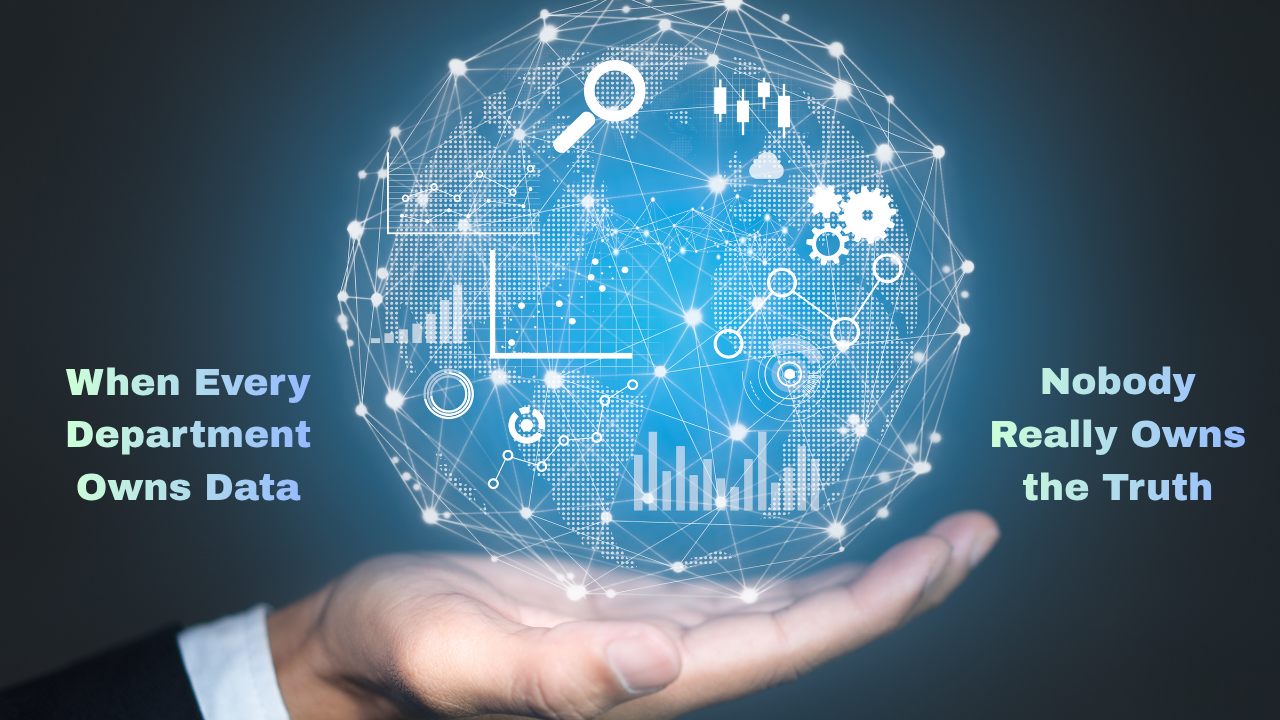
Data ownership is becoming one of the most important foundations of reliable decision-making in modern enterprises. Most organizations do not suffer from a lack of data. Sales has customer information, marketing has campaign data, finance manages revenue records, HR maintains employee information, and operations tracks business performance. The challenge is that these teams may not always define, maintain, or interpret information in the same way.
That creates a fundamental enterprise problem: everyone has data, but nobody necessarily owns the complete definition of the truth. Different departments can produce legitimate reports from legitimate systems while reaching different conclusions about the same business metric. What looks like a technology problem is often a problem of ownership, definitions, processes, and governance.
For business leaders, this distinction matters. A dashboard cannot create trustworthy information if the underlying data is inconsistent. An integration platform cannot resolve unclear business definitions by itself. And AI cannot automatically turn fragmented information into reliable insight. Enterprises need clear ownership and governance before technology can deliver its full value.
1. Establish Clear Data Ownership Across the Enterprise
Data ownership should be more specific than simply saying, “IT owns the data.”
IT may be responsible for the infrastructure that stores, protects, processes, and moves information. However, the business function that understands a particular dataset may need to own its definition and quality.
For example, finance may be responsible for financial information, sales may own opportunity-related data, HR may own employee records, and operations may be accountable for specific operational metrics. IT can provide the architecture and controls that connect these datasets.
Effective data ownership should clarify:
- Who defines a data element or business metric?
- Who maintains the information?
- Who validates its accuracy?
- Who can modify it?
- Which system is authoritative?
- Who is accountable when quality declines?
Without these responsibilities, data ownership becomes ambiguous. When problems occur, teams can spend more time determining who is responsible than fixing the underlying issue.
Why ownership matters
Clear ownership creates accountability. It also makes it easier for employees to understand where information comes from and which source should be trusted.
The objective is not to give one department control over all enterprise information. It is to create clear responsibility for critical datasets and metrics.
2. Create Consistent Definitions for Critical Business Metrics
One of the most common sources of enterprise data conflict is not incorrect information. It is different definitions.
Consider the seemingly simple question: How many customers does the company have?
Sales might count organizations with active opportunities. Finance might count organizations that have completed transactions. Marketing could include prospects at a particular lifecycle stage, while customer success might count only accounts currently receiving services.
Each definition can be valid within its own business context. The problem occurs when leadership assumes that all four teams are reporting the same metric.
This is why organizations need shared definitions for critical business concepts.
Examples may include:
- Customer
- Active account
- Revenue
- Pipeline
- Churn
- Employee
- Product
- Qualified lead
- Profitability
A shared business glossary or data dictionary can help document these definitions and make them accessible across departments.
When everyone understands what a metric means, meetings can focus on business decisions rather than arguments over whose number is correct.
3. Build a Single Source of Truth Without Forcing One System
A single source of truth does not necessarily mean that every department must use the same application.
Different business functions have different requirements. Specialized CRM, ERP, HR, marketing, finance, operations, and analytics platforms can all serve legitimate purposes.
The goal is consistency where consistency matters.
An organization can operate multiple systems while maintaining a reliable enterprise view if it establishes rules for:
- Which system is authoritative for specific information
- How data moves between systems
- Which definitions apply across departments
- How conflicting information is resolved
- How frequently important data is updated
- Who is responsible for maintaining the information
This approach allows departments to retain specialized tools without creating disconnected versions of the business.
The real question is not, “Do we have one system?”
It is, “Do we know which information to trust and why?”
4. Treat Data Governance as a Business Discipline
Data governance is often viewed as an IT responsibility. That approach is too narrow.
Governance affects business decisions, operational processes, compliance, reporting, customer experiences, and strategic planning. It therefore requires participation from both business and technology leaders.
A practical governance framework should answer questions such as:
- Who owns this data?
- What does this metric mean?
- Which system is authoritative?
- How often should the information be updated?
- Who is permitted to change it?
- What happens when systems disagree?
- How is data quality monitored?
- Which information should be shared across departments?
- What data requires additional security or access controls?
These questions may not appear as exciting as deploying a new analytics platform or AI solution. Yet they determine whether those technologies can produce trustworthy results.
Strong governance turns data from a collection of departmental assets into an enterprise resource that can support consistent decisions.
5. Reduce Data Fragmentation and Manual Workarounds
Poor data governance often reveals itself through operational workarounds.
Employees create spreadsheets because they do not trust centralized reports. Managers maintain personal trackers because dashboards do not provide the information they need. Analysts spend hours cleaning data before producing reports. Teams manually transfer information between systems because integrations are incomplete.
These workarounds can become so common that organizations begin treating them as normal business processes.
The hidden cost can include:
- Repeated manual reconciliation
- Delayed reporting
- Duplicated work
- Conflicting reports
- Inaccurate forecasting
- Employee frustration
- Slower decision-making
- Reduced confidence in enterprise systems
The challenge is that these costs are not always visible as a single line item on a financial statement. They are distributed across departments and processes.
For enterprise leaders, identifying these hidden costs is an important part of understanding the business value of better data ownership.
6. Use Technology to Support Governance—Not Replace It
Modern technology can significantly improve enterprise data management.
Integration platforms can connect systems. Data warehouses can consolidate information. Master data management solutions can help organizations manage important business entities. Analytics platforms can surface patterns and inconsistencies. Automation can reduce repetitive data-management tasks.
These technologies are valuable, but they cannot make business ownership decisions on their own.
For example, a system may identify two customer records that appear to represent the same organization. It may detect duplicate information or inconsistent fields. But technology may not know which business definition should take priority or which department should be accountable for maintaining the record.
This distinction is critical.
Technology can help organizations:
- Identify duplicate or inconsistent records
- Connect information across systems
- Automate data-quality processes
- Monitor data for anomalies
- Improve visibility across departments
- Surface inconsistencies for investigation
But governance determines the rules those technologies operate under.
The best enterprise data strategy therefore combines technology with clearly defined business accountability.
7. Make Data Ownership a Foundation for Reliable AI
The importance of data ownership becomes even greater as organizations adopt AI.
Businesses are increasingly using AI to analyze information, generate reports, identify trends, support decisions, and automate processes. But AI systems still depend on the information they receive.
If customer records conflict, definitions vary across departments, or important information is outdated, AI can process those inconsistencies at scale without necessarily understanding the business context behind them.
That creates a potential problem: organizations may make decisions faster without necessarily making them better.
AI therefore increases the importance of data quality and governance rather than eliminating it.
Before asking how intelligent an AI system can become, organizations should also ask:
- Is the underlying data trustworthy?
- Are critical business definitions consistent?
- Can the organization identify authoritative sources?
- Are data owners clearly assigned?
- Can conflicting information be traced and resolved?
- Is the information current enough for the intended use?
Reliable AI requires reliable information foundations.
The Business Impact of Trusted Data Ownership
When departments operate with conflicting information, the problem extends beyond reporting.
It can affect forecasting, customer management, profitability analysis, operational planning, workforce reporting, and strategic decision-making.
A sales leader may spend time reconciling CRM data with finance. A marketing team may use outdated customer segments. Finance may manually reconcile information from multiple systems. Executives may delay decisions because they do not trust the numbers available to them.
Over time, these issues create organizational friction.
Teams can become protective of their datasets. Meetings may shift from discussing what the data means to debating which dataset should be believed. Employees may lose confidence in centralized systems and develop their own reporting processes.
This is why data ownership is ultimately a business issue, not simply a technical one.
How Enterprises Can Build Better Data Ownership
Organizations do not need to redesign every system at once. A practical approach is to start with the information that has the greatest impact on business decisions.
Begin by identifying critical datasets and metrics. Then assign accountable owners, document definitions, establish authoritative systems, and create processes for resolving discrepancies.
A practical roadmap can include:
- Identify critical data: Determine which datasets and metrics are essential to business operations and decision-making.
- Assign ownership: Define who is accountable for each important dataset or business metric.
- Standardize definitions: Establish common meanings for critical enterprise terms.
- Identify authoritative sources: Determine which systems should be trusted for specific information.
- Define quality standards: Establish expectations for accuracy, completeness, consistency, and timeliness.
- Create conflict-resolution processes: Decide what happens when systems or departments disagree.
- Use technology strategically: Apply integration, automation, analytics, and data-management technologies to enforce and support the framework.
- Review continuously: Data ownership is not a one-time project. Business processes, systems, and information requirements change over time.
The objective is not perfect uniformity. It is dependable consistency around the information that matters most.
Why Data Ownership Will Matter More in the AI-Driven Enterprise
Organizations are moving toward increasingly automated and data-driven decision-making. As that happens, the quality of enterprise information becomes increasingly important.
A dashboard can make information easier to consume, but it cannot determine whether the underlying definition is correct. An AI model can analyze large volumes of information, but it cannot automatically establish which department owns a disputed metric. An integration platform can connect applications, but it cannot independently establish business accountability.
Human ownership and organizational governance remain essential.
The enterprises that benefit most from advanced technology will not necessarily be those with the largest number of platforms or the most sophisticated dashboards. They will be the organizations that understand where their critical information comes from, what it means, who owns it, and how it should be maintained.
Conclusion
Data ownership is ultimately about creating confidence in the information an organization uses to make decisions.
Enterprises do not need every department to use identical systems, eliminate every functional difference, or centralize every dataset. They need shared definitions, clear accountability, reliable data-quality practices, and agreed rules for determining which information should be trusted.
Technology can connect systems, automate processes, identify inconsistencies, and improve visibility. But technology alone cannot decide what a business metric means or who should be accountable for its accuracy.
As organizations become increasingly dependent on analytics, automation, and AI, trusted information becomes a strategic requirement. The goal is not simply to collect more data. It is to create an environment where employees and leaders can confidently work from the same business reality when it matters.
When every department maintains its own version of the truth, an organization becomes more fragmented—not more data-driven. Strong data ownership provides the structure needed to turn fragmented information into reliable enterprise intelligence.
Frequently Asked Questions
1. What is data ownership?
Data ownership is the assignment of clear responsibility for defining, maintaining, validating, and governing specific data or business metrics within an organization. It establishes who is accountable for data quality and how information should be managed.
2. Why is data ownership important for enterprises?
Data ownership helps organizations establish accountability, consistent definitions, and reliable information. It reduces confusion between departments and makes it easier for leaders to trust the data used for business decisions.
3. Is data ownership the same as data governance?
No. Data ownership is one component of data governance. Ownership defines accountability for specific information, while data governance provides the broader policies, standards, processes, and controls used to manage enterprise data.
4. Should IT own all enterprise data?
Not necessarily. IT typically manages the technology infrastructure used to store, protect, integrate, and process information. Business departments may need to own the definitions, quality, and business rules associated with their specific data.
5. How does data ownership help create a single source of truth?
Clear data ownership helps organizations establish common definitions, identify authoritative systems, and define processes for resolving conflicting information. This makes it possible for multiple systems to contribute to a consistent enterprise view.
6. Can technology solve data ownership problems?
Technology can support data ownership but cannot completely solve the organizational decisions behind it. Integration, automation, analytics, and data-management platforms can identify and manage inconsistencies, while business leaders must establish definitions, accountability, and governance rules.
7. How does data ownership affect AI?
AI depends on the quality and consistency of the information it receives. Clear data ownership and governance can help organizations provide AI systems with more reliable, consistent, and appropriately managed information.
8. What are common signs of poor data ownership?
Common signs include conflicting reports, multiple versions of the same metric, excessive spreadsheet use, manual data reconciliation, duplicate records, inconsistent definitions, and employees who do not know which system or report they should trust.
9. How can an organization improve data ownership?
Organizations can start by identifying critical datasets, assigning accountable owners, standardizing important definitions, identifying authoritative systems, establishing data-quality standards, and creating processes for resolving conflicts.
10. Does a single source of truth require one enterprise system?
No. Organizations can use multiple specialized systems and still maintain a reliable single source of truth when they have clear definitions, authoritative sources, ownership responsibilities, and processes for exchanging and reconciling information.