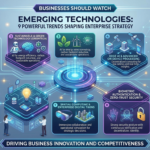
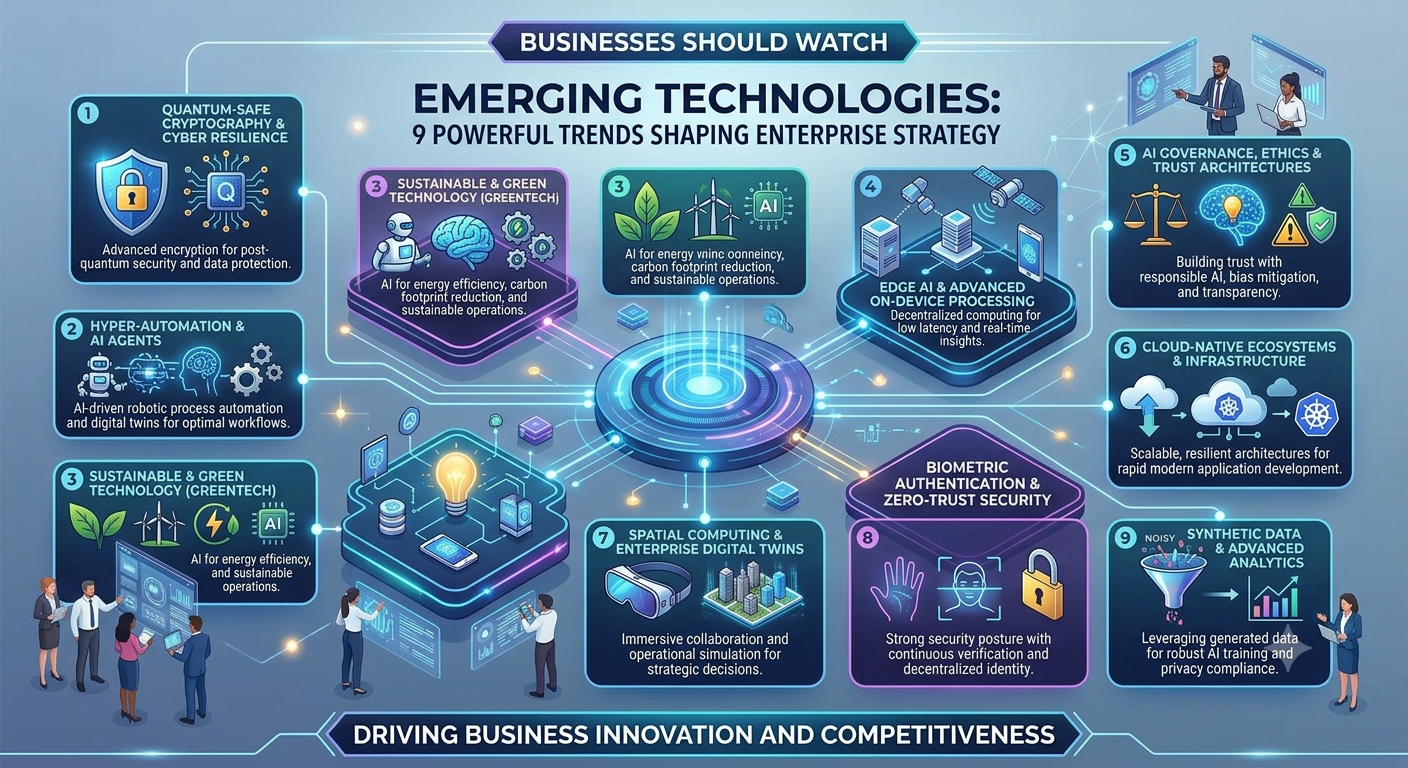
Emerging Technologies Businesses Should Watch are becoming an increasingly important part of enterprise strategy as organizations look for new ways to improve productivity, automate operations, strengthen security, and create better customer experiences. While not every emerging technology will become a mainstream business tool, understanding where technology is heading can help organizations make more informed investment and planning decisions.
The challenge for businesses is not simply identifying the newest technology. Leaders must determine which developments have practical applications, which problems they can solve, and how they fit into existing technology environments. A technology may be impressive in isolation but deliver limited business value if it lacks a clear use case or cannot integrate with existing systems. For technology leaders, Emerging Technologies Businesses Should Watch extend beyond artificial intelligence to include automation, intelligent infrastructure, cybersecurity, advanced computing, and technologies connecting physical and digital environments.
From AI agents and intelligent automation to edge computing, digital twins, robotics, and quantum technologies, several areas deserve closer attention. These technologies are developing at different rates, but together they illustrate how enterprise technology is moving toward more intelligent, connected, automated, and adaptive systems.
1. AI Agents: Emerging Technologies Businesses Should Watch
One of the most significant areas for businesses to watch is the development of AI agents. Unlike traditional software that performs predefined tasks, AI agents are designed to interpret objectives, interact with systems, make decisions within defined boundaries, and complete sequences of tasks.
For enterprises, this creates opportunities to rethink how repetitive knowledge-work processes are performed. Instead of using AI only to generate text or answer questions, organizations can explore how AI-powered systems can participate in workflows involving customer service, research, IT operations, document processing, and internal support.
Potential enterprise applications include:
- Automating multi-step administrative workflows
- Assisting customer service teams with case resolution
- Supporting IT service management processes
- Summarizing and analyzing large volumes of business information
- Coordinating tasks across enterprise applications
Businesses should also consider governance, permissions, security, human oversight, and auditability before deploying autonomous systems at scale.
Why Businesses Should Watch AI Agents
The important shift is from AI as an assistant to AI as a workflow participant. This could influence how organizations design processes, allocate human resources, and build enterprise applications.
Rather than asking only, “Where can we add AI?”, technology leaders may increasingly need to ask, “Which business processes could be redesigned around AI?”
2. Advanced Automation and Intelligent Process Orchestration
Automation has been part of enterprise technology for years, but emerging approaches are making automation increasingly intelligent and flexible.
Traditional automation typically follows clearly defined rules. Newer systems can combine AI, workflow engines, APIs, data platforms, and business rules to handle processes involving more variation and decision-making.
For example, an organization could build an automated workflow that receives a customer request, extracts relevant information, checks internal systems, determines the appropriate process, and routes the request to the correct team.
Business applications can include:
- Finance and accounts payable workflows
- Employee onboarding
- Procurement processes
- Customer support operations
- IT service management
- Compliance documentation
- Sales and marketing operations
The biggest opportunity may not be automating individual tasks but connecting multiple tasks into an integrated business process.
3. Edge Computing and Intelligent Infrastructure
As businesses deploy more connected devices, sensors, industrial systems, and real-time applications, processing information closer to where it is generated can become increasingly valuable.
Edge computing moves some computing and data-processing capabilities closer to devices, users, machines, or operational environments rather than relying entirely on centralized infrastructure.
This can be relevant to industries such as manufacturing, logistics, healthcare, retail, transportation, and energy.
Potential use cases include:
- Real-time equipment monitoring
- Industrial automation
- Connected retail environments
- Smart logistics operations
- Video and sensor analytics
- Remote infrastructure monitoring
Edge computing does not necessarily replace cloud infrastructure. In many enterprise environments, the two approaches can work together, with edge systems handling time-sensitive workloads while centralized platforms support broader analytics, storage, and management.
4. Digital Twins for Business and Operations
A digital twin is a digital representation of a physical asset, system, process, or environment that can be used for monitoring, analysis, simulation, or optimization.
Businesses can use digital twin concepts to create a more detailed digital view of physical operations. Instead of relying exclusively on historical reports, organizations can combine operational data with digital models to understand how systems behave under different conditions.
Potential applications include:
- Manufacturing equipment monitoring
- Facility management
- Supply chain modeling
- Product development
- Infrastructure planning
- Predictive maintenance
- Operational simulations
Digital Twins and Enterprise Decision-Making
The broader value of digital twins comes from connecting operational data with business decision-making. For example, a manufacturer could model production processes to examine the potential effects of equipment changes before making changes to the physical environment.
This makes digital twins particularly interesting for organizations managing complex physical operations.
5. Spatial Computing and Immersive Enterprise Applications
Spatial computing brings together digital information and physical environments through technologies such as advanced visualization, three-dimensional interfaces, and immersive computing experiences.
While consumer applications often receive attention, businesses can explore spatial technologies for professional and operational use cases.
Examples include:
- Virtual product demonstrations
- Employee training
- Remote technical assistance
- Engineering visualization
- Facility design
- Product development
- Collaboration across distributed teams
For enterprises, the key question is not whether immersive technology is visually impressive. It is whether a spatial interface can make a specific task easier, safer, faster, or more understandable than a conventional interface.
6. Robotics and Physical Automation
Robotics continues to expand beyond traditional industrial environments. Businesses are exploring robots for logistics, manufacturing, inspection, warehousing, delivery, and other physical processes.
The convergence of robotics with AI and computer vision is particularly important because it can enable machines to operate in environments that are less structured than traditional automated production lines.
Potential business applications include:
- Warehouse operations
- Inventory handling
- Manufacturing
- Inspection and quality control
- Agriculture
- Infrastructure maintenance
- Repetitive physical tasks
For organizations considering robotics, implementation should be approached as a broader operational transformation rather than simply purchasing machines. Infrastructure, workforce processes, safety requirements, maintenance, integration, and data management all influence the practical value of robotic systems. Emerging Technologies Businesses Should Watch are not equally mature, and their business value can vary significantly by industry. For this reason, organizations should evaluate each technology against specific operational challenges rather than adopting a technology simply because it is receiving attention in the market.
7. Quantum Computing and Post-Quantum Security
Quantum computing remains an emerging area, but businesses should understand its potential implications even when practical enterprise applications are still developing.
Quantum computing uses fundamentally different approaches to computation and may eventually affect certain categories of complex computational problems. Organizations in areas such as finance, pharmaceuticals, materials research, logistics, and scientific computing are among those that may have reasons to monitor developments closely.
At the same time, businesses should pay attention to post-quantum cryptography. Security teams need to consider how future advances in computing could affect existing cryptographic systems and long-term data protection strategies.
For most organizations, the immediate focus does not need to be building quantum computers. Instead, businesses can:
- Monitor developments in quantum computing
- Identify data requiring long-term protection
- Review cryptographic dependencies
- Track post-quantum security standards
- Discuss quantum readiness with technology and security teams
8. Cybersecurity Powered by AI
As enterprise environments become more distributed and complex, cybersecurity is also evolving.
AI can be used in security operations to analyze large volumes of information, identify patterns, assist with threat detection, and support security teams during investigations. At the same time, attackers can also use increasingly sophisticated technologies, creating a continuing need for stronger security practices.
Businesses should therefore consider AI security from two perspectives: using AI to improve defense and protecting AI-enabled systems themselves.
Important areas include:
- Automated security monitoring
- Threat detection and analysis
- Identity and access management
- AI application security
- Data protection
- Security operations automation
- Model and API security
Organizations adopting AI should treat security as part of the architecture rather than as a later-stage addition.
9. Intelligent Cloud and Hybrid Technology Platforms
Cloud computing continues to evolve as enterprises look beyond basic infrastructure hosting toward more intelligent and integrated technology platforms.
Modern enterprise environments may combine public cloud, private infrastructure, edge computing, SaaS applications, AI platforms, data platforms, and on-premises systems.
This makes hybrid technology architecture increasingly important for organizations with complex requirements.
Businesses should consider:
- Where data should be processed and stored
- Which workloads belong in the cloud or on-premises
- How applications communicate with each other
- How AI workloads are managed
- How infrastructure costs are controlled
- How security policies are applied consistently
The emerging opportunity is not simply moving everything to the cloud. It is creating an architecture where different technologies work together according to business requirements.
How Businesses Should Evaluate Emerging Technologies Businesses Should Watch
Tracking emerging technology is only the first step. The bigger challenge is determining whether a technology deserves investment.
Technology leaders can evaluate potential opportunities by considering the business problem first rather than starting with the technology itself.
A practical evaluation framework can include:
- Business value: What measurable or strategic problem could the technology address?
- Implementation complexity: How difficult would integration and deployment be?
- Technology maturity: Is the technology experimental, developing, or established enough for the intended use?
- Security: What new security risks could it introduce?
- Data requirements: What information, infrastructure, or data quality does it depend on?
- Integration: Can it work with existing enterprise systems?
- Workforce impact: What skills and organizational changes would be required?
- Scalability: Can a successful pilot expand across the organization?
- Governance: What controls are needed around access, decisions, data, and accountability?
This approach helps organizations distinguish between technology experimentation and technology that can support a genuine business objective.
Building an Emerging Technology Strategy
Businesses do not need to adopt every new technology. A better approach is to establish a structured process for identifying, testing, and evaluating emerging technologies.
A technology strategy can begin with a small number of clearly defined experiments. When evaluating Emerging Technologies Businesses Should Watch, organizations should begin with clearly defined business problems and measurable objectives. This allows IT and business teams to determine whether an emerging technology has practical value before expanding an experimental deployment. Teams can select business problems where new technology could potentially produce meaningful improvements, establish success criteria, and evaluate the results before considering broader deployment.
Organizations can also create an internal technology radar that categorizes technologies according to their maturity and relevance.
For example:
- Explore: Technologies worth researching and monitoring
- Experiment: Technologies suitable for controlled pilots
- Adopt: Technologies with validated business applications
- Review: Existing technologies that may need replacement or modernization
This gives technology leadership a repeatable way to manage innovation without treating every new technology announcement as an immediate investment opportunity.
The Role of IT Leaders in Emerging Technology Adoption
CIOs, CTOs, enterprise architects, and other technology leaders increasingly need to connect technology decisions with broader business objectives.
The responsibility is not simply to identify what is technically possible. Leaders must also understand operational requirements, security implications, financial considerations, workforce changes, and long-term architecture.
A successful emerging technology strategy therefore requires collaboration between IT and business teams.
Technology teams can provide technical feasibility and risk analysis, while business teams can define operational requirements and expected outcomes. Together, they can determine whether an emerging technology has a meaningful role in the organization.
What Businesses Should Watch Next
The technologies discussed above are developing at different speeds, and their practical business value will vary by industry and organization. Some may become foundational enterprise technologies, while others may remain specialized or require further development.
Rather than attempting to predict exactly which technology will dominate, businesses can focus on understanding the capabilities these technologies are introducing.
The broader trends are clear areas to monitor:
- More intelligent software and AI-powered workflows
- Greater automation across business operations
- More computing at the edge
- Increased integration between physical and digital environments
- More sophisticated robotics
- New approaches to cybersecurity
- Continued evolution of cloud and hybrid infrastructure
- Growing interest in advanced computing
Organizations that continuously evaluate these developments can make technology decisions based on business requirements rather than reacting to technology hype.
Conclusion
Emerging Technologies Businesses Should Watch are not important simply because they are new. Their significance comes from the problems they may help organizations solve and the ways they could change how businesses operate.
AI agents, intelligent automation, edge computing, digital twins, spatial computing, robotics, quantum technologies, AI-powered cybersecurity, and evolving cloud platforms each present different opportunities and challenges. The right approach depends on an organization’s industry, technology environment, security requirements, workforce, and strategic priorities.
For business and technology leaders, the goal should be to remain curious without becoming distracted by every new technology trend. By monitoring developments, testing practical use cases, measuring results, and establishing appropriate governance, organizations can create a more disciplined approach to technology innovation.
The businesses best positioned for technological change may not be those that adopt every emerging technology first. They may be those that understand new capabilities early, identify where they can create genuine value, and build the organizational and technical foundations needed to use them effectively.
Frequently Asked Questions
1. What are emerging technologies businesses should watch?
Emerging technologies businesses should watch include AI agents, intelligent automation, edge computing, digital twins, spatial computing, robotics, quantum computing, AI-powered cybersecurity, and evolving cloud platforms. Their relevance varies according to industry and business requirements.
2. Why should businesses monitor emerging technology trends?
Monitoring emerging technology helps organizations understand how new capabilities could affect operations, customer experiences, infrastructure, security, and competitive strategy. It also gives technology teams time to evaluate potential applications before making major investments.
3. How should a business evaluate an emerging technology?
Businesses should evaluate an emerging technology based on its potential business value, maturity, implementation complexity, security implications, data requirements, integration needs, scalability, workforce impact, and governance requirements.
4. Is artificial intelligence an emerging technology for businesses?
AI includes both established and emerging technologies. While many AI applications are already used in businesses, areas such as AI agents, autonomous workflows, and advanced AI-powered enterprise systems continue to evolve.
5. How can AI agents help enterprises?
AI agents can potentially assist with multi-step workflows such as research, customer support, IT operations, document processing, and internal business services. Their deployment should include appropriate permissions, security controls, human oversight, and monitoring.
6. What is the role of edge computing in business?
Edge computing enables some data processing and computing to occur closer to where data is generated. It can be useful for applications requiring timely processing, including industrial monitoring, connected devices, logistics, and operational environments.
7. Why are digital twins important for enterprises?
Digital twins can provide digital representations of physical assets, processes, or environments. Businesses can use them for monitoring, simulation, analysis, maintenance planning, product development, and operational decision-making.
8. Should every business invest in emerging technologies?
Not necessarily. The relevance of an emerging technology depends on the organization’s business objectives, industry, infrastructure, resources, security requirements, and specific use cases. Businesses can begin with research or controlled pilots before considering broader adoption.
9. How can businesses prepare for future technology changes?
Businesses can prepare by maintaining modern technology foundations, improving data quality and governance, developing technical skills, monitoring emerging technologies, conducting controlled experiments, and creating processes for evaluating technology investments.
10. What is the biggest challenge with adopting emerging technology?
A major challenge is connecting technology experimentation to genuine business value. Organizations also need to consider integration, security, governance, workforce readiness, costs, and scalability rather than evaluating a technology solely on its technical capabilities.