

For years, B2B growth has been built around a relatively straightforward question: Who can we reach? Marketing teams built databases, sales teams created account lists, demand generation teams defined ideal customer profiles (ICPs), and organizations invested heavily in identifying companies and contacts that matched predetermined characteristics.
That approach remains useful, but the B2B environment is becoming increasingly dynamic. Companies do not behave like static records inside a CRM, and buyers rarely move according to fixed profiles. An organization that looked like an ideal account six months ago may have completely different priorities today. Meanwhile, a company that previously appeared irrelevant could suddenly become an important opportunity because something changed inside the business. For modern B2B Growth, this makes timing just as important as identifying the right companies and decision-makers.
That is why the question behind modern B2B Growth is beginning to shift from “Who can we reach?” to “Who is changing right now?”
Traditional B2B targeting is largely an attribute-based exercise. Teams identify companies according to characteristics such as industry, geography, revenue, employee count, technology environment, job title, or company size.
These attributes establish whether an organization broadly fits an ICP. However, they do not necessarily explain timing.
A company can perfectly match an ICP and still have no immediate reason to purchase. Another organization may not initially look like an obvious prospect but could suddenly become highly relevant because of a major business change.
Consider an organization that has recently:
- Appointed a new executive with a different strategic mandate.
- Expanded into a new geographic market.
- Acquired another company.
- Started hiring heavily for a new capability.
- Announced a major technology transformation.
- Launched a new product or business line.
- Changed its operating model.
- Responded to a new regulatory requirement.
None of these events automatically means the company is ready to buy. But they can indicate that the organization’s priorities and requirements are changing.
This is the fundamental difference between account fit and account timing. For B2B Growth teams, recognizing this difference can make account prioritization more responsive to real-world business conditions.
Fit Tells You Who Matters. Change Tells You When to Look.
An ICP can tell a sales team that a company is relevant. Business-change signals can provide additional context about why that company may deserve attention now.
This creates a more dynamic approach to B2B growth:
Company attributes → Account fit → Business signals → Context → Prioritization → Relevant engagement
Rather than treating every ICP account equally, organizations can continuously identify which accounts are experiencing meaningful changes.
The Difference Between Intent and Business Change
B2B intent data has become an important part of modern demand generation. Website visits, content downloads, webinar participation, search behavior, and other engagement activities can help identify potential interest.
However, many traditional intent signals appear relatively late in the buying journey.
By the time a prospect begins actively researching a category, the organization may already have spent considerable time discussing the underlying business problem.
The more interesting question for B2B growth teams may therefore be:
What is happening before visible buying intent appears?
A company beginning a transformation initiative may not have visited a vendor website. A newly appointed executive may not have publicly searched for a solution. A business entering a new market may not have completed a lead form.
Yet the circumstances surrounding these events can provide valuable context. This gives B2B Growth teams an opportunity to understand potential changes before conventional buying intent becomes visible.
Early Business Signals Can Include
- Leadership and organizational changes
- Expansion announcements
- Mergers and acquisitions
- Hiring patterns
- New technology investments
- Product launches
- Strategic initiatives
- Changes in website messaging
- Regulatory developments
- Public statements from executives
- Changes in operational priorities
These signals can give B2B Growth teams an earlier view of changing account conditions and potential commercial opportunities.
The objective is not to treat every signal as buying intent. Instead, it is to understand whether multiple changes collectively suggest a meaningful shift in the organization’s business context.
AI Can Turn Business Signals Into B2B Growth Intelligence
This is where AI and modern data infrastructure can have a significant role. For B2B Growth leaders, the opportunity is to transform fragmented business information into a more connected view of account activity, priorities, and timing. This can make B2B Growth intelligence more useful by connecting individual events to broader account-level patterns.
Traditional B2B databases are generally designed to answer questions such as:
- What does this company do?
- Where is it located?
- How large is it?
- What industry does it operate in?
- Who works there?
- What technologies does it use?
Modern revenue teams increasingly need answers to a different set of questions:
- What has changed recently?
- Which priorities appear to be emerging?
- Is the company expanding?
- Has its leadership structure changed?
- Is it investing in a new capability?
- Has its messaging shifted?
- Are multiple signals connected?
- Why might this change matter commercially?
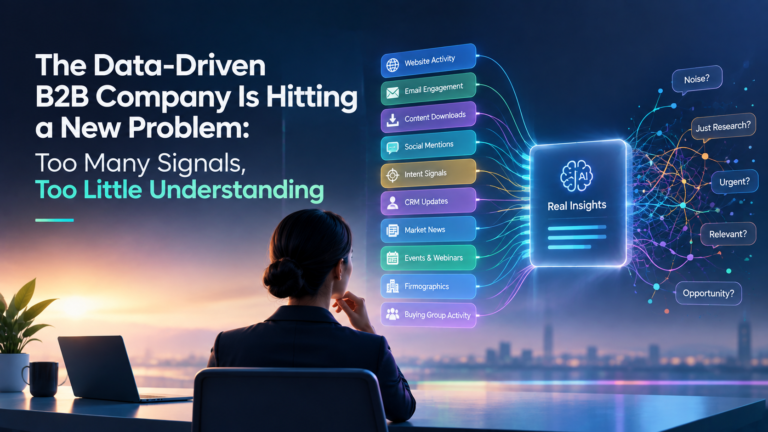
The challenge is that relevant information can exist across many different sources. Individually, these signals may appear insignificant. Connected together, they can provide a much clearer picture.
From Signal Collection to Signal Interpretation
Collecting more data is not necessarily the answer.
A modern growth team can already have access to CRM records, marketing engagement, company information, technology data, hiring information, website activity, and external business signals.
The challenge is determining which changes matter.
AI can potentially help connect events over time and identify relationships that would be difficult for humans to monitor manually at scale.
For example:
Leadership change + new hiring pattern + technology investment + market expansion
may provide considerably more context than any one of those events individually.
The value comes from connecting the signals, not simply generating more alerts. For B2B Growth teams, this distinction is critical because useful intelligence depends on understanding why a change matters, not simply knowing that it happened.
Dynamic Account Targeting Could Change ABM
Account-based marketing traditionally begins with a target-account list.
Marketing and sales teams identify priority accounts and then build campaigns, content, advertising, and outreach around them.
The challenge emerges when those lists become static.
An account may remain on a target list for months simply because it fits the ICP, even though nothing significant has happened to indicate that the timing is right.
At the same time, a company experiencing a major transformation could remain outside the target universe simply because it was not part of the original list.
A more dynamic ABM model could continuously adjust account priorities based on meaningful changes. This approach can make B2B Growth programs more responsive by allowing account priorities to evolve as business circumstances change. This creates a more adaptive model for B2B Growth, where account priorities can change as new business signals emerge.
A Dynamic ABM Approach Could Help Teams
- Identify accounts experiencing relevant business changes.
- Reassess account priorities continuously.
- Adjust campaigns according to current business circumstances.
- Align sales outreach with recent developments.
- Move accounts into or out of active engagement based on context.
- Reduce resources spent on accounts with little current relevance.
In this model, ABM becomes less about managing a permanent list and more about responding intelligently to changing business conditions.
Sales Prospecting Becomes More Contextual
Sales teams have always understood that timing matters.
However, sales technology has often emphasized activity volume:
- Number of accounts assigned
- Contacts identified
- Emails sent
- Calls completed
- Meetings booked
- Follow-ups performed
These metrics are useful for managing sales activity, but they do not necessarily indicate whether the outreach is relevant. For B2B Growth, that means giving sales teams stronger context for deciding which accounts deserve attention now.
There is a significant difference between contacting an account because it appears on a list and contacting it because something has recently changed within the organization.
The second approach gives the salesperson a contextual reason for starting the conversation. For B2B Growth teams, this connects sales activity more closely to current business circumstances rather than relying only on predefined account lists.
Instead of generic personalization such as:
“We work with companies like yours.”
The conversation can begin with a relevant business development and explore whether that change is creating a challenge or opportunity.
Context Can Improve the Quality of Outreach
Contextual prospecting can help salespeople understand:
What changed? → Why might it matter? → Who is affected? → What problem could emerge? → Is there a reason to have a conversation?
Importantly, the signal should support research rather than replace it.
A business event is not proof that an organization needs a particular product. It is a reason to investigate further.
Personalization Is Moving From Identity to Circumstance
B2B personalization has traditionally focused on identity. Modern B2B Growth strategies can increasingly focus on what is happening inside the buyer’s organization.
A message might mention:
- The company name
- Industry
- Job title
- Geography
- Employee count
- Technology stack
- Recent achievement
These details can make a message appear customized, but customization does not always equal relevance.
More useful personalization begins with circumstance.
If an organization is expanding internationally, the conversation should reflect the operational implications of expansion.
If a company is consolidating technology systems, the conversation can address the complexity associated with consolidation.
If an executive team has changed strategic priorities, communication can connect to those priorities rather than simply mentioning an executive’s name.
Identity-Based vs. Context-Based Personalization
| Identity-Based Personalization | Context-Based Personalization |
|---|---|
| Company name | Recent business change |
| Job title | Current strategic priority |
| Industry | Emerging business challenge |
| Company size | Transformation stage |
| Location | Expansion or restructuring |
| Technology used | Current operational context |
The distinction is important because purchasing decisions are often influenced by business circumstances, not simply organizational identity. This makes contextual personalization an increasingly important component of modern B2B Growth strategies.
Content Strategy Can Follow Business Moments
Traditional B2B content strategies often organize content around industries, personas, funnel stages, and product categories.
Those structures remain valuable. This creates another opportunity for B2B Growth teams: aligning content with the business moments that create new priorities for target accounts.
However, marketers can add another dimension: business situations.
Instead of creating content exclusively for “enterprise CIOs,” for example, organizations can develop content around situations CIOs may encounter during specific phases of transformation.
Examples could include:
- Technology consolidation
- International expansion
- Post-acquisition integration
- Cloud transformation
- Organizational restructuring
- New compliance requirements
- Digital modernization
- Rapid workforce expansion
This approach connects content more closely to the moment when information becomes useful.
The question shifts from:
“What content should we create for this persona?”
to:
“What information becomes useful when this persona enters this business situation?”
That is a much more contextual approach to B2B demand generation.
B2B Growth and Forecasting May Become More Dynamic
Traditional revenue forecasting focuses heavily on existing pipeline data. A broader B2B Growth intelligence model could also consider changes happening across the wider addressable market.
Sales organizations analyze:
- Opportunities
- Deal stages
- Conversion rates
- Sales velocity
- Historical performance
- Activity levels
These metrics remain important because they describe opportunities already inside the commercial process.
But they do not necessarily reveal how the future opportunity landscape is changing.
Suppose an industry begins experiencing significant transformation. New regulations, technology adoption, expansion, restructuring, or other market developments could change the number and type of future opportunities.
Monitoring these changes can help revenue teams think beyond the existing pipeline.
From Pipeline Forecasting to Market Intelligence
A more dynamic model considers both:
What is happening inside our pipeline?
and
What is changing across the market that could influence future demand?
This can give marketing, sales, and revenue operations teams additional context when deciding where to invest resources.
The Goal Is Not More Signals. It Is Better Signals.
One of the biggest risks of signal-based B2B growth is information overload.
Companies constantly change.
Executives move between organizations. Companies hire employees. Products launch. Websites change. Businesses enter markets. Technologies are adopted and replaced.
Not every event has commercial significance.
A new executive does not automatically create buying intent. Hiring activity does not necessarily indicate an upcoming technology purchase. Funding does not guarantee expansion. A product launch may have no connection to a particular vendor category.
This makes signal interpretation more important than signal volume.
Effective Signal Intelligence Should Consider
- Relevance: Does the change relate to the problem being solved?
- Recency: How recently did the change occur?
- Magnitude: Is it meaningful enough to affect priorities?
- Multiple signals: Are several changes pointing in the same direction?
- Business context: What does the event mean for the organization?
- Actionability: Can marketing or sales do something useful with the insight?
The goal should not be to turn every change into a sales opportunity.
The goal is to determine which changes materially alter the relevance or timing of a potential conversation. In other words, effective B2B Growth depends less on collecting every available signal and more on identifying the signals that can support meaningful decisions.
What This Means for B2B Revenue Teams
The shift toward dynamic account intelligence has implications across the entire revenue organization.
Marketing can use business-change signals to refine audience selection and campaign timing.
Sales can use them to prioritize research and create more contextual conversations.
Revenue operations can use them to develop more dynamic account-prioritization models.
Leadership teams can use market-change intelligence to understand where future opportunities may emerge. For B2B Growth teams, the larger shift is from static account management toward continuously updated commercial intelligence.
A Connected B2B Growth Model
The emerging model can be viewed as four layers:
- Who is the company?
Firmographic and organizational attributes establish basic relevance. - Does the company fit?
ICP and segmentation determine whether the account belongs within the addressable market. - What is the company doing?
Behavioral and intent signals reveal observable engagement. - What is changing?
Business-change signals provide context around timing and evolving priorities.
The fourth layer does not replace the others. It makes them more dynamic.
The Future of B2B Growth Is Context-Aware
The evolution of B2B intelligence can be viewed as a progression.
The first question was:
Who exists?
Then:
Who fits?
Then:
Who is showing intent?
Increasingly, the question is becoming:
Who is changing?
These approaches are complementary.
Company attributes establish relevance. ICPs establish fit. Behavioral signals provide evidence of interest. Business-change signals can add context and timing.
When these layers are connected, the market stops looking like a static database and starts looking more like a constantly changing network of business situations.
That perspective has important implications for technology providers, enterprise sales organizations, demand generation teams, and modern go-to-market strategies.
How Organizations Can Start Using Change Signals
Companies do not necessarily need to rebuild their entire revenue technology stack to begin thinking this way.
A practical starting point is to identify the business changes that are most closely connected to the problems the organization solves.
For example, a technology provider might monitor:
- Leadership changes
- New geographic expansion
- M&A activity
- Relevant hiring patterns
- Technology transformation initiatives
- Product launches
- Regulatory developments
- Changes in business messaging
The next step is to define what each signal means operationally.
A signal should answer:
“If this happens, what should our team do differently?”
That could mean researching an account, changing its priority, adapting messaging, triggering a campaign, notifying an account executive, or simply monitoring the situation.
This prevents signal intelligence from becoming another source of noise. For organizations building a modern B2B Growth strategy, the practical objective is simple: connect meaningful business changes to clear actions across marketing, sales, and revenue operations.
Conclusion
The future of B2B growth is increasingly about understanding change rather than simply identifying reachable audiences.
Traditional databases remain valuable. ICPs remain valuable. Intent data remains valuable. But these tools become significantly more useful when organizations add another dimension: what is happening right now inside the accounts they care about?
A company does not become a potentially relevant opportunity simply because it matches an ideal customer profile. Its commercial relevance can change when its business circumstances change.
That is why modern B2B organizations are increasingly looking beyond static attributes toward dynamic business intelligence. The competitive advantage may not come from having the largest database or sending the most outreach. It may come from recognizing meaningful changes earlier, understanding their context, and giving sales and marketing teams the information they need to respond appropriately.
The central shift is simple:
Stop asking only who you can reach. Start understanding who is changing, why that change matters, and when it creates a reason to pay attention.
In a B2B market where priorities can change faster than databases are updated, the ability to understand business change may become one of the most valuable forms of commercial intelligence.
Frequently Asked Questions
1. What is B2B growth?
B2B growth refers to the strategies, processes, technologies, and activities organizations use to increase revenue from business customers. It can include demand generation, sales development, account-based marketing, customer acquisition, expansion, and retention.
2. What is dynamic account targeting?
Dynamic account targeting is an approach where account priorities can change based on current business circumstances and signals rather than relying exclusively on a fixed target-account list.
3. How is business-change intelligence different from intent data?
Intent data generally focuses on observable behaviors that suggest research or interest in a product or category. Business-change intelligence focuses on changes in the organization or its environment that may influence priorities, needs, or timing.
4. What are examples of B2B business-change signals?
Examples include leadership changes, market expansion, acquisitions, new hiring patterns, technology initiatives, product launches, restructuring, regulatory developments, and changes in strategic messaging.
5. Can AI improve B2B account intelligence?
AI can help analyze large volumes of information, connect signals across sources, identify patterns, and summarize potential business context. Human judgment is still important for determining whether a signal is commercially meaningful.
6. How can sales teams use business-change signals?
Sales teams can use relevant signals to prioritize accounts, conduct better research, understand potential business circumstances, and develop more contextual outreach. A signal should be treated as a reason to investigate rather than automatic evidence of purchase intent.
7. Does dynamic targeting replace the ideal customer profile?
No. ICPs remain useful for establishing which organizations broadly fit the target market. Dynamic signals can add another layer by helping teams determine which relevant accounts may have changing circumstances.
8. How can B2B marketers use business-change signals?
Marketers can use them to refine account prioritization, adjust campaign timing, develop situation-specific content, personalize messaging around current circumstances, and identify emerging opportunities within their addressable market.
9. Why is signal interpretation important in B2B growth?
Organizations generate and encounter large amounts of business data. Without interpretation, teams can become overwhelmed by alerts that have little commercial relevance. Effective intelligence focuses on identifying meaningful changes and explaining why they may matter.
10. What is the future direction of B2B demand generation?
B2B demand generation is increasingly moving toward more contextual and dynamic approaches that combine company attributes, behavioral data, intent signals, and business-change intelligence to improve account prioritization and engagement timing.