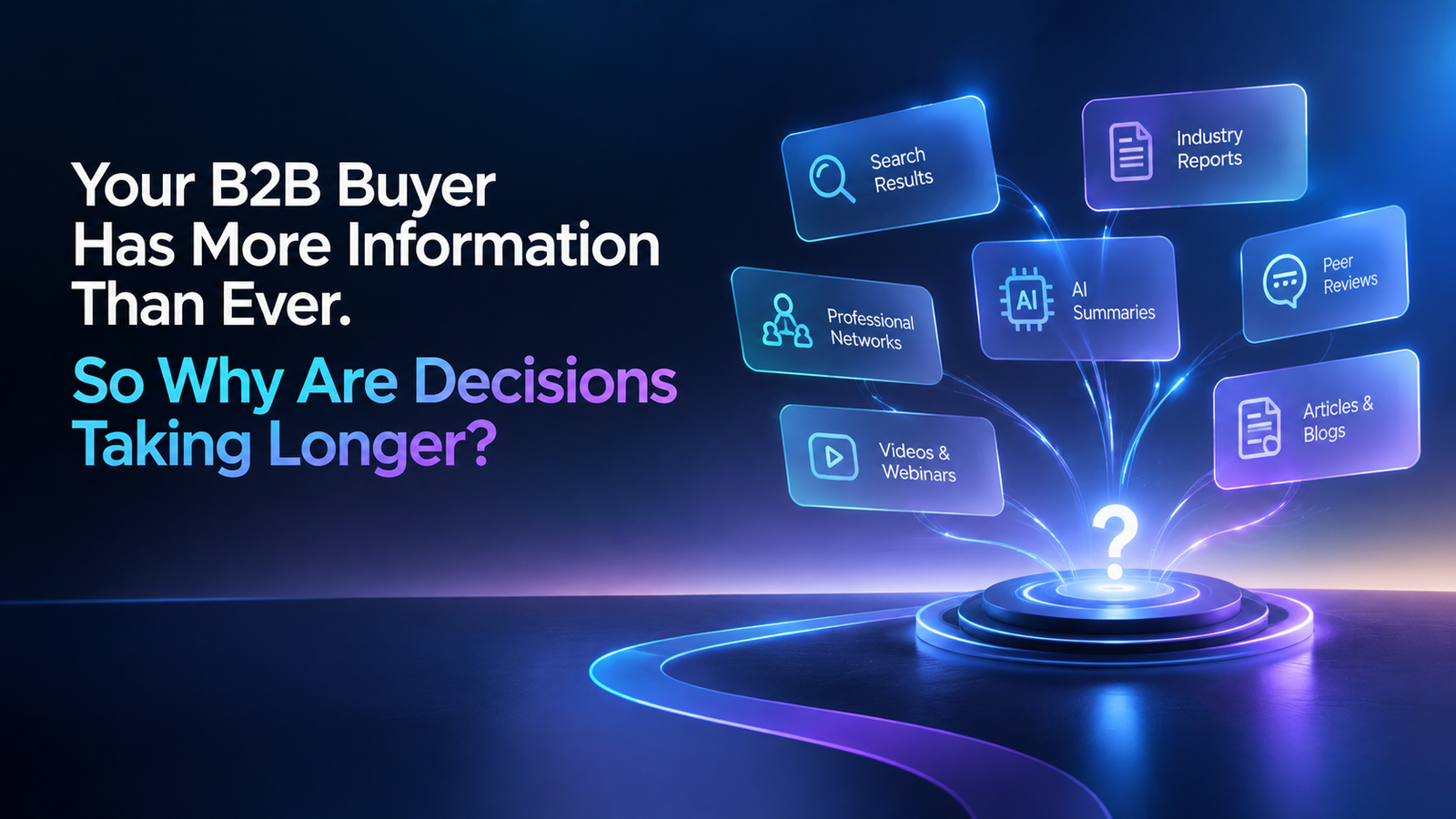
B2B buying decisions have become more complicated despite buyers having access to more information than ever before. A few years ago, researching a business solution might have meant speaking to sales representatives, downloading a handful of reports, attending an industry event, or relying on recommendations from colleagues. Today, a buyer can investigate a market from almost every direction without speaking to a single vendor. Search engines can surface thousands of pages, professional communities provide real-world experiences, social platforms expose buyers to expert opinions, review platforms provide customer perspectives, analyst reports offer market context, and AI tools can summarize an entire category within minutes.
On the surface, this should make B2B buying decisions easier. Yet many B2B organizations are experiencing the opposite: buying cycles are becoming more complicated, stakeholders are becoming harder to align, evaluation processes are expanding, and decisions are taking longer. The paradox is that information has become abundant while clarity has not.
B2B buyers have never had access to more information than they do today. A few years ago, researching a business solution might have meant speaking to sales representatives, downloading a handful of reports, attending an industry event, or relying on recommendations from colleagues. Today, a buyer can investigate a market from almost every direction without speaking to a single vendor. Search engines can surface thousands of pages, professional communities provide real-world experiences, social platforms expose buyers to expert opinions, review platforms provide customer perspectives, analyst reports offer market context, and AI tools can summarize an entire category within minutes.
On the surface, this should make B2B buying decisions easier. Yet many B2B organizations are experiencing the opposite: buying cycles are becoming more complicated, stakeholders are becoming harder to align, evaluation processes are expanding, and decisions are taking longer. The paradox is that information has become abundant while clarity has not.
The problem is not necessarily that buyers lack information. It is that they have too much of it, and much of it is difficult to distinguish, validate, prioritize, and translate into a decision. A buyer researching a technology solution may find dozens of vendors making similar claims, hundreds of articles discussing the same trends, countless opinions about what matters, and multiple frameworks suggesting different ways to evaluate the category. AI can make this information easier to summarize, but summarization does not automatically eliminate uncertainty.
In fact, it can sometimes accelerate the production of competing perspectives. The buyer can receive an answer in seconds, but that answer may generate five additional questions. Which information is reliable? Which claims are relevant to the organization’s specific situation? Which features actually matter? Which vendor can deliver on its promises? What will implementation involve? Who needs to approve the investment? What happens if the organization chooses the wrong option? The buyer’s challenge has shifted from finding information to determining what deserves to influence their B2B buying decisions.
Why B2B Buying Decisions Are Taking Longer
This creates a new form of friction inside B2B buying journeys: decision friction. Traditional marketing has often focused on reducing friction around lead capture, website navigation, forms, demos, and conversions. Those things still matter, but they address only the visible part of the buying process. The deeper friction exists when buyers have enough information to keep researching but not enough clarity to confidently move forward.
Every additional article, vendor comparison, product demonstration, internal opinion, or AI-generated recommendation can potentially add another variable to the decision. The buyer may become more informed while simultaneously becoming less certain. This is why a company can have an extremely educated prospect and still struggle to convert that prospect into a customer.This decision friction can make B2B buying decisions slower even when the buyer has a strong understanding of the available options.
What Makes B2B Buying Decisions More Complex?
One reason this happens is that modern B2B purchases rarely involve a single decision-maker. Even when one person initiates the research, the final decision may involve finance, IT, procurement, operations, security, legal, leadership, and the actual users of the solution. Each stakeholder evaluates the purchase through a different lens. A technology leader may focus on integration and security. A finance leader may focus on cost and measurable return. An operational leader may care about implementation and efficiency.
A business leader may be interested in strategic impact and scalability. Procurement may focus on commercial terms and vendor risk.The more stakeholders involved, the more information needs to be interpreted differently before B2B buying decisions can move forward. What looks like a strong business case to one stakeholder may create additional questions for another. As a result, the buying process does not simply require more information; it requires shared understanding.
This is where many B2B companies unintentionally create additional complexity. Their marketing assets are often organized around what the company wants to communicate rather than what the buying group needs to understand. Product pages explain features. Case studies explain outcomes. whitepapers discuss industry trends. Sales presentations explain capabilities.
Pricing pages discuss packages. Each asset may be useful individually, but the buyer is left to assemble the larger picture. They have to determine how the pieces connect to their own situation, how the solution compares with alternatives, what risks are involved, and how the investment should be justified internally. The company has provided information, but it has not necessarily provided decision support.
Information vs. Decision Support in B2B Buying Decisions
The distinction between information and decision support is becoming increasingly important. Information answers questions such as what a product does, what features it has, or what an industry trend means. Decision support helps a buyer understand whether a particular solution makes sense for their situation. It can include evaluation frameworks, comparison criteria, implementation considerations, business-case models, risk factors, use cases, practical checklists, and clear explanations of when a particular approach may or may not be appropriate.
This type of content does not simply tell buyers what to buy. It helps them understand how to think about the purchase. In a market where almost every vendor can produce polished product messaging, that ability to reduce uncertainty can become a meaningful source of differentiation.Effective decision support helps buyers approach B2B buying decisions with greater clarity and less unnecessary research.
How AI Is Changing B2B Buying Decisions
AI is making this shift even more important because buyers can now generate enormous amounts of research very quickly. A buyer can ask an AI system to compare vendors, summarize product categories, identify evaluation criteria, explain technical concepts, create questions for vendor meetings, or analyse competing approaches. This can dramatically accelerate research and reshape how buyers approach B2B buying decisions. but it can also create a new problem: the buyer may start optimizing for information rather than progress.
Every answer can become the starting point for another question. Every comparison can expose another alternative. Every recommendation can lead to another round of validation. Instead of moving through a straightforward funnel, the buyer can move through an expanding web of research. The technology has reduced the cost of finding information while potentially increasing the amount of information that must be considered.
This is why B2B companies should pay more attention to the concept of cognitive load. Buyers are not processing information in a vacuum. They are already managing operational responsibilities, internal meetings, competing priorities, budgets, deadlines, and organizational expectations. Asking them to consume more content does not necessarily move the decision forward. In some situations, it can make the decision harder.
A 50-page report may contain valuable insights, but a buyer under time pressure may benefit more from a concise framework that identifies the three issues they need to evaluate first. A detailed product comparison may be useful, but a clear explanation of which capabilities matter for different use cases may be more valuable. The objective should not always be to give buyers more material. It should be to help them reach clarity with less unnecessary effort.
How B2B Websites Can Simplify Buying Decisions
This changes the role of the B2B website as well. For years, websites were primarily treated as digital brochures: a place to communicate company information, products, services, credentials, and contact details. But buyers increasingly arrive with questions rather than simple information needs. They want to understand whether the company is relevant to their situation, how its solution compares with alternatives, what implementation might look like, whether similar companies have succeeded, and what they should consider before making a decision.
A website that simply describes products may force buyers to leave the site to find those answers elsewhere. A website designed around decision-making can become a much more useful part of the buying process because it helps buyers move from curiosity to understanding to evaluation.
The same principle applies to sales conversations. When buyers have already conducted extensive research, salespeople cannot assume that repeating product information will add value. The buyer may already know the features. They may already have compared competitors. They may already have read customer reviews and used AI to summarize the category. What they may need is help interpreting how the solution applies to their specific circumstances.
This changes the role of the salesperson from information provider to decision facilitator. The strongest conversations may focus less on explaining everything the product can do and more on understanding what the buyer is trying to accomplish, identifying constraints, clarifying trade-offs, addressing uncertainty, and helping stakeholders align around the decision.
This also creates an opportunity for marketing and sales teams to learn from the questions buyers repeatedly ask. If prospects consistently ask about implementation timelines, integration challenges, security requirements, pricing structures, internal adoption, or expected business outcomes, those questions are not simply objections to overcome during sales calls.
They are evidence about where decision friction exists. Marketing can use that information to create content and tools that address those uncertainties earlier. Sales can use it to structure better conversations. Product teams can use it to understand where buyers perceive complexity. The organization begins treating buyer questions as intelligence rather than merely as obstacles.
Another important source of decision friction is the growing number of seemingly similar choices. B2B markets are becoming crowded across technology, services, software, consulting, data, and professional solutions. Buyers often encounter multiple companies claiming to provide efficiency, automation, intelligence, transformation, scalability, personalization, or growth.
When positioning becomes highly similar, the buyer has to spend more effort determining what actually differentiates the options. This is where vague marketing language becomes particularly expensive. If every vendor describes itself as innovative, customer-centric, AI-powered, data-driven, and results-focused, those statements provide little help in making a decision. Specificity becomes more valuable because buyers need concrete reasons to understand how one approach differs from another.
Clarity therefore becomes a competitive asset. A company that can explain complicated concepts simply, define where its solution fits, identify who benefits most from it, acknowledge limitations, explain implementation realities, and provide evidence for its claims can reduce the amount of work required from the buyer. This does not mean hiding complexity. It means organizing complexity in a way that helps people navigate it. Buyers do not necessarily expect every B2B purchase to be simple. They expect the process of understanding the purchase to be manageable.
There is also a growing need for internal decision enablement. The person researching a solution is often not the only person who needs to be convinced. They may need to explain the recommendation to a manager, justify the investment to finance, answer technical questions from IT, address security concerns, or provide procurement with the information required to move forward.
A vendor that gives the initial researcher material they can easily use internally can help reduce this friction. Business-case templates, executive summaries, implementation outlines, security documentation, comparison frameworks, and outcome-focused case studies can become valuable because they allow information to travel inside the buying organization.
This is particularly important because B2B buying decisions are often less about discovering the perfect solution and more about building enough confidence to move forward. No buyer has complete information. Every major purchase involves uncertainty. The question is whether the organization can reduce that uncertainty to a level where the decision becomes acceptable.
Vendors that understand this can structure their entire buyer experience around confidence rather than simply conversion. Instead of asking only how to generate more demos, they can ask how to make a qualified buyer more confident after the demo. Instead of asking how to generate more content consumption, they can ask whether the content answered a question that was preventing progress.
This shift also challenges the assumption that longer buying cycles are always caused by lack of urgency. Sometimes the buyer may have a genuine business need but still struggle to move because the internal decision environment is complicated. The problem may not be demand. It may be alignment. Different stakeholders may disagree about priorities. The business case may not be clear enough.
Risks may not have been addressed. The organization may not know how to compare options. Procurement may require information that sales has not provided. In these situations, sending another promotional email is unlikely to solve the underlying problem. The buyer needs clarity that can help the organization move collectively.
From Creating Urgency to Reducing Decision Friction
The most effective B2B marketing in this environment may therefore become less focused on creating urgency and more focused on removing uncertainty. That requires a different understanding of the buyer journey. The journey is not simply awareness, consideration, decision, and purchase. It is a series of questions. What problem are we actually trying to solve? How important is it? What options exist? What should we evaluate? Which risks matter? Which solution fits our situation? How do we justify the investment? How do we implement it? What happens after the purchase? Companies that can answer these questions clearly can become useful throughout the buying process rather than appearing only when the buyer is ready to request a demo.
Ultimately, the paradox of modern B2B buying is that information abundance does not automatically create decision confidence. Buyers can research more, compare more, ask more questions, and access more expertise than ever before, yet still struggle to determine what they should actually do. The next evolution of B2B marketing and sales will therefore not be about producing information simply because information is available.
It will be about organizing knowledge into clarity, turning signals into context, turning product information into decision support, and helping buying groups move from endless research toward informed action. The companies that understand this shift will have to think differently about their websites, content, sales conversations, customer proof, AI experiences, and measurement. The central question will no longer be, “How much information can we give the buyer?” It will be, “How much unnecessary uncertainty can we remove from the buyer’s decision?” That is a very different challenge, and potentially a much more important one for the future of B2B growth.