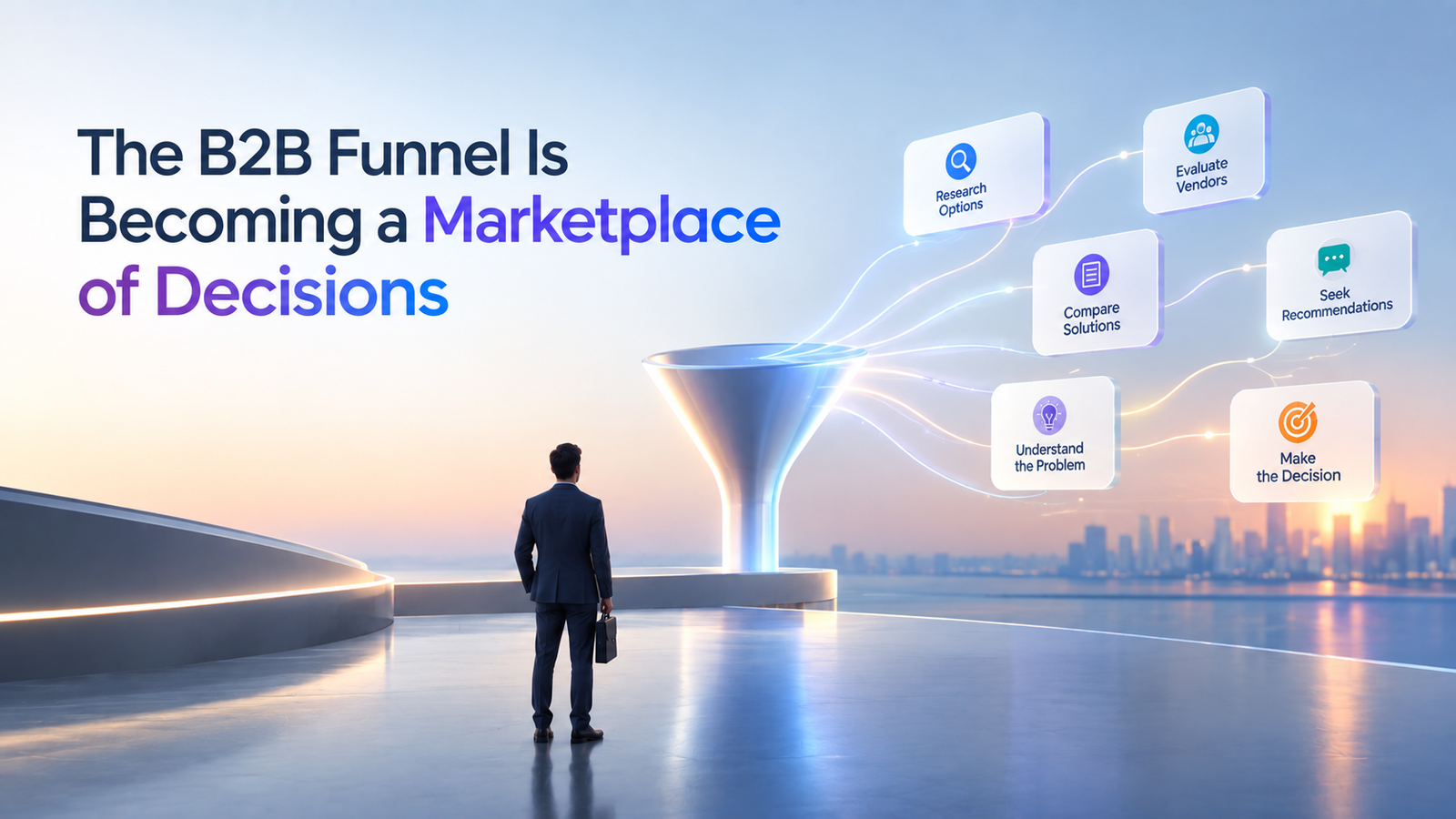

The B2B buyer journey is no longer a predictable path from awareness to purchase. Traditionally, B2B organizations have viewed the funnel as a sequence: awareness becomes interest, interest becomes a lead, a lead becomes an opportunity, and an opportunity becomes a customer. The model has provided marketing and sales teams with a common framework for measuring demand and forecasting revenue. But modern buyers increasingly move through the process in ways that do not follow a fixed sequence.
A prospect might discover a company through an industry article, disappear for months, encounter the same company through a peer recommendation, independently research competitors, use an AI tool to compare solutions, discuss the problem with colleagues, and eventually return to the vendor’s website. Meanwhile, another stakeholder within the same organization may be researching the same problem through an entirely different channel. The result is a buying environment that looks less like a controlled funnel and more like a marketplace of decisions.
This shift changes what businesses need to understand about conversion, intent, demand generation, and sales engagement. Buyers are not simply progressing through stages. They are constantly deciding what deserves attention, which information they trust, which vendors they want to investigate, whether a problem is important enough to solve, and when an organization should take action.
The B2B Buyer Journey Is No Longer a Straight Line –
The traditional B2B sales funnel assumes that buyers move progressively downward. In practice, modern buying journeys can be fragmented, nonlinear, and distributed across multiple people and channels.
A buyer may enter through a search result and leave without engaging. Months later, the same organization may return after a conversation with a colleague. Another stakeholder could encounter the company through social content or an industry event. Eventually, several independent research activities may converge into a formal buying process.
This means the funnel still exists, but the path through it is less predictable.
Businesses need to account for:
- Multiple stakeholders researching the same business problem.
- Different entry points into the buying journey.
- Long periods between research and direct engagement.
- Independent comparison of vendors and alternatives.
- Internal discussions that are invisible to marketing systems.
- Changes in priorities before a formal sales opportunity exists.
The practical implication is important: buyer activity should not automatically be interpreted as buyer progress.
A website visit, content download, or meeting request represents an event. It does not necessarily explain what decision the buyer is trying to make.
Buyers Are Making Decisions Before They Become Leads –
One of the biggest limitations of conventional funnel thinking is that it places too much emphasis on the moment a prospect becomes identifiable.
Before filling out a form or booking a meeting, buyers may already have made numerous decisions. They decide whether a problem matters, whether it deserves investment, whether a particular technology category is relevant, and which sources appear credible.
In many situations, the most important decision is not which vendor should we choose?
It is:
Should we solve this problem at all?
This distinction has major implications for B2B demand generation. A company can spend considerable resources trying to capture demand that has not yet fully formed. Another company may influence the market by helping potential buyers understand the problem itself.
The second company may shape the eventual buying journey without immediately generating a conventional lead.
That is why organizations should look beyond lead volume and ask what is happening in the market before buyers raise their hands.
Conversion Is Becoming a Series of Micro-Decisions –
In traditional marketing dashboards, conversion often means a measurable action: downloading an asset, completing a form, requesting a demo, or scheduling a meeting.
But the modern B2B buying process contains many smaller decisions that occur before those events.
A buyer may decide:
- Whether a topic is relevant to their organization.
- Whether a source is credible enough to trust.
- Whether a business problem requires attention.
- Whether a technology category is worth exploring.
- Whether a vendor demonstrates sufficient expertise.
- Whether a solution should be discussed internally.
- Whether an existing process is still acceptable.
- Whether the organization is ready to consider change.
These micro-decisions may not appear in a CRM. Yet they influence what eventually becomes a measurable opportunity.
For B2B technology companies, this creates an important challenge. Marketing systems are often designed to measure activities, while buying decisions happen partly outside those systems.
The opportunity is to connect observable signals with the decisions they may represent rather than treating every interaction as an isolated conversion event.
Self-Directed Research Is Expanding the B2B Buying Environment –
The modern B2B buyer has access to more independent sources of information than ever before. Buyers can research a category, compare vendors, examine customer experiences, explore technical content, participate in professional communities, and use AI systems to synthesize information before speaking with sales.
The salesperson is therefore no longer necessarily the buyer’s first source of market education.
In many cases, the buyer arrives at a sales conversation having already formed an initial understanding of:
- The business problem.
- Potential solution categories.
- Alternative approaches.
- Relevant vendors.
- Common objections.
- Technical considerations.
- Questions that need to be answered.
This changes the competitive environment.
Companies are not simply competing for leads. They are competing for inclusion in the buyer’s research environment.
That means useful content, credible expertise, clear product information, technical education, customer evidence, and consistent messaging can influence the journey well before a prospect enters the CRM.
B2B Demand Intelligence Must Connect Signals to Decisions –
Modern organizations already collect large amounts of data across marketing, sales, customer success, and digital channels. The challenge is increasingly less about collecting another signal and more about understanding what existing signals mean.
A page visit tells a company that an interaction occurred. A broader change in research behavior may provide a different indication: something could be becoming more important to the buyer.
For example, consider two prospects.
The first downloads a generic industry report and never returns. The second researches technical content, explores implementation information, revisits pricing material, and engages with several resources related to the same business problem.
Counting activities alone can make both prospects appear engaged. Looking at the pattern can provide more context about what each buyer may be trying to understand.
Relevant signals can include:
- Website and content engagement.
- Search and research behavior.
- Sales conversation themes.
- Marketing automation activity.
- Intent signals.
- Event participation.
- Customer-support interactions.
- Changes in engagement across multiple stakeholders.
The goal is not to assign meaning to every individual action. It is to identify meaningful patterns that help teams understand where buyers may be in their decision-making process.
Funnel Stages Alone Cannot Explain Buyer Intent –
Two accounts can have similar lead scores while being in completely different situations.
One organization may be casually researching a technology category for future planning. Another may have already developed an internal business case and be quietly comparing vendors.
If both receive similar scores because they completed similar activities, the score can hide the difference between them.
This is where decision-oriented demand intelligence becomes valuable.
Instead of asking only:
“How many activities did this account complete?”
Teams can also ask:
“What decision appears to be developing around this account?”
That shift changes how marketing and sales teams interpret data.
A low-activity account could become significant if several stakeholders suddenly begin engaging around the same business problem. Conversely, an account with high activity may not be progressing toward a meaningful purchase decision.
The objective is not to eliminate funnel stages. It is to add context to them.
Sales Engagement Must Become More Contextual –
The changing B2B buyer journey also affects the role of sales.
A salesperson’s effectiveness increasingly depends on understanding what the buyer is trying to decide rather than simply reacting to the latest activity or lead score.
For example, a conversation with a buyer determining whether a problem deserves investment should look very different from a conversation with a procurement team comparing vendors.
Likewise, a technical stakeholder evaluating implementation requirements needs a different conversation from an executive assessing business impact.
Sales engagement can therefore become more contextual by considering:
- What problem the buyer appears to be investigating.
- Which stakeholders are involved.
- What questions or objections are emerging.
- Whether the buyer is exploring a category or comparing vendors.
- What information has already been consumed.
- Where the organization may be experiencing uncertainty.
This approach moves sales away from simply following up on activity and toward entering conversations with greater context.
The Funnel Is Becoming a Marketplace of Decisions –
The marketplace model helps explain why some B2B organizations can generate substantial funnel activity without seeing proportional revenue impact.
They may be highly effective at converting clicks into forms and forms into meetings. But if buyers have not reached meaningful decision points, the resulting pipeline can contain considerable activity without equivalent momentum.
The reverse can also happen.
An account may demonstrate relatively little measurable activity and then move quickly once multiple stakeholders align around a problem. A rigid funnel may interpret the account as low engagement. A decision-oriented approach may recognize a meaningful change in buying behavior.
The difference is not necessarily the amount of data available.
It is the ability to interpret the data in context.
What This Means for B2B Marketing and Sales Teams –
The changing B2B buyer journey does not make the traditional funnel irrelevant. Instead, it changes how organizations should use it.
The funnel can continue to provide structure for reporting and revenue planning. But teams increasingly need additional layers of context to understand the decisions taking place around those stages.
For B2B organizations, that means shifting attention toward:
- Market understanding: What problems are buyers trying to understand?
- Decision intelligence: What decisions are emerging before formal opportunities?
- Content strategy: Is the organization helping buyers answer meaningful questions?
- Sales context: Does sales engagement reflect the buyer’s current decision?
- Signal interpretation: Are teams analyzing patterns rather than isolated activities?
- Cross-functional alignment: Are marketing, sales, and revenue teams working from the same understanding of buyer behavior?
This approach can make the funnel more useful because it connects measurable stages with the underlying buying behavior those stages are meant to represent.
From Funnel Activity to Buyer Decision Intelligence –
The future of B2B growth is unlikely to be defined simply by who can generate the greatest volume of funnel activity.
The more important capability is understanding what is changing inside the market and within individual buying groups.
Marketing needs to understand more than how many people entered a stage. It needs to understand what buyers are trying to solve and what is changing their priorities.
Sales needs more than a score. It needs context about the decision behind the activity.
Data needs to do more than describe what happened. It needs to help teams recognize meaningful patterns in buyer behavior.
This is particularly important as self-directed research, digital channels, multiple stakeholders, and AI-assisted discovery continue to influence how B2B buyers gather and evaluate information.
Conclusion –
The B2B funnel is not disappearing. It is becoming more complex because the decisions that shape a purchase increasingly happen across multiple people, channels, systems, and timeframes.
The modern B2B buyer journey is better understood as a marketplace of decisions. Buyers decide what deserves attention, which problems require action, which information they trust, which technologies they should investigate, which vendors belong on the shortlist, and when the organization is ready to move.
For marketing and sales leaders, this creates a broader opportunity. Instead of optimizing only for movement between funnel stages, organizations can focus on understanding the decisions that create that movement.
Frequently Asked Questions
The B2B buyer journey is the process through which business buyers identify a problem, research potential solutions, evaluate alternatives, involve internal stakeholders, and eventually decide whether and how to act. Unlike a traditional funnel, it may involve multiple people, channels, and non-linear research paths.
The traditional funnel is changing because B2B buyers increasingly conduct independent research before engaging with sales. Buyers can access industry content, peer opinions, technical information, vendor comparisons, and AI-assisted research without following a predefined sequence of marketing and sales interactions.
Micro-decisions are the smaller choices buyers make before a formal conversion or purchase decision. Examples include deciding whether a problem is important, whether a source is credible, whether a technology category is relevant, and whether a vendor should be considered.
Self-directed research means buyers can develop significant knowledge about a problem and potential solutions before contacting sales. B2B marketing therefore needs to provide useful, credible information that supports buyers throughout their independent research process.