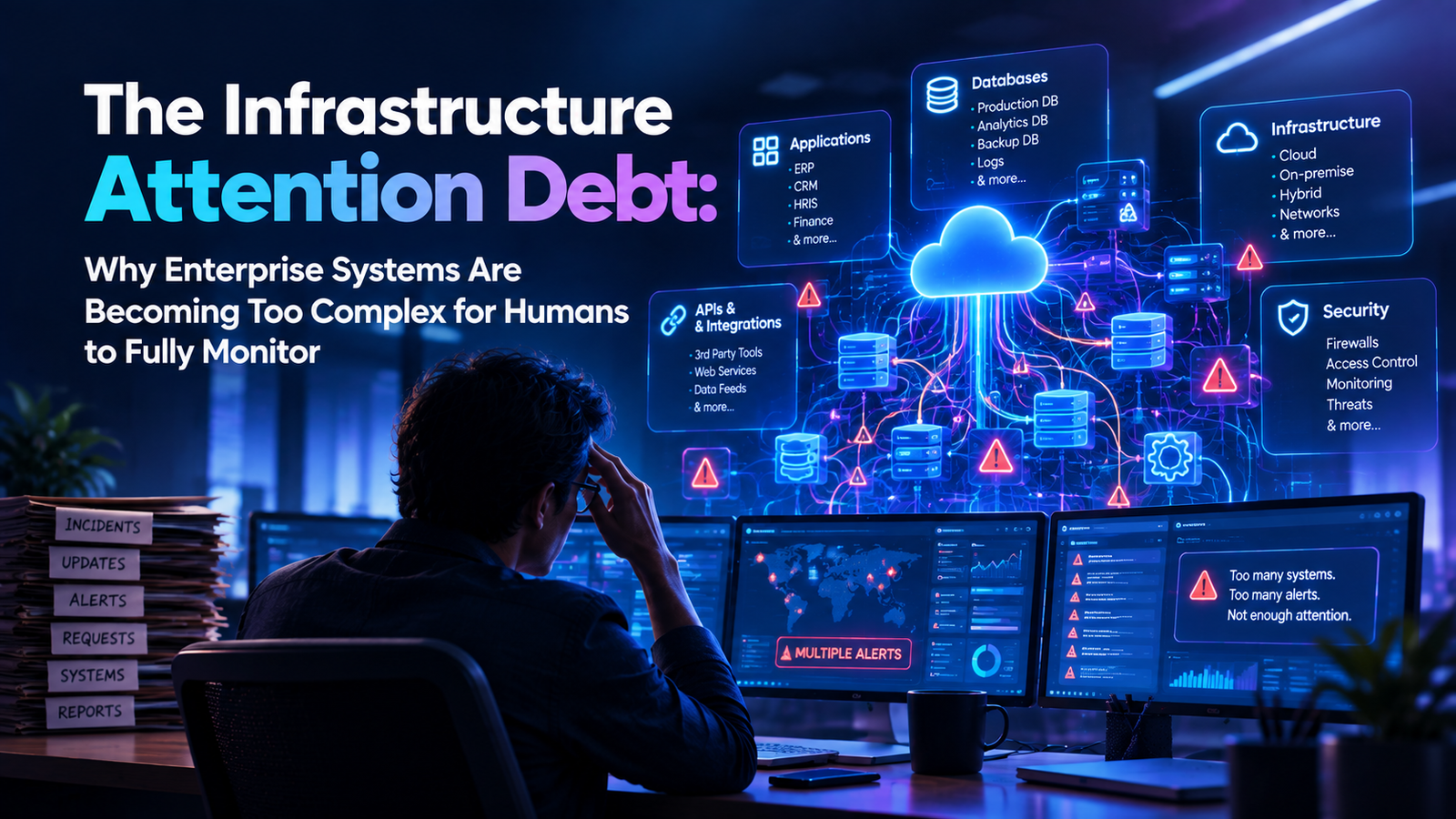
Enterprise technology infrastructure has entered an era where complexity is no longer measured simply by the number of servers, applications, or databases an organisation operates. Modern businesses increasingly depend on cloud environments, microservices, APIs, containers, SaaS platforms, data pipelines, identity providers, cybersecurity tools, AI models, automated workflows, and third-party services that continuously interact. Each component may be manageable on its own, but the relationships between them create an environment that can become difficult for even highly experienced IT teams to understand completely.
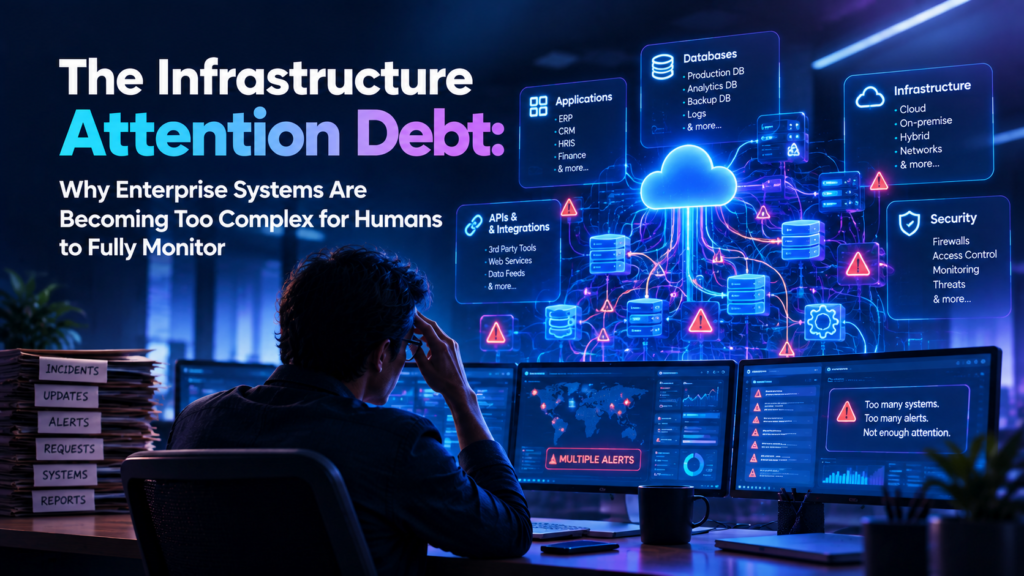
Monitoring platforms generate thousands of alerts, observability tools capture enormous quantities of telemetry, and dashboards provide real-time visibility into individual systems, yet visibility does not necessarily equal understanding. This dynamic is creating a new form of technical burden: infrastructure attention debt, the growing gap between the complexity of enterprise systems and the amount of human attention available to meaningfully understand, interpret, and govern them. Addressing this gap is critical for maintaining long-term business resilience and operational control.
Understanding the Rise of Infrastructure Attention Debt
While technical debt describes the future cost created by software shortcuts, infrastructure attention debt emerges when an organisation creates or adopts more technological dependencies than its teams can continuously reason about. A company may have excellent documentation, modern monitoring tools, and skilled engineers, yet still struggle to understand how hundreds of interconnected services behave during an unusual event.
Every new API, cloud service, security rule, automation workflow, or AI agent adds another component that must eventually be monitored, updated, secured, and understood. The infrastructure may continue functioning normally, creating the impression that complexity is under control, while the organisation gradually loses the ability to maintain a complete mental model of its technology environment.
- Cumulative Growth: Small, reasonable technology additions compound into massive structural complexity.
- Mental Model Breakdown: Teams can view individual metrics but lose sight of cross-system behaviors.
- Hidden Dependencies: Undocumented integrations remain dormant until an unusual incident triggers a cascading failure.
How Artificial Intelligence and Decentralization Accelerate Complexity
This problem has existed in enterprise IT for years, but artificial intelligence and decentralized deployment models are accelerating it in a new way. AI makes it easier for developers and business teams to create applications, automate processes, and connect systems without requiring every decision to pass through a central IT team. A developer can generate infrastructure code with an AI assistant, while a marketing team connects several SaaS applications through automation tools.
Furthermore, the problem is not simply that there are too many systems; it is that systems increasingly make decisions about other systems. Automated monitoring tools adjust thresholds, cloud platforms scale resources according to demand, security tools block or adapt traffic, and AI agents execute workflows based on dynamic business rules. IT teams are no longer monitoring only machines; they are monitoring interactions between automated decision-making systems.
- Decentralized Adoption: Business units deploy SaaS and AI tools outside of central IT oversight.
- Autonomous Interactions: Systems dynamically configure and adjust other systems without human touchpoints.
- Ecosystem Shift: Enterprise IT resembles a living ecosystem rather than a collection of static components.
The Observability Challenge: When “Up” Does Not Mean “Working”
Traditional monitoring was designed largely around measurable technical conditions like CPU usage, memory consumption, network latency, and application errors tracked against predefined thresholds. Modern environments produce a much broader range of signals where an application may be functioning within technical limits while delivering incorrect business outcomes. An API may have normal response times while returning incomplete information, or a database may show healthy resource utilization while a data pipeline silently transforms records incorrectly.
This creates a new challenge for enterprise observability: monitoring must increasingly understand context rather than simply measuring basic infrastructure health. When an AI service is available and responding quickly while producing outputs that are operationally unsuitable, the system is technically operational, but the business process is effectively degraded.
- Contextual Blind Spots: Healthy resource metrics can mask broken business logic or bad data transformations.
- Functional Drift: AI models and APIs can return technically valid responses that fail operational requirements.
- Silent Failures: Data pipelines and integrations can fail silently without triggering standard infrastructure alarms.
Alert Fatigue and the Trap of Excessive Automation
Alert fatigue is one of the most visible symptoms of infrastructure attention debt. Enterprise monitoring systems generate enormous numbers of notifications, many of which are technically valid but operationally insignificant. When hundreds or thousands of alerts compete for attention, the important ones become harder to identify. Organisations respond by creating additional automation, suppression rules, and prioritisation systems, which ultimately create another layer of configuration that must itself be maintained.
While AI can help reduce this burden by correlating signals across multiple systems to connect an application error with a database change and an unusual traffic pattern, it also introduces a new dependency on machine-generated interpretation. If engineers begin relying heavily on AI to determine which signals matter, they need deep confidence that the system understands the environment accurately.
- Notification Overload: Thousands of transient alerts drown out critical operational warnings.
- Maintenance Loops: Suppression rules and alerting filters require ongoing configuration and upkeep.
- Trust Deficit: Relying on AI correlation requires absolute trust in machine-generated diagnostic interpretations.
Navigating Incidents and Safeguarding Organisational Resilience
Infrastructure attention debt becomes particularly challenging during major outages or security events when engineers need to understand the environment quickly. If the infrastructure has accumulated undocumented dependencies, inherited configurations, and automated behaviors, the incident response team may not know which systems are safe to modify. A seemingly simple restart could trigger another workflow, and disabling one service could break an unrelated application.
This dynamic directly impacts organisational resilience. A system can have multiple backup servers and automated failovers while still being difficult to recover because nobody fully understands its dependencies. Recovery requires not just infrastructure capacity, but operational knowledge of what needs to be restored, in what sequence, and under which conditions.
- Paralysis by Complexity: Engineers hesitate to intervene during incidents due to unpredictable secondary consequences.
- Stale Recovery Plans: Automated workflows and cloud shifts render static disaster recovery documentation obsolete.
- Knowledge Gaps: System recovery depends on comprehensive operational understanding rather than raw redundancy alone.
The Proliferation of SaaS and External AI Dependencies
Businesses increasingly adopt specialised tools for CRM, marketing automation, finance, HR, analytics, and cybersecurity. While SaaS adoption improves business capability without requiring large internal development teams, every platform introduces integrations, authentication requirements, data flows, user permissions, and contractual dependencies that the internal IT team does not directly control.
Similarly, many modern AI applications depend on external model providers, vector databases, and separate authentication platforms. If any critical component changes pricing, availability, model behavior, or technical specifications, the organisation must adapt, forcing IT teams to understand not only their own architecture but also the evolving architectures of external services.
- External Vulnerabilities: Changes to third-party APIs can break internal workflows without warning.
- Opaque Architectures: IT remains responsible for securing SaaS and AI platforms it does not fully own.
- Model Behavior Shifts: AI updates can alter functional outputs even when uptime and latency remain stable.
Practical Strategies for Managing Infrastructure Attention Debt
Organisations must adopt a proactive philosophy to prevent complexity from outpacing human governance. This involves rethinking visibility, establishing cross-functional ownership, and actively reducing unnecessary technical burden across the enterprise portfolio.
- Contextual Visibility: Deploy dependency maps that continuously update to show relationships, business criticality, and recent changes.
- Cross-Functional Ownership: Assign clear operational ownership for critical business services rather than isolated component-level management.
- Strategic Decommissioning: Periodically audit technology portfolios to remove redundant platforms and reduce cognitive load.
- Appropriate Automation: Retain mechanisms for human intervention and override in critical automated workflows.
Conclusion
The modern enterprise IT challenge is no longer simply keeping systems running; it is keeping systems understandable while they become increasingly autonomous and interconnected. Artificial intelligence can help organizations process the enormous volume of information generated by modern infrastructure, but it cannot remove the need for human comprehension. The companies that manage infrastructure attention debt effectively will be those that design technology environments where automation increases human visibility rather than replacing it, where complexity is continuously challenged, and where engineers can answer why a system is working, what it depends on, and what will happen when something changes.
Frequently Asked Questions
What is infrastructure attention debt?
Infrastructure attention debt is the growing gap between the complexity of modern enterprise systems and the amount of human attention available to meaningfully understand, interpret, and govern them.
How does infrastructure attention debt differ from technical debt?
Technical debt refers to the future software maintenance cost caused by design shortcuts. Attention debt occurs when an organisation adopts more technological dependencies and automated interactions than its teams can continuously reason about.
Why do traditional monitoring tools struggle with modern enterprise systems?
Traditional monitoring focuses on measurable technical conditions like CPU usage and latency. Modern environments require contextual visibility because systems can be technically operational while delivering incorrect business outcomes or broken workflows.
What causes alert fatigue in IT operations?
Alert fatigue happens when monitoring systems generate thousands of notifications for transient errors and minor resource fluctuations, making it difficult for engineers to identify truly critical operational events.
How does artificial intelligence contribute to infrastructure attention debt?
AI enables developers, business units, and automated agents to rapidly deploy applications, workflows, and integrations outside of central IT oversight, causing the infrastructure to expand faster than the organisation can map it.
How can organisations reduce infrastructure attention debt?
Organisations can reduce this debt by developing dynamic dependency maps, establishing cross-functional ownership models, periodically decommissioning underutilised systems, and maintaining human oversight over automated workflows.
Why is SaaS proliferation a source of attention debt?
Businesses adopt numerous specialised SaaS platforms that introduce hidden integrations, data flows, and authentication dependencies. IT teams remain responsible for their secure operation without having control over their internal architecture.
What is functional drift in AI applications?
Functional drift occurs when an AI application remains technically operational with good uptime, but its output quality or behavior changes due to model updates, prompt shifts, or underlying data modifications.