AI Sales Rep: How B2B Sales Is Changing
AI sales rep technology is changing the way B2B organizations approach selling. For decades, B2B sales has been built around information, timing, relationships, and trust. Sales representatives spend a significant portion of their time researching accounts, identifying decision-makers, qualifying leads, preparing outreach, updating CRM records, following up with prospects, and determining which opportunities deserve their attention.
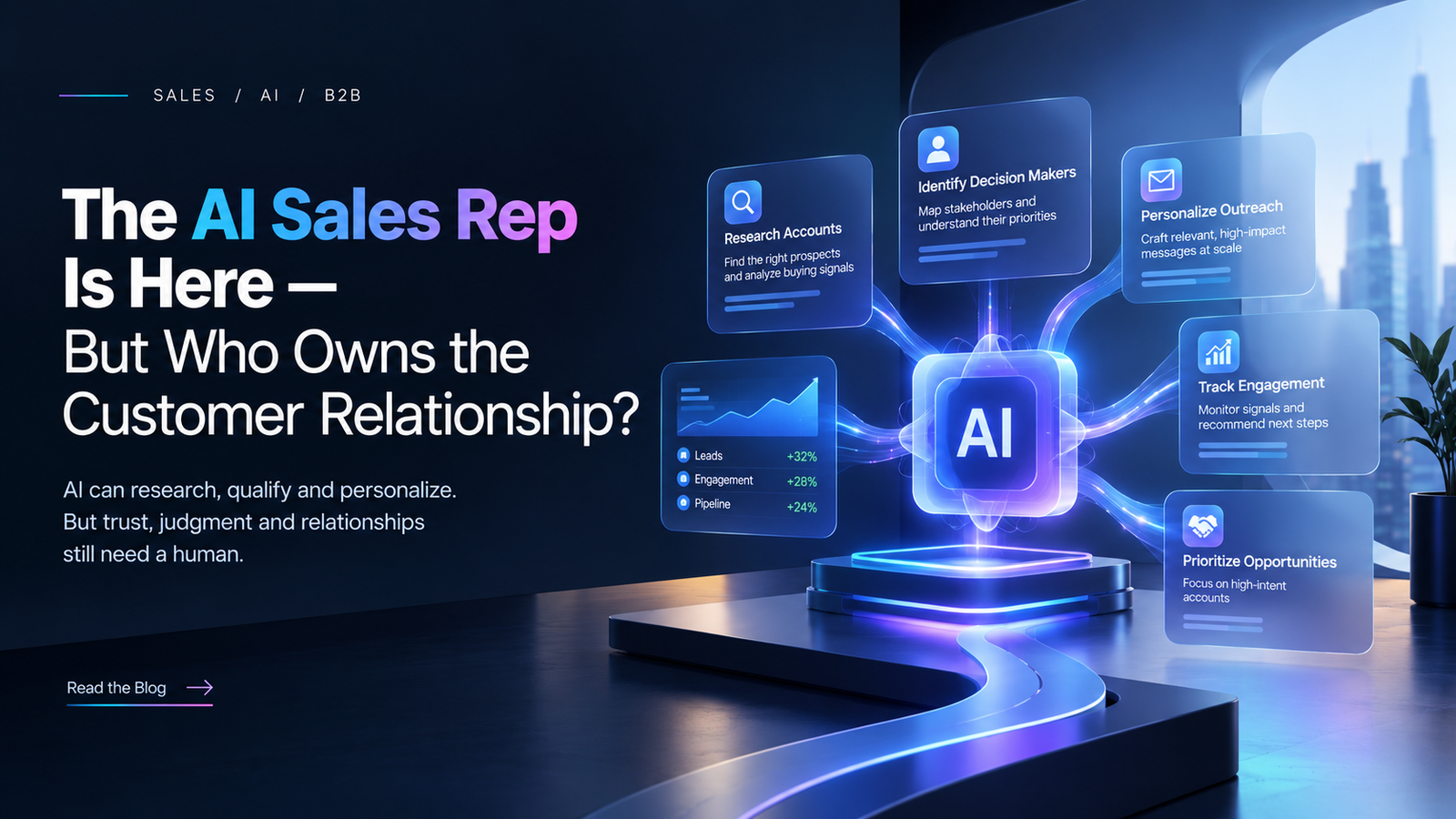
For years, sales technology has helped automate individual parts of this process, but the fundamental model remained unchanged: a human salesperson used software to become more productive. In 2026, that model is beginning to change. AI sales agents are moving beyond simply helping salespeople write emails or summarize calls. They can now research accounts, identify buying signals, prepare prospecting lists, personalize communication, execute multi-step workflows, and support sellers throughout the sales cycle.
The important question, however, is not whether AI can perform more sales tasks. It is whether organizations are prepared for a world where the sales representative is no longer working alone.
Imagine a salesperson beginning the day with an AI agent that has already reviewed the CRM, identified accounts showing increased buying activity, researched recent company announcements, analysed changes in leadership, checked relevant technology investments, and prepared a prioritized list of opportunities. Instead of spending hours collecting information, the salesperson begins with context.
Another agent might monitor existing accounts for signals such as hiring patterns, new funding, technology changes, procurement activity, or leadership changes. A third system could prepare personalized outreach based on the account’s business situation. The human salesperson then becomes less of a data collector and more of a decision-maker, relationship builder, negotiator, and strategic advisor.
How AI Sales Reps Are Changing the B2B Buying Journey
This shift matters particularly in B2B sales because the buying journey is becoming more complicated while buyers themselves are becoming more informed. A prospect can research vendors, compare solutions, read customer reviews, analyse pricing information, consume expert content, and use AI tools before speaking with a salesperson.
That means simply reaching the buyer earlier is no longer enough. Sales teams need to understand what the buyer is actually trying to accomplish and where the organization is experiencing friction.
AI can help identify patterns across enormous volumes of information, but it cannot automatically establish credibility or understand every organizational nuance. A purchasing decision involving multiple stakeholders, budget constraints, internal politics, compliance requirements, implementation concerns, and long-term business objectives still requires human judgment.
The role of AI therefore becomes less about replacing the relationship and more about giving the salesperson better information before and during that relationship.
AI Sales Rep vs. Agentic AI: What Is Changing?
There is also a major difference between AI assistance and agentic AI. A traditional AI assistant waits for an instruction. A sales representative might ask it to “summarize this account” or “write a follow-up email,” and the system responds.
An agentic system is designed around an objective. It may be given a goal such as identifying high-intent accounts or preparing an opportunity for the next stage, and then perform multiple connected actions to move toward that objective.
This is why the technology is attracting so much enterprise attention. OpenAI’s 2026 enterprise data shows that agentic AI use is spreading beyond engineering into areas including sales, recruiting, and marketing, indicating that enterprises are increasingly experimenting with delegated, multi-step work rather than using AI purely as a conversational assistant.
Who Is Accountable When an AI Sales Rep Acts?
But greater autonomy introduces a question that sales organizations cannot ignore: who is accountable when the AI acts?
If an AI system sends the wrong message to an important prospect, recommends an unsuitable account, exposes confidential information, or makes an inaccurate statement about a product, the responsibility does not disappear because software made the decision. The organization still owns the outcome.
This is why the future of AI-powered sales cannot simply be measured by how many tasks can be automated. It must also be measured by how effectively organizations establish boundaries around those tasks.
What can an agent do independently? What requires human approval? Which customer information can it access? What actions should be logged? When should a salesperson intervene?
These questions are becoming part of sales operations, technology architecture, and governance at the same time.
Human and AI Sales Rep Collaboration
The most valuable sales teams may therefore be the ones that learn how to divide work intelligently between humans and machines.
AI is exceptionally useful when the task involves processing large volumes of information, identifying patterns, monitoring signals, preparing drafts, organizing data, or performing repetitive workflows.
Humans remain essential when the task involves trust, ambiguity, negotiation, empathy, strategic interpretation, and accountability.
The goal should not be to create a sales organization where humans disappear from the process. It should be to remove low-value operational work so salespeople have more time for the activities that actually influence complex B2B decisions.
How AI Sales Reps Change Sales Performance
This also changes what sales leadership should measure. If a salesperson spends fewer hours researching accounts because an AI agent handles the initial analysis, lower research time does not automatically mean the organization has become more productive.
The more meaningful question is whether those recovered hours are being converted into better customer conversations, stronger opportunity progression, improved retention, higher-quality proposals, or faster decision-making.
AI creates capacity; leadership still has to decide where that capacity should go. Organizations that simply automate existing processes without redesigning the sales workflow may discover that they have faster versions of inefficient processes.
The Future of the AI Sales Rep
The next generation of B2B sales will therefore not be defined simply by “AI-powered selling.” It will be defined by human-agent collaboration.
A salesperson may manage several specialized AI systems, each responsible for different parts of the revenue process. The salesperson will decide which opportunities deserve attention, challenge AI recommendations, validate important information, build relationships, and take ownership of high-impact decisions.
In this environment, the competitive advantage may not belong to the company with the most AI tools. It may belong to the company that has redesigned its sales process around the right division of responsibility between people and agents.
The AI sales representative is already becoming a practical enterprise concept, but the technology does not eliminate the need for human ownership. In fact, as AI becomes more capable, human ownership becomes more important.
Buyers still need confidence that the company understands their business, that recommendations are based on reality, and that someone accountable is available when the situation becomes complicated.
The future of B2B sales is therefore unlikely to be “AI versus salesperson.” It is much more likely to be salesperson plus AI agent, with technology handling more execution and humans taking greater responsibility for judgment, relationships, and outcomes.