Legacy applications continue to power some of the most important processes inside modern enterprises. Banking platforms, insurance systems, manufacturing applications, healthcare platforms, ERP environments, customer databases, and internal business systems may have been developed years or even decades ago, yet they remain deeply connected to day-to-day operations. Replacing these systems is rarely as simple as deploying a new application. Their business logic, data, integrations, and operational dependencies can make modernization a complex undertaking. Cloud-Native Modernization provides enterprises with a structured approach to improve legacy applications while maintaining business continuity and reducing the risks associated with large-scale technology changes.
Cloud-Native Modernization provides enterprises with a structured approach to evolving these applications without necessarily replacing everything at once. Instead of treating cloud migration as a simple infrastructure move, organizations can progressively modernize application architecture, deployment processes, infrastructure, security, data management, and operations. The objective is to create an environment that can respond more effectively to changing business requirements while reducing unnecessary disruption. Unlike a simple cloud migration, Cloud-Native Modernization focuses on improving how applications are designed, deployed, secured, integrated, and operated in modern cloud environments.
For technology leaders, the central challenge is finding the right balance between modernization and continuity. A large-scale transformation that interrupts critical business services can create significant operational risk. A carefully planned modernization program, however, can allow organizations to introduce modern capabilities incrementally, validate each stage, and continue supporting existing users and customers throughout the transformation.
What Is Cloud-Native Modernization?
Cloud-Native Modernization is the process of transforming existing applications and supporting technology environments so they can take advantage of cloud-native architecture, automation, scalability, resilience, and modern software delivery practices.
Cloud-native modernization does not necessarily mean rebuilding an application from scratch. Different applications require different levels of transformation. Some may only require infrastructure changes, while others may benefit from architectural restructuring.
Common modernization approaches include:
- Rehosting: Moving an existing application to cloud infrastructure with minimal modification.
- Replatforming: Making selected changes to use cloud-managed services or improve operational efficiency.
- Refactoring: Changing portions of application code to improve maintainability or cloud compatibility.
- Rearchitecting: Redesigning the application structure, potentially introducing independently deployable services.
- Replacing: Moving from an existing application to a different platform or software solution.
- Retiring: Decommissioning applications that no longer provide sufficient business value.
The appropriate approach depends on business requirements, application complexity, technical debt, integration dependencies, security requirements, and the expected value of modernization.
For example, an internal application with limited future development requirements may not justify a major architectural rewrite. On the other hand, a customer-facing platform that requires frequent releases, elastic capacity, and integration with digital services may benefit from deeper modernization.
The key principle is simple: cloud-native does not mean using every available cloud technology. It means using technology and engineering practices that solve real business and operational requirements.
Why Legacy Application Modernization Is Becoming a Business Priority
Legacy applications can remain reliable for years, but reliability alone does not eliminate the challenges associated with aging technology. For organizations managing complex legacy environments, Cloud-Native Modernization can provide a gradual path toward better scalability, automation, integration, and operational flexibility without requiring an immediate replacement of every existing system.
As business requirements evolve, legacy systems can become increasingly difficult to integrate with modern platforms. Development teams may spend significant effort maintaining older components instead of delivering new capabilities. Infrastructure may require specialized knowledge, while manual deployment processes can make releases slower and more difficult to standardize.
Legacy systems can also accumulate technical debt over time.
Technical debt can appear in several forms:
- Outdated programming languages or frameworks
- Tightly coupled application components
- Complex integrations
- Manual deployment processes
- Limited automated testing
- Aging infrastructure
- Inconsistent environments
- Poor documentation
- Difficult-to-maintain code
- Dependencies on specialized skills
These issues do not automatically mean an application should be replaced. They do, however, make application assessment increasingly important.
Modernization can help organizations create a more flexible foundation while allowing critical business capabilities to continue operating.
The Difference Between Cloud Migration and Modernization
Cloud migration and application modernization are related, but they are not identical.
A cloud migration can involve moving an existing workload from on-premises infrastructure to cloud infrastructure while making relatively few application changes.
Application modernization goes further. It can involve changes to architecture, code, databases, deployment pipelines, infrastructure, security, and operational processes.
Consider a traditional application running on a physical server.
A basic migration might move that application into a cloud virtual machine.
The infrastructure has changed, but the application architecture may remain largely the same.
A modernization initiative could instead introduce:
- Containerized deployment
- Automated CI/CD pipelines
- API-based integration
- Managed databases
- Infrastructure as code
- Automated testing
- Centralized observability
- Improved security controls
- Independent application components
This distinction matters because moving an application to the cloud does not automatically make it cloud-native.
Organizations should therefore define what modernization means for each application before selecting migration technologies. Cloud-Native Modernization goes beyond simply moving an existing application to the cloud. The objective is to determine which parts of the application should be retained, improved, redesigned, replaced, or retired based on business and technical requirements.
9 Powerful Cloud-Native Modernization Strategies
1. Begin With Application Discovery and Assessment
The first step in Cloud-Native Modernization should be understanding the existing environment. A successful Cloud-Native Modernization initiative typically combines several of these strategies rather than relying on a single migration technique.
Enterprise applications rarely operate independently. A single application may communicate with multiple databases, APIs, external services, message queues, identity systems, reporting platforms, and other applications.
Without understanding these relationships, modernization teams can make architectural decisions that unintentionally affect other systems.
An application assessment should examine:
- Business criticality
- Application ownership
- Technology stack
- Infrastructure dependencies
- Database dependencies
- Integration points
- Security requirements
- Availability requirements
- Performance characteristics
- Deployment processes
- Operational dependencies
- Data flows
Dependency mapping is especially important.
For example, an application may appear to be an isolated internal system but may actually provide data consumed by several reporting platforms. Modernizing it without understanding those dependencies could disrupt downstream processes.
A structured assessment allows organizations to classify applications and select a modernization strategy based on evidence rather than assumptions. This assessment creates the foundation for Cloud-Native Modernization by identifying dependencies, technical constraints, security requirements, and opportunities for improvement.
2. Prioritize Applications Based on Business Value
Not every legacy application needs to be modernized immediately.
Large enterprises may have hundreds or thousands of applications. Attempting to modernize the entire portfolio simultaneously can spread resources too thin and make governance more difficult.
Instead, organizations can establish a modernization portfolio and prioritize workloads according to business and technical considerations.
Useful criteria include:
- Business importance
- Customer impact
- Current operational challenges
- Maintenance complexity
- Integration requirements
- Security concerns
- Scalability requirements
- Future development plans
- Modernization effort
- Dependency complexity
A highly visible application is not automatically the right starting point. A smaller application with manageable dependencies may provide a better environment for validating the organization’s modernization approach.
The goal is to build experience and repeatable processes before expanding the transformation program. This approach helps Cloud-Native Modernization teams focus their resources on applications where modernization can deliver meaningful business and operational value.
3. Modernize Incrementally Instead of Rebuilding Everything
One of the biggest decisions in legacy application modernization is determining whether to rebuild, refactor, or progressively replace existing functionality. An incremental Cloud-Native Modernization approach also allows teams to validate new architecture and processes before expanding modernization across additional applications.
A complete rewrite can produce a cleaner architecture, but it can also create a long period during which the organization is maintaining both the old and new systems.
Incremental modernization provides another option.
A team can identify a specific capability within an existing application and modernize that capability while leaving the remaining functionality operational.
For example, an enterprise customer-management system might contain:
- Customer registration
- Customer profile management
- Billing
- Notifications
- Reporting
- Authentication
Rather than rebuilding the entire system, an organization could modernize the notification capability first and gradually address additional components.
This approach provides several practical benefits:
- Smaller implementation scope
- More manageable testing
- Earlier validation
- Reduced transition risk
- Incremental learning
- Easier rollback planning
Modernization becomes a sequence of controlled engineering initiatives rather than a single high-risk transformation.
Using the Strangler Pattern for Progressive Modernization
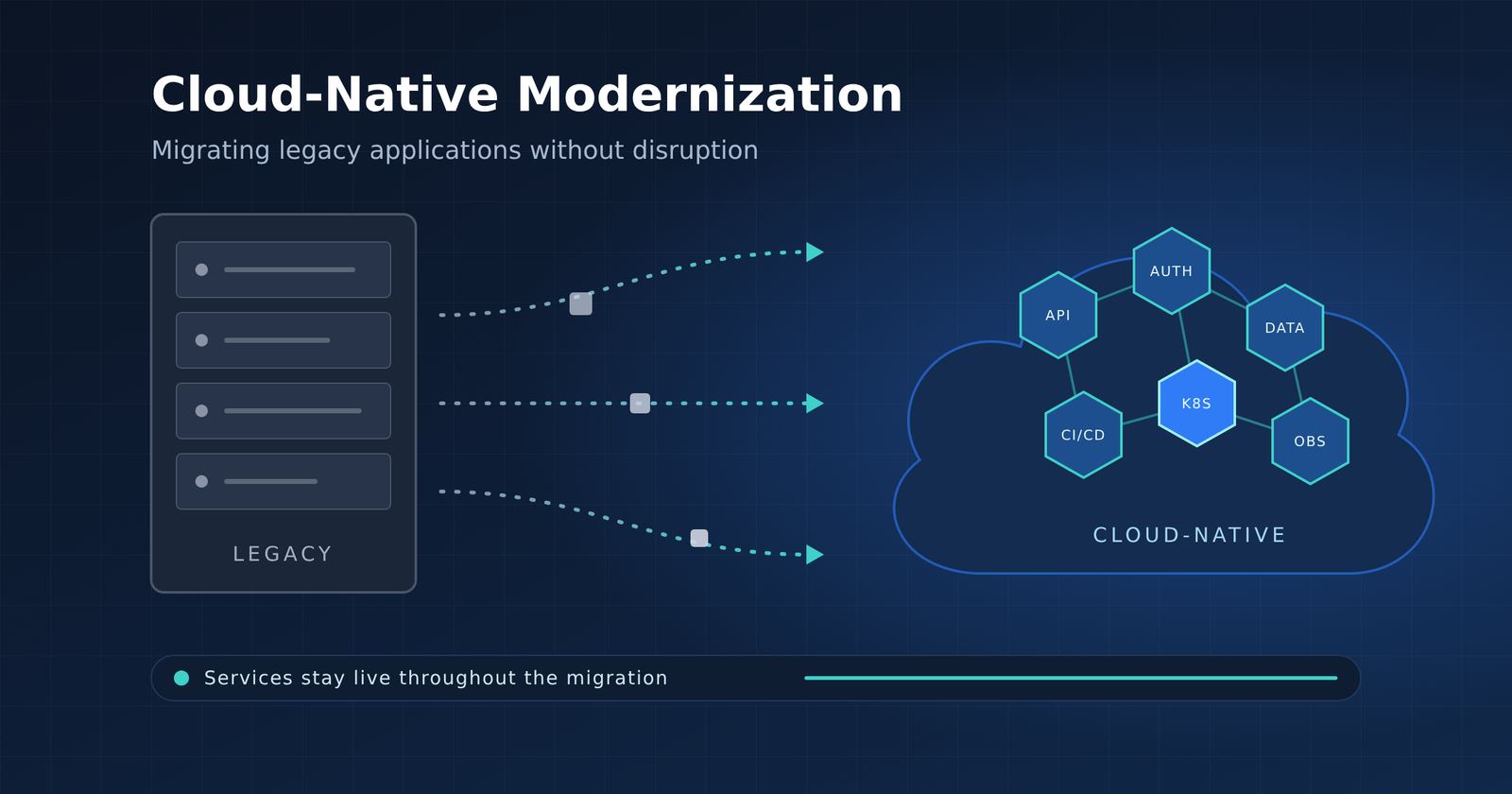
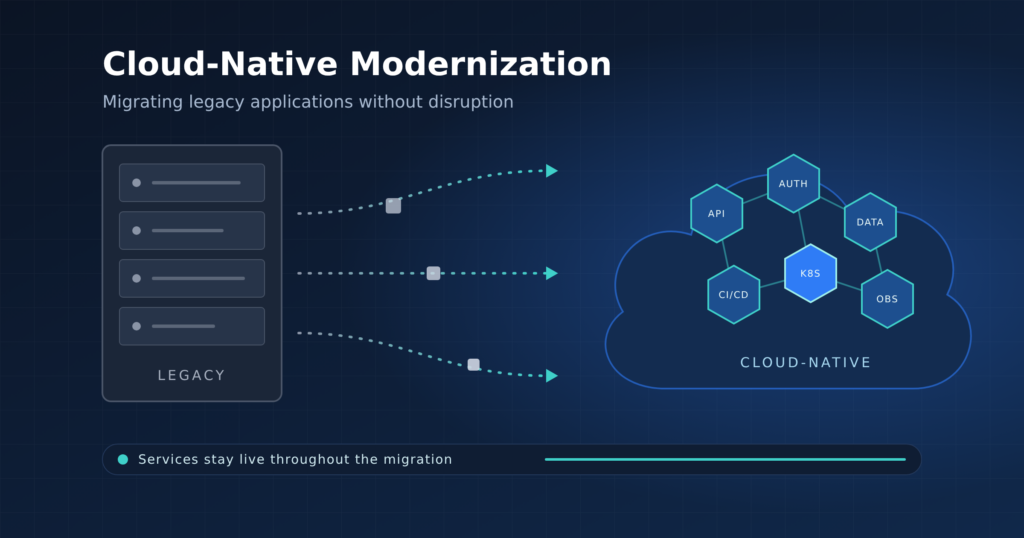
The Strangler Pattern is one architectural approach that can support incremental application modernization. The Strangler Pattern is particularly useful for Cloud-Native Modernization because it allows organizations to gradually replace legacy functionality while keeping the existing application operational.
The basic idea is to build new functionality around an existing application and gradually replace portions of the legacy system.
Instead of removing the old application immediately, organizations progressively move capabilities into the new environment.
A simplified process might look like:
Legacy Application → Interface/API Layer → New Cloud-Native Capability → Gradual Traffic Migration → Legacy Component Retirement
This can be particularly useful for large applications where a complete replacement would be difficult.
However, running old and new systems simultaneously introduces its own challenges. Teams need to consider data synchronization, integration behavior, monitoring, ownership, and operational processes during the transition period.
The Strangler approach therefore works best when the organization has clear boundaries between capabilities and a well-defined transition strategy.
4. Use APIs to Decouple Legacy Systems
APIs can play an important role in connecting legacy applications with modern services. APIs can therefore serve as a critical bridge in Cloud-Native Modernization, allowing legacy systems and modern cloud-native services to operate together during the transition.
Legacy systems frequently expose functionality through tightly coupled integrations or direct database access. Modern applications can become dependent on these implementation details, making future changes more difficult.
An API layer can establish a clearer contract between systems.
For example:
Modern application → API → Legacy capability
The modern application does not necessarily need to know how the legacy capability is implemented.
Over time, the functionality behind the API can be modernized without requiring every consuming application to change at the same time.
API-driven modernization can support:
- Application integration
- Mobile and web applications
- Partner integrations
- Internal services
- Event-driven workflows
- Gradual replacement of legacy capabilities
However, APIs should be designed carefully.
Organizations need to consider authentication, authorization, versioning, rate limits, monitoring, error handling, data contracts, and lifecycle management.
Simply placing an API in front of a legacy application does not eliminate the underlying technical debt. It creates an abstraction that can support a broader modernization strategy.
5. Introduce Containers Where They Add Value
Containerization can provide a more consistent way to package and deploy applications. Containers can support Cloud-Native Modernization by providing a consistent way to package and deploy applications across development, testing, and production environments.
For legacy applications that can be adapted to run in containers, this can help standardize environments across development, testing, and production.
Containers can also work alongside modern delivery practices such as:
- Automated builds
- Automated testing
- Continuous integration
- Continuous delivery
- Infrastructure as code
- Automated deployment
- Application monitoring
However, containerization should not be treated as a modernization objective by itself.
An application running inside a container can still have architectural limitations.
Similarly, Kubernetes can be valuable for organizations operating complex containerized environments, but not every application requires Kubernetes.
Technology selection should follow application and operational requirements.
6. Modernize Data Without Losing Business Continuity
Data is often one of the most difficult parts of enterprise modernization. Data architecture should be treated as a core part of Cloud-Native Modernization, particularly when applications depend on shared databases or real-time business information.
Legacy applications may share databases with other systems. Business logic may depend on specific database structures. Reporting tools may consume tables directly. Historical records may need to remain accessible.
This means database modernization requires more than copying data from one environment to another.
Organizations should examine:
- Data ownership
- Data dependencies
- Data quality
- Database compatibility
- Synchronization requirements
- Backup and recovery
- Security
- Performance
- Migration validation
- Application dependencies
A phased data strategy can reduce the complexity of migration.
For example, an organization may initially establish synchronization between old and new environments before gradually moving application capabilities.
Data validation should also be treated as a formal part of the migration process rather than an informal post-migration activity.
7. Modernize the Software Delivery Pipeline
Modernization is not complete if the application architecture changes but software delivery remains manual. For Cloud-Native Modernization to remain sustainable, organizations also need automated testing, continuous integration, continuous delivery, and infrastructure automation.
Many legacy environments depend on manual deployment procedures, environment-specific configuration, and lengthy release processes.
A cloud-native environment can introduce a more automated delivery model.
A modern CI/CD pipeline may include:
- Source-code validation
- Application build
- Automated unit testing
- Security checks
- Artifact creation
- Infrastructure provisioning
- Deployment
- Integration testing
- Production validation
- Monitoring and rollback
Infrastructure as code can further improve consistency by allowing infrastructure configurations to be version-controlled and reproduced across environments.
This can reduce configuration differences between development, testing, staging, and production environments.
More importantly, automation allows organizations to create a repeatable modernization model that can be applied to additional applications.
8. Build Security Into the Modernization Lifecycle
Security should be integrated from the beginning of modernization planning. Security should therefore be embedded throughout the Cloud-Native Modernization lifecycle rather than addressed only after applications have been migrated.
Cloud-native applications may introduce additional interfaces, services, containers, identities, APIs, and infrastructure components.
A modernization program should therefore address security across the application lifecycle.
Key areas include:
- Identity and access management
- API security
- Secrets management
- Encryption
- Network controls
- Container security
- Dependency management
- Vulnerability scanning
- Security logging
- Access monitoring
DevSecOps can help integrate security activities into development and deployment workflows.
For example, automated security checks can become part of the CI/CD pipeline rather than being performed only before production release.
This creates a more continuous security process and gives development teams earlier visibility into potential problems.
9. Introduce Observability Before Scaling the New Architecture
Cloud-native architectures often distribute application functionality across multiple services and infrastructure components. Strong observability gives Cloud-Native Modernization teams the visibility required to understand application behavior and identify issues during each stage of migration.
That can make troubleshooting more complex.
A single business transaction may pass through an API gateway, application service, database, message queue, external API, and additional internal services.
If the organization cannot trace that transaction across the environment, diagnosing failures can become difficult.
Observability can provide visibility into:
- Logs
- Metrics
- Traces
- Application events
- Infrastructure telemetry
- Service dependencies
- Deployment changes
Distributed tracing can help teams understand how individual requests move across services.
The goal is not simply to collect more data. The goal is to provide enough context to answer three operational questions:
What happened? Where did it happen? Why did it happen?
This becomes especially important when organizations move from relatively centralized applications toward distributed architectures.
Cloud-Native Modernization and DevOps
Cloud-native modernization and DevOps often reinforce each other. Cloud-Native Modernization and DevOps work together because modernization changes not only application architecture but also how software is built, tested, deployed, and maintained.
An organization can modernize application architecture, but without corresponding changes to development and operations, many of the benefits may remain difficult to realize.
DevOps practices can support:
- Faster and more consistent deployment
- Automated testing
- Infrastructure automation
- Continuous feedback
- Standardized environments
- Improved collaboration
- Faster incident response
For example, an application that previously required a manual deployment process may be packaged and deployed through an automated pipeline after modernization.
This creates a repeatable process that can be tested, audited, and improved.
The modernization journey therefore needs to consider not just what the application becomes, but also how teams build, deploy, monitor, and maintain it.
Why Microservices Should Not Be the Default Answer
Microservices are frequently associated with cloud-native architecture, but they should not automatically be the target architecture for every legacy application.
Breaking a large application into dozens of services can create additional complexity around:
- Network communication
- Service discovery
- Deployment
- Monitoring
- Testing
- Data consistency
- Failure handling
- Operational ownership
If an application does not require independently deployable components or independent scaling, a modular monolith may sometimes be a more practical architectural direction.
The decision should be based on application requirements.
Organizations should ask:
- Do components need to scale independently?
- Do different teams need independent ownership?
- Do components need independent deployment?
- Are clear business boundaries available?
- Is the organization prepared to operate distributed systems?
The objective of Cloud-Native Modernization should be architectural suitability—not technology adoption for its own sake.
Managing Cost During Cloud Modernization
Cloud environments introduce flexible consumption models, but they also require disciplined cost management. Cost management should be part of Cloud-Native Modernization from the planning stage, rather than becoming a concern only after workloads have moved to the cloud.
Organizations should consider cost as part of modernization architecture rather than as an issue to address after migration.
Relevant considerations include:
- Compute utilization
- Storage consumption
- Database usage
- Network traffic
- Managed service consumption
- Non-production environments
- Idle resources
- Scaling configurations
- Data transfer
FinOps practices can help technology and business teams understand how cloud consumption relates to applications, teams, products, and business functions.
However, cost optimization should not focus exclusively on reducing infrastructure expenditure.
A less expensive environment may not be beneficial if it creates unacceptable performance, availability, security, or operational risks.
A better approach is to evaluate cost in relation to business value and technical requirements.
Hybrid Cloud and Legacy Modernization
For some organizations, modernization will involve a hybrid cloud environment rather than an immediate move to fully cloud-based infrastructure.
Certain applications may continue running on-premises because of technical dependencies, specialized infrastructure, latency requirements, regulatory considerations, or existing investments.
A hybrid architecture can allow organizations to modernize selected components while maintaining other workloads in existing environments.
This can support a gradual transition.
However, hybrid environments also require consistent approaches to:
- Identity
- Security
- Networking
- Monitoring
- Governance
- Data integration
- Operational management
Hybrid cloud should therefore be treated as an intentional architectural model rather than simply a temporary migration state.
Managing Business Risk During Modernization
The technical architecture is only one part of the modernization challenge.
Business continuity must remain a central consideration.
Before migrating a critical workload, teams should establish clear answers to questions such as:
- What happens if the new environment fails?
- How will users be affected?
- How will data be recovered?
- Can traffic be returned to the previous environment?
- How will integrations be validated?
- Who owns the migration decision?
- How will incidents be handled?
A practical risk framework can include:
| Risk Area | Key Consideration |
|---|---|
| Availability | Can the application continue operating during transition? |
| Data | Can data remain accurate and synchronized? |
| Security | Are security controls maintained throughout migration? |
| Performance | Does the modernized system meet operational requirements? |
| Integration | Can dependent systems continue communicating correctly? |
| Rollback | Is there a tested recovery path? |
| Operations | Can teams monitor and support the new environment? |
Controlled releases, phased migrations, testing, and rollback planning can reduce the impact of unexpected problems.
Building the Right Skills for Modernization
Technology transformation is also a workforce transformation.
A company may introduce cloud platforms, containers, infrastructure as code, DevOps, and observability, but teams still need the knowledge to operate these technologies effectively.
Modernization programs may require capabilities in:
- Cloud architecture
- Application engineering
- Containerization
- Kubernetes
- DevOps
- Infrastructure as code
- API management
- Cloud security
- Data engineering
- Observability
- Automation
Organizations can develop these capabilities through training, internal knowledge sharing, documentation, and hands-on projects.
A carefully selected pilot can provide a practical environment for teams to learn how new technologies and operating models work together.
Creating a Cloud-Native Modernization Roadmap
A structured roadmap can help enterprises turn modernization from an abstract strategy into a sequence of practical activities. A practical Cloud-Native Modernization roadmap should move from discovery and prioritization to controlled implementation, validation, optimization, and continuous improvement.
Phase 1: Discover
Create an inventory of applications, infrastructure, integrations, databases, ownership, and business dependencies.
Phase 2: Assess
Evaluate technical condition, business importance, complexity, security, scalability, and modernization effort.
Phase 3: Prioritize
Select applications and capabilities based on business value, technical requirements, risk, and organizational readiness.
Phase 4: Pilot
Choose a manageable workload to validate architecture, tools, security, automation, and operational practices.
Phase 5: Modernize
Apply the appropriate approach—rehost, replatform, refactor, rearchitect, replace, or retire.
Phase 6: Validate
Test application behavior, data, performance, security, integrations, deployment, and recovery procedures.
Phase 7: Transition
Move workloads or users progressively while monitoring application behavior.
Phase 8: Optimize
Review infrastructure, architecture, automation, security, performance, and cost after stabilization.
Phase 9: Scale
Apply lessons learned, reusable tooling, and established standards to additional applications.
This final phase is important because successful modernization should create an organizational capability—not simply complete a single migration.
Measuring Modernization Success
A modernization program should define success before implementation begins.
Different applications require different measurements, but organizations can consider metrics such as:
- Deployment frequency
- Release cycle time
- Application availability
- Incident frequency
- Recovery time
- Application performance
- Infrastructure utilization
- Operational effort
- Development productivity
- Cloud resource consumption
Business outcomes should also be considered.
For example, if modernization is intended to accelerate the introduction of new digital capabilities, the organization should establish a way to evaluate whether the development and release process has actually improved.
Metrics should provide a baseline for comparison rather than becoming targets disconnected from business outcomes.
Common Cloud-Native Modernization Mistakes
Even well-funded modernization programs can encounter difficulties when technology decisions are made without sufficient architectural and business context. One common mistake is treating Cloud-Native Modernization as a technology upgrade rather than a broader application, infrastructure, security, and operational transformation. One common mistake is treating Cloud-Native Modernization as a technology upgrade rather than a broader application, infrastructure, security, and operational transformation.
Treating Cloud Migration as Modernization
Moving a legacy application to a cloud virtual machine may change the hosting environment without addressing application limitations.
Rewriting Everything at Once
A complete rewrite can create a large technical and operational commitment before the organization has validated the new architecture.
Introducing Microservices Without Clear Boundaries
Splitting an application into many services without meaningful business or technical boundaries can increase operational complexity.
Ignoring Dependencies
A seemingly independent application may have critical relationships with databases, integrations, or downstream systems.
Treating Security as an Afterthought
Modernization can introduce new interfaces and infrastructure components. Security needs to be part of architecture and delivery planning.
Underestimating Data Complexity
Data migration can involve dependencies that are not immediately visible in application code.
Migrating Without Observability
If teams cannot understand application behavior after migration, troubleshooting and operational support become more difficult.
Ignoring the Operating Model
New technologies require appropriate processes, ownership, skills, and operational practices.
How Enterprises Can Make Modernization More Sustainable
Long-term modernization requires more than completing migration projects.
Organizations should establish reusable capabilities that make future modernization easier.
A modernization center of excellence or cloud platform team can help create:
- Reference architectures
- Security standards
- Infrastructure-as-code templates
- CI/CD patterns
- API guidelines
- Container standards
- Observability practices
- Migration playbooks
- Governance frameworks
- Cost-management practices
Reusable standards can reduce duplicated effort and create greater consistency across application teams.
Over time, modernization becomes part of the organization’s normal technology lifecycle rather than a special project performed only when legacy systems become difficult to maintain.
The Future of Enterprise Application Modernization
Enterprise application modernization is likely to remain an ongoing process as technology platforms, customer expectations, security requirements, and business models continue to evolve.
The modern enterprise environment is increasingly characterized by combinations of cloud infrastructure, APIs, automation, data platforms, distributed applications, AI-enabled services, and software-driven business processes.
Legacy applications do not necessarily need to disappear immediately.
Instead, organizations can progressively determine:
- Which systems should remain stable
- Which applications should move to cloud infrastructure
- Which capabilities should be modernized
- Which components should be replaced
- Which systems can be retired
- Where automation can reduce operational complexity
This creates a more deliberate approach to technology transformation.
The result is not simply a newer infrastructure environment. It is an IT ecosystem that can evolve more effectively as business requirements change.
Conclusion
Cloud-Native Modernization is not simply about moving legacy applications from a data center to a cloud platform. It is about creating a practical path from existing technology environments toward more flexible, automated, observable, secure, and scalable systems.
For enterprises, the most important consideration is continuity. Critical applications cannot always be switched off while a new architecture is designed and deployed. Incremental modernization provides an alternative by allowing organizations to modernize selected capabilities, introduce APIs, automate delivery, improve observability, modernize data, and gradually transition workloads.
The right strategy will vary from application to application. Some systems may benefit from rehosting or replatforming, while others may justify refactoring, rearchitecting, replacement, or retirement. The most effective Cloud-Native Modernization programs balance innovation with stability. They modernize applications incrementally, protect critical business processes, and introduce new technologies where they provide measurable value.
The strongest modernization programs therefore begin with understanding rather than technology selection. Organizations should understand their applications, dependencies, data, business priorities, operational requirements, and risk profile before determining the appropriate modernization path.
Ultimately, the objective is not to make every application look the same. It is to build a technology environment that can support the organization’s current operations while creating a stronger foundation for future innovation.
When modernization is approached incrementally—with disciplined architecture, automation, security, observability, cost management, and continuous measurement—enterprises can evolve legacy systems without turning transformation into unnecessary disruption. Ultimately, Cloud-Native Modernization gives enterprises a practical path to evolve legacy applications without making modernization an unnecessarily disruptive event.
Frequently Asked Questions
1. What is Cloud-Native Modernization?
Cloud-Native Modernization is the process of transforming existing applications, infrastructure, and operational practices so they can take advantage of cloud-native technologies and principles. It can involve changes to application architecture, deployment, infrastructure, data, security, and operations.
2. Is Cloud-Native Modernization the same as cloud migration?
No. Cloud migration generally involves moving workloads to cloud infrastructure, while Cloud-Native Modernization can involve deeper changes to application architecture, automation, deployment, security, and operations.
3. Does legacy application modernization require a complete rewrite?
No. Organizations can choose from several approaches, including rehosting, replatforming, refactoring, rearchitecting, replacing, or retiring an application. The appropriate approach depends on the application’s business and technical requirements.
4. How can enterprises modernize legacy applications without disruption?
Enterprises can use incremental modernization, phased migration, controlled releases, API-based integration, parallel operation, progressive traffic migration, extensive testing, monitoring, and rollback planning where appropriate.
5. Should every legacy application be converted into microservices?
No. Microservices are one architectural option. A modular monolith or another architecture may be more appropriate depending on application boundaries, scalability requirements, deployment needs, team structure, and operational capabilities.
6. What role do APIs play in legacy application modernization?
APIs can create an abstraction layer between legacy functionality and modern applications. This can allow organizations to expose existing capabilities while progressively replacing or modernizing the underlying implementation.
7. Why is observability important in cloud-native modernization?
Modernized applications may contain multiple services and infrastructure components. Observability provides visibility through logs, metrics, traces, and other telemetry, helping teams understand application behavior and troubleshoot distributed systems.
8. How does DevOps support Cloud-Native Modernization?
DevOps practices such as CI/CD, automated testing, infrastructure as code, automated deployment, monitoring, and collaboration can make modernization more repeatable and improve the organization’s ability to operate modernized applications.
9. What should organizations consider before modernizing a legacy application?
Organizations should evaluate business criticality, application architecture, dependencies, data, security, performance, scalability, technical debt, operational requirements, modernization effort, and the expected business value.
10. What is the biggest mistake enterprises make during application modernization?
A common mistake is treating modernization as a technology migration rather than a broader business and engineering transformation. Moving an application to the cloud without addressing architecture, automation, security, observability, or operational processes may leave many legacy limitations in place.