Introduction
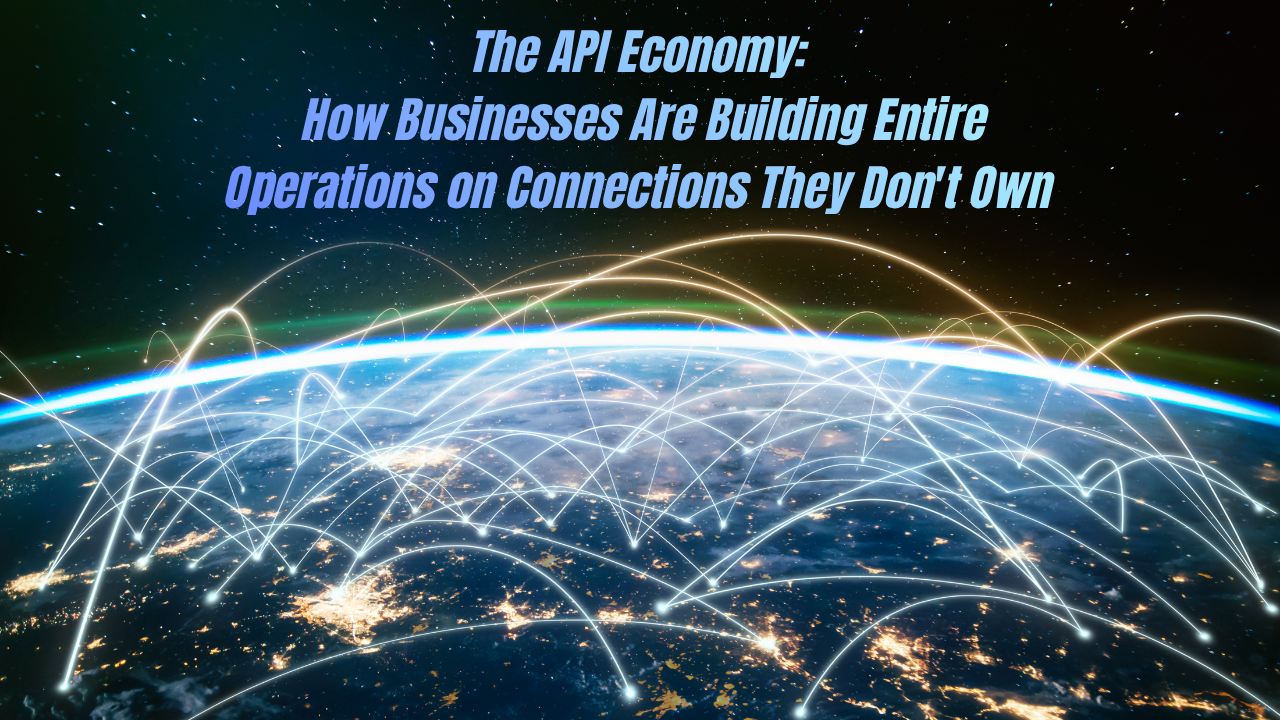
The API Economy is fundamentally changing how modern businesses build, connect, and manage their digital operations. Organisations are increasingly moving away from developing every technology capability internally and instead relying on interconnected platforms, external services, and third-party applications. From payment processing and customer relationship management to cloud infrastructure, logistics, and artificial intelligence, APIs have become the foundation that allows different technologies to communicate and operate together.
Consider a modern enterprise operating an online business. Its website might depend on an external payment gateway, its sales team might use a cloud-based CRM platform, its marketing department might connect multiple automation tools, and its logistics team might rely on third-party shipment tracking services. Although these technologies are developed and managed by different providers, APIs allow them to function as part of a connected business environment.
This interconnected approach creates opportunities for faster innovation, improved operational efficiency, and reduced development costs. However, it also introduces a critical challenge: businesses are increasingly building essential operations on technological connections they do not own or fully control. Understanding the opportunities, dependencies, and risks associated with the API Economy is therefore becoming an important part of enterprise technology strategy. The API Economy is changing how enterprises approach technology ownership and digital infrastructure.
1. What Is the API Economy and Why Does It Matter to Businesses?
The API Economy refers to the business ecosystem in which organisations create, exchange, and deliver value through Application Programming Interfaces (APIs). Instead of treating software applications as isolated systems, businesses use APIs to connect platforms, share information, access external capabilities, and build services that operate across multiple technology environments.
An API acts as an intermediary that allows two software systems to communicate according to predefined rules. It determines how applications request information, exchange data, and access specific functionality without requiring each system to understand the internal architecture of the other.
For businesses, this means technology capabilities can be accessed rather than independently developed.
For example, an e-commerce company does not necessarily need to build its own payment infrastructure. It can integrate an established payment provider through an API. Similarly, a business can connect its CRM platform with marketing automation software, customer support applications, and business intelligence tools.
The API Economy makes these integrations possible at scale.
Its growing business relevance comes from several advantages:
- Faster development: Organisations can introduce new capabilities without building every component internally.
- Operational connectivity: Different departments can exchange information through connected applications.
- Business scalability: Companies can expand their technology capabilities as operational requirements increase.
- Innovation opportunities: Existing services can be combined to create new products and customer experiences.
- Reduced development complexity: Teams can focus on business-specific functionality rather than recreating commonly available services.
For enterprise organisations, the API Economy is no longer simply a software development concept. It is becoming a strategic approach to designing interconnected business operations. The API Economy enables businesses to create value through connected services rather than isolated software applications.
2. How Businesses Are Building Operations Around Third-Party APIs
One of the biggest advantages of the API Economy is that businesses can access sophisticated technology capabilities without developing and maintaining every component themselves. The API Economy helps organisations introduce new capabilities without extensive internal development.
Building payment infrastructure, identity verification systems, communication platforms, location services, or data processing capabilities internally can require substantial investment. APIs provide an alternative by allowing organisations to integrate services that already exist.
Consider a company launching a digital commerce platform. Instead of independently developing every technology component, it can connect multiple external services to establish its operational environment. The API Economy makes it easier to connect business applications across multiple departments.
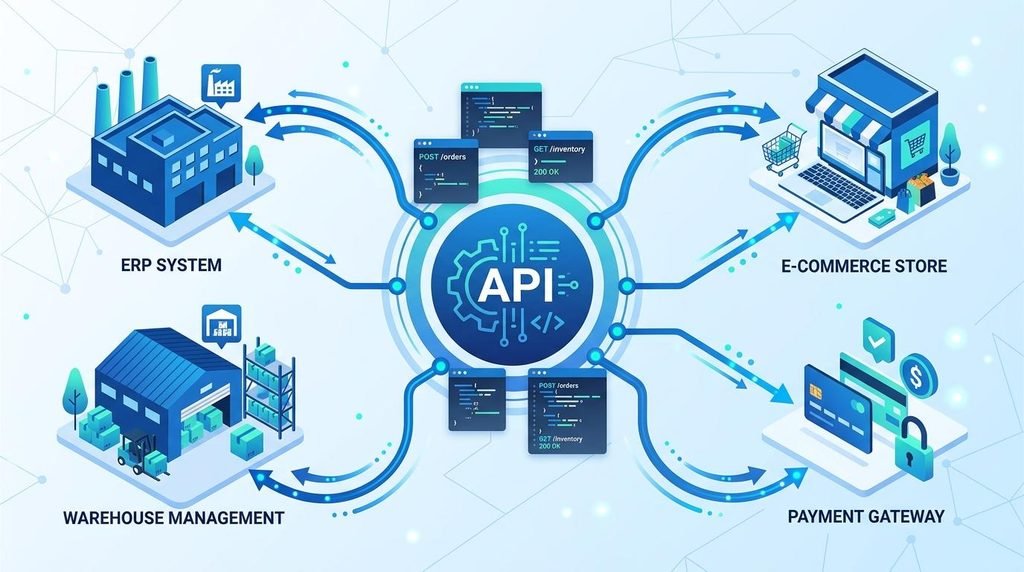
A typical API-driven business environment may include:
- Payment processing: External payment APIs handle transactions, payment confirmations, and related operations.
- Customer management: CRM APIs connect customer information across sales, marketing, and support platforms.
- Communication: Email, SMS, and notification APIs automate customer and employee communication.
- Logistics: Shipping and tracking APIs provide delivery information and shipment updates.
- Analytics: Data APIs connect operational systems with reporting and business intelligence platforms.
- Authentication: Identity and access management APIs help organisations implement secure application access.
The real advantage comes from combining these capabilities into connected workflows.
For instance, when a customer completes an online purchase, the payment API can confirm the transaction, the order management system can update inventory, the CRM platform can record the purchase, and the logistics platform can initiate shipment processing.
These processes can operate with minimal manual intervention when integrations are properly designed.
However, businesses must recognise that each integration introduces an external dependency. The more operational processes rely on third-party APIs, the more important it becomes to understand the reliability and limitations of those connections.
3. The Hidden Risk: When External API Dependencies Become Business-Critical
The convenience of the API Economy can gradually create a complex network of dependencies that organisations do not always fully understand.
A business may begin with a few integrations to simplify specific operations. Over time, additional APIs are introduced across finance, marketing, customer service, analytics, human resources, and infrastructure management.
Eventually, these connections can become essential to everyday business operations.
The problem is not necessarily the number of APIs. It is the organisation’s ability to understand how deeply those APIs are embedded in critical business processes.
For example, consider an enterprise that relies on an external authentication provider to manage employee access to internal applications. If that provider experiences an outage, employees may lose access to several business systems even when the organisation’s own infrastructure remains operational.
Similarly, a company depending on an external data provider could experience disruptions across reporting, sales operations, or customer communication if the provider becomes unavailable.
Understanding the impact of API dependency
Several situations can turn an ordinary integration into an operational risk:
- Service outages: An external provider becomes unavailable, interrupting dependent business processes.
- Pricing changes: A vendor introduces new charges that increase operational expenditure.
- API version changes: Technical updates make existing integrations incompatible.
- Usage restrictions: Request limits or service restrictions affect application performance.
- Provider discontinuation: A vendor removes an API or changes the direction of its product.
- Vendor lock-in: Replacing a deeply integrated service becomes expensive and operationally complicated.
The API Economy requires organisations to look beyond whether an integration works today. They must also understand what happens when the external service changes tomorrow.
A reliable business API strategy should therefore include dependency mapping, service monitoring, contingency planning, and clearly defined ownership for critical integrations. The API Economy makes managing external technology dependencies a critical business responsibility.
4. API Security: Protecting Data Across Connected Business Systems
Security becomes more complicated as businesses connect internal applications with external platforms.
Every API connection creates a pathway through which information can move between systems. If that pathway is poorly protected, it can introduce vulnerabilities that affect multiple applications and business processes.
Within the API Economy, organisations must consider not only the security of their internal infrastructure but also the security of the external services with which they exchange information.
For example, a company might maintain strong security controls within its CRM platform but expose sensitive customer information through an improperly configured API integration. Similarly, excessive API permissions could allow an application to access information beyond what it actually requires.
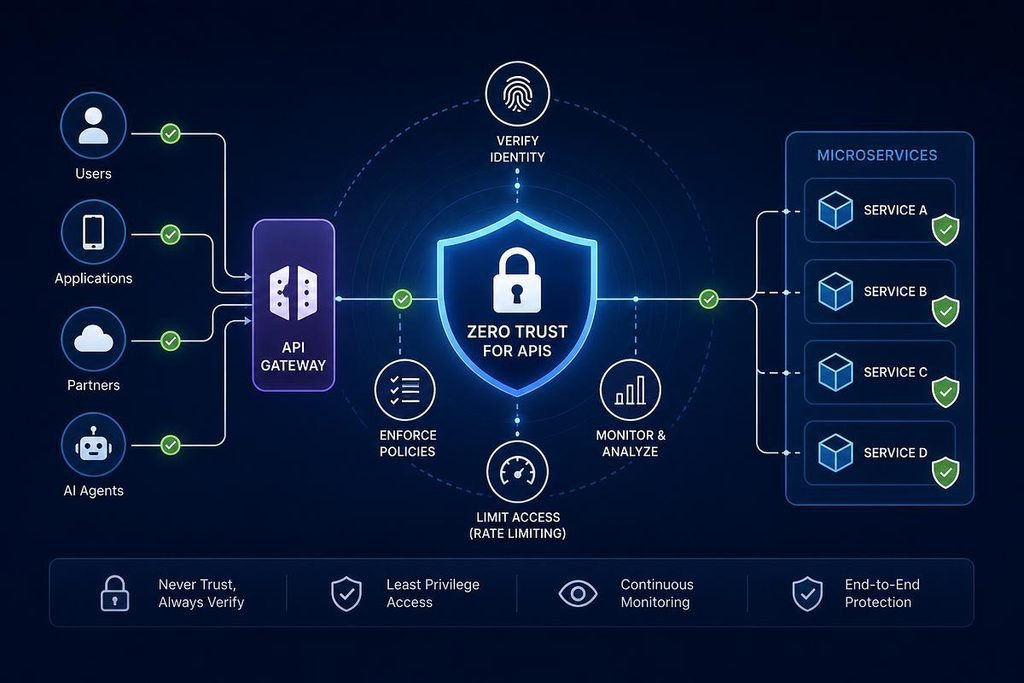
Essential API security practices for enterprises
Organisations should establish security controls across the entire API lifecycle.
1. Strong authentication and authorisation
APIs should use appropriate authentication mechanisms to verify applications and users. Authorisation policies should ensure that each integration receives only the permissions required to perform its assigned tasks.
2. Data encryption
Sensitive information should be protected during transmission using appropriate encryption protocols. Organisations should also consider how connected providers store and process exchanged information.
3. API gateways and access management
API gateways can help centralise traffic management, authentication enforcement, rate limiting, and policy application. They also provide greater visibility into how APIs are being accessed.
4. Continuous monitoring
API traffic should be monitored for unusual request patterns, unauthorised access attempts, excessive usage, and unexpected behaviour.
5. Third-party security assessments
External providers should be evaluated based on their security practices, data handling policies, compliance requirements, and incident response capabilities.
6. Regular testing and updates
Security assessments, vulnerability testing, dependency reviews, and timely updates help reduce the risks associated with changing API environments.
API security should not be treated as a one-time implementation task. It requires continuous attention because integrations, permissions, providers, and business requirements change over time. Security is a central consideration for every organisation participating in the API Economy.
5. The Hidden Financial Cost of an API-Dependent Business Model
Another important consideration within the API Economy is the long-term financial impact of maintaining external integrations.
APIs are often introduced because they appear more affordable than developing internal capabilities. However, the financial equation can change significantly as the business grows.
Many API providers use pricing structures based on request volumes, data processing, number of users, transaction counts, or service tiers.
An integration that is inexpensive during the initial implementation may become a significant recurring expense when business usage increases.
For example, an organisation using an external communication API for customer notifications may experience rising costs as its customer base and transaction volumes expand.
There can also be indirect costs associated with maintaining API-driven operations:
- Developer time spent managing integrations and resolving compatibility issues.
- Additional infrastructure required to process and monitor API traffic.
- Migration expenses when changing external providers.
- Operational losses caused by service interruptions.
- Security assessment and compliance-related expenses.
- Ongoing maintenance when providers modify API functionality.
How enterprises can manage API-related costs
A structured API management strategy should include regular financial reviews.
Businesses should:
- Evaluate total cost of ownership rather than focusing only on subscription pricing.
- Monitor API request volumes and identify unnecessary or inefficient calls.
- Review provider pricing changes and usage restrictions.
- Compare alternative providers before becoming heavily dependent on one service.
- Optimise integrations through caching, batching, and efficient request management where appropriate.
- Assess whether critical capabilities should be developed internally or maintained through external providers.
The objective is not to eliminate external services. It is to ensure that the financial benefits of the API Economy remain sustainable as business operations scale. Businesses operating in the API Economy must evaluate the long-term financial impact of external integrations.
6. API Governance: Managing Technology Connections Across the Enterprise
As API usage expands across departments, organisations need a structured approach to managing their integrations.
Without proper governance, different teams may independently connect applications, adopt external services, and establish data-sharing arrangements without central visibility.
This can result in duplicated integrations, inconsistent security practices, unclear ownership, and unnecessary operational complexity.
API governance provides the policies, processes, and accountability required to manage these connections effectively.
Key elements of enterprise API governance
API inventory and discovery: Maintain a central record of internal, external, and third-party APIs used across the organisation.
Ownership and accountability: Assign responsibility for every business-critical integration, including technical maintenance and vendor communication.
Standardisation: Establish consistent requirements for API documentation, authentication, versioning, error handling, and integration design.
Lifecycle management: Define how APIs are approved, introduced, monitored, updated, and eventually retired.
Vendor management: Evaluate external providers based on reliability, security, pricing, support, and long-term business suitability.
Data governance: Establish clear rules for what information can be exchanged, where it can be processed, and how it should be protected.
These practices help organisations gain better control over their API ecosystems without restricting innovation.
A mature API governance framework also makes it easier for enterprise architects and IT leaders to understand which business processes depend on external technology providers. Effective governance helps organisations manage the growing complexity of the API Economy.
7. How Artificial Intelligence Is Expanding the API Economy
Artificial intelligence is creating another major growth opportunity for the API Economy.
Modern AI-powered applications frequently depend on external APIs to access language models, cloud infrastructure, databases, analytics services, and specialised business tools.
Rather than developing every AI capability internally, organisations can integrate existing services into their applications and operational workflows.
For example, an enterprise customer support platform could connect an AI model API with its CRM system and internal knowledge base. When a customer submits a request, the connected services can retrieve relevant information, generate a response, and update the customer record.
Similarly, an organisation could combine AI APIs with document processing systems, enterprise databases, and workflow automation platforms to streamline administrative operations.
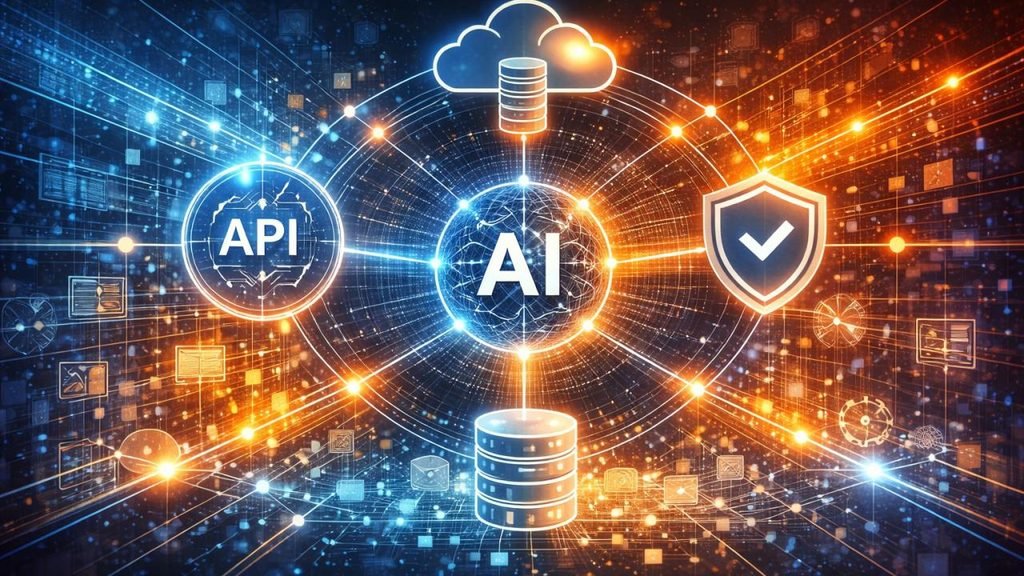
Business applications of AI-powered API integrations
- Customer support automation: Connect AI services with customer databases and support platforms to assist with enquiries.
- Intelligent document processing: Integrate AI models with document management systems to extract and organise information.
- Business intelligence: Connect AI capabilities with enterprise data platforms to support information retrieval and analysis.
- Workflow automation: Combine AI APIs with business applications to automate repetitive operational tasks.
- Personalised customer experiences: Integrate AI services with CRM and marketing platforms to support more relevant customer interactions.
However, AI integrations can introduce additional dependencies.
An AI-powered workflow might rely on a language model provider, a cloud platform, a database, and several internal applications. If one component becomes unavailable or changes its functionality, the entire workflow could be affected.
Organisations must also consider data privacy, model-provider policies, usage costs, performance requirements, and the implications of sending business information to external services.
As AI adoption expands, API governance and dependency management will become increasingly important parts of enterprise AI strategy. AI adoption is accelerating the API Economy by connecting intelligent services with enterprise applications.
8. Building a Resilient API Strategy: What Businesses Should Do Next
The long-term success of the API Economy will depend on how effectively organisations manage the relationships between their connected technologies.
Avoiding third-party APIs is neither practical nor necessary for most modern businesses. The real objective should be to use external capabilities while maintaining operational visibility, security, and flexibility. The API Economy allows businesses to combine AI capabilities with cloud platforms, databases, and automation tools.
Enterprise leaders can strengthen their API strategy through several practical steps.
1. Identify critical API dependencies
Start by documenting the APIs used across business applications. Identify which integrations support essential processes such as payments, customer access, financial operations, communication, and data management.
2. Classify integrations by business importance
Not every API requires the same level of monitoring. Organisations should distinguish between low-impact integrations and services whose failure could interrupt critical operations.
3. Establish alternative service options
For highly critical dependencies, evaluate whether alternative providers or backup processes are available. Where practical, design integrations in ways that make provider replacement easier.
4. Monitor availability and performance
Implement monitoring for response times, error rates, request volumes, service availability, and provider-specific limitations.
5. Build API resilience into application architecture
Use appropriate architectural practices such as timeouts, retries with backoff, circuit breakers, caching, and graceful degradation. These mechanisms can help prevent an external service failure from spreading across connected applications.
6. Review contracts and service-level agreements
Understand provider commitments around availability, support, incident communication, data handling, and service changes.
7. Conduct regular dependency assessments
Business requirements and external providers change. Review API dependencies periodically to identify unnecessary integrations, increasing costs, security concerns, and opportunities to simplify the technology environment.
The strongest API strategies balance innovation with operational independence. Businesses should be able to benefit from external technology without allowing a single provider or integration to become an uncontrollable point of failure. A sustainable API Economy requires businesses to balance external innovation with operational independence.
Conclusion
The API Economy represents a fundamental shift in how businesses build, operate, and expand their digital capabilities. APIs allow organisations to connect previously isolated systems, introduce new services faster, automate processes, and access technologies that would otherwise require substantial internal investment.
However, the growing reliance on external connections also creates new responsibilities. Security vulnerabilities, service interruptions, pricing changes, vendor lock-in, and complex integration dependencies can all affect business continuity when they are not properly managed.
For CTOs, CIOs, enterprise architects, and technology leaders, the priority should be to develop an API strategy that supports innovation without compromising operational resilience.
This requires more than selecting reliable providers. It involves maintaining an accurate view of API dependencies, establishing strong governance, monitoring connected services, controlling long-term costs, and preparing alternatives for business-critical integrations.
The future of enterprise technology will increasingly depend on interconnected platforms and services. Businesses that understand how these connections work, where their risks exist, and how to manage them effectively will be better positioned to scale and innovate.
The future belongs to connected businesses, but the smartest ones will know exactly what happens when a connection breaks.
Frequently Asked Questions
What is the API Economy in simple terms?
The API Economy is a business environment in which organisations create value by connecting software applications and services through APIs. It allows businesses to access external technology capabilities, exchange information, and build connected digital operations without developing every component internally.
Why is the API Economy important for modern businesses?
The API Economy helps businesses accelerate development, reduce infrastructure complexity, automate workflows, and integrate specialised technology services. It also allows organisations to introduce new capabilities without making significant investments in developing everything from scratch.
How do APIs help businesses reduce development costs?
APIs allow organisations to use existing services such as payment processing, authentication, communication, and analytics instead of building equivalent systems internally. This can reduce initial development requirements, although ongoing usage and integration costs must also be considered.
What are the biggest risks of relying on third-party APIs?
Major risks include service outages, security vulnerabilities, unexpected pricing changes, API discontinuation, usage restrictions, compatibility issues, and vendor lock-in. These risks can affect multiple business processes when critical applications depend on external services.
How can enterprises improve API security?
Enterprises can strengthen API security through strong authentication, role-based authorisation, encryption, API gateways, continuous monitoring, regular security testing, and third-party vendor assessments. They should also review API permissions and data-sharing practices regularly.
What is API governance, and why does it matter?
API governance refers to the policies, standards, and processes used to manage APIs throughout their lifecycle. It helps organisations maintain visibility, enforce security requirements, assign ownership, manage external providers, and reduce unnecessary integration complexity.
How does artificial intelligence contribute to the API Economy?
AI applications use APIs to connect language models, databases, cloud platforms, analytics tools, and enterprise applications. These integrations allow businesses to introduce AI-powered automation, intelligent customer support, document processing, and information retrieval into existing workflows.
How can businesses avoid vendor lock-in when using APIs?
Businesses can reduce vendor lock-in by documenting integrations, using standardised interfaces, maintaining clear data portability requirements, evaluating alternative providers, and designing critical systems so that external services can be replaced without rebuilding entire applications.
What should businesses consider before adopting a third-party API?
Before adopting an API, businesses should evaluate its security, reliability, pricing model, scalability, documentation, support, data handling practices, service commitments, and long-term availability. They should also understand how its failure could affect dependent business processes.