Introduction
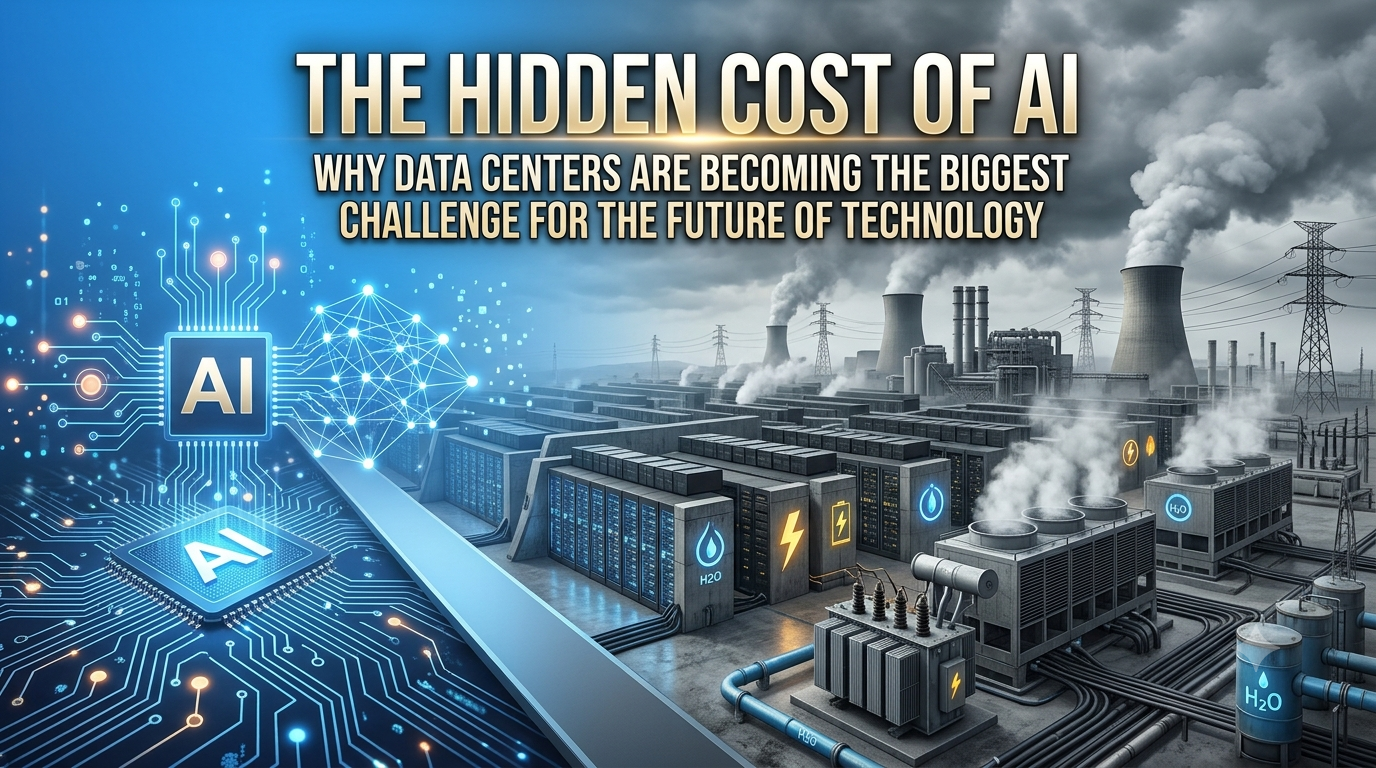
Artificial intelligence is transforming industries, from healthcare and banking to software development and customer service. Businesses are increasingly integrating AI into their operations to improve productivity, automate repetitive tasks, and make faster decisions. However, behind every AI-powered application is a massive technology infrastructure that requires computing power, storage, networking, electricity, and advanced cooling systems.
As AI models become more sophisticated, the infrastructure required to train and operate them is also expanding. Data centers that once primarily supported websites, cloud applications, and enterprise databases are now handling increasingly demanding AI workloads. This creates a growing challenge for technology companies: How can the world support the rapid expansion of AI without putting unsustainable pressure on energy resources and digital infrastructure?
For businesses, this is no longer just an environmental discussion. Electricity costs, infrastructure availability, cooling requirements, and data center capacity are becoming important factors in AI investment decisions.
Why Is AI Increasing Data Center Energy Consumption?
Traditional data centers support activities such as hosting websites, managing databases, running enterprise applications, and storing business information. AI introduces additional computational requirements, particularly when organizations train large models or run AI applications at scale.
Training advanced AI models involves processing enormous amounts of data through powerful processors. Once deployed, these models continue consuming computing resources whenever users interact with them. As organizations introduce AI assistants, recommendation engines, automated workflows, and generative AI applications, the demand for computing infrastructure grows.
Modern AI infrastructure frequently relies on GPUs and other specialized accelerators that support parallel processing. These systems generate significant heat and require carefully designed cooling infrastructure to operate reliably.
The challenge becomes even more complex when thousands of servers operate continuously within a single facility.
For enterprise organizations, this means AI adoption requires more than software investment. It also requires planning for the physical infrastructure supporting those applications.
The Growing Challenge of Electricity and Cooling –
Electricity is one of the most important resources required to operate modern data centers. AI workloads can increase power requirements because they involve intensive computational operations across specialized hardware.
However, electricity is only one part of the challenge. Almost all the electrical energy consumed by computing equipment eventually becomes heat, which must be managed to maintain safe operating temperatures.
Traditional air-cooling systems may not be sufficient for certain high-density AI computing environments. Consequently, data center operators are increasingly evaluating advanced cooling approaches.
Why cooling is becoming important –
- Liquid cooling: Uses liquid-based systems to remove heat from high-performance computing equipment.
- Advanced airflow management: Improves air circulation and reduces unnecessary cooling requirements.
- Thermal monitoring: Helps operators identify temperature issues before they affect equipment.
- Energy-efficient infrastructure: Reduces unnecessary electricity consumption across data center operations.
For businesses operating large AI environments, cooling efficiency directly affects infrastructure costs, hardware reliability, and operational planning.
How AI Infrastructure Is Changing Enterprise IT Investments –
The expansion of AI is changing how organizations evaluate their IT infrastructure. Previously, businesses could focus primarily on application performance, storage capacity, and cloud service costs. Today, AI infrastructure introduces additional considerations involving specialized hardware, computing capacity, energy availability, and cooling.
For example, a company planning to deploy an enterprise AI assistant across thousands of employees must consider more than the cost of the AI software. It must also evaluate model hosting, inference requirements, network performance, security, and ongoing operational expenses.
This creates several important investment considerations:
- Whether to use public cloud AI services or private infrastructure.
- Whether specialized GPU capacity is required.
- How to manage increasing AI workloads efficiently.
- Whether existing data center capacity can support future requirements.
- How to balance performance with infrastructure costs.
Organizations that evaluate these factors early can make better long-term infrastructure decisions.
The Environmental Impact of Expanding AI Infrastructure –
AI’s growing infrastructure requirements also raise environmental concerns. Data centers consume electricity and require cooling resources, while manufacturing specialized computing hardware involves additional material and energy requirements.
The environmental impact depends on several factors, including the facility’s efficiency, electricity source, cooling technology, hardware utilization, and geographical location.
Water consumption is another consideration for facilities using water-based cooling systems. In regions where water resources are limited, data center operators must carefully evaluate their cooling strategies and local environmental conditions.
This makes sustainable infrastructure an important part of future AI development.
Businesses should consider measuring their infrastructure efficiency, selecting appropriate energy sources, improving hardware utilization, and evaluating the environmental impact of their cloud and AI providers.
Can Green Data Centers Solve the AI Energy Challenge?
Green data centers aim to reduce the environmental impact of digital infrastructure through energy-efficient equipment, improved cooling, renewable electricity, and better resource management.
Several approaches are becoming increasingly important:
Renewable Energy Integration: Data center operators can use renewable electricity through suitable procurement arrangements and energy partnerships to reduce dependence on fossil-fuel-based electricity.
Efficient Hardware Utilization: Organizations can improve computing efficiency by avoiding unnecessary workloads and ensuring that available processing resources are used effectively.
Advanced Cooling Technology: Liquid cooling and improved thermal management can help address the heat generated by high-density computing systems.
Intelligent Infrastructure Monitoring: AI itself can support data center operations by helping analyze workloads, detect inefficiencies, and optimize resource allocation.
However, renewable energy and improved cooling alone cannot solve every infrastructure challenge. Power availability, grid capacity, hardware supply, and local environmental conditions also matter.
What Businesses Should Prepare for in the Future –
AI adoption is likely to remain an important part of enterprise technology strategies. As a result, organizations should start treating computing infrastructure and energy efficiency as strategic considerations rather than purely technical concerns.
IT leaders should evaluate how AI workloads affect cloud budgets, infrastructure capacity, application performance, and long-term sustainability.
Some practical priorities include:
- Evaluating the actual computing requirements of AI applications before deployment.
- Monitoring infrastructure utilization and energy efficiency.
- Comparing cloud-based and privately managed AI infrastructure.
- Choosing providers with transparent sustainability practices.
- Optimizing AI models and reducing unnecessary computational workloads.
- Including infrastructure costs in long-term AI investment planning.
The companies that successfully manage these challenges will be better positioned to scale AI applications without allowing infrastructure costs to grow unnecessarily.
Conclusion –
Artificial intelligence is creating enormous opportunities for businesses, but its expansion also exposes the limitations of the infrastructure supporting modern technology. Data centers are becoming increasingly important as organizations depend on powerful computing systems to train and operate AI models.
Electricity consumption, cooling requirements, water resources, hardware availability, and sustainability are no longer isolated infrastructure concerns. They are becoming important business considerations that can influence the cost and scalability of enterprise AI adoption.
The future of AI will not depend only on developing more powerful models. It will also depend on building efficient, reliable, and sustainable infrastructure capable of supporting them.
The next major challenge for the technology industry may not be making AI smarter, but making the infrastructure behind AI more sustainable.
Frequently Asked Questions
AI data centers operate powerful processors and specialized hardware to train and run AI models. These computational workloads require significant electricity, while additional energy is needed for cooling and supporting infrastructure.
AI data center energy consumption refers to the electricity used by computing equipment, storage systems, networking infrastructure, cooling systems, and other facilities supporting AI workloads.
High-performance processors generate substantial heat during operation. Effective cooling helps maintain appropriate temperatures, protects equipment, and supports reliable data center performance.
Green data centers are facilities designed to reduce environmental impact through energy-efficient infrastructure, improved cooling, renewable energy integration, and responsible resource management.
AI increases demand for specialized computing resources, storage, networking, and processing capacity. Cloud providers must continuously develop infrastructure to support growing AI workloads.