Software-Defined Networking (SDN) is transforming how organizations design, manage, and secure their enterprise networks. As businesses adopt cloud computing, hybrid infrastructure, distributed applications, and remote work environments, traditional networking approaches can become increasingly complex to operate. SDN introduces a more programmable and centralized approach to network management, helping IT teams adapt network behavior to changing business and application requirements.
In conventional networks, control decisions are often distributed across individual networking devices, and configuration changes may require administrators to manage multiple switches and routers separately. Software-Defined Networking separates the network’s control logic from its packet-forwarding functions, enabling software-based systems to manage network behavior through programmable interfaces. This separation can simplify administration, improve visibility, and support consistent network policies across complex environments.
For enterprise IT leaders, SDN is more than a networking technology. It is an architectural approach that can support infrastructure automation, cloud integration, application delivery, and security enforcement. However, realizing these benefits requires careful planning, appropriate controller design, compatible infrastructure, and a clear understanding of operational requirements. This guide explores how SDN works, its major benefits, practical enterprise use cases, implementation considerations, and its role in modern IT infrastructure.
What Is Software-Defined Networking (SDN)?
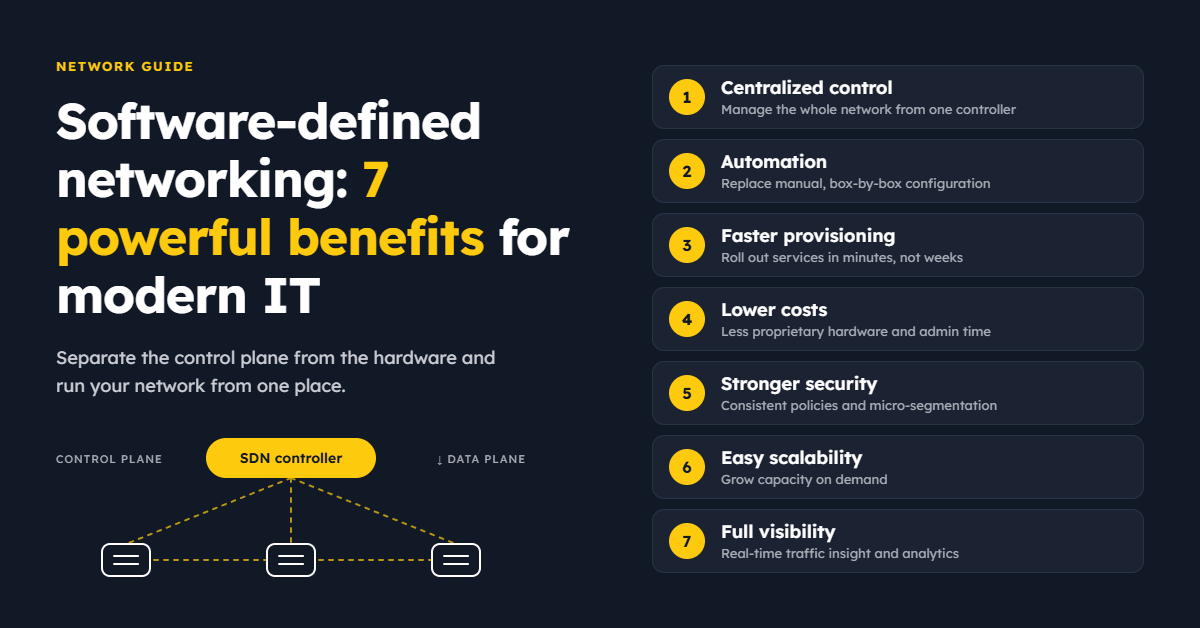
Software-Defined Networking (SDN) is a networking architecture that separates the control plane, which determines how traffic should move through a network, from the data plane, which forwards packets according to established rules. A software-based control layer can manage network behavior through programmable interfaces rather than requiring administrators to configure every networking device independently.
This architecture enables network teams to automate configuration, define traffic policies centrally, and respond to application or infrastructure changes more efficiently. Instead of treating each network device as an isolated management point, organizations can coordinate network behavior through software and standardized or vendor-specific interfaces.
SDN does not necessarily eliminate physical switches, routers, or other networking hardware. Rather, it changes how those resources are controlled and managed. The underlying network continues forwarding traffic, while software-based control mechanisms determine how network resources should behave. Software-Defined Networking (SDN) also helps organizations align network infrastructure with evolving business requirements. By making network resources programmable, Software-Defined Networking (SDN) enables IT teams to manage connectivity, apply consistent policies, and support application deployment across distributed environments. This flexibility is particularly valuable for enterprises modernizing legacy infrastructure and adopting hybrid cloud strategies.
How SDN Differs from Traditional Networking
Traditional networking commonly relies on device-by-device configuration, distributed control functions, and management tools that may operate independently. Although conventional networks can also support automation and centralized management, implementing consistent changes across large environments can require significant coordination.
Software-Defined Networking provides a programmable abstraction layer that allows administrators and applications to manage network policies more consistently.
Key differences include:
- Network configuration: Traditional environments may require individual device configuration, while SDN can automate changes across multiple devices.
- Control and forwarding: SDN separates control logic from packet forwarding, although the exact implementation varies by architecture.
- Policy management: SDN can apply network policies centrally and translate them into device-level rules.
- Infrastructure flexibility: Programmable network control can make it easier to support changing workloads and virtualized environments.
- Operational visibility: SDN platforms can provide a consolidated view of network topology, policies, and operational state, depending on the solution.
The practical advantage depends on the existing infrastructure, the SDN implementation, and how effectively the organization integrates network automation into its operational processes.
How Does Software-Defined Networking Work?
SDN works by introducing a software-based control mechanism that communicates with network devices and coordinates how traffic should be handled. The architecture typically includes applications and policy systems, an SDN controller, and the physical or virtual infrastructure responsible for forwarding packets.
These components work together to translate high-level requirements into network behavior. For example, an administrator might define a policy that limits access to a sensitive application or prioritizes traffic for a business-critical service. The SDN control system can then coordinate the required network rules across supported devices.
1. Application Layer
The application layer contains software that defines network requirements, security policies, traffic priorities, and operational objectives. Software-Defined Networking (SDN) relies on communication between applications, controllers, and network infrastructure to implement network policies. This model allows administrators to define desired network behavior through software and translate those requirements into configurations supported by the underlying devices. As a result, Software-Defined Networking (SDN) can reduce repetitive configuration work and improve consistency across complex network environments.
Applications may include network monitoring platforms, security tools, orchestration systems, and policy management interfaces. They communicate desired behavior to the control layer through suitable APIs.
For example, a cloud operations team might use an orchestration platform to request network connectivity for a newly deployed application without manually configuring every switch involved.
2. Control Layer
The control layer contains the SDN controller or controller system. It maintains or uses information about network topology, available paths, policies, and device capabilities to coordinate network behavior.
The controller translates higher-level instructions into rules that supported networking devices can implement. Depending on the architecture, controllers may operate as a centralized service, a clustered system, or a distributed control environment.
Important controller responsibilities can include:
- Coordinating network configuration and forwarding policies.
- Managing communication with supported network devices.
- Applying segmentation and traffic-control rules.
- Providing interfaces for automation and orchestration platforms.
- Maintaining network state and helping detect configuration inconsistencies.
Centralized logical control does not mean that every packet passes through the controller. In typical SDN deployments, forwarding devices continue handling data traffic locally, while the controller manages network decisions and configuration.
3. Infrastructure or Data Plane
The infrastructure layer contains physical and virtual switches, routers, gateways, and other network elements that forward traffic.
These devices implement the forwarding rules and policies delivered through the control system. Depending on the platform, communication may use protocols such as OpenFlow, device APIs, or other southbound interfaces.
For example, an SDN controller can configure supported switches to direct application traffic along an approved path or prevent unauthorized communication between network segments.
4. Northbound and Southbound Interfaces
SDN platforms use interfaces to connect applications, controllers, and network infrastructure.
- Northbound interfaces allow applications and orchestration systems to communicate network requirements to the controller.
- Southbound interfaces allow the controller to communicate with network devices and manage forwarding behavior.
These interfaces are important because they enable integration between network management, cloud platforms, security systems, and enterprise automation tools. However, compatibility varies, so organizations should evaluate APIs, protocols, and vendor dependencies before deployment.
7 Powerful Benefits of Software-Defined Networking (SDN)
Software-Defined Networking can help enterprises improve network operations by introducing programmable control, policy consistency, and automation. The extent of each benefit depends on network size, application requirements, infrastructure compatibility, and the organization’s operational maturity.
1. Simplified Network Management
Managing a large enterprise network can involve configuring numerous switches, routers, virtual networks, and security policies. Manual administration increases the operational effort required to maintain consistency across distributed infrastructure.
SDN helps simplify this work by allowing administrators to define policies centrally and automate supported configuration changes across multiple network devices. This approach can reduce repetitive tasks and make network administration more consistent.
For example, when an organization opens a new office, its network team may use automation to deploy approved connectivity and segmentation policies instead of configuring every compatible device individually.
Key advantages include:
- More consistent network configuration.
- Reduced repetitive administrative work.
- Centralized policy visibility.
- Easier coordination of network changes.
2. Greater Network Automation
Network automation is one of the primary benefits of Software-Defined Networking. By exposing programmable interfaces and central policy controls, SDN can help IT teams integrate network provisioning with application deployment, infrastructure management, and operational workflows.
Consider an enterprise that deploys applications across multiple environments. Without integrated automation, developers and infrastructure teams may need to submit separate requests for network connectivity, security rules, and traffic routing.
With an appropriately integrated SDN platform, approved network configurations can be applied as part of a deployment workflow. This can reduce manual handoffs and help teams deliver infrastructure more consistently.
Common automation opportunities include:
- Provisioning virtual networks for new workloads.
- Applying network access and segmentation policies.
- Updating traffic-routing rules.
- Integrating network changes with infrastructure-as-code workflows.
- Detecting configuration drift and coordinating remediation.
Software-Defined Networking (SDN) makes network automation more practical by enabling administrators to manage supported network resources through programmable interfaces. Instead of repeating manual configuration tasks, IT teams can develop workflows that apply approved network settings consistently. This approach helps organizations streamline routine operations, reduce configuration errors, and coordinate network changes with application deployment processes.
Automation should still include approval controls, validation, audit logging, and rollback procedures. Otherwise, an incorrect policy could propagate across multiple devices and affect a larger portion of the network. One important advantage of Software-Defined Networking (SDN) is its ability to simplify network operations across multiple environments. Instead of managing every compatible device independently, administrators can use centralized policy controls and automation workflows to coordinate changes. Software-Defined Networking (SDN) can therefore help enterprises improve operational consistency while reducing the effort required to maintain network configurations.
3. Improved Network Visibility and Control
Enterprise networks often span physical data centers, cloud environments, branch offices, and remote locations. Understanding how traffic moves between these environments can be difficult when monitoring and configuration information is distributed across separate tools.
SDN platforms can provide centralized views of network topology, policy configuration, and device state. When integrated with telemetry and monitoring systems, they can help administrators investigate connectivity problems, identify policy conflicts, and understand network behavior.
For instance, if a business application experiences intermittent connectivity, network engineers may use controller information and traffic telemetry to investigate routing, segmentation, or configuration issues.
Improved visibility can support:
- More efficient troubleshooting.
- Better understanding of application connectivity.
- Easier identification of policy inconsistencies.
- More informed capacity planning.
- Better coordination between network and security teams.
Centralized visibility is not automatically equivalent to complete observability. Organizations still need reliable telemetry, appropriate monitoring coverage, and tools that can correlate network events with application performance. Another advantage of Software-Defined Networking (SDN) is the ability to coordinate network management through a programmable control layer. When combined with suitable monitoring and analytics tools, SDN can help administrators understand network conditions, identify configuration inconsistencies, and investigate connectivity problems. This consolidated approach supports better-informed operational decisions and helps enterprise teams manage increasingly complex network environments.
4. Enhanced Network Security and Segmentation
Security teams must control how users, applications, servers, and devices communicate. Traditional network architectures can make consistent enforcement challenging when policies must be maintained across numerous devices and environments.
Software-Defined Networking can help centralize policy definition and automate network segmentation. This allows organizations to define communication boundaries around business applications, workloads, or security requirements.
For example, a financial services organization may separate customer-facing applications, internal business systems, development environments, and sensitive databases. An SDN-enabled architecture can help enforce these boundaries across supported network infrastructure.
Security-related capabilities may include:
- Automated application or workload segmentation.
- Centralized policy distribution.
- Controlled communication between network zones.
- Integration with identity and security platforms.
- Faster implementation of approved network restrictions.
However, SDN is not a complete security solution by itself. Effective protection still requires identity controls, endpoint security, encryption where appropriate, vulnerability management, monitoring, and well-defined incident response procedures.
5. Better Scalability and Infrastructure Flexibility
Enterprise networks must accommodate changing application demand, new business locations, cloud adoption, and increasing numbers of connected devices. Hardware-centric provisioning processes can create operational challenges when network changes require repeated manual configuration.
SDN provides a programmable approach to network management that can simplify the creation and modification of logical network resources. Organizations can use these capabilities to support virtualized workloads and evolving infrastructure requirements.
For example, an organization expanding its application environment may need additional network segments and access policies for new workloads. An SDN platform can automate supported changes and coordinate them with the infrastructure deployment process.
Potential benefits include:
- Faster provisioning of logical network resources.
- More consistent management across supported devices.
- Easier integration with virtualized infrastructure.
- Support for dynamic application environments.
- Simplified coordination between networking and cloud operations.
Software-Defined Networking (SDN) can help enterprises respond to changing infrastructure demands without relying entirely on manual, device-by-device configuration. As businesses introduce new applications, expand their data centers, or deploy additional virtual machines, programmable network controls can simplify supported provisioning tasks. Careful capacity planning and controller design remain essential to ensure that the network continues to meet performance and availability requirements as it grows.
Scalability still depends on controller capacity, network topology, device limits, and the architecture used to maintain control-plane availability. Software-Defined Networking (SDN) can strengthen network security by making segmentation policies easier to manage and enforce across supported infrastructure. IT teams can define communication boundaries between applications, servers, and network zones, helping limit unnecessary access. When combined with identity management, monitoring, and established security controls, Software-Defined Networking (SDN) can contribute to a more consistent enterprise security strategy.
6. More Efficient Traffic Management
Different applications have different networking requirements. Real-time communications, enterprise databases, backup operations, and bulk data transfers may compete for available bandwidth and network resources.
SDN can help administrators implement traffic policies that reflect application requirements and business priorities. Depending on the platform, these policies may influence path selection, traffic prioritization, bandwidth allocation, and network segmentation.
For example, an enterprise running voice and video services alongside large data transfers may use policy-based traffic management to prioritize latency-sensitive applications on supported network paths.
Practical use cases include:
- Prioritizing critical business application traffic.
- Applying quality-of-service policies.
- Managing traffic between data centers.
- Coordinating connectivity for distributed applications.
- Supporting more consistent application network requirements.
SDN does not automatically eliminate congestion or guarantee better application performance. Effective traffic management depends on available capacity, accurate telemetry, routing design, and correctly configured policies.
7. Support for Cloud and Hybrid IT Environments
Many enterprises operate across on-premises infrastructure, public cloud services, private clouds, and distributed application platforms. Maintaining consistent connectivity and security policies across these environments can be challenging.
Software-Defined Networking can help abstract network configuration from individual devices and integrate network management with cloud orchestration systems. This can make it easier to provision logical networks and apply consistent policies across supported infrastructure.
For example, an organization migrating a business application from its data center to a cloud environment may need to recreate connectivity rules, segmentation policies, and access controls. An SDN-enabled architecture can automate parts of this process when the relevant platforms and integrations support it.
SDN can support hybrid IT through:
- Programmable connectivity for virtualized workloads.
- Integration with cloud and infrastructure orchestration.
- Consistent network policy management across supported environments.
- Automated network provisioning during application deployment.
- Better coordination between network and cloud operations teams.
Organizations should evaluate cross-platform compatibility carefully. Different cloud providers and networking vendors may use distinct control mechanisms, APIs, and policy models, which can limit portability.
Enterprise Use Cases for Software-Defined Networking
The value of SDN becomes clearer when it is connected to specific operational requirements. Organizations can use programmable networking to address provisioning delays, inconsistent security policies, complex application connectivity, and the need to manage infrastructure at scale.
Data Center Networking
Data centers support applications, databases, storage systems, and virtualized workloads that often require frequent network changes. SDN can help automate network provisioning and segmentation as workloads are deployed or relocated.
A data center operations team might use SDN policies to create isolated network segments for production applications, development systems, and shared services. When integrated with workload orchestration, these policies can be applied more consistently as infrastructure changes.
Cloud and Hybrid Infrastructure
Hybrid infrastructure introduces connectivity requirements across on-premises data centers and cloud platforms. SDN can help coordinate logical network provisioning and policy enforcement across supported environments.
Organizations may use SDN capabilities to support application migration, automate virtual network creation, and manage connectivity between distributed workloads. The implementation should account for routing, latency, security boundaries, and provider-specific limitations. Software-Defined Networking (SDN) can support cloud adoption by integrating network provisioning with infrastructure orchestration. As workloads move between on-premises data centers and cloud environments, organizations can use compatible SDN solutions to automate connectivity and apply network policies. Software-Defined Networking (SDN) is particularly useful when network configuration must keep pace with frequently changing application environments.
Enterprise Branch Networks
Businesses with multiple offices must maintain consistent network configurations, user access policies, and connectivity to centralized applications.
SDN-based approaches can simplify policy management across supported branch infrastructure. When combined with software-defined wide-area networking (SD-WAN), organizations can also manage WAN connectivity and traffic-routing decisions through software-based policies.
SDN and SD-WAN are related but distinct concepts: SDN describes a broader networking architecture, while SD-WAN focuses on managing wide-area network connectivity.
Network Security and Zero Trust
Zero Trust architectures require access decisions to be based on verified identity, device posture, application context, and other relevant signals rather than assuming that internal network traffic is trustworthy.
SDN can support these objectives by helping enforce segmentation and communication policies. For example, an enterprise can restrict a workload’s access to approved services and limit unnecessary communication with other network segments.
The security architecture should combine SDN with identity-aware access controls, endpoint protection, continuous monitoring, and appropriate authentication mechanisms.
Telecommunications and Large-Scale Network Operations
Telecommunications providers and large infrastructure operators manage networks with diverse traffic patterns and demanding availability requirements.
Programmable networking can help coordinate network configuration and support automation across compatible environments. Specific implementations vary considerably, and operators must account for scale, latency, resilience, interoperability, and operational complexity.
SDN vs. Traditional Networking: Key Differences
Both SDN and traditional networking can provide reliable enterprise connectivity. The difference lies primarily in how control, configuration, and automation are organized.
| Area | Traditional networking | Software-Defined Networking |
|---|---|---|
| Control model | Often distributed across network devices | Control logic is separated from forwarding and managed through an SDN control layer |
| Configuration | May involve device-by-device administration | Supports centralized, programmable configuration |
| Automation | Depends on available tools and integrations | Designed to support programmatic control and policy-based automation |
| Policy management | May require coordination across devices | Can coordinate policy deployment through a controller |
| Scalability | Depends on design and operational processes | Can simplify scaling when controller and infrastructure capacity are sufficient |
| Security | Uses device-level and centralized security controls | Can automate network segmentation and policy enforcement |
| Integration | Depends on existing management platforms | Can integrate with orchestration and cloud systems through supported interfaces |
| Operational considerations | Familiar workflows and established infrastructure | Requires controller management, integration planning, and appropriate skills |
Traditional networks can also support centralized management and sophisticated automation. Similarly, SDN deployments can include distributed control functions and device-level configuration. Therefore, organizations should evaluate the actual capabilities of each architecture rather than assuming that all conventional networks are manual or all SDN environments are fully automated.
Challenges and Limitations of Software-Defined Networking
Although SDN can simplify many networking operations, it introduces technical and organizational considerations that must be addressed before deployment. An implementation that ignores these issues may increase complexity rather than reduce it.
Controller Availability and Resilience
The SDN controller plays an important role in coordinating network configuration and policy enforcement. Controller outages or communication failures can affect the ability to make network changes, although existing forwarding behavior may continue depending on the implementation.
Organizations should evaluate controller redundancy, failover behavior, state synchronization, and recovery procedures. Testing should establish how the network behaves when controllers, links, or management services become unavailable.
Security Risks
An SDN controller has significant influence over network behavior. If its management interfaces or credentials are compromised, an attacker may be able to manipulate network policies or disrupt connectivity.
Security measures should include:
- Strong authentication and role-based access control.
- Protected communication between controllers and devices.
- Regular software updates and vulnerability management.
- Audit logs for administrative and policy changes.
- Network isolation for management systems.
- Tested recovery procedures for unauthorized or incorrect changes.
Integration and Vendor Compatibility
Organizations may operate equipment from multiple vendors, legacy systems, and cloud platforms with different management capabilities. Not every device supports the same protocols, APIs, or policy models.
A compatibility assessment should identify which devices can be managed directly, which require adapters or additional platforms, and which may need replacement. Pilot deployments can help reveal integration challenges before a wider rollout.
Skills and Operational Readiness
SDN changes how network teams approach design, configuration, automation, and troubleshooting. Administrators may need experience with APIs, scripting, software-based policy models, orchestration tools, and infrastructure-as-code practices.
Training and documentation are important, particularly when networking, security, cloud, and application teams share responsibility for network changes.
Cost and Migration Complexity
SDN may require investments in software, compatible infrastructure, controller services, training, and operational integration. Existing networks may also contain applications and devices that cannot be migrated immediately.
A phased approach can help organizations validate benefits and costs before expanding the implementation. Business cases should consider licensing, infrastructure changes, operational effort, migration risks, and ongoing support requirements.
Best Practices for Implementing SDN in Enterprise IT
A successful SDN implementation begins with business and operational objectives rather than technology selection alone. Organizations should identify the network problems they need to solve and evaluate how programmable control can address them.
1. Define Clear Business Objectives
Start by identifying measurable operational goals, such as reducing manual provisioning effort, improving segmentation consistency, simplifying cloud connectivity, or improving visibility.
Document the current state and establish baseline measurements where possible. These baselines can later help determine whether the implementation delivers meaningful improvements.
2. Assess the Existing Network
Inventory network devices, software versions, application dependencies, routing policies, and management platforms. Determine which components support the intended SDN architecture and identify systems that may require integration or replacement.
This assessment should also cover network availability requirements, existing security controls, and dependencies on legacy applications.
3. Choose an Appropriate Architecture
Evaluate controller capabilities, supported protocols, APIs, integration options, resilience, scalability, and vendor dependencies. Consider whether the organization needs SDN primarily for data center networking, cloud integration, segmentation, or broader infrastructure automation.
The architecture should match the use case instead of introducing unnecessary complexity.
4. Start with a Controlled Pilot
Select a limited environment with clear boundaries and manageable operational risk. A pilot could focus on a test data center segment, a noncritical application, or a specific provisioning workflow.
Use the pilot to validate compatibility, policy enforcement, controller resilience, monitoring, and rollback procedures before expanding the deployment.
5. Integrate Security from the Beginning
Security policies should be part of the initial design rather than added after the network is operational. Define access requirements, management-plane protections, segmentation boundaries, and approval workflows.
Test both expected and prohibited traffic flows to confirm that network policies behave as intended.
6. Integrate SDN with Existing Automation
Where appropriate, connect SDN to infrastructure-as-code systems, cloud orchestration, monitoring platforms, configuration management, and IT service management workflows.
Use version control, automated validation, change approval, and rollback procedures to reduce the risk of incorrect configuration changes.
7. Measure Results and Improve Continuously
Track operational metrics that align with the project’s objectives. Relevant measurements may include provisioning time, configuration drift, network-related incident frequency, change failure rate, policy compliance, and time spent on manual administration.
Review these measurements regularly and use the findings to refine automation, update policies, and improve operational processes. Before deploying Software-Defined Networking (SDN), organizations should identify their primary operational challenges and evaluate the capabilities of their existing network infrastructure. A focused implementation can help teams validate automation workflows, controller resilience, device compatibility, and security policies. By measuring results during a pilot, enterprises can determine whether Software-Defined Networking (SDN) meets their technical and business objectives.
The Future of Software-Defined Networking in Modern IT
Enterprise networking continues to evolve alongside cloud computing, distributed applications, infrastructure automation, and security modernization. Software-Defined Networking provides an architectural foundation for making network resources more programmable and integrating network management with broader IT operations.
As organizations adopt more automated infrastructure workflows, SDN can help coordinate network provisioning with application deployment and workload lifecycle management. Integration with observability platforms can also support more informed troubleshooting and policy adjustments, provided the required telemetry and automation safeguards are available.
Artificial intelligence and machine learning may further assist network operations by identifying unusual traffic patterns, correlating events, and recommending configuration changes. However, automated recommendations should be validated, and high-impact changes should use appropriate safeguards and human oversight.
Several developments are particularly relevant to enterprise IT:
- Intent-based networking: Translating high-level business or operational requirements into network policies.
- Network automation: Integrating network configuration with application and infrastructure deployment workflows.
- Cloud-native networking: Supporting dynamic workloads and distributed applications through programmable network controls.
- Security-driven segmentation: Enforcing more precise communication boundaries across applications and infrastructure.
- AI-assisted operations: Using analytics to help identify anomalies, investigate incidents, and recommend corrective actions.
These developments do not remove the need for sound network architecture, resilient infrastructure, and skilled operations teams. Instead, they create opportunities to combine programmable control with better policy management and more consistent automation. The long-term value of Software-Defined Networking (SDN) depends on how effectively it integrates with the organization’s broader IT strategy. Combining programmable networking with infrastructure automation, cloud orchestration, and security governance can help enterprises build more adaptable network environments. With careful planning and ongoing evaluation, Software-Defined Networking (SDN) can support the operational needs of modern enterprise IT.
Conclusion
Software-Defined Networking (SDN) is an important architectural approach for organizations seeking greater control, automation, and flexibility across modern IT infrastructure. By separating network control logic from packet forwarding, SDN enables software-based systems to coordinate network configuration, apply policies, and support changing application requirements.
Its potential benefits extend across enterprise network management, data center operations, cloud integration, security segmentation, and infrastructure automation. However, SDN is not an automatic solution to every networking challenge. Controller resilience, security, compatibility, migration complexity, and operational readiness all influence the outcome.
For IT leaders, the most effective approach is to begin with clearly defined business objectives, assess the existing network, test a suitable use case, and measure results before scaling the deployment. When implemented with appropriate architecture and governance, Software-Defined Networking can help enterprises build networks that are more programmable, manageable, and aligned with evolving business needs.
Frequently Asked Questions
1. What is Software-Defined Networking (SDN)?
Software-Defined Networking (SDN) is a networking architecture that separates the control plane from the data plane. It enables software-based controllers to coordinate network configuration and forwarding policies, making it easier to automate supported network operations.
2. What are the main benefits of SDN?
The main benefits include centralized policy management, network automation, improved visibility, flexible network provisioning, security segmentation, traffic management, and support for cloud and hybrid IT environments. Actual results depend on the architecture and implementation.
3. How does SDN differ from traditional networking?
Traditional networking often distributes control functions across individual devices and may rely on device-level configuration workflows. SDN separates control logic from packet forwarding and supports programmable management through a control layer. Traditional networks can also support centralized management and automation.
4. What are the main components of SDN architecture?
SDN architecture commonly includes an application layer, a control layer, and an infrastructure or data plane. Northbound interfaces connect applications to the controller, while southbound interfaces enable communication between the controller and supported network devices.
5. Is Software-Defined Networking secure?
SDN can support centralized security policies and automated network segmentation, but it is not inherently secure. Organizations must protect controller access, secure management communications, maintain software updates, monitor network activity, and test policy enforcement.
6. What is the difference between SDN and SD-WAN?
SDN is a broader architectural approach that separates network control from forwarding functions. SD-WAN applies software-based control and policy management specifically to wide-area networking, helping organizations manage connectivity between branch offices, data centers, and cloud environments.
7. Can SDN work with existing network infrastructure?
Yes, in some environments. Compatibility depends on device capabilities, supported protocols, available APIs, and the chosen SDN platform. Organizations should assess their existing infrastructure and test integrations before planning a large-scale migration.
8. Is SDN suitable for small and medium-sized businesses?
SDN may be suitable for small and medium-sized businesses that need network automation, segmentation, centralized management, or scalable connectivity. However, implementation costs, operational complexity, and support requirements should be evaluated against the organization’s actual needs.
9. What challenges should organizations consider before implementing SDN?
Important considerations include controller resilience, security, compatibility with existing devices, migration complexity, staff training, licensing, and integration with current management tools. A controlled pilot and clearly defined success criteria can help reduce implementation risks.
10. How can an organization get started with SDN?
Start by identifying a specific business or operational problem, such as manual network provisioning or inconsistent segmentation. Assess infrastructure compatibility, select an appropriate architecture, run a limited pilot, integrate security and monitoring, and measure results before expanding the implementation.