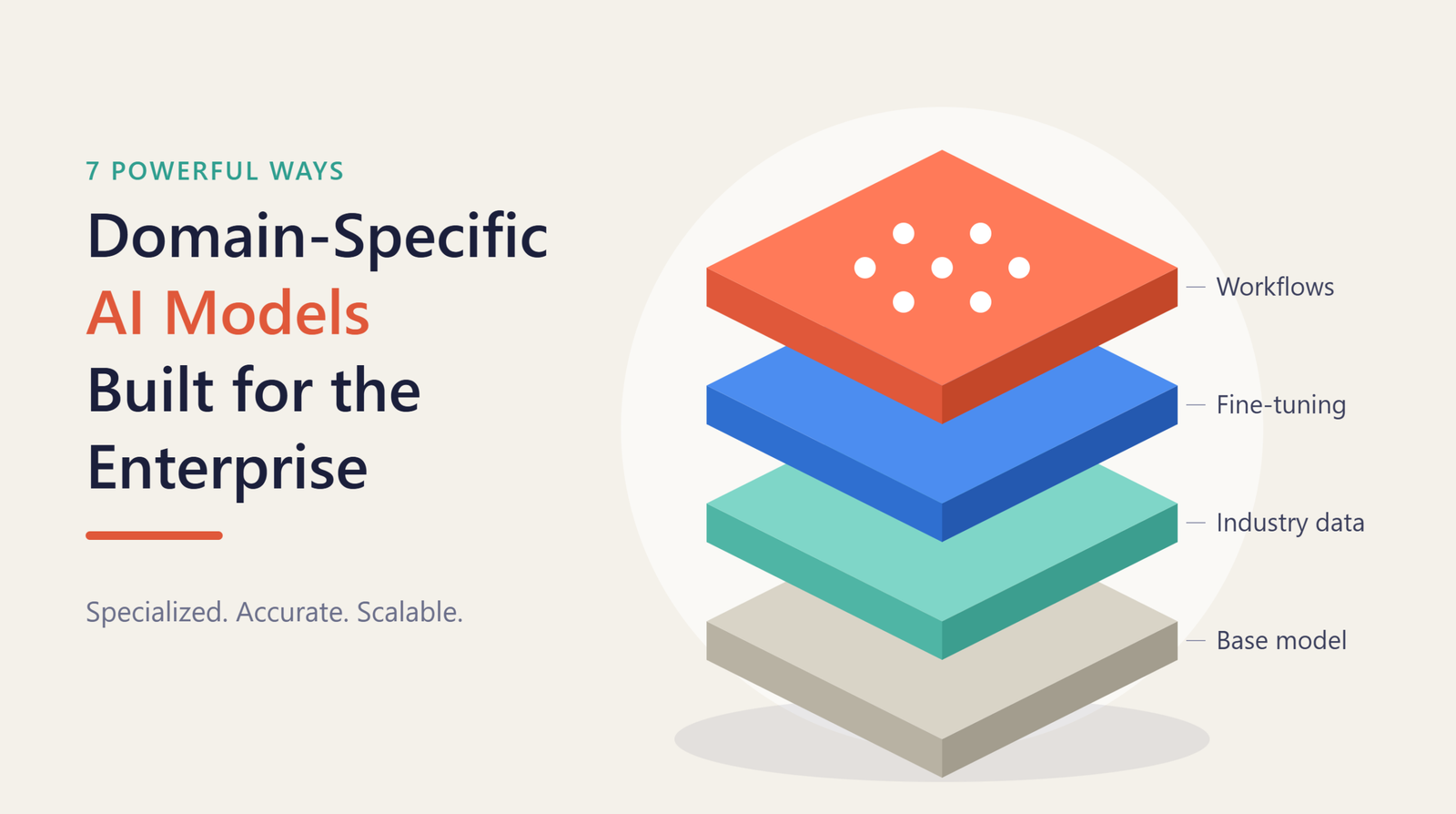
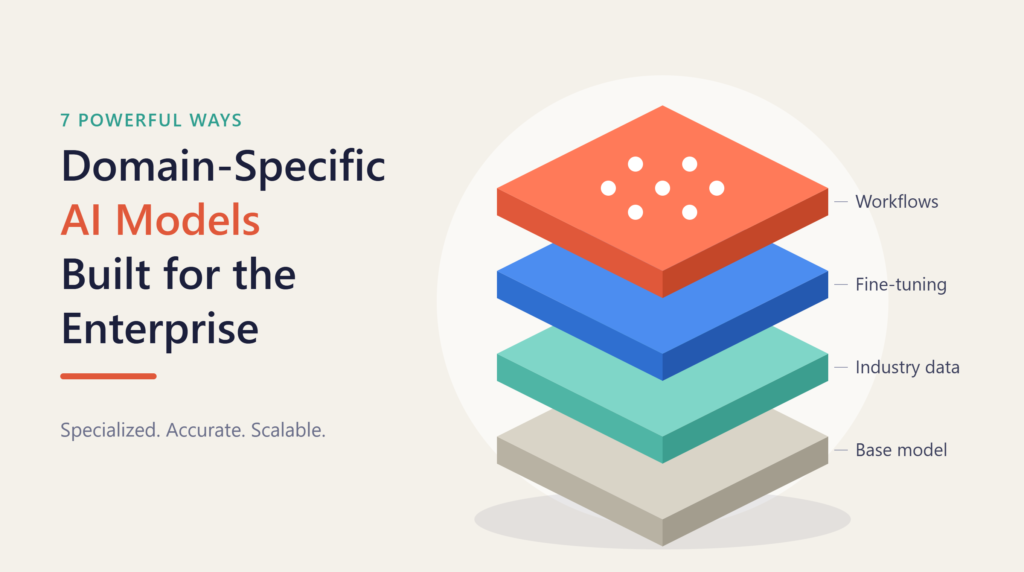
Artificial intelligence is moving beyond the era of one-size-fits-all models. Domain-Specific AI Models are emerging as an important approach for enterprises that need AI systems designed around particular industries, business functions, workflows, and specialized knowledge. Instead of relying entirely on broad models that attempt to handle every type of task, organizations can increasingly use AI that is optimized for a defined business context.
This shift is particularly relevant as enterprises move from experimenting with AI to integrating it into operational systems. A general-purpose model may be capable of answering questions, generating content, or analyzing information, but enterprise applications often require deeper contextual understanding, predictable behavior, specialized terminology, and stronger controls.
The rise of Domain-Specific AI Models therefore represents more than another development in machine learning. It reflects a broader change in how businesses think about AI architecture: the most useful model is not necessarily the largest or most general model, but the one that is appropriately aligned with the problem it needs to solve.
What Are Domain-Specific AI Models?
Domain-Specific AI Models are AI or machine learning models designed, adapted, or configured to perform tasks within a particular business domain, industry, or area of expertise.
A general-purpose AI model might be designed to handle a wide variety of requests. A domain-specific model, by contrast, focuses on a narrower context. It may be developed or adapted to understand specialized terminology, workflows, documents, data structures, and business requirements.
For example, an enterprise operating in financial services may need AI that understands financial terminology and regulatory documentation. A healthcare organization may require systems capable of working with highly specialized medical information. A manufacturing company may prioritize AI for equipment monitoring, production processes, or quality control.
Domain-specific approaches can help organizations address challenges that are difficult to solve effectively with a purely general-purpose approach.
Key characteristics can include:
- Specialized knowledge and terminology
- Focused business use cases
- Industry- or function-specific workflows
- Greater control over model behavior
- Integration with enterprise data and applications
- Requirements for domain-specific security and governance
The objective is not necessarily to replace general-purpose AI. Instead, enterprises can combine different AI approaches depending on the task.
Why Enterprises Are Moving Toward Specialized AI
Enterprise AI adoption is becoming increasingly practical. Businesses are no longer evaluating AI only as a productivity experiment; they are considering how it can become part of applications, processes, decision-support systems, and customer experiences.
This creates a new requirement: context.
A model that performs well on broad tasks may not automatically understand an organization’s terminology, internal processes, data structures, or industry-specific requirements. Enterprises therefore need ways to make AI more relevant to their operating environment.
Several factors are driving interest in specialized AI:
1. More Complex Enterprise Workflows
Business processes often contain multiple steps, rules, systems, and sources of information. A domain-specific model can be designed or adapted around the requirements of a particular workflow rather than treating every request as a generic AI task.
2. Specialized Business Knowledge
Industries such as finance, healthcare, manufacturing, legal services, telecommunications, and energy rely on highly specialized terminology and processes.
AI systems operating in these environments need to work effectively within that context.
3. Greater Need for Control
Enterprises typically require predictable behavior, security controls, governance, and integration with existing technology environments. Specialized AI can make it easier to define boundaries around specific use cases.
4. Demand for Business-Relevant Outcomes
The ultimate objective of enterprise AI is not simply to deploy an AI model. It is to solve a business problem.
A smaller, specialized system that performs one important task effectively can sometimes be more useful to an organization than a broad system that attempts to do everything.
7 Powerful Ways Domain-Specific AI Models Are Transforming Enterprise Technology
The impact of Domain-Specific AI Models extends across applications, infrastructure, data management, cybersecurity, and business operations.
1. Improving Enterprise Decision Support
Organizations generate enormous amounts of information through applications, databases, documents, customer interactions, operational systems, and other sources.
Domain-specific AI can help transform this information into decision-support capabilities tailored to particular business functions.
For example, an enterprise procurement system could use specialized AI to analyze supplier documentation, identify relevant contract information, and support procurement teams in reviewing large volumes of material.
The important distinction is that the AI is operating within a defined business context.
This can help organizations:
- Analyze domain-specific information
- Surface relevant patterns
- Support human decision-making
- Reduce time spent searching through documents
- Integrate intelligence into existing workflows
AI should still be treated as decision support where human judgment, verification, or approval is required.
2. Creating More Intelligent Industry Applications
Software vendors and enterprise technology teams are increasingly incorporating AI directly into business applications.
Instead of offering AI as a separate chatbot or assistant, organizations can embed specialized intelligence into the systems employees already use.
Consider an enterprise asset-management platform. Rather than simply providing a generic conversational interface, an AI capability could be designed around asset records, maintenance workflows, equipment information, and operational terminology.
This creates a more contextual experience because the AI is connected to the application and its business purpose.
The same principle can apply to:
- Customer service platforms
- Enterprise resource planning
- Human resources systems
- Supply-chain management
- Financial applications
- IT service management
- Security operations platforms
3. Enhancing Enterprise Automation
Automation becomes more powerful when AI understands the context of the process being automated.
Traditional automation generally follows predefined rules. AI can introduce capabilities such as language understanding, classification, summarization, prediction, and information extraction.
A domain-specific AI system can combine these capabilities with knowledge of a particular workflow.
For example, an enterprise could use specialized AI to process incoming business documents, classify them, extract relevant information, and route them into an appropriate workflow.
This can reduce manual effort while keeping the automation focused on a defined business objective.
However, enterprises should carefully determine which decisions can be automated and which require human review.
4. Supporting More Relevant Customer Experiences
Customer expectations increasingly involve fast, contextual, and personalized interactions.
General-purpose AI can provide conversational capabilities, but enterprise customer experiences often require access to specific products, policies, services, and organizational processes.
A domain-specific AI solution can be designed around those requirements.
For example, a telecommunications provider could use specialized AI to help customer-service teams understand service plans, troubleshoot common issues, and retrieve relevant account information.
The value comes from connecting AI capabilities with the organization’s actual business context.
5. Strengthening AI Governance and Control
As AI becomes embedded into enterprise operations, governance becomes increasingly important.
Organizations need to understand:
- What information an AI system can access
- How the system is being used
- Which decisions it influences
- How outputs are validated
- Who is responsible for the system
- How security and privacy requirements are enforced
A domain-specific implementation can provide a narrower operational scope, which can make governance requirements easier to define for a particular application.
That does not automatically make a system secure or compliant. Enterprises still need appropriate controls, testing, monitoring, access management, and governance processes.
6. Enabling Specialized AI at the Edge and Within Enterprise Environments
Not every AI workload needs to run through a large centralized model.
Some enterprise applications require AI capabilities closer to where data is generated. This can be particularly relevant in manufacturing, logistics, retail, telecommunications, and other environments involving connected devices or operational technology.
Specialized models can be appropriate for narrower tasks where the organization needs:
- Fast inference
- Reduced dependency on network connectivity
- More controlled data processing
- Integration with operational systems
- Efficient use of computing resources
This creates an important connection between AI models and enterprise infrastructure.
AI strategy therefore increasingly needs to consider not only models and applications, but also where inference occurs and how AI workloads are managed.
7. Driving the Next Generation of Enterprise AI Architecture
Perhaps the biggest transformation is architectural.
Enterprise AI is unlikely to consist of a single model performing every task. Organizations may instead build AI environments that combine general-purpose models, specialized models, retrieval systems, enterprise data, APIs, automation platforms, and human oversight.
A future enterprise AI architecture could involve:
- General-purpose models for broad reasoning and communication
- Domain-specific models for specialized tasks
- Retrieval systems for accessing enterprise knowledge
- AI agents for executing defined workflows
- APIs connecting AI to business applications
- Governance layers for monitoring and control
- Human approval for sensitive decisions
This model-based approach allows enterprises to choose the appropriate technology for each business requirement.
Domain-Specific AI Models vs. General-Purpose AI
The decision between a general-purpose model and a domain-specific approach should depend on the organization’s requirements.
| Requirement | General-Purpose AI | Domain-Specific AI |
|---|---|---|
| Broad range of tasks | Strong fit | Limited |
| Specialized terminology | May require additional context | Stronger potential fit |
| Narrow business workflow | May require customization | Strong fit |
| Enterprise-specific knowledge | Usually needs connected data | Can be adapted around specific context |
| Flexibility | High | More focused |
| Governance scope | Broad | Can be more narrowly defined |
| Specialized applications | May require additional engineering | Designed around specific needs |
The two approaches are not necessarily competitors.
In many enterprise environments, the most practical architecture may use both.
What Enterprises Should Consider Before Adopting Specialized AI
Implementing a domain-specific AI solution requires more than selecting a model.
Organizations should first define the business problem and determine whether AI is actually the appropriate solution.
Start With the Use Case
Avoid starting with the question, “Which AI model should we deploy?”
Instead ask:
What business problem are we trying to solve?
The answer should define the technology strategy.
Evaluate the Data
AI quality depends heavily on the quality, relevance, availability, and governance of the data involved.
Enterprises should assess:
- Data quality
- Data ownership
- Data accessibility
- Data sensitivity
- Data freshness
- Data governance requirements
Determine the Right AI Approach
A specialized model is not always necessary.
Depending on the use case, organizations may be able to achieve their goals through a combination of:
- General-purpose AI
- Retrieval-augmented generation
- Fine-tuning
- Smaller specialized models
- Traditional machine learning
- Rules-based automation
- Agent-based systems
The right solution should be determined by the business requirement rather than by the popularity of a particular technology.
Build Governance Into the Architecture
Governance should not be an afterthought.
AI systems should be evaluated for security, privacy, access control, reliability, monitoring, and appropriate human oversight before being integrated into critical enterprise workflows.
The Role of IT Leaders in the Domain-Specific AI Era
For CIOs, CTOs, enterprise architects, and technology leaders, the rise of specialized AI introduces a strategic question: How should AI become part of the enterprise technology architecture?
The answer requires balancing innovation with operational reality.
Technology leaders need to evaluate AI based on business value, integration requirements, infrastructure, security, governance, and long-term maintainability.
Instead of deploying AI simply because it is available, organizations should develop a portfolio of clearly defined AI use cases.
A practical strategy can include:
- Identify high-value business problems.
- Evaluate available data and systems.
- Determine whether general or specialized AI is appropriate.
- Build a controlled proof of concept.
- Establish security and governance requirements.
- Measure business and technical outcomes.
- Scale successful implementations through enterprise architecture.
This approach makes AI adoption more deliberate and sustainable.
The Future of Domain-Specific AI Models
The future of enterprise AI is likely to become increasingly specialized.
As organizations gain experience with AI, the focus is shifting from simply asking what AI can do to determining where AI creates measurable value.
That shift favors systems designed around specific business contexts.
At the same time, general-purpose models will continue to have an important role because enterprises need broad reasoning, language, multimodal capabilities, and flexible interfaces.
The emerging architecture is therefore likely to be heterogeneous. Different models and AI technologies can work together, with each performing the task for which it is best suited.
This creates opportunities for technology teams to build AI ecosystems rather than relying on a single model or vendor.
Conclusion
Domain-Specific AI Models are becoming an important part of the enterprise AI conversation because businesses need more than generic intelligence. They need AI that can operate within specific industries, applications, workflows, data environments, and organizational requirements.
The opportunity is significant, but successful adoption depends on choosing the right problem, understanding the available data, selecting an appropriate AI architecture, and establishing strong governance.
For enterprise technology leaders, the next phase of AI adoption will not simply be about finding the biggest or most capable model. It will be about matching the right intelligence to the right business context.
As AI becomes increasingly embedded into enterprise applications and operations, domain-specific intelligence could become one of the key building blocks of the next generation of business technology.
Frequently Asked Questions
1. What are Domain-Specific AI Models?
Domain-Specific AI Models are AI systems designed or adapted for a particular industry, business function, workflow, or area of specialized knowledge. They focus on a narrower context than general-purpose AI models.
2. How are Domain-Specific AI Models different from general-purpose AI?
General-purpose AI models are designed to handle a broad range of tasks. Domain-specific models focus on particular tasks or business environments and can be adapted to specialized terminology, data, and workflows.
3. Why are Domain-Specific AI Models important for enterprises?
They can help organizations build AI applications that are more closely aligned with specific business requirements, specialized knowledge, workflows, and operational environments.
4. Are Domain-Specific AI Models better than general-purpose models?
Not necessarily. The appropriate choice depends on the use case. General-purpose models provide flexibility, while specialized models can be useful for focused enterprise applications.
5. Which industries can benefit from Domain-Specific AI Models?
Potential applications exist across industries including financial services, healthcare, manufacturing, telecommunications, retail, logistics, energy, and professional services.
6. Can Domain-Specific AI Models improve enterprise automation?
Yes. When AI is designed or adapted around a specific workflow, it can support activities such as classification, information extraction, document processing, decision support, and workflow automation.
7. What challenges should enterprises consider?
Organizations should consider data quality, security, privacy, governance, integration, model performance, infrastructure requirements, monitoring, and the need for human oversight.
8. Do enterprises always need to build their own AI models?
No. Organizations can use different approaches depending on the problem, including existing models, retrieval-based systems, fine-tuning, specialized models, traditional machine learning, or combinations of these technologies.
9. What is the future of Domain-Specific AI Models?
Domain-specific AI is likely to become increasingly integrated into enterprise applications and workflows. Organizations may use multiple AI models and technologies rather than relying on a single general-purpose model.
10. How should businesses start adopting Domain-Specific AI?
Businesses should begin with a clearly defined business problem, evaluate their data and technology environment, select the appropriate AI approach, establish governance controls, test the solution, and scale it based on measurable outcomes.