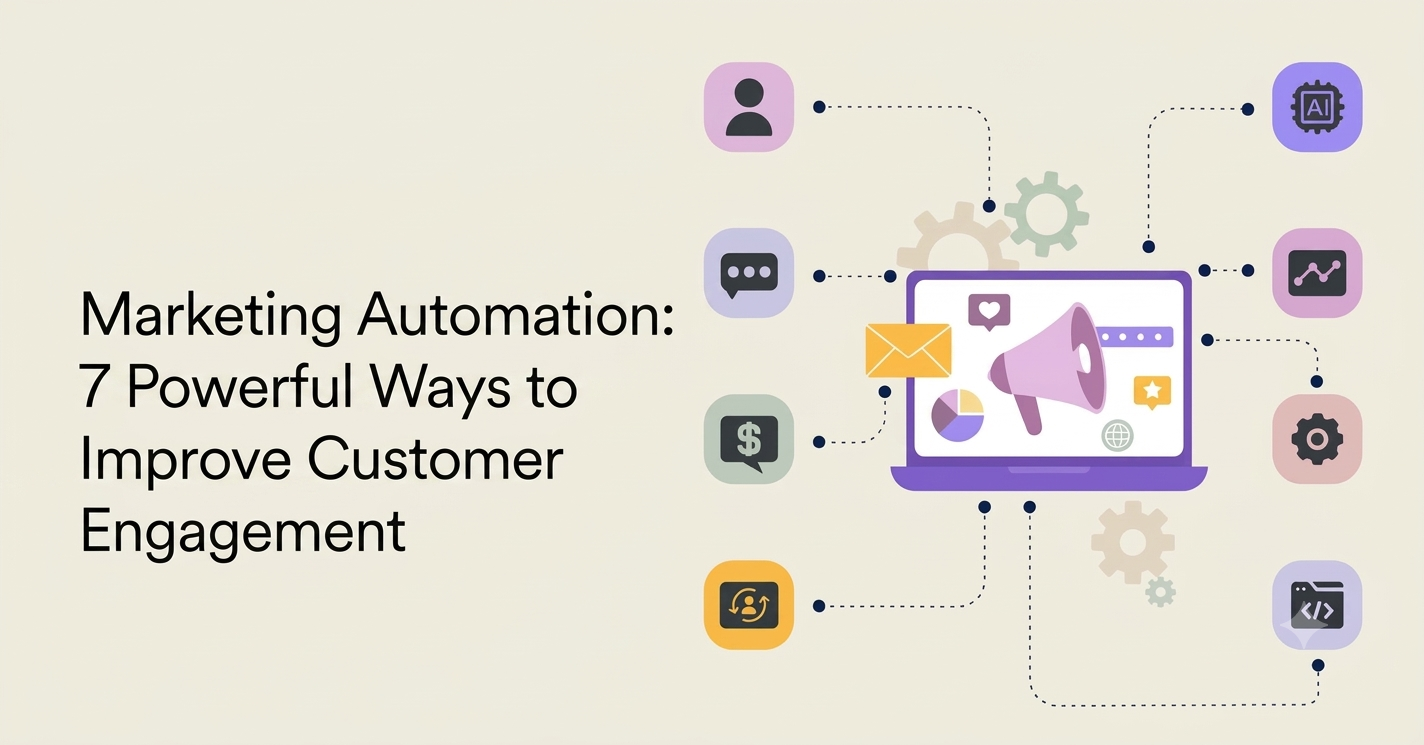
Marketing Automation helps B2B organizations improve customer engagement by delivering relevant messages at the right time throughout the customer journey. Instead of relying entirely on manual emails, follow-ups, and campaign management, businesses can use technology to create consistent and personalized interactions at scale.
For B2B companies, customer engagement is increasingly about more than simply generating leads. Prospects may interact with websites, download resources, attend webinars, respond to emails, and communicate with sales teams before making a purchasing decision. Marketing automation can connect these interactions and help organizations respond more intelligently.
When implemented strategically, marketing automation can support both marketing and sales teams by reducing repetitive tasks, improving lead nurturing, and creating more relevant customer experiences. The key is to use automation to strengthen human engagement rather than replace it.
What Is Marketing Automation?
Marketing automation refers to the use of technology to automate repetitive marketing activities and manage customer interactions based on predefined rules, behaviors, or triggers.
A marketing automation platform can connect activities such as email campaigns, lead management, customer segmentation, website interactions, and CRM data. This enables marketing teams to create workflows that respond to customer behavior rather than sending the same communication to every prospect.
For example, a B2B technology company could create a workflow for a prospect who downloads a technical whitepaper. Instead of immediately sending unrelated promotional messages, the company could gradually provide additional educational content and notify the sales team when the prospect demonstrates stronger buying intent.
Common marketing automation activities include:
- Automated email campaigns
- Lead nurturing workflows
- Customer segmentation
- Lead scoring
- Webinar and event follow-ups
- CRM synchronization
- Personalized content delivery
- Campaign performance tracking
How Marketing Automation Improves Customer Engagement
1. Marketing Automation Enables More Personalized Communication
Modern B2B buyers expect businesses to understand their interests and challenges. Sending identical messages to every contact can make communication feel generic and disconnected.
Marketing automation allows businesses to segment audiences based on information such as industry, job role, company characteristics, previous interactions, and content engagement. Marketers can then create different communication journeys for different audiences.
For example, a cybersecurity company could have separate nurturing campaigns for IT managers, security leaders, and business executives. Each audience can receive content that addresses its specific priorities.
This type of personalization can make communication more relevant without requiring marketing teams to manually manage every individual interaction.
2. It Supports Timely Customer Interactions
Timing plays an important role in customer engagement. A useful message delivered at the wrong time may have little impact, while a timely message can help move a prospect to the next stage of the buying journey.
Marketing automation enables organizations to create trigger-based workflows. These workflows can respond to actions such as:
- Downloading an eBook
- Registering for a webinar
- Visiting a product page
- Opening or engaging with an email
- Requesting additional information
- Returning to a website after a period of inactivity
Instead of waiting for a marketer to manually identify every interaction, the system can initiate the appropriate next step automatically.
3. Marketing Automation Strengthens Lead Nurturing
B2B purchasing decisions often involve multiple stakeholders and can take considerable time. Not every prospect who interacts with a company is ready to speak with sales immediately.
Marketing automation provides a structured way to nurture these prospects over time.
A lead might initially receive educational content explaining a business problem. As engagement increases, the workflow can introduce solution-focused resources, case studies, product information, or event invitations.
A typical nurturing journey might look like this:
Awareness → Education → Engagement → Evaluation → Sales Conversation
The exact journey will vary by organization, but the principle remains the same: provide useful information based on where the prospect is in the buying process.
4. It Helps Marketing and Sales Teams Work Together
Customer engagement can suffer when marketing and sales teams operate with disconnected information.
Marketing may know which resources a prospect downloaded, while sales may have information from conversations with that prospect. When these systems are integrated, teams can develop a more complete understanding of customer activity.
Marketing automation can help establish processes for:
- Lead qualification
- Lead scoring
- Sales notifications
- CRM updates
- Campaign attribution
- Lead handoffs
- Follow-up workflows
For example, when a prospect repeatedly engages with high-intent content, a marketing automation workflow can update the lead’s score and notify the appropriate sales representative.
The goal is not simply to generate more sales alerts. It is to provide sales teams with better context so that their conversations are more relevant.
5. Marketing Automation Creates Consistent Customer Journeys
Large B2B organizations often manage thousands of prospects across multiple campaigns, markets, and communication channels. Maintaining consistent engagement manually can become difficult.
Automation provides repeatable processes that help ensure customers receive the appropriate communication at different stages of their journey.
Example: A B2B Software Company
Consider a SaaS company promoting an enterprise software platform.
A potential customer visits the website and downloads a product guide. The marketing automation system could then:
- Add the contact to a relevant audience segment.
- Send a follow-up email containing related educational content.
- Monitor subsequent engagement.
- Adjust the lead score based on activity.
- Recommend a webinar or product demonstration.
- Notify sales when the prospect reaches a predefined engagement threshold.
This creates a connected journey rather than a collection of unrelated marketing messages.
6. It Makes Customer Engagement More Data-Driven
Effective engagement requires understanding what customers respond to. Marketing automation provides data that can help organizations evaluate campaign and customer behavior.
Marketing teams can analyze activities such as email engagement, content interactions, campaign responses, and movement through different stages of the customer journey.
These insights can help answer questions such as:
- Which content attracts the most engagement?
- Which campaigns generate qualified opportunities?
- Where are prospects dropping out of the customer journey?
- Which segments respond to specific messages?
- Which interactions indicate stronger purchase intent?
The objective is not to collect data simply because it is available. Businesses should use relevant data to make better decisions about content, timing, segmentation, and customer communication.
7. Marketing Automation Improves Engagement at Scale
One of the biggest advantages of Marketing Automation is scalability.
A marketing team may be able to personally manage communication with dozens of prospects, but that approach becomes difficult when an organization has thousands of contacts across different markets.
Automation allows businesses to maintain structured engagement while reducing repetitive manual work.
For enterprise organizations, this can be particularly valuable when managing:
- Multiple customer segments
- Global campaigns
- Large databases
- Product-specific campaigns
- Long B2B sales cycles
- Multiple lead sources
- Cross-channel customer journeys
However, scalability should not mean sending more messages simply because technology makes it possible. The focus should remain on delivering useful and relevant experiences.
Building an Effective Marketing Automation Strategy
Technology alone does not create effective customer engagement. Organizations need a clear strategy before implementing complex automation workflows.
Start With the Customer Journey
First, identify how customers interact with your organization from initial awareness through evaluation, purchase, and potentially retention.
Map the important customer touchpoints and determine where automation can improve the experience.
Define Audience Segments
Avoid treating your entire database as one audience. Develop meaningful segments based on business-relevant characteristics and behaviors.
Potential segmentation criteria can include:
- Industry
- Company size
- Job role
- Product interest
- Buying stage
- Previous engagement
- Customer status
Create Valuable Content
Automation cannot compensate for poor content. If every automated message is promotional, customers may quickly disengage.
Develop content that helps prospects solve problems, understand technology, evaluate options, and make informed decisions.
Establish Clear Automation Rules
Every workflow should have a clear purpose. Define:
- Trigger
- Audience
- Message
- Timing
- Desired action
- Exit criteria
- Measurement method
This prevents automation workflows from becoming unnecessarily complicated.
Common Marketing Automation Mistakes to Avoid
While Marketing Automation can significantly improve customer engagement, poorly designed automation can have the opposite effect.
Common mistakes include:
- Sending too many automated messages
- Using the same workflow for every audience
- Ignoring customer preferences
- Creating overly complicated workflows
- Failing to integrate marketing and CRM data
- Measuring activity instead of meaningful outcomes
- Automating communication that requires human interaction
The most effective approach is usually a balance between automation and human involvement. Technology should handle repetitive processes while marketers and sales professionals focus on strategy, relationships, and complex customer conversations.
Measuring the Impact of Marketing Automation
Businesses should establish clear metrics before launching automation initiatives. The appropriate metrics will depend on campaign objectives and the stage of the customer journey.
Useful areas to monitor include:
- Email engagement
- Lead progression
- Content engagement
- Marketing-qualified leads
- Sales-qualified leads
- Conversion rates
- Campaign performance
- Customer retention and engagement
It is important to look beyond individual campaign metrics. A campaign with strong email engagement may not necessarily contribute to meaningful business outcomes. B2B organizations should connect engagement data with broader marketing and sales objectives wherever possible.
The Future of Marketing Automation and Customer Engagement
Marketing Automation is becoming an increasingly important component of modern B2B marketing technology. As organizations collect information from websites, CRM systems, marketing platforms, events, and other customer touchpoints, the ability to coordinate those interactions becomes increasingly valuable.
The future of marketing automation is likely to focus less on simply automating individual tasks and more on creating connected customer experiences.
Organizations that approach automation strategically can use it to make communication more relevant, identify customer intent, support sales teams, and create consistent experiences across the customer lifecycle.
The technology is only one part of the equation. Successful organizations will continue to combine automation, high-quality content, reliable data, thoughtful customer journeys, and human expertise.
Conclusion
Marketing Automation can transform customer engagement by helping B2B organizations deliver more relevant, timely, and consistent communication at scale. From personalized campaigns and lead nurturing to sales alignment and data-driven decision-making, automation can connect different parts of the customer journey.
However, effective automation is not about communicating with customers more frequently. It is about communicating more intelligently. Businesses should focus on understanding their audiences, delivering useful content, creating purposeful workflows, and knowing when human interaction is needed.
For B2B organizations, the strongest Marketing Automation strategies combine technology with customer-centric thinking. When those two elements work together, automation becomes more than a productivity tool—it becomes a strategic component of the overall customer experience.