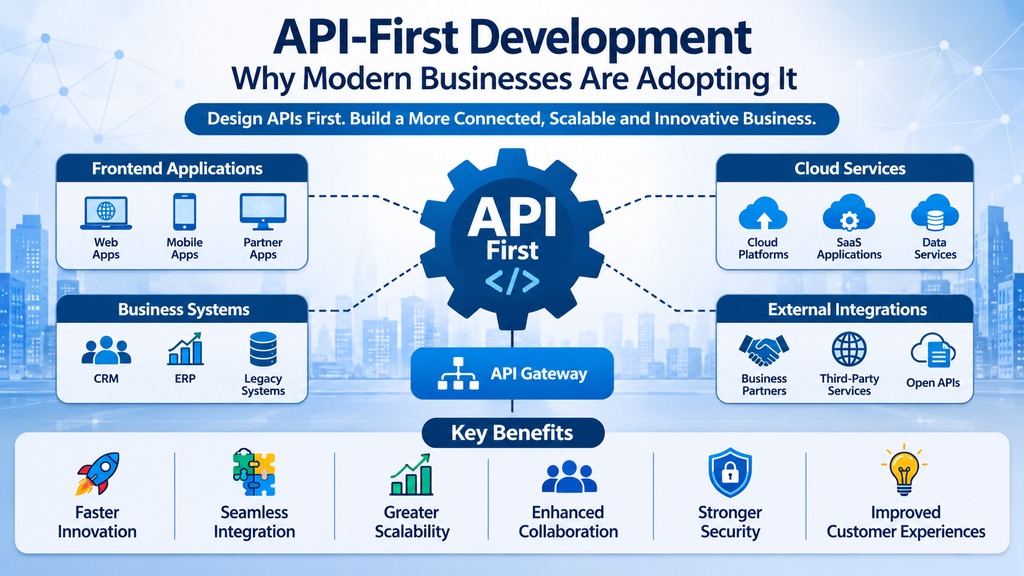
Modern businesses rely on multiple applications, cloud platforms, enterprise systems, and digital services to deliver seamless customer and employee experiences. As organizations expand their technology ecosystems, connecting these systems efficiently becomes increasingly important. API-first development provides a strategic approach to addressing this challenge by making APIs a fundamental part of software architecture rather than treating them as an afterthought.
Traditional software development often focuses on building individual applications first and introducing APIs later to enable integrations. Although this approach can work for smaller projects, it may create integration challenges as businesses adopt additional platforms, expand operations, and introduce new digital services. API-first development takes a different direction by prioritizing API design and defining how systems communicate before application implementation begins.
For enterprises pursuing digital transformation, API-first development offers more than a technical advantage. It creates opportunities to improve collaboration between development teams, accelerate software delivery, simplify integrations, and support scalable digital ecosystems. By establishing consistent communication standards across applications, businesses can build technology environments that are easier to maintain, extend, and adapt to changing requirements.
What Is API-First Development?
API-first development is a software development approach in which Application Programming Interfaces (APIs) are designed and defined before the applications, services, or systems that consume them are built. Instead of developing an application and exposing its functionality through APIs afterward, development teams establish the API contract as an initial step in the development lifecycle.
An API contract defines how different software components interact. It typically specifies available endpoints, request and response formats, authentication requirements, data structures, error handling, and communication protocols. These specifications provide a shared understanding of how an application or service will interact with other systems.
For example, consider an enterprise developing a new customer relationship management platform. The organization may need to connect its CRM with marketing automation software, billing applications, customer portals, and analytics platforms. With API-first development, teams define these integration requirements before implementing individual components.
This approach allows frontend developers, backend engineers, integration specialists, and external partners to work against an agreed API specification rather than waiting for the entire application to become available.
How API-First Development Differs From Traditional API Development
Traditional API development generally follows an application-first approach. Developers build the core application functionality and introduce APIs when integration requirements emerge. While this method can be suitable for isolated applications, it may result in inconsistent interfaces and additional development work when multiple systems need to communicate.
API-first development reverses this process by making API contracts an early architectural priority.
The key differences include:
- Development sequence: Traditional development builds the application first, whereas API-first development starts with API design and specifications.
- Team collaboration: API-first development enables frontend and backend teams to work in parallel using shared contracts.
- Integration planning: Integration requirements are considered during the initial architecture and design stages.
- Consistency: Standardized API specifications help maintain consistent communication across applications.
- Scalability: Well-designed APIs make it easier to introduce additional services and integrations as business requirements evolve.
Neither approach is universally appropriate for every project. However, organizations managing complex application ecosystems can benefit significantly from making API design a strategic priority.
Why Modern Businesses Are Adopting API-First Development
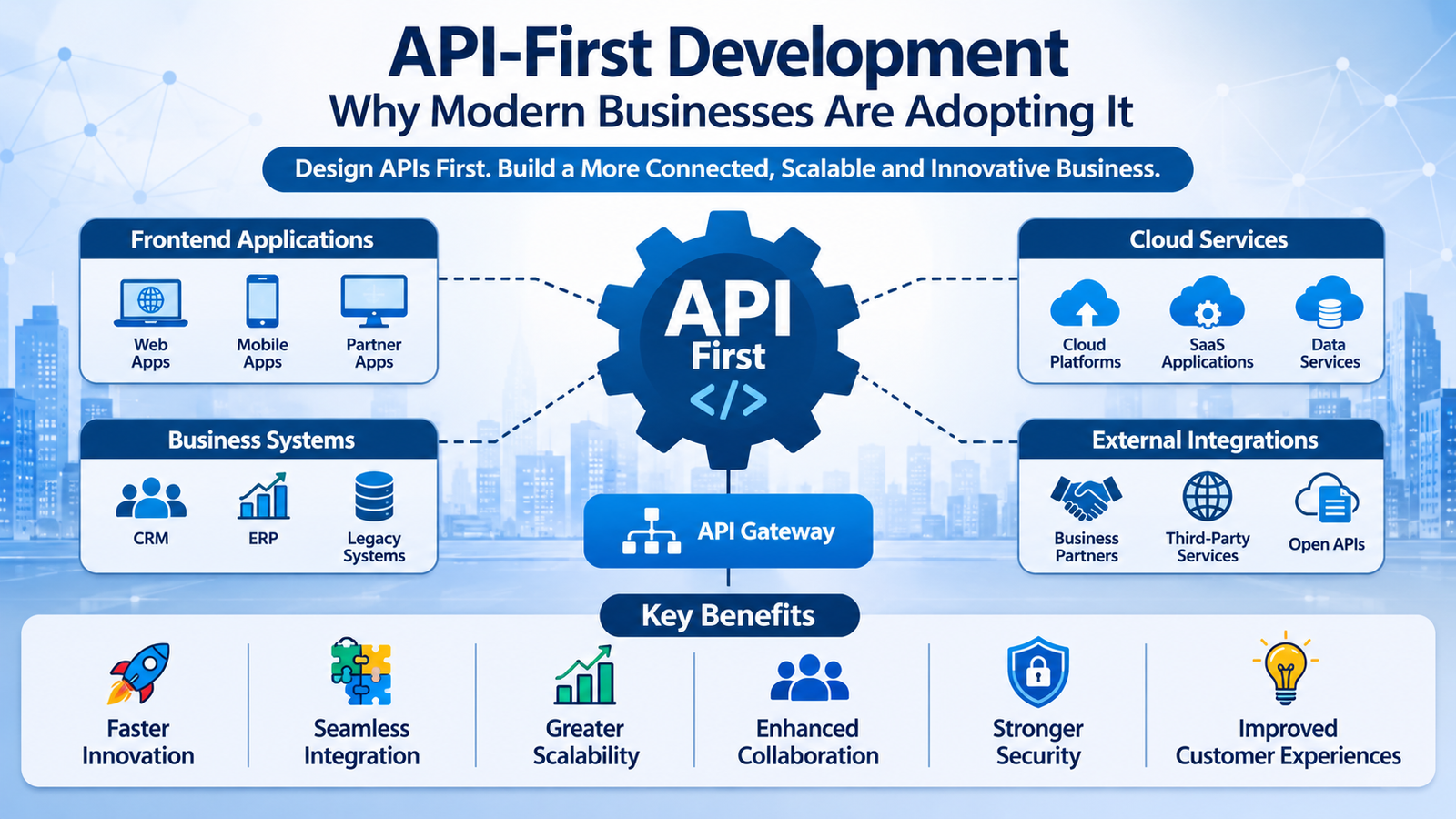
Modern enterprises operate in increasingly connected technology environments. A single business process may involve several applications, cloud services, databases, third-party platforms, and customer-facing interfaces. Without a consistent integration strategy, managing these connections can become difficult.
API-first development provides a structured foundation for building and maintaining these connections. It helps businesses move away from isolated applications toward reusable services that can support multiple digital experiences.
Organizations are increasingly considering this approach for several reasons.
1. Faster Software Development and Delivery
One of the most important advantages of API-first development is the ability to support parallel development. When API specifications are established early, frontend and backend teams can work independently against the same agreed contract.
Frontend developers can use mock APIs to develop application interfaces, while backend engineers implement the corresponding services. This reduces dependencies between teams and helps avoid unnecessary delays caused by waiting for complete backend functionality.
For enterprises managing multiple development teams, this approach can improve coordination and make software delivery more predictable.
2. Improved System Integration
Businesses frequently depend on different software platforms to manage operations, customer relationships, financial processes, supply chains, and internal workflows. Connecting these systems efficiently is essential for maintaining operational continuity.
API-first development establishes consistent integration interfaces that allow applications to exchange information through clearly defined contracts.
For example, an organization can connect its CRM, ERP, marketing automation platform, and customer support system through APIs. When a customer updates their information, relevant systems can exchange the required data without relying on extensive manual processes.
Benefits include:
- Simplified communication between enterprise applications.
- Reduced dependency on custom point-to-point integrations.
- Better coordination between internal and external platforms.
- Improved data accessibility across business systems.
- Easier integration of new applications and services.
3. Greater Scalability and Flexibility
Business requirements change over time. Organizations may introduce new digital products, expand into additional markets, adopt cloud platforms, or replace legacy applications.
API-first development supports these changes by separating application functionality from the interfaces through which services communicate.
When APIs are designed around well-defined business capabilities, organizations can reuse existing services across different applications. For example, a payment API can support an e-commerce platform, a mobile application, and an internal billing system without requiring each application to develop its own payment functionality.
This architectural flexibility allows enterprises to extend their technology capabilities without rebuilding every connected application.
4. Better Developer Collaboration
Complex software projects frequently involve frontend developers, backend engineers, QA specialists, architects, and external integration partners. Miscommunication between these teams can create inconsistencies in application behavior and integration requirements.
API-first development establishes a shared technical contract that teams can reference throughout the development process.
API specifications clarify expected inputs, outputs, authentication mechanisms, and error responses. This allows teams to identify potential integration issues earlier and coordinate implementation more effectively.
It also supports developer onboarding because new team members can understand available services and integration requirements through standardized documentation.
5. Improved Reusability and Reduced Development Duplication
Without a structured API strategy, development teams may build similar functionality across multiple applications. This can increase maintenance requirements and create inconsistencies in business logic.
API-first development encourages organizations to identify reusable services and expose them through standardized interfaces.
For example, an enterprise authentication service can support multiple applications instead of requiring each application to implement its own user authentication process.
Reusable APIs can support:
- Customer identity and authentication.
- Payment processing.
- Product catalog management.
- Customer information retrieval.
- Notifications and messaging.
- Reporting and analytics.
By making existing capabilities accessible through reusable APIs, businesses can reduce duplicated development effort and improve consistency across their application environments.
6. Stronger Governance and Security
APIs provide access to application functionality and business data, making security an important consideration throughout the development lifecycle.
API-first development creates an opportunity to address security and governance requirements during the design stage rather than introducing them only after implementation.
Organizations can define authentication, authorization, data validation, rate limiting, and access control requirements as part of their API standards.
A centralized API management strategy can also help organizations monitor API usage, enforce policies, and identify unusual traffic patterns.
Important considerations include:
- Implementing appropriate authentication and authorization mechanisms.
- Using HTTPS to protect data in transit.
- Applying role-based access controls where appropriate.
- Validating incoming requests and handling errors securely.
- Monitoring API traffic and maintaining audit logs.
- Reviewing API specifications for security weaknesses.
API-first development does not automatically make an application secure. Its value comes from giving teams an opportunity to incorporate security requirements into the initial architecture.
7. Faster Digital Transformation and Business Innovation
Digital transformation often requires organizations to modernize existing applications while introducing new digital services. API-first development supports this transition by providing a consistent way to connect legacy systems, cloud platforms, and modern applications.
For example, a financial services organization may want to introduce a mobile banking experience without replacing its entire core banking infrastructure. APIs can provide controlled access to selected backend capabilities, allowing the organization to develop new customer experiences while retaining existing systems.
This approach can help businesses:
- Introduce new digital products and services.
- Connect legacy platforms with modern applications.
- Support partner and third-party integrations.
- Develop new customer-facing experiences.
- Adapt technology capabilities to changing business needs.
Ultimately, API-first development helps organizations treat integration capabilities as reusable business assets rather than isolated technical requirements.
How API-First Development Works: A Step-by-Step Approach
Implementing API-first development requires more than creating API endpoints. Organizations need a structured process that connects business requirements, API design, development, testing, security, and ongoing management.
The following steps provide a practical starting point.
Step 1: Identify Business Requirements
Start by understanding the business processes and applications that need to communicate. Identify the systems involved, the information they exchange, and the expected outcomes of each integration.
For example, an enterprise order management project may require connections between inventory management, payment processing, shipping services, and customer notifications.
Documenting these requirements helps teams identify which APIs need to be developed and what functionality they should provide.
Step 2: Design the API Contract
Once requirements are clear, define the API structure and behavior before beginning implementation.
API contracts should specify:
- Endpoints and supported HTTP methods.
- Request and response data structures.
- Authentication and authorization requirements.
- Expected status codes and error responses.
- Data validation rules.
- Versioning and compatibility expectations.
OpenAPI is a widely used specification for describing REST APIs. It allows development teams to document endpoints, parameters, request bodies, responses, and security requirements in a structured format.
Step 3: Establish API Standards
Organizations managing multiple APIs should establish common design standards to maintain consistency.
These standards may cover endpoint naming, resource structures, pagination, error handling, authentication, documentation, and versioning.
Consistent standards make APIs easier to understand, integrate, test, and maintain across different development teams.
Step 4: Enable Parallel Development
Once API specifications are approved, frontend and backend teams can begin implementation independently.
Mock servers and API testing tools allow frontend developers to interact with simulated API responses while backend engineers develop the actual services.
This reduces development dependencies and provides opportunities to validate integration requirements earlier.
Step 5: Test and Validate APIs
API testing should cover functional behavior, performance expectations, security requirements, and compatibility.
Testing should verify that APIs behave according to their documented contracts and handle unexpected inputs appropriately.
Useful testing activities include:
- Functional testing of endpoints and responses.
- Contract testing between API providers and consumers.
- Integration testing across connected systems.
- Authentication and authorization testing.
- Performance and load testing.
- Security testing and vulnerability assessment.
Step 6: Deploy, Monitor, and Manage APIs
After implementation and testing, APIs can be deployed through the organization’s established release and infrastructure processes.
However, deployment is not the end of the API lifecycle. Organizations must monitor availability, response times, errors, traffic patterns, and security events.
API management platforms can help centralize access control, analytics, developer onboarding, traffic management, and lifecycle governance.
API-First Development Architecture and Key Technologies
A successful API-first architecture combines API specifications, application services, security controls, integration infrastructure, and monitoring capabilities.
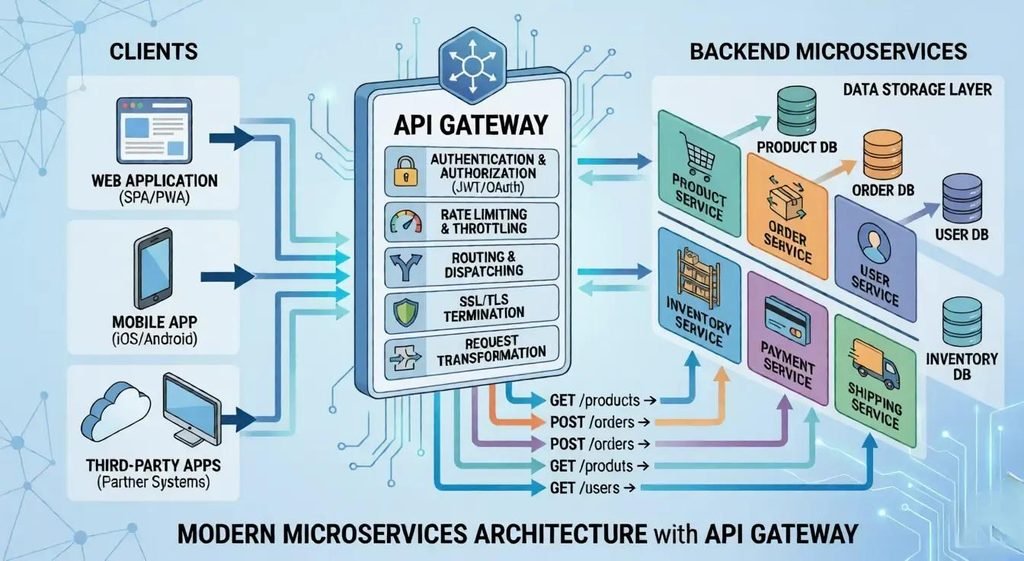
Several technologies and architectural components commonly support API-first development.
REST APIs
Representational State Transfer (REST) is an architectural style commonly used to build web APIs. REST APIs typically use HTTP methods such as GET, POST, PUT, PATCH, and DELETE to interact with resources.
They are widely used in enterprise applications because of their straightforward communication model and compatibility with web technologies.
GraphQL
GraphQL is a query language and runtime for APIs that allows clients to request the specific data they need.
It can be useful when applications require flexible data retrieval from multiple related resources. However, its implementation requires careful attention to query complexity, authorization, and performance.
OpenAPI Specification
OpenAPI provides a standardized way to describe REST APIs. It helps developers understand available endpoints, request formats, responses, and authentication requirements.
Organizations can use OpenAPI specifications to support documentation generation, mock servers, and parts of their API testing and development workflows.
API Gateways
An API gateway acts as an entry point between API consumers and backend services. It can support request routing, authentication enforcement, rate limiting, and traffic management.
In distributed architectures, API gateways help organizations apply consistent policies to incoming API requests.
API Management Platforms
API management platforms provide capabilities for publishing, securing, monitoring, and managing APIs throughout their lifecycle.
They can help enterprise teams maintain API catalogs, manage developer access, monitor usage, and enforce organizational governance standards.
Real-World Business Use Cases of API-First Development
API-first development is relevant across industries because organizations increasingly depend on connected applications and services.
Its value becomes particularly clear when businesses need to integrate multiple platforms or introduce new digital experiences without replacing their existing technology infrastructure.
Banking and Financial Services
Financial institutions operate complex technology environments involving customer accounts, payment processing, transaction systems, identity verification, and reporting platforms.
API-first development can help connect these capabilities through standardized interfaces.
For example, a banking application may use separate APIs for customer authentication, account information, transaction history, and payment processing. These services can support mobile banking, online banking, and other authorized digital channels.
Retail and E-Commerce
Retail organizations often manage multiple systems for product catalogs, inventory, orders, payments, shipping, and customer engagement.
API-first development allows these systems to communicate through reusable services.
An e-commerce business, for instance, can use APIs to retrieve product information, check inventory, process payments, and provide shipment updates across its website and mobile application.
Healthcare and Life Sciences
Healthcare organizations frequently work with electronic health records, appointment systems, laboratory platforms, insurance services, and patient portals.
APIs can help these applications exchange information through defined interfaces, subject to applicable privacy, interoperability, and regulatory requirements.
This can support more connected healthcare workflows while maintaining appropriate controls over sensitive information.
Manufacturing and Supply Chain
Manufacturing businesses rely on systems that manage production schedules, equipment monitoring, inventory, procurement, and logistics.
API-first development can connect these applications to support better information exchange across operational environments.
For example, production planning software can communicate with inventory systems to retrieve material availability and support more coordinated planning.
Common Challenges in Adopting API-First Development
Although API-first development offers significant architectural advantages, organizations should understand the challenges associated with implementation.
A successful adoption strategy requires technical planning, organizational collaboration, and long-term governance.
Managing API Complexity
As organizations introduce more APIs, managing specifications, dependencies, documentation, and ownership can become increasingly difficult.
Without clear governance, different teams may create overlapping APIs or follow inconsistent design practices.
Practical approach: Maintain a centralized API catalog, establish reusable design standards, and assign ownership for important API services.
Maintaining API Version Compatibility
Changes to API contracts can affect applications and services that depend on them. Removing fields, changing response structures, or modifying endpoint behavior may introduce breaking changes.
Practical approach: Establish versioning policies, communicate changes to API consumers, and provide appropriate migration periods for deprecated versions.
Addressing Security Risks
APIs may expose sensitive business functionality and information. Poor authentication, excessive permissions, inadequate validation, and insufficient monitoring can introduce security vulnerabilities.
Practical approach: Integrate security reviews into API design, enforce appropriate access controls, and regularly test APIs for vulnerabilities.
Building Organizational Alignment
API-first development often requires changes to established development processes. Teams accustomed to application-first workflows may need additional training and coordination.
Practical approach: Start with a focused project, establish shared API standards, and demonstrate the benefits through measurable delivery and integration improvements.
Best Practices for Successful API-First Development
To achieve long-term value, enterprises should treat API-first development as an architectural strategy rather than an isolated software development practice.
The following best practices can help organizations establish a sustainable API ecosystem.
- Design APIs around business capabilities: Build interfaces that represent meaningful business functions rather than exposing internal implementation details.
- Use standardized specifications: Adopt OpenAPI or other appropriate specifications to document API behavior consistently.
- Prioritize security from the beginning: Include authentication, authorization, validation, and threat modeling in the design process.
- Maintain comprehensive documentation: Ensure developers and integration partners can understand how APIs work and how to use them.
- Encourage reusable API design: Identify common services that can support multiple applications and business workflows.
- Establish versioning policies: Manage API changes carefully to reduce disruption for existing consumers.
- Automate testing and validation: Use contract testing, integration testing, and automated security checks wherever appropriate.
- Monitor API performance: Track availability, response times, errors, and usage patterns to identify operational issues.
- Create clear ownership: Assign responsibility for API development, maintenance, documentation, and governance.
- Review APIs regularly: Evaluate whether existing interfaces continue to meet business requirements and architectural standards.
The Future of API-First Development
As enterprises continue adopting cloud-native applications, microservices, automation, and AI-powered capabilities, APIs will remain an important part of modern software architecture.
API-first development provides a foundation for connecting these technologies through reusable and clearly defined interfaces.
One emerging area is AI integration. Organizations are increasingly exploring how APIs can connect AI models with enterprise data, business applications, and automated workflows. Well-designed APIs can help make these capabilities accessible to authorized applications while maintaining defined security and governance controls.
Another important area is platform engineering. As development organizations standardize internal tools and services, reusable APIs can support self-service development environments and improve consistency across engineering teams.
The growing adoption of event-driven architectures also creates opportunities to combine synchronous APIs with asynchronous messaging. This allows systems to exchange information through different communication patterns depending on business requirements.
Organizations that invest in API design, lifecycle management, and governance can build more adaptable technology environments. However, the long-term value will depend on how effectively APIs align with business goals, security requirements, and evolving application needs.
Conclusion
API-first development is becoming an important architectural approach for modern businesses that need to build connected, scalable, and adaptable digital environments. By prioritizing API design before application implementation, organizations can establish consistent integration standards, improve collaboration between development teams, and make software capabilities more reusable.
For enterprises managing multiple applications, cloud services, and third-party integrations, API-first development offers a structured way to reduce integration complexity and support ongoing digital transformation. It also creates opportunities to improve security governance, accelerate development workflows, and introduce new digital services without rebuilding entire technology ecosystems.
However, successful adoption requires more than designing endpoints and publishing API documentation. Businesses must establish clear standards for API security, versioning, testing, monitoring, and lifecycle management.
As technology environments become increasingly interconnected, organizations that approach API-first development strategically will be better positioned to adapt their software architecture to changing business requirements and deliver sustainable digital innovation.
Frequently Asked Questions
What is API-first development?
API-first development is a software development approach in which APIs are designed and documented before the applications or services that use them are implemented. It establishes clear communication contracts between different software components.
Why is API-first development important for businesses?
API-first development helps businesses improve application integration, support parallel development, encourage service reusability, and build scalable software architectures. It is particularly useful for enterprises managing multiple applications and technology platforms.
What is the difference between API-first and API-led development?
API-first focuses on designing APIs before implementing applications, while API-led development emphasizes organizing business capabilities and system connectivity around reusable APIs. Both approaches support integration and modular architecture but address different aspects of API strategy.
Which technologies are commonly used in API-first development?
Common technologies include REST, GraphQL, OpenAPI, API gateways, API management platforms, mock servers, and automated API testing tools. The appropriate combination depends on application requirements and enterprise architecture.
Is API-first development suitable for small businesses?
Yes. Small businesses can adopt API-first development when building applications that require integrations with payment providers, CRM platforms, cloud services, or third-party applications. The implementation approach can be scaled according to project complexity.
How does API-first development improve software scalability?
It allows organizations to expose reusable application capabilities through standardized interfaces. New applications and services can consume existing APIs without requiring the underlying functionality to be rebuilt.
What are the main challenges of API-first development?
Common challenges include API governance, security management, version compatibility, documentation maintenance, and coordination between development teams. Clear standards and lifecycle management practices help address these challenges.
How does API-first development support digital transformation?
It helps connect legacy systems, modern applications, cloud platforms, and external services. This allows businesses to introduce new digital experiences and modernize existing workflows without necessarily replacing their entire technology infrastructure.
What role does OpenAPI play in API-first development?
OpenAPI provides a standardized format for describing REST APIs. It documents endpoints, parameters, request and response structures, and security requirements, helping development teams collaborate and validate API contracts.
Is API-first development the same as microservices architecture?
No. API-first development is an approach to designing and building software interfaces, while microservices architecture is an architectural style that organizes applications into independently deployable services. They can complement each other, but neither requires the other.