
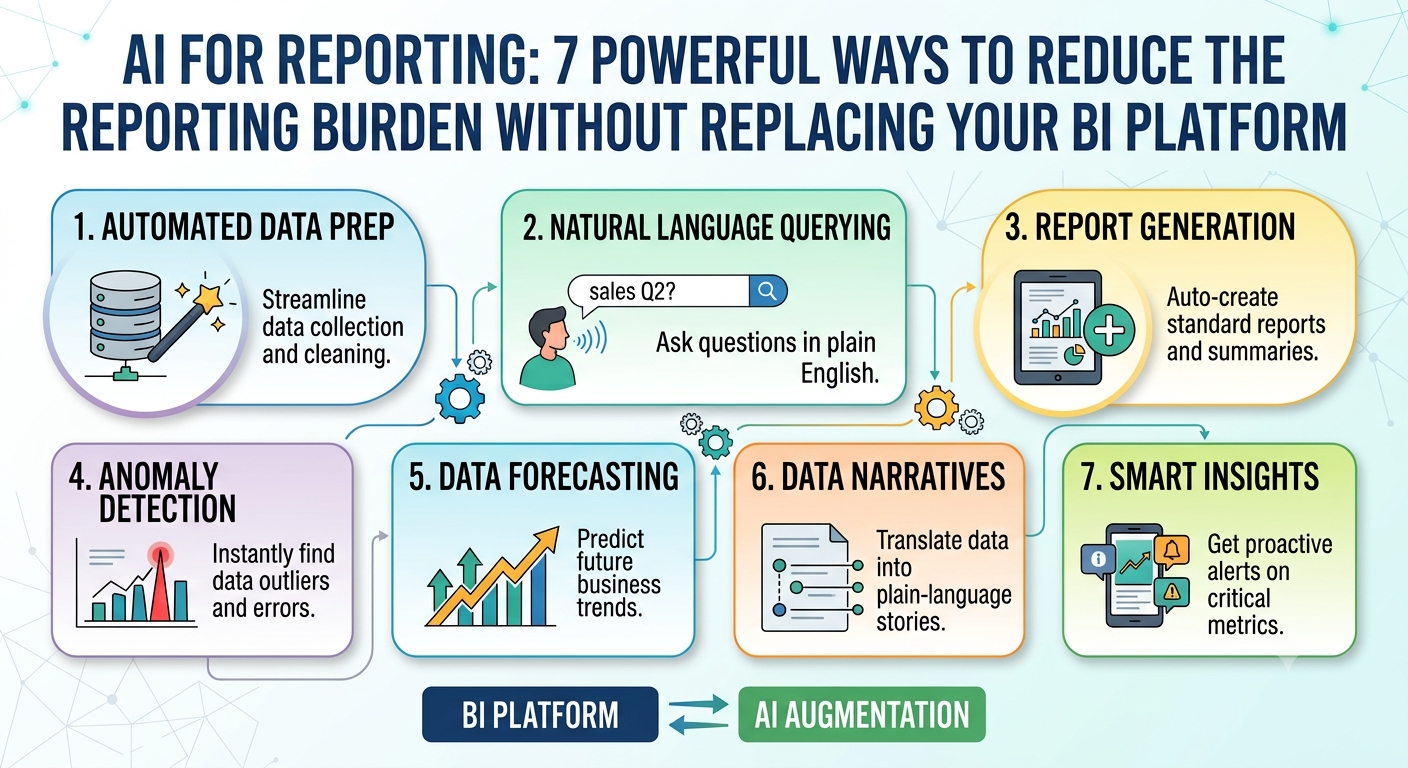
Reporting is essential to how organisations understand performance, identify problems and make business decisions. Yet producing those reports can consume a surprising amount of time. Teams often spend hours collecting information, cleaning data, reconciling figures, refreshing dashboards and answering repetitive questions before they can focus on what the numbers actually mean.
This is where AI for reporting can make a practical difference. Rather than replacing an organisation’s existing business intelligence (BI) platform, AI can work alongside it to reduce repetitive tasks, make information easier to access and help analysts spend more time on analysis rather than preparation.
For organisations that have already invested in BI, the opportunity isn’t necessarily to start again with a completely new platform. It may be to make better use of the data, dashboards and reporting infrastructure they already have.
Why Reporting Still Takes So Much Time –
Modern BI platforms have made it easier to visualise and analyse business information. However, the reporting process often involves considerably more than opening a dashboard.
Behind a typical monthly or weekly report, there may be multiple manual steps involving different people and systems. Data might need to be extracted from several applications, checked for inconsistencies, combined with spreadsheets and validated before the final report can be produced.
Common sources of reporting effort include:
- Collecting data from multiple business systems.
- Cleaning and preparing datasets.
- Reconciling conflicting figures.
- Maintaining recurring reports.
- Answering routine data questions.
- Writing commentary around business results.
- Investigating unexpected changes in performance.
The result is that analysts can spend significant amounts of time assembling information instead of interpreting it.
AI can help address some of these activities without requiring organisations to abandon their existing BI investment.
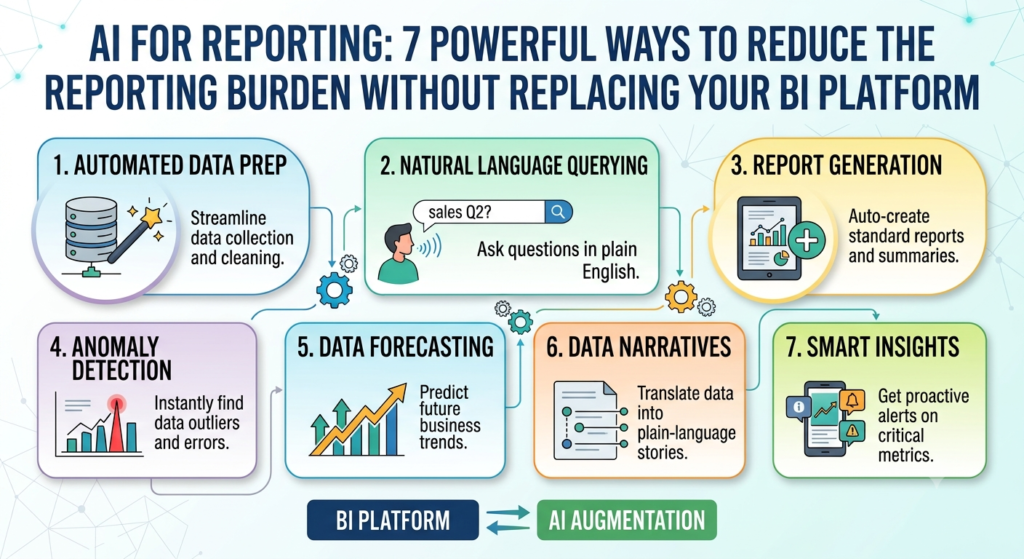
7 Ways AI for Reporting Can Reduce the Burden:
Automate Repetitive Reporting Tasks –
One of the most practical applications of AI for reporting is reducing repetitive work around the reporting cycle.
AI-enabled workflows can support activities such as identifying unusual changes, preparing summaries and triggering notifications when particular conditions occur.
For example, rather than having an analyst manually review a recurring report looking for significant changes, an AI-supported workflow could highlight areas that deserve attention.
This does not eliminate the analyst. It changes where their time is spent.
Instead of:
Collect → Check → Format → Summarise → Analyse
the process can move closer to:
Monitor → Identify → Review → Analyse → Act
That distinction can make reporting teams more productive without requiring a new BI platform.
Make Business Data Easier to Query –
BI platforms can contain large amounts of valuable information, but not every business user knows how to navigate dashboards or construct complex queries.
Natural-language interfaces can make business information easier to access.
A user might ask:
“Which regions experienced the largest revenue change this quarter?”
Instead of manually filtering multiple dashboards, an AI interface can help users locate and interpret the relevant information.
For organisations, this can reduce the volume of straightforward questions directed toward data and BI teams.
The BI platform remains the underlying reporting environment, while AI becomes an additional way for users to interact with information.
Turn Dashboards Into More Actionable Insights –
A dashboard can show that a metric has changed.
AI can help users understand which changes may deserve attention.
For example, a sales dashboard may show a decline in performance across several regions. An AI-powered analysis layer could help identify which regions, products or time periods contributed most significantly to the change.
This doesn’t mean AI should automatically determine the reason behind a business result.
Instead, it can help analysts and decision-makers identify where to investigate first.
That can shorten the distance between seeing a change and understanding what needs further investigation.
Reduce Repetitive Questions to Analysts –
Data teams frequently receive requests for information that already exists within the organisation’s reporting environment.
Questions may include:
- What were sales last month?
- Which region missed its target?
- How does this quarter compare with the previous one?
- Which products changed the most?
- Why does this report differ from another report?
Each request may be relatively simple. Collectively, they can take considerable time.
AI can provide a conversational interface for approved business information, allowing users to find answers to straightforward questions without creating a new request for the analytics team every time.
This allows analysts to focus more heavily on complex analysis, investigation and strategic work.
AI and Business Intelligence: Complementary, Not Competitive –
A common misconception is that adopting AI means replacing the BI platform.
In many organisations, that isn’t necessary.
AI and business intelligence can perform different but complementary roles.
A BI platform can provide the structured and governed environment for reporting, dashboards, data models and established business metrics.
AI can add a more flexible layer for interacting with that information.
| BI platform | AI capabilities |
|---|---|
| Provides governed reporting | Enables natural-language interaction |
| Presents dashboards | Generates summaries |
| Defines business metrics | Highlights notable changes |
| Supports visual analysis | Helps identify patterns |
| Provides structured information | Answers approved business questions |
| Maintains reporting processes | Automates selected repetitive tasks |
The objective isn’t to replace one with the other.
It’s to make the existing reporting environment easier and more efficient to use.
Generate First-Draft Report Summaries
Creating the report itself is only part of the workload.
Someone may also need to write an explanation of what changed, what stands out and what decision-makers should pay attention to.
AI can help create an initial narrative from structured reporting information.
For example, instead of an analyst starting with a blank document, AI could generate a draft highlighting:
- Significant changes from the previous reporting period.
- Metrics that moved outside expected ranges.
- Areas requiring further investigation.
- Comparisons with established reporting periods.
An analyst can then review, correct and add context before the report is distributed.
The important point is that AI-generated commentary should be treated appropriately for the organisation and use case. Human review can remain an important part of the reporting process, particularly where business decisions depend on the interpretation.
Identify Anomalies Earlier
Traditional reporting often relies on people noticing something unusual.
That can be difficult when teams are reviewing large numbers of metrics across multiple dashboards.
AI can assist by identifying patterns or changes that warrant attention.
For example, it could flag an unexpected movement in:
- Sales performance.
- Operational volumes.
- Customer activity.
- Costs.
- Inventory levels.
- Service performance.
The purpose isn’t to automatically declare why something happened.
Instead, AI can help answer an earlier question:
“Where should we look?”
That can help analysts spend less time scanning information and more time investigating meaningful changes.
Perhaps the biggest opportunity is not producing reports faster.
It is giving skilled people more time to do work that requires human judgement.
When analysts spend less time:
- Cleaning recurring datasets.
- Producing routine summaries.
- Answering simple questions.
- Searching through dashboards.
- Preparing repetitive commentary.
they have more capacity for:
- Investigating business problems.
- Identifying opportunities.
- Supporting strategic decisions.
- Building better analytical models.
- Working directly with business stakeholders.
This is where AI for reporting can move beyond simple automation and become part of a broader data and decision-making strategy.
The Data Foundation Still Matters –
AI cannot compensate for fundamentally unreliable business data.
If an organisation has inconsistent definitions, duplicate records, missing information or multiple versions of the same metric, introducing AI may make those problems easier to interact with without actually resolving them.
This is particularly important because AI-generated answers can appear clear and confident even when the underlying information requires further validation.
Before introducing AI into reporting workflows, organisations should understand:
- Where the data comes from.
- Who owns it.
- How important metrics are defined.
- Which datasets are considered trusted.
- How data quality is monitored.
- Who is allowed to access different information.
The stronger the underlying data foundation, the more useful AI can become.
How to Introduce AI Without Replacing Your BI Platform –
Organisations don’t need to automate the entire reporting process immediately.
A more practical approach is to start with specific problems.
Map the reporting process :
Document how information moves from source systems to the final report.
Identify where people spend the most time.
Find repetitive work :
Look for activities that happen regularly and follow predictable patterns.
These are often good candidates for automation.
Identify common information requests :
Review the questions users repeatedly ask data and BI teams.
Some may be suitable for natural-language access.
Check your data foundation :
Make sure important metrics, datasets and definitions are understood and appropriately governed.
Start with a focused use case :
Rather than deploying AI across every reporting process, test one clearly defined workflow.
Measure the outcome :
Look at whether the initiative reduces manual effort, improves access to information or gives analysts more time for higher-value work.
The goal should be measurable improvement—not simply adding another AI capability to the technology stack.
What AI Should—and Shouldn’t—Replace
AI is well suited to reducing repetitive work, but not every part of reporting should be automated.
AI can help with:
- Summarising information.
- Finding patterns.
- Answering straightforward questions.
- Highlighting anomalies.
- Preparing draft commentary.
- Automating repetitive workflows.
People should continue to provide:
- Business context.
- Critical judgement.
- Validation of important findings.
- Strategic interpretation.
- Accountability for decisions.
The strongest reporting environments are likely to combine automation with human expertise rather than treating them as alternatives.
The Business Case for AI-Powered Reporting –
The value of AI-powered reporting shouldn’t be measured solely by how advanced the technology is.
A more useful business case starts with the existing reporting burden.
Consider questions such as:
- How many hours are spent producing recurring reports?
- How much analyst capacity is spent on report preparation?
- How often are reports manually reconciled?
- How long does it take to answer routine data questions?
- How quickly can decision-makers access trusted information?
- Which reporting processes create the most operational friction?
These questions establish a baseline.
From there, organisations can identify where AI could produce a meaningful improvement.
Conclusion –
AI for reporting doesn’t have to mean replacing your BI platform.
For organisations with established BI environments, AI can provide an additional layer that makes reporting more accessible, reduces repetitive work and helps analysts focus on higher-value analysis.
The most effective approach is not to introduce AI simply because it is available. It is to identify where reporting creates unnecessary manual effort and determine whether AI can remove artificial intelligence to support activities such as report summarisation, natural-language data queries, anomaly identification that friction without compromising data quality, governance or human oversight.
Frequently Asked Questions
AI for reporting refers to using artificial intelligence to support activities such as report summarisation, natural-language data queries, anomaly identification, insight generation and repetitive reporting workflows.
AI does not necessarily need to replace a BI platform. Organisations can use AI alongside existing BI systems to improve how users interact with governed business information and reduce manual reporting work can AI reduce reporting workload.
AI can reduce workload by supporting repetitive tasks such as summarising reports, answering routine data questions, identifying unusual changes and preparing draft reporting commentary.
Yes, but enterprise adoption requires appropriate consideration of data quality, access controls, security, governance and human oversight. The specific implementation should reflect the organisation’s data environment and business requirements.
AI can help identify potential anomalies or inconsistencies, but it does not automatically fix underlying data-quality problems. Organisations still need appropriate data management, governance and ownership processes.