
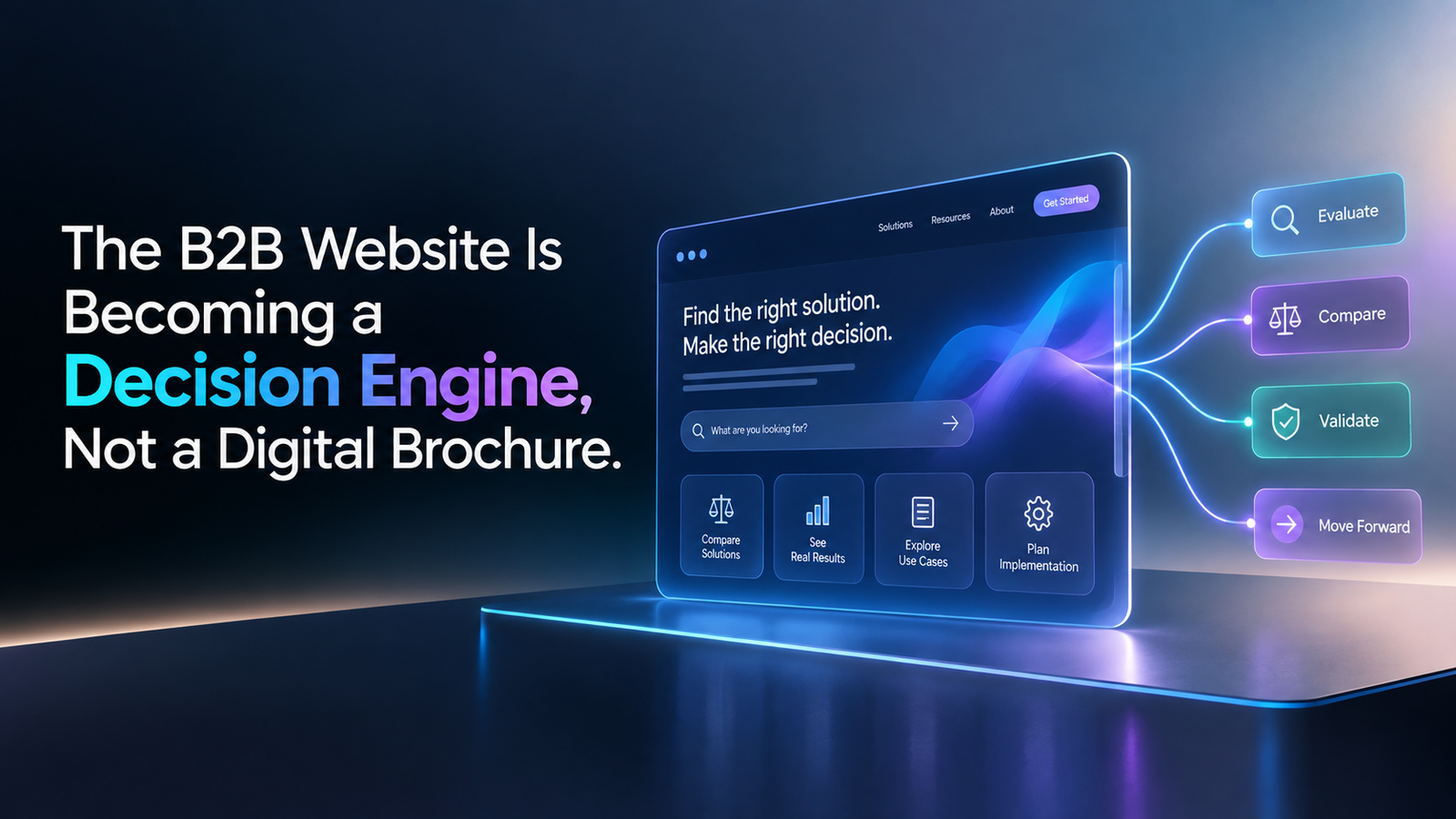
For years, the B2B website was treated as a digital brochure. It introduced the company, explained its products or services, listed capabilities, displayed customer logos, shared case studies, and eventually directed visitors toward a contact form or sales conversation.
That model made sense when websites were primarily destinations buyers visited after discovering a company through sales outreach, events, referrals, search engines, or advertising. Today, however, the B2B buyer journey looks very different. Buyers are more informed, more independent, and often further into their research before they ever speak with a sales representative.
They are not simply asking, “Who are you?” They are asking whether the company can solve their specific problem, whether they should trust the solution, how it compares with alternatives, what implementation involves, and whether they can justify the decision internally. A modern B2B website therefore needs to do more than introduce a company. It needs to help buyers understand, evaluate, validate, and progress toward a decision.
Why the B2B Website Is Becoming a Decision Engine –
The buying journey has changed because buyers can conduct substantial research without interacting directly with vendors. They can search for solutions, compare providers, read customer experiences, watch demonstrations, examine technical documentation, explore industry discussions, and use AI tools to summarize complex technology categories.
By the time a potential customer reaches a vendor’s website, they may already have a shortlist and a set of questions.
They may want to understand:
- Whether the solution addresses their specific business problem
- Which organizations the solution is designed for
- What outcomes they can realistically expect
- How the solution differs from alternatives
- What implementation involves
- What evidence supports the vendor’s claims
- Whether the solution can meet technical and business requirements
This changes the role of the B2B website. Instead of functioning primarily as a corporate presentation, it increasingly becomes part of the buyer’s research and evaluation process.
Build the B2B Website Around Buyer Decisions –
One common problem with B2B websites is that their structure reflects the company’s internal organization rather than the buyer’s decision process.
Navigation may be organized around departments, product categories, service lines, or internal terminology. Buyers, however, tend to think about problems, outcomes, risks, priorities, and decisions.
A technology buyer may not know the exact name of the solution they need. An operations leader may understand the business problem without knowing the technology category. A finance executive may be more interested in economic impact than technical functionality.
A stronger B2B website strategy starts with the questions buyers need answered.
Make B2B Website Design About Clarity, Not Complexity –
Turning a website into a decision engine does not mean adding more animations, pop-ups, calculators, chat windows, or complicated navigation.
In many cases, effective B2B website design means making important information easier to find, understand, compare, and apply.
A clean website with strong decision support can be more useful than a visually impressive website that forces visitors to search for basic information.
The goal is not to create more digital activity.
The goal is to reduce the effort buyers need to determine whether a solution is relevant to them.
A strong B2B website should make it easier to move from:
Question → Understanding → Evaluation → Confidence → Action
Adapt the Website to AI-Driven Buyer Research –
AI is changing how buyers discover and evaluate companies.
A potential customer may encounter a company through an AI-generated answer, search result, third-party article, professional recommendation, or industry discussion.
When they eventually arrive at the company’s website, they may already know what the company does.
They may be looking for validation rather than introduction.
This means the website needs to make evidence easy to discover.
Buyers may immediately look for:
- Customer examples
- Technical capabilities
- Industry experience
- Product comparisons
- Security information
- Implementation details
- Pricing or commercial information
- Technical documentation
If visitors have to navigate through several layers of generic corporate messaging before reaching those answers, the experience creates unnecessary friction.
The website should help them validate what they have already learned and answer the next questions in their research process.
Create a Homepage That Establishes Relevance –
The homepage is often treated as the most important piece of B2B marketing real estate. This can lead companies to fill it with broad statements about innovation, transformation, excellence, leadership, and customer-centricity.
These statements may sound polished, but they do not necessarily help buyers make decisions.
A stronger homepage establishes relevance quickly.
It should communicate:
- What problem the company solves
- Who it helps
- What makes its approach distinctive
- What evidence supports the offering
- Where visitors can go next
The objective is not to tell the entire company story on the first screen.
It is to help the right visitor recognize that they are in the right place.
Turn Product Pages Into Evaluation Resources –
Many B2B product pages function primarily as feature catalogues. They explain what a product includes but not always why those capabilities matter.
A decision-oriented product page connects capabilities with real situations and business outcomes.
For example, instead of simply saying that a platform provides real-time analytics, a stronger page could explain what decisions become possible with real-time information, which organizations benefit from the capability, and what buyers should consider when evaluating similar solutions.
This creates an important distinction:
A product page describes the solution. A decision-oriented product page helps the buyer evaluate it.
Use Comparison Content to Help Buyers Evaluate Alternatives –
Buyers are already comparing alternatives, even when a vendor does not provide comparison content.
Avoiding the subject does not remove the comparison from the buying process. It simply means buyers may look elsewhere for answers.
A useful comparison framework can explain:
- Different approaches
- Relevant evaluation criteria
- Common use cases
- Business and technical trade-offs
- Implementation considerations
- Situations where different approaches may be appropriate
The purpose is not to attack competitors.
It is to help buyers understand the decision they are trying to make.
This can also strengthen credibility because the company demonstrates that it understands the broader category rather than only promoting its own product.
Turn B2B Case Studies Into Decision Evidence –
Case studies can play an important role in the B2B buying journey, but they need to provide more than a promotional success story.
Buyers want to understand whether another organization’s experience is relevant to their own situation.
A useful case study can explore:
- The customer’s original situation
- Why the organization pursued a solution
- The factors considered during evaluation
- Implementation challenges
- Teams involved
- Changes after implementation
- Measurable outcomes, where available
- Lessons learned
The objective is to help potential customers see themselves in the story.
A case study becomes decision evidence when it helps the reader evaluate whether a similar approach could work in their environment.
Support the Entire B2B Buying Group –
The person researching a B2B solution is not always the person who approves the purchase.
A researcher may need to explain the solution to executives, finance, IT, security, procurement, operations, or other stakeholders.
This means the B2B website should provide information that can travel across the organization.
Useful resources can include:
- Executive summaries
- Business-case materials
- Implementation guides
- Security documentation
- Technical documentation
- ROI frameworks
- FAQs
- Procurement information
- Stakeholder-specific content
The website becomes more valuable when it supports the entire buying group rather than a single visitor.
Use Interactive Tools to Make B2B Content More Useful –
Interactive tools can help transform a website from an information repository into a decision-support environment.
Potential examples include:
- Readiness assessments
- Calculators
- Maturity models
- Comparison tools
- Configuration guides
- Diagnostic experiences
- ROI assessments
The important factor is usefulness.
If a tool exists primarily to collect an email address, buyers may recognize the commercial intent immediately.
If the same tool helps them identify gaps, understand their current position, compare options, or determine appropriate next steps, it can become a meaningful part of the buying experience.
Use AI to Help Buyers Navigate Complex Information –
AI can take the decision-engine concept further.
A B2B website can use AI to help visitors:
- Find relevant information
- Answer product questions
- Navigate technical content
- Summarize documentation
- Compare available approaches
- Identify relevant use cases
- Find appropriate next steps
However, adding an AI chatbot to a website does not automatically make the experience more intelligent.
The AI needs to solve a real information problem.
A useful AI experience provides accurate, context-aware answers and directs buyers toward relevant evidence. Simply repeating marketing language or pushing every visitor toward a sales conversation adds limited value.
Build a Strong Content Architecture for B2B SEO –
A decision engine also depends on strong content architecture.
Search engines, AI systems, buyers, and sales teams all depend on clear and consistent information.
Product capabilities should be described consistently. Industry use cases should be specific. Customer outcomes should be supported by evidence. Technical information should be accessible. Terminology should be understandable.
A strong B2B SEO strategy should therefore go beyond targeting individual keywords.
Content should address the broader topic and the questions that naturally surround it.
For example, someone searching for a specific business problem should not land on a generic service page and have to start navigating again. The page should help them understand the problem, potential approaches, evaluation criteria, relevant use cases, and logical next steps.
Search visibility gets the buyer through the door. Decision support helps them move forward.
Evidence Matters More in the Age of AI –
AI makes it easier to generate polished marketing language.
That makes generic claims such as “innovative,” “trusted,” “leading,” and “future-ready” increasingly difficult to differentiate.
Specificity provides something buyers can evaluate.
Useful evidence can include:
- Detailed use cases
- Customer examples
- Technical explanations
- Clear methodologies
- Measurable outcomes
- Product documentation
- Transparent limitations
- Implementation information
In an environment where AI can generate large volumes of marketing content, evidence becomes increasingly important because it gives buyers something more substantial than promotional language.
Measure Whether the Website Helps Buyers Progress –
Traditional metrics such as traffic, bounce rate, form submissions, and time on page remain useful.
But they do not tell the entire story.
B2B organizations should also examine whether visitors are engaging with decision-support content and progressing through the evaluation journey.
Relevant signals can include:
- Engagement with comparison content
- Use of interactive tools
- Visits to implementation pages
- Consumption of customer evidence
- Engagement with technical resources
- Return visits to evaluation content
- Progression toward meaningful commercial conversations
The goal is not to replace traditional website analytics.
It is to understand whether the website is helping buyers answer the questions they need to resolve.
The B2B Website Is Part of the Buying Experience –
Companies need to think about their website as more than a marketing asset. It is part of the experience of buying from them.
The website is one of the first places where buyers experience how clearly a company thinks, how well it understands their problems, how transparent it is, and how easy it makes evaluation.
A confusing website can create unnecessary uncertainty.
A clear website can help reduce that uncertainty before a sales conversation begins.
The website is therefore not simply communicating the brand. It is demonstrating how the company helps customers make decisions.
Conclusion –
The modern B2B website is evolving from a digital brochure into a decision engine.
The most valuable website is not necessarily the one with the most pages, animations, or advanced technology. It is the one that understands what buyers need to know and makes that information easier to find, understand, compare, and validate.
As buyers conduct more independent research and AI increasingly influences discovery, B2B companies have an opportunity to rethink what their websites are designed to accomplish.
The goal should be more than generating traffic or collecting leads.
A strong B2B website should help buyers move from questions to clarity, clarity to confidence, and confidence to action.
Frequently Asked Questions
A B2B website is a digital platform designed to explain a company’s products, services, expertise, and value to business buyers. Modern B2B websites increasingly support the full buyer journey by helping visitors research, their needs. Effective design combines usability, clear messaging evaluate, compare, and validate solutions.
A B2B website decision engine is a website designed to help buyers make informed purchasing decisions. It provides relevant information, evidence, comparisons, use cases, technical details, and interactive resources that reduce uncertainty during the buying process.
B2B website design affects how easily buyers can understand a company’s offering and determine whether it is relevant to their needs. Effective design combines usability, clear messaging, logical navigation, evidence, and decision-support content.
AI gives buyers new ways to discover companies, research technologies, summarize information, and compare solutions. As a result, visitors may arrive at a B2B website already familiar with the company and looking for deeper validation rather than basic introductions.
A B2B website can include product and service information, use cases, customer evidence, comparison content, technical documentation, implementation resources, FAQs, business-case materials, security information, and interactive tools.