Artificial intelligence has become remarkably capable of demonstrating what is possible. Modern AI systems can summarize thousands of documents, generate campaigns, analyze customer conversations, write code, identify patterns, automate repetitive tasks, and produce recommendations within seconds. Yet many enterprises are discovering an uncomfortable reality: the technology can work without the business knowing where to put it. This is the heart of the Enterprise AI Integration Gap. Understanding the Enterprise AI Integration Gap is critical for organizations that want to move beyond AI experimentation and turn artificial intelligence into measurable business value.
The gap exists between what an AI system can technically accomplish and what an organization can practically operationalize. Model quality, computing power, and sophisticated capabilities still matter, but they are no longer the only barriers to value. AI must also connect naturally with existing processes, applications, data, people, approvals, permissions, and decision structures.
An AI demonstration asks, “Can the technology perform this task?” Enterprise adoption asks a much harder question: “Can this capability become part of the way our business actually works?” Closing that gap will increasingly determine whether enterprise AI becomes a genuine business capability or remains another collection of disconnected tools.
1. Understand the Enterprise AI Integration Gap
The difference between an AI demonstration and an AI-enabled workflow is fundamental.
Consider a sales AI system that can identify promising prospects with impressive accuracy. The capability may be valuable, but if sales representatives do not receive those insights inside the systems they already use, the recommendation may never influence an action.
The same problem can appear across departments. A marketing AI can generate excellent content, but employees may still spend substantial time moving content between platforms if approval, brand governance, localization, compliance, and publishing processes remain disconnected.
A customer-service AI can produce accurate responses, but its usefulness can quickly decline if it cannot access customer history or escalate complex issues into the organization’s existing support process.
The lesson is simple: AI creates value when intelligence connects to execution.
The Enterprise AI Integration Gap often appears when:
- AI operates as a standalone application rather than part of an existing workflow.
- Employees must manually transfer information between systems.
- AI recommendations have no clearly defined operational destination.
- The output cannot trigger an appropriate business action.
- Data, permissions, or business rules prevent AI from accessing necessary context.
- Employees continue using informal workarounds outside the official process.
This is why enterprises need to evaluate AI not only as a technology capability, but as an operational capability.
2. Embed AI Where Work Already Happens
Employees rarely want another dashboard simply because it contains AI.
They already work across CRM platforms, collaboration tools, marketing systems, project management applications, customer-service environments, finance platforms, and internal communication channels. Every additional interface introduces another place employees have to check, another login to remember, and another stream of information to interpret.
One of the most effective ways to close the Enterprise AI Integration Gap is to bring intelligence into the existing operating environment.
If AI identifies a high-value sales opportunity, the insight should appear where the salesperson is managing that opportunity. If AI identifies a compliance concern, the alert should enter the workflow where the issue can be reviewed and resolved. If AI predicts customer churn, the organization needs a mechanism for converting that prediction into an appropriate customer action.
From intelligence to action
A useful enterprise AI workflow should answer several questions:
- Where does the AI output appear?
- Who is responsible for reviewing it?
- What action should follow?
- What information does the employee need to make a decision?
- How is the action recorded?
- What happens if the recommendation is rejected?
Without these connections, intelligence can become another source of information overload.
The strongest enterprise AI experiences may ultimately feel almost invisible. Employees may not think of themselves as “using an AI tool.” They simply complete their work with better information, better recommendations, and less unnecessary effort.
3. Connect Enterprise Data With Context
Enterprise AI integration is more complicated than simply connecting databases.
AI needs context, but enterprise context is frequently distributed across multiple systems. A salesperson, for example, may need customer history from a CRM, recent communications from an email platform, engagement signals from marketing automation, contract information from a document system, and support history from a customer-service platform.
Technically connecting these sources does not automatically make them useful together.
The AI needs access to the right information, in the right format, at the right time, under the right permissions. It also needs to understand how information from different systems relates to the business process.
This makes enterprise integration a major determinant of AI output quality. For many organizations, this is where the Enterprise AI Integration Gap becomes particularly visible: the AI may be capable, but the surrounding data environment prevents that capability from being used effectively.
Why disconnected data weakens AI
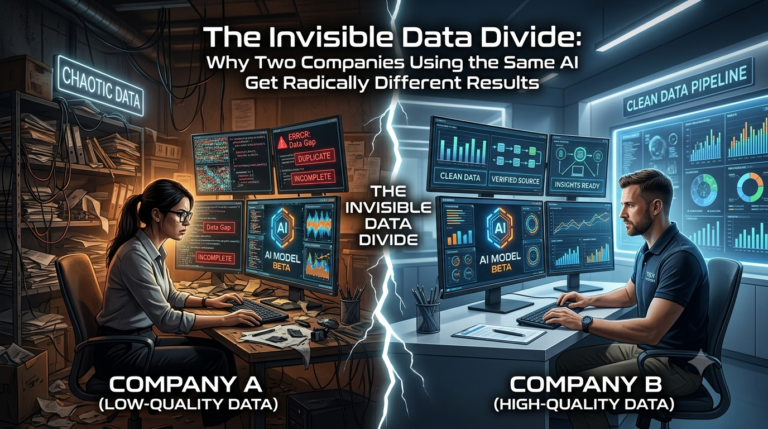
A model can be highly capable and still produce incomplete recommendations when the surrounding business context is incomplete.
Common challenges include:
- Data stored across disconnected applications.
- Different definitions for the same business entities.
- Inconsistent data structures and formats.
- Restricted access to important information.
- Missing historical context.
- Limited ability to move information back into operational systems.
The result is an important principle for enterprise AI: the intelligence of the model cannot fully compensate for disconnected business context.
AI integration therefore needs to consider both data access and data meaning.
4. Design for Human-AI Collaboration
Enterprise workflows are not purely technical systems. They contain habits, responsibilities, approvals, exceptions, judgment calls, informal knowledge, and organizational expectations.
A process may look straightforward on a flowchart while operating very differently in practice because employees have developed workarounds over time.
This creates a human dimension to the Enterprise AI Integration Gap. Closing the Enterprise AI Integration Gap therefore requires organizations to consider how employees actually work, make decisions, handle exceptions, and respond to AI recommendations.
Suppose an organization automates an official approval process with AI. If employees continue using an informal communication channel to make decisions, the new system may technically function while failing to become part of the real workflow.
AI implementation can also struggle when recommendations do not align with how employees actually make decisions. Even a technically strong recommendation can be ignored if employees do not understand it, trust it, or have the authority to act on it.
Integration must account for people
Successful AI-enabled workflows should define:
- Where humans make decisions.
- Where AI provides recommendations.
- Which decisions require human approval.
- How employees handle exceptions.
- How disagreements with AI are recorded.
- Who remains accountable for the final outcome.
This is why integration should not be confused with complete automation.
For many enterprise processes, AI-assisted execution is more practical than removing humans from the workflow. AI can handle information-heavy tasks while people retain responsibility for judgment, relationships, exceptions, and accountability.
5. Move From AI Usage to AI Operationalization
Employee access is not the same as business integration.
An organization may provide thousands of employees with an AI assistant and still see limited operational change. Employees might use AI occasionally to write emails, summarize documents, or conduct research while continuing to perform the core business workflow manually.
That is AI usage, but not necessarily AI operationalization. The Enterprise AI Integration Gap becomes clear when AI is being used by employees but is not changing the underlying business workflow.
A more meaningful question is:
How many important business workflows have been measurably improved by AI?
Consider a B2B lead qualification process. AI might score leads, identify intent signals, summarize company information, and recommend next actions. But the real value emerges when those capabilities become part of a continuous operational process.
A connected lead qualification workflow
A mature process could look like this:
- Customer and engagement data enters the system.
- AI evaluates available signals and context.
- The system identifies relevant opportunities.
- A salesperson reviews the recommendation.
- An appropriate action is triggered.
- The outcome is recorded.
- The result becomes feedback for future prioritization.
The important part is not the individual AI prediction. It is the operational loop surrounding that prediction.
This distinction changes how organizations should evaluate AI initiatives. Usage metrics can indicate activity, but workflow outcomes provide a stronger indication of operational value.
6. Establish Ownership, Governance, and Accountability
AI frequently crosses organizational boundaries.
A single AI-enabled workflow might involve technology teams, business operations, security, legal, compliance, marketing, sales, finance, or customer success. That can make ownership surprisingly difficult.
Traditional enterprise software usually has a relatively clear owner. AI can disrupt that model because the technology and the business process may belong to different groups.
For example:
- IT may own the AI platform.
- A business department may own the workflow.
- Security may control access.
- Legal may govern data usage.
- Operations may manage the resulting process.
- Business leadership may ultimately own the outcome.
Without coordination, an AI initiative can become trapped between departments. This organizational fragmentation can widen the Enterprise AI Integration Gap because no single team may be accountable for connecting AI capabilities with the complete business process.
Define the chain of responsibility
Organizations should establish clear ownership for:
- AI system administration.
- Workflow design.
- Data access.
- Security and permissions.
- Model evaluation.
- Human review.
- Exception handling.
- Business outcomes.
This becomes particularly important when AI recommendations influence decisions.
If an AI system recommends prioritizing one customer, escalating a support case, changing a campaign strategy, adjusting a forecast, or flagging a transaction, the organization needs to know who is responsible for reviewing and acting on that recommendation.
Technical connectivity without organizational accountability is not true integration.
7. Build Closed-Loop AI Workflows
The next stage of enterprise AI will increasingly involve closed-loop workflows.
In a mature system, AI does not simply generate an answer and stop. It observes information, interprets it, recommends or initiates an action, receives feedback, and contributes to future decisions.
This creates a continuous relationship between AI and business operations.
For example, an AI system might identify an account showing signs of buying intent, trigger a review, recommend an outreach strategy, record the outcome, and use that outcome to improve future prioritization.
The value comes from the complete loop rather than from the prediction alone. Closed-loop workflows are therefore an important mechanism for reducing the Enterprise AI Integration Gap and turning AI-generated intelligence into measurable business action.
The closed-loop model
A practical enterprise AI loop can be understood as:
Data → Context → AI Interpretation → Human or Automated Action → Outcome → Feedback → Improved Decision
This model also creates a more useful way to think about AI governance. Organizations should not only ask whether an AI output is accurate. They should also ask what happens after the output is generated.
If an AI system identifies a likely churn risk:
- Who receives the signal?
- What should they do?
- How quickly should they respond?
- What information should they review?
- What happens if they disagree?
- How is the result recorded?
- How does the organization determine whether the prediction was useful?
Answering these questions turns an AI signal into an operational capability.
AI-Added Workflows vs. AI-Native Workflows
There is an important distinction between adding AI to an existing workflow and designing a workflow around what AI makes possible.
An AI-added workflow takes an established process and inserts AI into one or more steps. This can improve efficiency, but the rest of the process may remain unchanged.
An AI-native workflow is designed around AI capabilities from the beginning. It may eliminate unnecessary steps, restructure approvals, change information flows, or create new operating models.
Neither approach is universally appropriate.
Rebuilding every enterprise workflow around AI can create unnecessary disruption. A more practical strategy is to identify the points where AI creates the greatest leverage.
Look for high-value integration points
Organizations should examine where:
- Employees spend significant time on repetitive cognitive work.
- Decisions depend on large amounts of information.
- Manual analysis creates delays.
- Errors occur frequently.
- Work repeatedly moves between different systems.
- Employees perform similar research or summarization tasks.
- Important decisions depend on information that is difficult to consolidate.
These areas can provide opportunities to integrate AI without attempting to rebuild the entire enterprise.
Why Legacy Architecture Makes AI Integration Harder
Many enterprise systems were designed before AI became a central component of business operations.
Some may have limited APIs, rigid data structures, older authentication mechanisms, or workflows that assume humans will perform every decision step. Connecting modern AI capabilities to these systems can therefore require significant engineering effort. When legacy architecture cannot easily support modern AI capabilities, the Enterprise AI Integration Gap can become an infrastructure problem as much as an AI strategy problem.
This creates an architectural imbalance: AI capabilities can advance faster than the infrastructure needed to operationalize them.
The solution is not necessarily to replace every existing application.
Instead, enterprises can build integration layers that allow AI to interact with existing systems while maintaining control and reducing unnecessary complexity.
These layers may include:
- Standardized data interfaces.
- Workflow orchestration.
- Identity and access controls.
- Integration services.
- Monitoring and evaluation systems.
- Governance mechanisms.
- Feedback and audit capabilities.
The objective is to create an environment in which AI can work across the enterprise’s existing technology landscape.
What the Enterprise AI Integration Gap Means for B2B Technology Buyers
The integration gap is also changing how organizations evaluate AI vendors.
Model quality will remain important, but enterprise buyers increasingly need to understand how a solution fits into the broader operating environment.
Instead of asking only, “What can your AI do?” buyers should ask:
- How does the platform integrate with our existing applications?
- Can data move in both directions?
- How are permissions managed?
- Can AI outputs appear inside our existing workflows?
- How are exceptions handled?
- What happens when the AI is wrong?
- Can human approvals be incorporated?
- How is performance evaluated?
- Who owns the workflow after implementation?
- What business outcome is the system designed to improve?
The strongest enterprise AI product may not be the one with the most impressive standalone demonstration. For buyers, closing the Enterprise AI Integration Gap means choosing solutions that can fit into existing applications, processes, data environments, and organizational responsibilities.
It may be the one that disappears most effectively into the workflow.
What the Integration Gap Means for B2B Marketers
AI integration will also change how B2B technology companies communicate their value.
Feature-focused messaging can demonstrate technical capability, but enterprise buyers increasingly need evidence that a solution can operate within their environment.
A more compelling demonstration shows the entire operational journey:
Information enters → AI interprets → employee receives context → action occurs → outcome is recorded → feedback improves future decisions.
This type of workflow evidence allows prospective customers to visualize the technology inside their own organization.
It also makes the value proposition more concrete.
Instead of simply saying that an AI system can “identify high-value opportunities,” a vendor can demonstrate how the opportunity enters the existing CRM process, how the AI evaluates it, how the salesperson receives the recommendation, what action follows, and how the result is captured.
That is the difference between demonstrating a feature and demonstrating business impact.
How Enterprises Can Close the Enterprise AI Integration Gap
Closing the gap does not require organizations to transform everything at once.
A practical approach begins with a small number of high-value workflows and expands from there. The best way to address the Enterprise AI Integration Gap is to start with focused workflows where integration can produce a clear and measurable operational improvement.
Step 1: Identify the workflow
Choose a process where AI can address a meaningful operational problem rather than simply adding another capability.
Step 2: Map the current process
Understand how work actually happens, including unofficial workarounds, approvals, exceptions, and handoffs.
Step 3: Identify the required context
Determine which systems, data sources, business rules, and permissions AI needs to produce useful results.
Step 4: Define the human role
Specify where AI recommends, where it acts, where humans approve, and where accountability remains with people.
Step 5: Create the operational destination
Make sure every important AI output has a clear place in the workflow and a defined next action.
Step 6: Establish feedback loops
Capture outcomes so the organization can determine whether recommendations were useful and improve future decisions.
Step 7: Measure business outcomes
Evaluate whether the workflow is becoming faster, more consistent, less manual, or more effective rather than relying only on AI usage metrics.
This approach allows enterprises to scale AI integration based on demonstrated value rather than technology enthusiasm alone.
Conclusion
The Enterprise AI Integration Gap is not fundamentally a failure of artificial intelligence. It is a systems problem.
AI has advanced rapidly, but enterprises are complex systems built over years or decades. They contain legacy applications, established processes, human habits, data silos, regulatory requirements, organizational structures, and countless exceptions. Expecting a new AI tool to automatically fit into that environment is unrealistic.
The real challenge is connecting intelligence to the machinery of the business.
Organizations that successfully close the Enterprise AI Integration Gap will focus on more than acquiring sophisticated AI capabilities. They will identify high-value workflows, connect relevant data, establish clear ownership, design effective human-AI collaboration, create feedback loops, and measure outcomes rather than simple usage.
The future enterprise will not be defined by how many AI tools it has purchased. It will be defined by how deeply intelligence is woven into the way work gets done.
The most successful AI may eventually be the AI employees barely notice—not because it is unimportant, but because it has become a natural part of the workflow.
When intelligence reaches the right person, at the right moment, with the right context, inside the process where action can actually happen, AI stops being a technology demonstration and becomes business infrastructure.
That is the difference between having AI and operationalizing AI. The next competitive advantage will not simply come from finding smarter machines. It will come from building smarter connections between those machines, enterprise systems, business processes, and the people responsible for turning intelligence into action.
Frequently Asked Questions
1. What is the Enterprise AI Integration Gap?
The Enterprise AI Integration Gap is the distance between what an AI system can technically accomplish and what an organization can practically operationalize. It occurs when AI capabilities are not effectively connected to business workflows, applications, data, people, and decision processes.
2. Why is AI integration important for enterprises?
AI integration is important because standalone AI capabilities do not automatically create business value. Integration allows AI-generated insights and recommendations to reach the right people, trigger appropriate actions, and become part of established business processes.
3. What is the difference between AI adoption and AI operationalization?
AI adoption means employees are using an AI capability. AI operationalization means that AI has become part of an important business workflow and is measurably changing how work gets done.
4. How does disconnected enterprise data affect AI?
Disconnected data can limit the context available to AI. When relevant customer, operational, financial, or business information exists across separate systems, AI may produce incomplete recommendations unless those sources can be appropriately connected and interpreted.
5. Does enterprise AI integration require replacing legacy systems?
Not necessarily. Organizations can often integrate AI with existing systems through APIs, integration layers, workflow orchestration, standardized data interfaces, and appropriate identity and access controls. Replacing legacy platforms should not automatically be the starting point.
6. What role do employees play in AI integration?
Employees remain important, particularly for judgment, exceptions, approvals, relationships, and accountability. Effective AI integration should fit the way employees actually work rather than simply automating an idealized process.
7. What is a closed-loop AI workflow?
A closed-loop AI workflow connects data, AI interpretation, action, outcomes, and feedback. Instead of generating an isolated recommendation, the system captures what happens afterward and uses that information to support future decisions.
8. How should enterprises evaluate AI vendors?
Enterprises should evaluate model capabilities alongside integration depth, data access, permissions, workflow compatibility, governance, human oversight, exception handling, monitoring, and the ability to measure business outcomes.
9. What should B2B technology marketers emphasize when selling AI?
B2B technology marketers should demonstrate how AI fits into real customer workflows. Showing the complete journey—from data entering a system through AI analysis, human action, and outcome measurement—can be more useful to enterprise buyers than demonstrating an isolated AI feature.
10. What is the future of enterprise AI integration?
The future is likely to involve AI becoming increasingly embedded into existing business processes rather than existing only as standalone applications. The strongest implementations will connect intelligence, enterprise systems, workflows, and human decision-making into continuous operational loops.