AI Knowledge Management: Turning Business Information into Actionable Knowledge
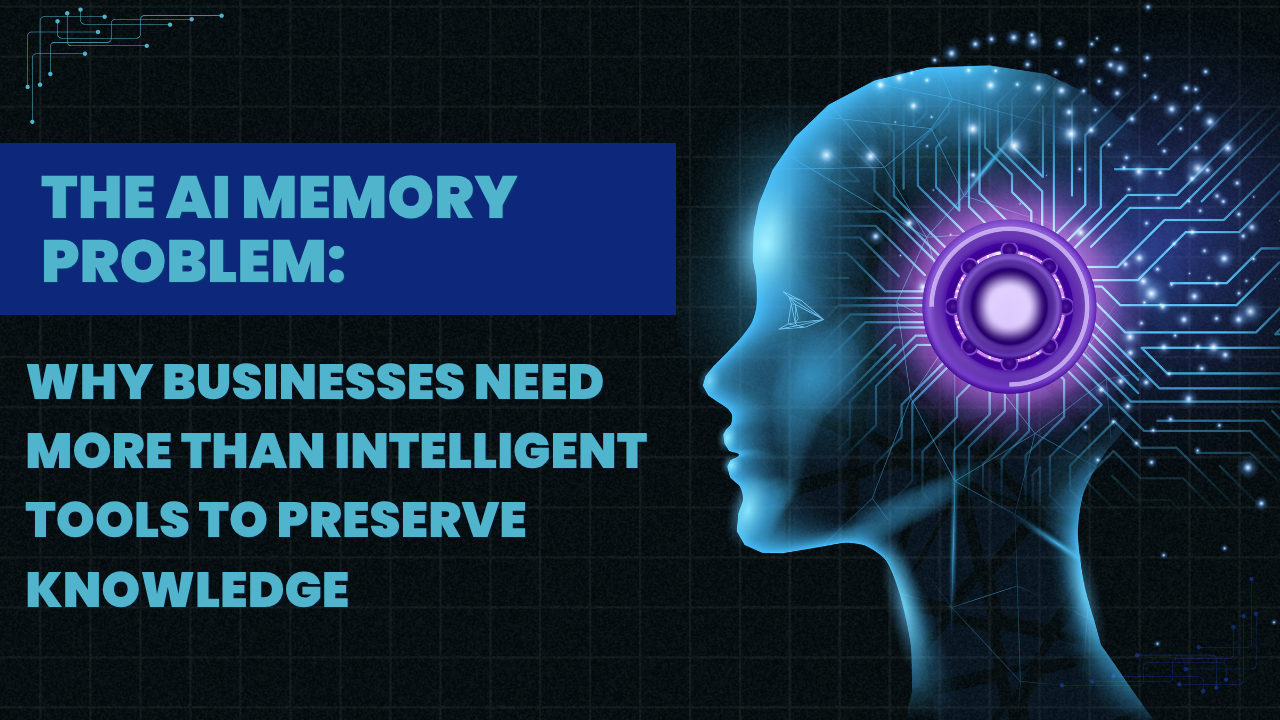
AI Knowledge Management is becoming essential for businesses investing in artificial intelligence to improve productivity, automate repetitive work, and support better decision-making. Yet, while organisations are becoming more capable of generating information, many still struggle to preserve and reuse the knowledge they already possess. Important decisions remain buried in email threads, customer conversations sit inside individual inboxes, project updates are scattered across collaboration platforms, and valuable lessons from completed projects often disappear when employees move to different roles or leave the company.
Why AI Knowledge Management Is Important for Businesses
One of the biggest reasons business knowledge gets lost is that employees rarely work within a single system. A sales representative may store customer requirements in a CRM, discuss pricing over email, share meeting notes through a collaboration platform, and receive product updates through an internal messaging application. A marketing professional may keep campaign insights in spreadsheets, performance reports in dashboards, creative feedback in chat conversations, and strategic decisions in presentation files.
Each piece of information may be useful on its own, but the complete picture is often spread across several locations. When another employee needs to understand the history of a customer relationship, the reasoning behind a campaign decision, or the lessons learned from an earlier project, they may have to search through multiple platforms and ask several colleagues before finding the relevant details. This creates unnecessary delays and makes businesses dependent on individual employees to explain information that should already be available.
The problem becomes more serious as organisations grow, because the volume of information increases while the relationships between different pieces of knowledge become harder to maintain. Without a structured way to connect information, businesses risk creating digital environments that contain enormous amounts of data but offer limited understanding.
The Challenges of AI Knowledge Management
The challenge is not simply about storing more documents or creating another internal knowledge base. Many organisations already have shared drives, intranets, document management platforms, and extensive collections of internal files. The difficulty is ensuring that information remains useful, accurate, searchable, and connected to the context in which it was created. A document might explain what decision was made without explaining why it was made.
A project report might record the final result without identifying the assumptions that influenced it. A customer record might contain contact details and purchase history while omitting the concerns raised during earlier conversations. These missing details matter because business knowledge involves more than facts; it also includes experience, reasoning, relationships, exceptions, and lessons learned over time. An employee who understands why a particular customer rejected a proposal can approach the next conversation more effectively than someone who only knows that the proposal was unsuccessful.
Similarly, a marketing team that understands why a campaign performed poorly can make better decisions than a team that simply receives a final performance report. Preserving knowledge means retaining enough context for other people to understand not only what happened, but also what can be learned from it.
How AI Knowledge Management Improves Knowledge Retrieval
This is where artificial intelligence creates an opportunity, but also introduces a risk. AI-powered search and knowledge assistants can help employees find relevant information across large collections of documents, summarise lengthy reports, identify recurring questions, and connect information that would otherwise remain separated. Instead of manually reviewing dozens of files, an employee may be able to ask a question in natural language and receive a response based on available internal information.
A sales team could use such a system to review previous interactions with an account before an important meeting, while a project manager could retrieve lessons from similar projects completed by other teams. New employees could use internal AI assistants to understand established processes without depending entirely on colleagues for basic explanations. However, these benefits depend on the quality of the underlying information and the system’s ability to retrieve the right material.
If the knowledge base contains outdated policies, contradictory documents, incomplete records, or information that should not be accessible to the requesting employee, AI may produce an answer that is misleading or inappropriate. A polished response can create the impression of certainty even when the underlying information is weak. Businesses therefore need to treat AI as a way to improve access to knowledge, not as a substitute for maintaining that knowledge properly.
Building Reliable Knowledge for AI Knowledge Management
Another important issue is the difference between information that exists and information that employees can actually use. A company might have detailed records of customer interactions, but those records may be inconsistent because different employees use different formats or leave out important details. One salesperson might document a prospect’s budget, decision timeline, and business priorities, while another might record only a brief note about the last conversation.
A support team may resolve recurring customer problems without documenting the solution in a shared location. An engineering team may develop a useful workaround that remains known only to the people who implemented it. In these situations, the organisation technically possesses valuable information, but it cannot reliably turn that information into repeatable knowledge. AI systems may struggle to identify meaningful patterns when the information is incomplete or inconsistent, and employees may lose confidence in the answers they receive.
Businesses need clear practices for recording important decisions, documenting customer interactions, maintaining process information, and capturing lessons from completed work. These practices do not need to create unnecessary administrative burdens. Even small improvements in how information is recorded can make it easier for future employees and AI systems to retrieve the context required for better decisions.
AI Knowledge Management and Employee Knowledge Retention
Employee turnover makes the knowledge problem even more visible. When experienced employees leave an organisation, they take years of practical understanding with them. Some of that knowledge may be documented in procedures and reports, but much of it exists in the way they recognise unusual situations, manage difficult customers, solve recurring problems, or navigate internal processes. A replacement employee may receive access to the same systems and files without gaining the experience needed to interpret them correctly.
The result can be repeated mistakes, longer onboarding periods, inconsistent customer experiences, and unnecessary dependence on a small number of experienced team members. AI can help reduce this gap by making documented knowledge easier to discover and by supporting structured handovers, process explanations, and internal learning. For example, an organisation could use AI to organise approved project documentation, identify common questions asked by new employees, and highlight areas where existing guidance is missing. However, AI cannot automatically recover every piece of knowledge that was never captured.
If an employee leaves without documenting important decisions or explaining an undocumented process, the organisation may have already lost the information needed to reproduce their judgement. Knowledge preservation must therefore become an ongoing part of everyday work rather than an activity that begins only when someone resigns.
Maintaining Accurate and Updated AI Knowledge Management Systems
The growing use of AI also raises an important question about how organisations should manage conflicting or outdated information. Business knowledge changes constantly as products evolve, policies are revised, customers change their requirements, and markets shift. A company may have several versions of the same document stored across different folders, with no clear indication of which one is authoritative.
An old pricing sheet might remain accessible after a new commercial structure has been introduced, or an outdated process document might continue circulating because employees have saved local copies. If an AI assistant retrieves the wrong version, it may provide an answer that was once correct but is no longer relevant. This is particularly important in areas such as finance, HR, compliance, customer contracts, and product specifications, where inaccurate information can have serious consequences. Organisations need to establish clear ownership of important information, define how updates are approved, and make it easier to identify authoritative sources.
Where possible, systems should preserve document dates, version history, permissions, and links to the original material so employees can verify answers before acting on them. AI-generated summaries and recommendations should also be reviewed according to the importance and risk of the decision involved. The goal is not to eliminate every possibility of error, but to create a knowledge environment in which information can be checked, corrected, and maintained over time.
Encouraging Knowledge Sharing Through AI Knowledge Management
A further challenge is that employees do not always share knowledge in the same way. Some people naturally document their work, while others rely on conversations and informal explanations. Certain teams may have strong processes for capturing project outcomes, while others prioritise immediate delivery and postpone documentation until it is forgotten. Employees may also hesitate to share information if they believe their individual expertise gives them greater importance within the organisation or if previous attempts to document their work have created additional effort without clear benefits.
These behaviours cannot be solved through technology alone. Businesses need to make knowledge sharing a practical part of their working culture by showing employees how documenting useful information helps colleagues, reduces repeated work, and improves the quality of future decisions. Managers can encourage teams to record important decisions, explain the reasoning behind major changes, and review what worked after completing significant projects.
Knowledge-sharing practices should be proportionate to the work being performed rather than requiring employees to write lengthy reports for every minor task. When employees see that shared knowledge saves time and prevents recurring problems, they are more likely to contribute consistently. AI can make this process easier by helping structure notes, summarise discussions, and organise information, but employees still need to determine what matters and confirm that the resulting records are accurate.
Security and Access Control in AI Knowledge Management
Businesses must also consider who should be allowed to access different types of knowledge. Making information easier to find does not mean making every document available to everyone. Internal knowledge repositories may contain personal information, confidential commercial details, customer records, contractual information, or sensitive business plans. An AI assistant that searches across these sources must respect the same access restrictions that apply to the original information.
Otherwise, a system intended to improve productivity could unintentionally expose information to employees who do not have permission to view it. Organisations should therefore evaluate access controls, data retention requirements, audit capabilities, and the security arrangements of the tools they use. They should understand how information is processed and stored, whether it is shared with external providers, and how access is managed when employees change roles or leave the company.
These safeguards become particularly important when AI tools connect multiple systems that were previously accessed separately. Responsible knowledge management is not simply about increasing access; it is about giving the right people access to the right information for the right purpose, while preserving confidentiality and accountability.
Measuring the Business Benefits of AI Knowledge Management
The value of better knowledge management becomes especially clear when it is connected to measurable business outcomes. A well-designed knowledge system can help sales teams prepare for customer conversations more efficiently, support teams resolve recurring issues faster, and project teams avoid repeating mistakes made in earlier work. It can also reduce the time new employees spend searching for information, improve consistency across departments, and help leaders understand why particular decisions produced certain results.
However, businesses should avoid judging success only by the number of documents stored, questions asked, or AI-generated summaries created. Those measurements may indicate activity without showing whether the organisation has become more effective. More useful indicators include the time required to locate reliable information, the frequency of repeated errors, the duration of employee onboarding, the speed of customer issue resolution, and the extent to which teams can reuse successful practices. Organisations should establish a baseline before implementing new systems and then evaluate whether those systems improve the work they were intended to support.
If employees still rely on personal messages, informal contacts, and manual searches to find essential information, the organisation may need to improve its processes rather than simply add more AI capabilities.
The Future of AI Knowledge Management
Ultimately, the next stage of business AI will depend on more than powerful models and sophisticated applications. It will depend on whether organisations can turn their accumulated experience into knowledge that employees can access, understand, verify, and apply. Businesses have spent years collecting data, expanding their software environments, and generating reports, but much of the knowledge created through everyday work remains difficult to retrieve or disappears when circumstances change. AI offers an opportunity to make that knowledge more accessible, connect information across departments, and reduce the amount of time employees spend searching for answers.
Yet these benefits will remain limited if the underlying information is poorly maintained, missing important context, or disconnected from actual business processes. Organisations that want to build lasting value from AI should start by understanding what knowledge they possess, where it resides, how it changes, and what prevents employees from using it effectively. The real advantage will not belong only to businesses with the most advanced AI tools, but to those that know how to preserve and use what their people have already learned.
When experience becomes accessible rather than remaining trapped in individual inboxes, conversations, and memories, AI can do more than help employees work faster. It can help an organisation learn from its past, make better decisions in the present, and prepare more intelligently for what comes next.