Introduction
Artificial intelligence is evolving rapidly, but one challenge remains constant: connecting AI models to external tools, data sources, and business systems. While large language models (LLMs) are powerful, they are limited by the information available in their training data and the tools they can access.
To solve this problem, the AI industry is increasingly adopting the Model Context Protocol (MCP), a standardized framework that allows AI applications to securely communicate with external systems. MCP is being recognized as one of the most important developments in AI infrastructure because it simplifies how AI models access real-time data, databases, APIs, and software tools.
In this guide, you’ll learn what MCP is, how it works, its architecture, benefits, use cases, and why it may become the standard communication layer for AI applications.
What Is Model Context Protocol (MCP)?
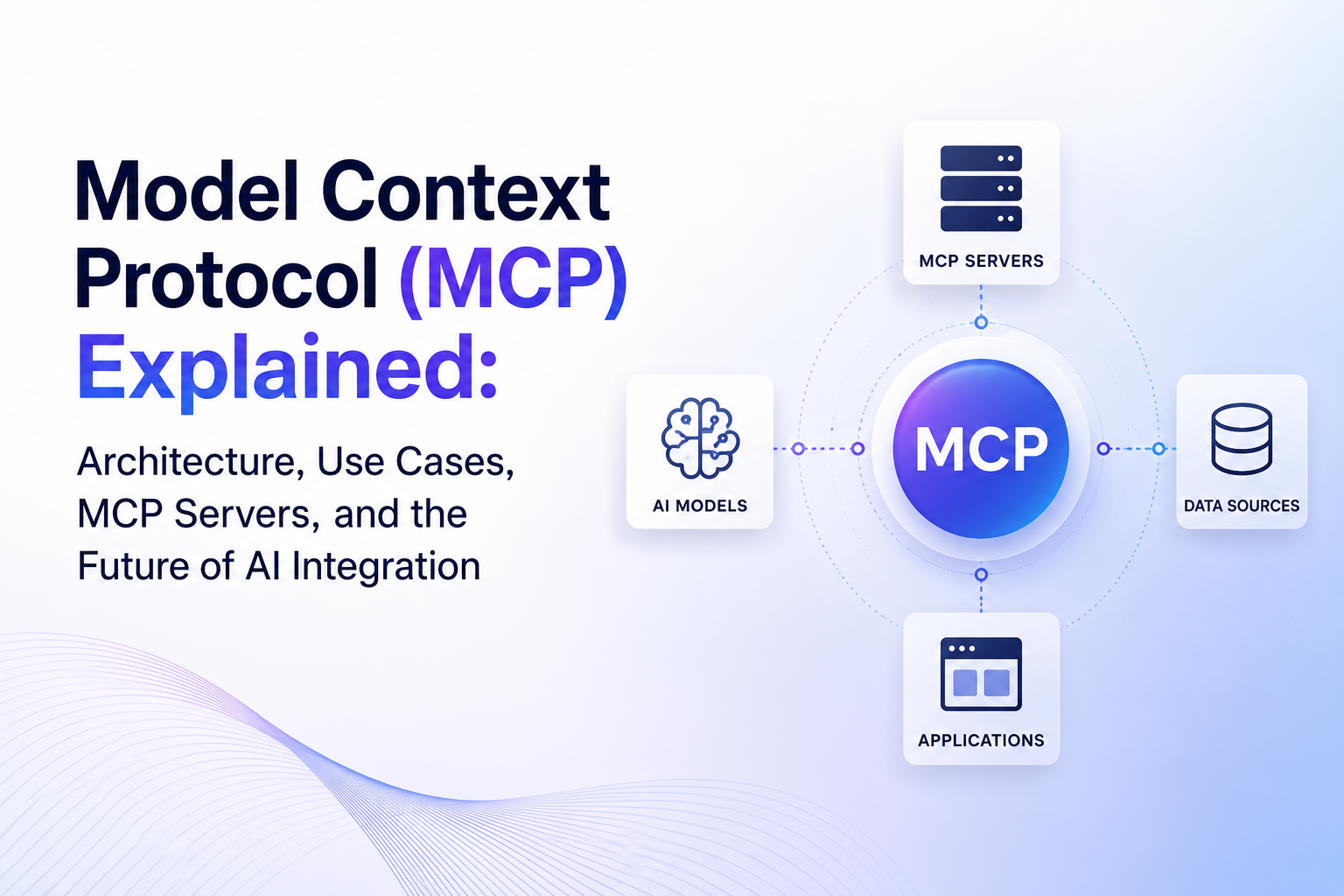
Model Context Protocol (MCP) is an open standard that enables AI models to interact with external data sources, applications, APIs, and tools through a consistent interface.
Think of MCP as a universal connector between AI models and external systems.
Without MCP, developers often need to build custom integrations for every tool they want an AI model to use. This approach creates complexity, increases maintenance costs, and limits scalability.
MCP solves this by creating a standardized communication protocol that allows AI applications to discover and use tools dynamically.
In Simple Terms
Instead of building separate integrations for:
- Databases
- CRMs
- Email systems
- Project management tools
- Internal company software
Developers can connect these systems through MCP, allowing AI assistants to access them using a common protocol.
Why MCP Matters
Modern AI systems need access to real-time information.
For example:
- A customer support assistant needs CRM data.
- A business analyst needs database access.
- A coding assistant needs repository information.
- A project management assistant needs task updates.
Traditional APIs work well, but managing hundreds of integrations becomes difficult.
MCP provides:
- Standardization
- Scalability
- Security
- Reduced development effort
- Better interoperability
This makes AI applications more powerful and easier to maintain.
How Model Context Protocol Works
MCP follows a client-server architecture.
Key Components
MCP Client
The MCP client is the AI application or assistant.
Examples include:
- AI chatbots
- AI agents
- Coding assistants
- Enterprise copilots
The client sends requests to external tools through the protocol.
MCP Server
The MCP server exposes capabilities and resources to AI systems.
It acts as a bridge between AI models and external systems.
Examples:
- Database server
- GitHub integration
- CRM connector
- File system connector
Resources
Resources are pieces of information available through MCP.
Examples:
- Documents
- Files
- Database records
- Reports
- Knowledge bases
Tools
Tools perform actions.
Examples:
- Send email
- Query database
- Create calendar event
- Update CRM record
- Execute workflow
MCP Architecture Explained
A typical MCP architecture consists of:
- User submits request
- AI model interprets intent
- MCP client identifies required tool
- MCP server exposes available capabilities
- AI retrieves information or executes action
- Results are returned to the user
This architecture enables AI systems to operate beyond static training data.
Benefits of MCP
Standardized Integrations
Developers no longer need custom connectors for every AI application.
Faster Development
Teams can build AI-powered applications more quickly using existing MCP servers.
Better Security
Organizations can control what data and actions AI systems can access.
Improved Scalability
New tools can be added without redesigning the entire architecture.
Real-Time Context
AI models can access live information rather than relying solely on historical training data.
MCP vs Traditional APIs
| Feature | Traditional APIs | MCP |
|---|---|---|
| Integration Method | Custom | Standardized |
| Tool Discovery | Manual | Dynamic |
| Maintenance | High | Lower |
| AI Compatibility | Limited | Optimized |
| Scalability | Moderate | High |
While APIs remain important, MCP provides an AI-first approach to integration.
MCP Use Cases
Enterprise AI Assistants
Organizations can connect AI assistants to:
- Internal databases
- HR systems
- CRM platforms
- Documentation repositories
This creates highly capable enterprise copilots.
Customer Support Automation
Support agents can retrieve:
- Customer information
- Order status
- Ticket history
in real time.
Software Development
AI coding assistants can access:
- Repositories
- Documentation
- CI/CD systems
- Issue trackers
to provide more accurate assistance.
Knowledge Management
Organizations can connect internal knowledge bases and document systems through MCP.
Business Process Automation
AI agents can perform actions such as:
- Creating tickets
- Updating records
- Scheduling meetings
- Sending notifications
without manual intervention.
MCP and AI Agents
One of the biggest reasons MCP is gaining attention is its role in agentic AI.
AI agents need:
- Tools
- Memory
- Context
- External actions
MCP provides a framework that helps agents discover and use these capabilities.
Without protocols like MCP, AI agents would require custom integrations for every system they interact with.
With MCP, agents become more scalable and interoperable.
MCP Servers Explained
MCP servers expose capabilities to AI applications.
Popular categories include:
Database MCP Servers
Allow AI models to:
- Query databases
- Retrieve records
- Generate reports
File System MCP Servers
Provide access to:
- Documents
- PDFs
- Internal files
Git Repository MCP Servers
Enable AI coding assistants to:
- Read code
- Analyze repositories
- Generate documentation
Productivity Tool MCP Servers
Connect AI systems to:
- Calendars
- Emails
- Project management software
Security Considerations
As AI systems gain access to business data, security becomes critical.
Best practices include:
Access Controls
Limit permissions based on user roles.
Authentication
Verify all requests and users.
Audit Logging
Track actions performed by AI systems.
Data Governance
Ensure compliance with organizational policies.
Human Oversight
Maintain approval workflows for sensitive operations.
Challenges of MCP Adoption
Despite its benefits, organizations may face challenges:
Infrastructure Complexity
Large deployments require proper architecture planning.
Security Risks
Improper permissions can expose sensitive data.
Standard Evolution
As MCP evolves, implementations may require updates.
Organizational Readiness
Teams need expertise in AI infrastructure and integrations.
Future of MCP
Industry experts believe MCP could become a foundational layer for enterprise AI.
Future developments may include:
- Improved interoperability
- Better agent coordination
- Standardized security models
- Enhanced developer tools
- Wider enterprise adoption
As AI agents become more autonomous, protocols like MCP will likely play a central role in enabling safe and scalable interactions with real-world systems.
Conclusion
Model Context Protocol (MCP) represents a major step forward in AI infrastructure. By providing a standardized way for AI models to interact with tools, databases, and external systems, MCP reduces integration complexity and enables more capable AI applications.
As businesses increasingly adopt AI assistants and autonomous agents, MCP is positioned to become one of the most important technologies supporting the next generation of intelligent systems.
Organizations that understand and implement MCP today will be better prepared for the future of AI-powered automation and enterprise intelligence.