AI Agents in the workplace –
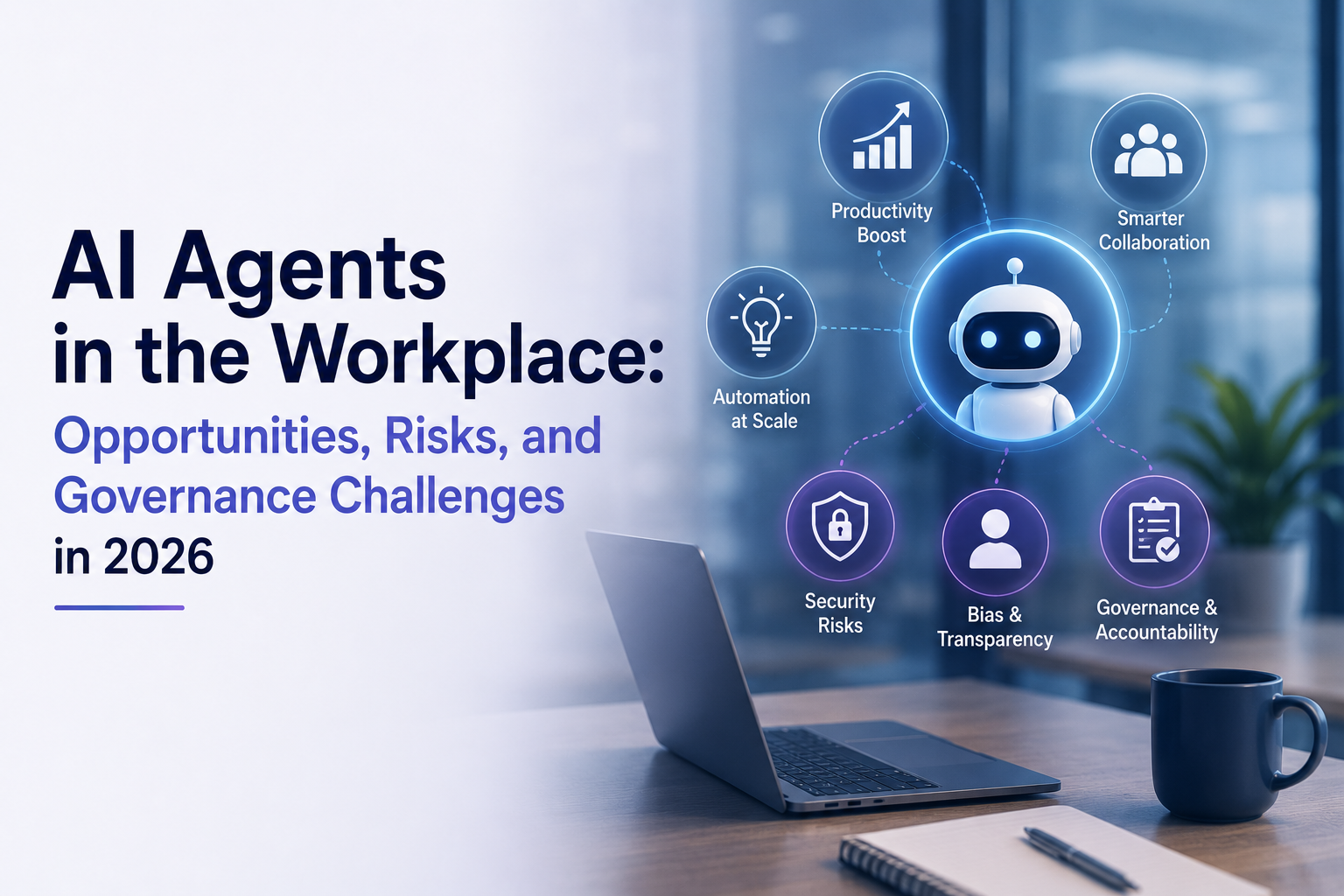
Artificial Intelligence (AI) agents have rapidly evolved from experimental tools into valuable business assets across industries. In 2026, organizations are increasingly deploying AI agents to automate workflows, support decision-making, improve customer interactions, and enhance employee productivity. Unlike traditional automation systems that follow predefined rules, AI agents can analyze data, learn from interactions, and perform complex tasks with minimal human intervention. From managing customer inquiries and generating reports to scheduling meetings and conducting research, these intelligent systems are becoming an integral part of daily business operations. As companies seek greater efficiency and cost optimization, AI agents are helping teams accomplish more in less time. However, their growing adoption also raises important questions about accountability, transparency, and responsible implementation.
Key workplace applications of AI agents include:
- Customer service and support automation.
- Research and data analysis assistance.
- Sales and marketing workflow optimization.
- Employee productivity and task management.
Opportunities Created by AI Agents for Businesses –
The adoption of AI agents presents significant opportunities for organizations looking to improve operational efficiency and competitiveness. One of the biggest advantages is the ability to automate repetitive and time-consuming tasks, allowing employees to focus on higher-value work that requires creativity, critical thinking, and relationship building. AI agents can process large volumes of information faster than humans, enabling businesses to make informed decisions based on real-time insights. They also help reduce operational costs by streamlining workflows and minimizing manual effort. In customer-facing roles, AI agents can provide 24/7 support, improving response times and customer satisfaction. As AI technology continues to mature, businesses are finding new ways to leverage these tools to drive innovation and accelerate growth.
Major benefits of AI agent adoption include:
- Increased employee productivity.
- Faster decision-making through real-time insights.
- Reduced operational and administrative costs.
The Risks Associated With AI Agents in the Workplace –
Despite their advantages, AI agents introduce several risks that organizations cannot afford to ignore. One of the most significant concerns is the potential for inaccurate or misleading outputs, commonly known as AI hallucinations. When AI systems generate incorrect information, it can impact business decisions, customer communications, and operational processes. Privacy and data security concerns also arise when AI agents access sensitive business or customer information. Additionally, overreliance on AI can reduce human oversight, increasing the likelihood of errors going unnoticed. Bias within AI models remains another challenge, as systems trained on incomplete or biased data may produce unfair or discriminatory outcomes. Without proper safeguards, these risks can create legal, financial, and reputational consequences for organizations.
Common risks businesses face include:
- Inaccurate or misleading AI-generated outputs.
- Data privacy and security vulnerabilities.
- Bias and fairness concerns in AI decision-making.
Why AI Governance Has Become a Business Priority –
As AI adoption accelerates, governance has emerged as a critical component of successful implementation. AI governance refers to the policies, frameworks, and oversight mechanisms that ensure AI systems operate responsibly, ethically, and in compliance with regulations. Organizations are recognizing that deploying AI without governance can expose them to significant operational and legal risks. Effective governance helps establish accountability by defining who is responsible for monitoring AI systems and validating their outputs. It also ensures transparency in how AI-driven decisions are made, which is particularly important in regulated industries. By implementing governance frameworks early, businesses can build trust among employees, customers, and stakeholders while reducing the likelihood of unintended consequences.
AI Agents in the Workplace: Benefits vs Challenges
| Area | Opportunities | Challenges |
|---|---|---|
| Productivity | Automates repetitive tasks and saves time | Overdependence on automation can reduce human oversight |
| Decision-Making | Provides real-time insights and data analysis | Incorrect outputs can lead to poor business decisions |
| Customer Service | Delivers 24/7 support and faster response times | Inaccurate responses may impact customer trust |
| Operations | Streamlines workflows and reduces costs | Integration with existing systems can be complex |
| Compliance | Supports monitoring and reporting processes | Regulatory requirements for AI are constantly evolving |
Building a Responsible AI Strategy for the Future –
To maximize the benefits of AI agents while minimizing risks, organizations must adopt a balanced and responsible implementation strategy. Businesses should begin by identifying specific use cases where AI can deliver measurable value and align with organizational goals. Employee training is equally important, as workers need to understand both the capabilities and limitations of AI systems. Organizations should establish clear guidelines for AI usage, invest in data quality management, and maintain human oversight for critical business decisions. Continuous monitoring and evaluation are necessary to ensure AI agents remain accurate, secure, and compliant as technologies evolve. Companies that approach AI adoption strategically will be better positioned to leverage innovation while maintaining operational integrity and customer trust.
Best practices for responsible AI adoption include:
- Defining clear objectives for AI deployment.
- Training employees on AI capabilities and limitations.
- Maintaining human oversight for critical processes.
- Monitoring AI performance regularly.
Conclusion –
AI agents are reshaping the workplace in 2026 by automating tasks, enhancing productivity, and enabling smarter decision-making across organizations. Their ability to streamline operations and support business growth makes them one of the most impactful technological developments of the decade. However, the benefits of AI agents come with important challenges, including accuracy concerns, data privacy risks, bias, and regulatory compliance issues. As a result, businesses can no longer view AI adoption as solely a technology initiative—it must also be a governance priority.