
The Rise of Autonomous Sales Development Representatives (SDRs)

The sales landscape is undergoing a major transformation as artificial intelligence (AI) continues to reshape how businesses engage with prospects. Among the most significant developments is the emergence of Autonomous Sales Development Representatives (SDRs)—AI-powered systems capable of performing many of the tasks traditionally handled by human sales teams. From identifying prospects and personalizing outreach to scheduling meetings and nurturing leads, autonomous SDRs are helping organizations accelerate sales processes while reducing operational costs. As businesses seek greater efficiency and scalability, the adoption of autonomous SDRs is rapidly gaining momentum across industries.
What Are Autonomous SDRs?
Autonomous SDRs are AI-driven sales agents designed to automate the top-of-the-funnel sales activities that typically consume significant time and resources. These systems leverage machine learning, natural language processing (NLP), and data analytics to identify potential customers, engage them through personalized communication, qualify leads, and book meetings with sales representatives. Unlike traditional sales automation tools that require extensive human oversight, autonomous SDRs can independently execute tasks, learn from interactions, and continuously improve their performance.
By analyzing customer behavior, company information, and engagement patterns, autonomous SDRs can determine the most promising prospects and tailor messages based on individual preferences. This level of personalization allows businesses to maintain meaningful customer interactions at scale.
Why Businesses Are Adopting Autonomous SDRs –
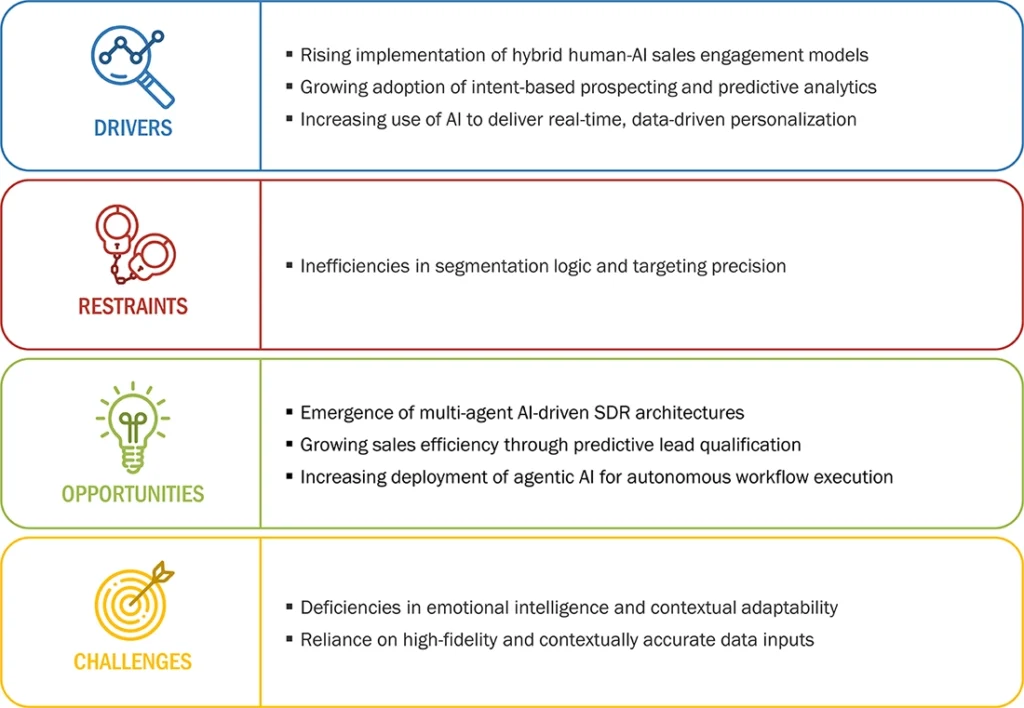
The growing adoption of autonomous SDRs is driven by the need for increased efficiency and productivity in sales operations. Traditional sales development often involves repetitive tasks such as prospect research, email outreach, follow-ups, and lead qualification. These activities can consume a significant portion of a salesperson’s time, leaving less room for strategic conversations and relationship building.
Autonomous SDRs eliminate much of this manual workload by automating routine processes. As a result, sales teams can focus on higher-value activities such as closing deals and developing customer relationships. Additionally, AI-powered SDRs operate around the clock, enabling businesses to engage prospects across different time zones without interruption.
Another key advantage is scalability. Companies can manage thousands of prospect interactions simultaneously without needing to expand their sales development workforce. This capability is particularly valuable for startups and fast-growing organizations looking to maximize outreach while controlling costs.
Key Capabilities of Autonomous SDRs –
Modern autonomous SDR platforms offer a wide range of capabilities that extend beyond simple automation. These include:
| Capability | Description | Business Impact |
|---|---|---|
| Prospect Identification | Uses AI to find and prioritize high-potential leads | Improves lead quality and conversion rates |
| Personalized Outreach | Generates customized emails and messages | Enhances engagement and response rates |
| Lead Qualification | Assesses prospect readiness based on predefined criteria | Reduces time spent on unqualified leads |
| Automated Follow-Ups | Sends timely reminders and nurturing messages | Increases consistency in communication |
| Meeting Scheduling | Books appointments directly into calendars | Streamlines the sales process |
| Performance Analytics | Tracks engagement and campaign effectiveness | Enables data-driven decision making |
Benefits of Autonomous SDRs –
One of the primary benefits of autonomous SDRs is increased efficiency. By automating repetitive sales tasks, organizations can significantly reduce the time required to move prospects through the sales funnel. This allows human sales professionals to focus on complex negotiations and strategic account management.
Cost savings also play a major role in adoption. Hiring and training large sales development teams can be expensive. Autonomous SDRs offer a scalable alternative that can handle large volumes of outreach without proportional increases in labor costs.
Additionally, AI-driven SDRs provide consistency in communication. Human representatives may vary in messaging quality and follow-up frequency, whereas autonomous systems ensure every prospect receives timely and personalized engagement. This consistency can lead to improved customer experiences and stronger brand perception.
Challenges and Limitations –
Despite their advantages, autonomous SDRs are not without challenges. Building genuine human relationships remains a critical component of sales, especially in complex B2B environments where trust and personal connections influence purchasing decisions. While AI can effectively manage initial interactions, human involvement is often necessary during later stages of the sales cycle.
Data quality is another important consideration. Autonomous SDRs rely heavily on accurate and up-to-date information to make decisions and personalize outreach. Poor-quality data can lead to ineffective targeting and reduced performance.
Organizations must also address concerns related to privacy, compliance, and ethical AI usage. As autonomous systems process large volumes of customer data, businesses must ensure adherence to regulations such as GDPR and other data protection frameworks.
The Future of Autonomous SDRs –
The future of autonomous SDRs appears highly promising as advancements in generative AI and conversational intelligence continue to improve system capabilities. Future SDRs are expected to engage in increasingly sophisticated conversations, understand customer intent more accurately, and adapt their communication styles in real time.
Rather than replacing human sales professionals entirely, autonomous SDRs will likely function as intelligent partners that enhance human productivity. Sales teams will increasingly rely on AI to handle repetitive processes while focusing their expertise on relationship management, strategic selling, and customer success.
As organizations continue to embrace digital transformation, autonomous SDRs are poised to become a standard component of modern sales operations. Companies that successfully integrate these technologies into their sales strategies will gain a competitive advantage through improved efficiency, scalability, and customer engagement.
Conclusion –
Autonomous Sales Development Representatives represent a significant evolution in sales technology. By automating prospecting, outreach, qualification, and scheduling, these AI-powered systems enable businesses to streamline operations and maximize sales productivity. While challenges related to data quality, compliance, and human interaction remain, the benefits of autonomous SDRs far outweigh the limitations for many organizations. As AI technology continues to advance, autonomous SDRs will play an increasingly important role in shaping the future of sales, helping businesses connect with prospects more effectively and drive sustainable growth.