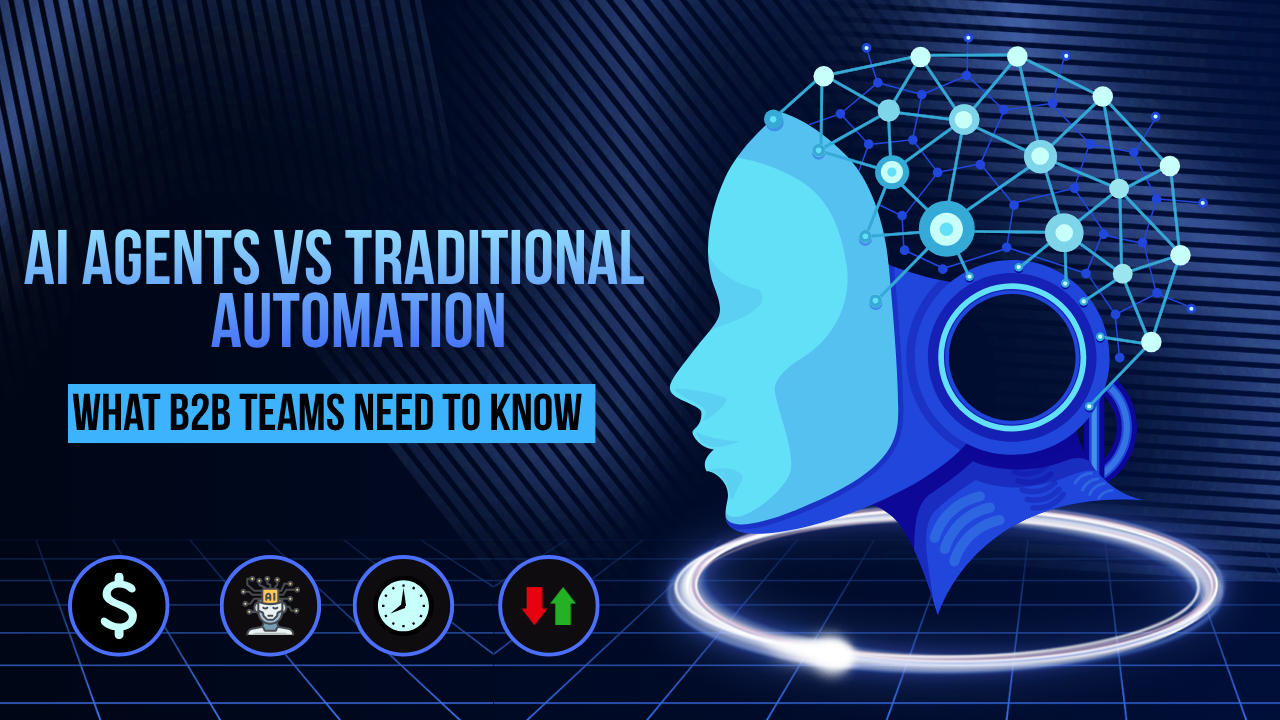
AI Agents vs Traditional Automation: What B2B Teams Need to Know
For years, automation has been one of the biggest productivity drivers in business. Every organization, regardless of size, has looked for ways to reduce repetitive work, speed up processes, and improve efficiency without continuously expanding teams. Automation became the obvious answer. Emails started sending automatically, CRMs began assigning leads on their own, reports generated themselves and operational workflows became faster and more structured.
But over the last year, a new conversation has entered boardrooms, marketing meetings and technology discussions.
Businesses are no longer only asking how they can automate work. They are asking whether technology can actually think through work.
This is where AI agents have entered the picture.
The rise of AI agents has created a lot of excitement in the B2B world, but also confusion. Many teams assume AI agents are simply a more advanced version of automation. Others believe they will replace existing systems entirely. In reality, both assumptions miss the bigger picture.
AI agents and traditional automation are related, but they solve different business challenges.
Understanding the distinction matters because businesses that approach AI strategically are likely to create stronger customer experiences, move faster internally and unlock more value from their teams. Those that chase trends without understanding the difference may simply end up adding more technology without creating meaningful impact.
The automation era: building systems that execute –
Traditional automation transformed businesses because it removed the need for human involvement in predictable tasks.
At its core, automation works on logic.
If something happens, the system responds in a predefined way.
If a customer fills out a form, send an email.
If a payment is received, generate an invoice.
If a lead reaches a score threshold, assign it to sales.
This structure created enormous efficiency across industries because many business activities are repetitive by nature.
Think about a B2B marketing team running campaigns every month. Before automation, teams manually downloaded reports, updated spreadsheets and followed up with prospects individually. Automation reduced hours of operational work and allowed teams to focus on strategy.
The same happened in sales. Instead of spending time updating records and moving prospects through stages manually, systems started doing that automatically.
For operations teams, automation became even more powerful. Internal approvals, procurement requests, scheduling, reporting and workflow management became standardized.
Traditional automation succeeded because it gave businesses something they value deeply predictability.
But predictability comes with a limitation.
Automation cannot decide.
It cannot understand changing context.
It cannot rethink its own process.
It follows instructions exactly as designed.
And that limitation is becoming more visible as business environments become more dynamic.
The shift from executing tasks to achieving outcomes –
This is where AI agents begin to change the conversation. Unlike traditional automation, AI agents are designed around goals rather than instructions. That difference sounds small at first, but it fundamentally changes how work gets done.
Imagine giving a marketing automation platform a task.
You might build a workflow that says:
“When someone downloads an e-book, send three emails across seven days.”
Everything is predetermined.
Now imagine giving an AI agent the objective:
“Identify the highest-value prospects from this campaign and maximize engagement.”
Instead of waiting for instructions, the AI agent may analyse behavioural data, identify patterns, segment audiences differently, generate messaging recommendations, and adapt actions based on performance.
The goal stays the same. The path changes.
That is the biggest difference.
Automation follows a process.
AI agents pursue an outcome.
This is why AI agents feel less like software and more like digital collaborators. They do not eliminate structure, but they introduce adaptability.
Why this matters specifically for B2B teams?
B2B environments have become increasingly complex.
The days of straightforward buyer journeys are disappearing. Customers interact across multiple channels, conduct extensive research independently, involve several decision-makers, and expect highly personalized experiences. At the same time, internal teams are expected to do more with tighter timelines.
Marketing is expected to generate measurable pipeline.
Sales teams are expected to personalize outreach at scale.
Customer success teams are expected to reduce churn while increasing retention.
Operations teams are expected to improve efficiency continuously.
The challenge is that complexity has increased faster than team capacity.
This is where AI agents become attractive.
They are not valuable because they work faster.
They are valuable because they help businesses process complexity more intelligently.
What this looks like inside real business functions –
Take marketing as an example.
Traditional automation already performs many useful activities. Campaign scheduling, email sequences, lead nurturing, CRM syncing, and reporting are largely automated in mature organizations.
But modern marketing generates far more data than most teams can realistically interpret.
Campaign metrics.
Website behaviour.
Engagement signals.
Customer intent.
Attribution data.
Audience movement.
AI agents can begin connecting these inputs and identifying patterns that humans may miss under time pressure.
Instead of producing a dashboard, they may recommend where to move budget.
Instead of generating reports, they may explain why performance changed.
Instead of creating generic content, they may personalize messaging for different audience groups.
Sales teams experience something similar.
For years, sales automation focused on making processes faster.
Today, AI agents are shifting focus toward making decisions smarter.
Rather than simply sending reminders or updating records, AI systems can help prioritize accounts, summarize meetings, recommend outreach angles, and identify stalled opportunities before revenue is lost.
The result is not necessarily replacing sales professionals.
It is allowing them to spend more time where humans create the most value, building trust, negotiating, and understanding people.
The misconception that AI replaces people –
Whenever new technology emerges, the conversation quickly turns toward replacement.
Will AI replace teams?
Will automation remove jobs?
Will agents eliminate human involvement?
In practice, that is rarely how transformation happens. Technology changes roles more often than it removes them. The businesses creating the strongest results are not removing people from processes.
They are redesigning work.
Routine execution becomes automated. Analysis becomes faster. Decision-making becomes better supported.
Humans move closer to strategy, creativity, relationships, and judgment. This shift is especially important in B2B because trust remains central to growth.
No AI system can replace understanding organizational politics, managing stakeholder relationships, or creating long-term partnerships.
Those remain deeply human capabilities.
The misconception that AI replaces people –
Whenever new technology emerges, the conversation quickly turns toward replacement.
Will AI replace teams?
Will automation remove jobs?
Will agents eliminate human involvement?
In practice, that is rarely how transformation happens. Technology changes roles more often than it removes them. The businesses creating the strongest results are not removing people from processes.
They are redesigning work.
Routine execution becomes automated. Analysis becomes faster. Decision-making becomes better supported.
Humans move closer to strategy, creativity, relationships, and judgment. This shift is especially important in B2B because trust remains central to growth.
No AI system can replace understanding organizational politics, managing stakeholder relationships, or creating long-term partnerships.
Those remain deeply human capabilities.
The future belongs to businesses that know when to automate and when to delegate –
AI agents are not the end of automation.
They are its evolution.
The conversation is not about replacing existing systems, it is about extending what businesses can accomplish.
Organizations that succeed over the next few years will likely not be those with the most technology.
They will be the ones that understand how to combine human judgment, automation, and intelligent systems in ways that create better experiences and better outcomes.
Because the future of B2B work is not automated.
It is augmented.
And businesses that understand that difference early will have an advantage that goes far beyond efficiency.