Introduction-
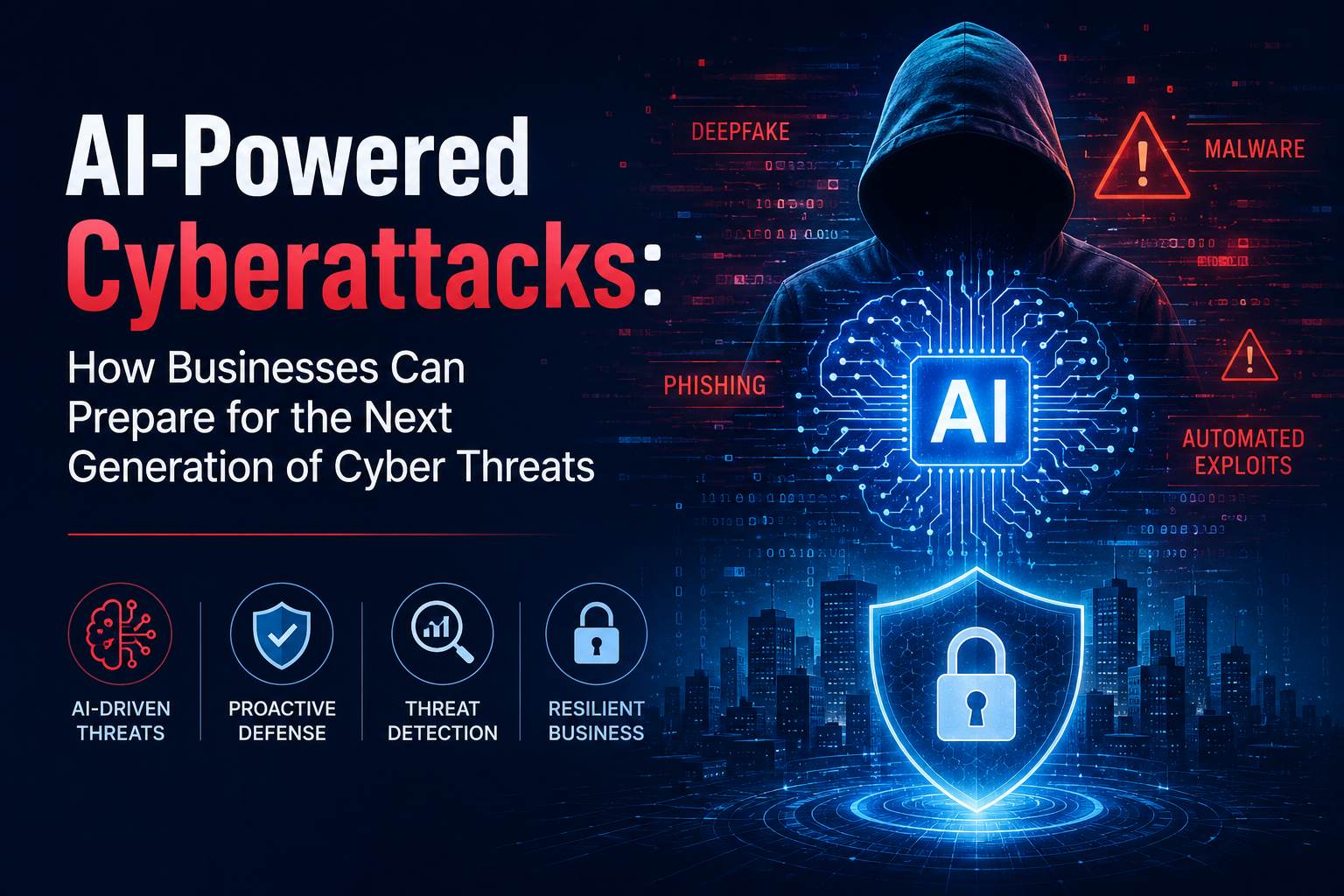
AI-Powered Cyberattacks are rapidly transforming the cybersecurity landscape. Artificial Intelligence (AI) has become a powerful tool for businesses, enabling automation, improving customer experiences, and accelerating digital transformation. However, the same technology is also empowering cybercriminals to execute faster, more sophisticated, and highly targeted attacks against organizations worldwide.
Unlike traditional cyber threats, AI-Powered Cyberattacks leverage machine learning, generative AI, and automation to identify vulnerabilities, launch intelligent phishing campaigns, create adaptive malware, and bypass conventional security measures. As businesses continue adopting cloud technologies, hybrid work environments, and connected devices, the risk posed by AI Security Threats continues to grow.
For organizations, Enterprise Cybersecurity is no longer just an IT function—it is a critical business strategy. Whether you’re a CIO, CISO, CTO, or business leader, understanding how AI-Powered Cyberattacks operate and implementing a proactive Cybersecurity for Businesses strategy is essential for protecting operations, customer trust, and long-term growth.
Understanding AI-Powered Cyberattacks-
AI-Powered Cyberattacks refer to cyberattacks that use Artificial Intelligence and machine learning to automate, improve, and scale malicious activities. Unlike conventional attacks, these threats can continuously learn, adapt, and evolve based on the security controls they encounter.
Modern attackers use AI to:
- Automate reconnaissance
- Generate highly convincing phishing emails
- Develop intelligent malware
- Analyze network vulnerabilities
- Predict user behavior
- Launch attacks at enterprise scale
These capabilities allow cybercriminals to execute attacks more efficiently while reducing the time and expertise traditionally required.
As organizations embrace digital transformation, AI Cybersecurity has become essential for defending against these increasingly intelligent threats.
Why AI-Powered Cyberattacks Are Becoming More Dangerous-
The growing accessibility of generative AI tools has significantly lowered the barrier for cybercriminals. Attackers no longer need advanced programming skills to launch sophisticated attacks.
Several factors contribute to the rise of AI-Powered Cyberattacks:
Automation at Scale:
AI enables attackers to automate phishing campaigns, vulnerability scanning, and credential attacks, allowing them to target thousands of organizations simultaneously.
Adaptive Malware:
Traditional malware follows predefined instructions. AI-powered malware can modify its behavior to evade detection, making it significantly harder for legacy security systems to identify malicious activity.
Personalized Social Engineering:
Using publicly available information from websites, social media, and professional platforms, AI can generate personalized phishing messages that closely resemble legitimate communications.
This evolution has made AI Security Threats one of the biggest concerns for organizations pursuing digital transformation.
Why Businesses Should Be Concerned-
Every organization—regardless of industry—is becoming more dependent on digital infrastructure. Cloud platforms, remote work, IoT devices, SaaS applications, and interconnected business systems increase operational efficiency but also expand the attack surface.
Businesses face several key risks from AI-Powered Cyberattacks.
Financial Losses:
Cyber incidents can result in direct financial losses through ransomware payments, fraudulent transactions, business disruption, legal costs, and recovery expenses.
According to industry research, the financial impact of cybercrime continues to rise as attackers become more sophisticated and organizations become increasingly interconnected.
Business Downtime:
A successful cyberattack can disrupt production systems, customer services, logistics, and internal operations.
Even a few hours of downtime may result in substantial revenue losses and reduced customer satisfaction.
Reputational Damage:
Customer trust is difficult to earn and easy to lose. Organizations that experience major security breaches often face long-term reputational challenges that affect customer retention and business growth.
Strong Enterprise Cybersecurity practices help organizations protect both their data and their brand reputation.
Regulatory Compliance Risks:
Businesses must comply with data protection regulations and industry standards. AI-enabled attacks that expose sensitive customer information may lead to regulatory investigations, legal liabilities, and financial penalties.
Common Types of AI-Powered Cyberattacks-
Understanding the most common attack techniques helps organizations prepare more effectively.
AI-Generated Phishing Attacks:
Traditional phishing emails often contain spelling mistakes or generic messaging.
Today’s AI-Powered Cyberattacks use generative AI to create highly personalized emails that imitate executives, suppliers, financial institutions, or trusted partners.
These emails often include:
- Personalized greetings
- Business-specific language
- Accurate writing styles
- Contextual information
- Convincing calls to action
As a result, employees are more likely to trust these communications.
Deepfake Executive Fraud:
Deepfake technology has become a powerful weapon in cybercrime.
Attackers can generate realistic voice recordings or videos that impersonate senior executives.
These impersonations are commonly used to:
- Approve fraudulent payments
- Request confidential documents
- Change banking information
- Influence business decisions
Organizations should establish verification procedures for sensitive requests to reduce this risk.
Intelligent Malware:
Unlike traditional malware, AI-enhanced malware can analyze its environment and alter its behavior to avoid detection.
These attacks can:
- Change code automatically
- Disable security tools
- Spread across networks
- Target high-value systems
This makes AI Cybersecurity technologies increasingly important for identifying unusual behavior instead of relying solely on known malware signatures.
Automated Credential Attacks:
Passwords remain one of the weakest security controls.
AI enables attackers to:
- Predict common password patterns
- Analyze leaked credentials
- Automate password guessing
- Perform credential stuffing attacks
Businesses should strengthen identity management through Multi-Factor Authentication (MFA), passwordless authentication, and continuous identity verification.
AI-Powered Vulnerability Discovery:
Cybercriminals increasingly use AI to scan enterprise applications, cloud environments, APIs, and network infrastructure for security weaknesses.
Instead of manually identifying vulnerabilities, AI allows attackers to automate the discovery process and prioritize high-value targets.
Organizations should conduct continuous vulnerability assessments and implement timely patch management to minimize exposure.
The Business Impact of AI Security Threats-
The consequences of AI-Powered Cyberattacks extend beyond technical systems. They affect business operations, financial performance, customer relationships, and organizational resilience.
Increased Operational Costs:
Incident response, forensic investigations, legal services, regulatory compliance, and business recovery can significantly increase operational expenses following a cyber incident.
Customer Trust:
Organizations that demonstrate strong Cybersecurity for Businesses practices are more likely to retain customer confidence and build long-term relationships.
Competitive Advantage:
Investing in Enterprise Cybersecurity is no longer just about reducing risk—it is also becoming a competitive differentiator. Customers, partners, and investors increasingly evaluate cybersecurity maturity when selecting vendors and business partners.
Business Continuity:
A proactive AI Cybersecurity strategy enables organizations to continue operating during cyber incidents, minimizing disruption and protecting critical services.
Conclusion-
AI-Powered Cyberattacks are no longer a future concern—they are a present-day reality that every organization must address. As artificial intelligence continues to evolve, cybercriminals are leveraging it to launch more sophisticated, automated, and targeted attacks that challenge traditional security measures. From AI-generated phishing campaigns and deepfake fraud to intelligent malware and automated vulnerability exploitation, the threat landscape is becoming increasingly complex.
To stay ahead of these AI Security Threats, businesses must adopt a proactive and resilient approach to Enterprise Cybersecurity. Investing in AI Cybersecurity solutions, implementing a Zero Trust Security framework, strengthening identity and access management, continuously training employees, and conducting regular risk assessments are no longer optional—they are essential components of a modern Cybersecurity for Businesses strategy.
Organizations that embrace advanced security technologies and foster a culture of cybersecurity awareness will be better equipped to protect sensitive data, ensure business continuity, maintain regulatory compliance, and build lasting customer trust. In today’s digital economy, cybersecurity is more than a defensive necessity—it is a strategic business enabler that supports innovation, resilience, and sustainable growth.
The next generation of AI-Powered Cyberattacks is already here. The question is not whether your organization will face these threats, but whether it is prepared to respond effectively. By taking action today, businesses can strengthen their security posture, reduce cyber risks, and confidently navigate the future of an AI-driven world.
Frequently Asked Questions (FAQs)
AI-Powered Cyberattacks are cyber threats that use artificial intelligence and machine learning to automate malicious activities such as phishing, malware creation, credential theft, and vulnerability exploitation. These attacks are more adaptive, scalable, and difficult to detect than traditional cyberattacks, making them a significant concern for modern businesses.
The growing availability of AI tools has made it easier for cybercriminals to launch sophisticated attacks. AI enables attackers to automate repetitive tasks, personalize phishing emails, identify security weaknesses, and bypass traditional security systems, increasing both the speed and success rate of cyberattacks.
Organizations can reduce the risk of AI-Powered Cyberattacks by implementing AI Cybersecurity solutions, adopting a Zero Trust Security framework, enabling Multi-Factor Authentication (MFA), conducting regular employee cybersecurity training, performing vulnerability assessments, and continuously monitoring their IT infrastructure for suspicious activity.