For more than two decades, digital marketing has been built on the assumption that businesses could continuously collect, analyze, and leverage customer data from multiple external sources to create personalized experiences. Third-party cookies, behavioral tracking, device identifiers, and extensive advertising networks enabled marketers to understand buyer journeys at an unprecedented scale. Enterprise marketing strategies evolved around acquiring more data, building larger audiences, and optimizing campaigns through increasingly sophisticated targeting capabilities.
Zero-Party Data in Enterprise Marketing is transforming how B2B organizations create personalized customer experiences while maintaining privacy and trust. As third-party tracking declines, businesses are adopting customer-declared data to improve AI-powered marketing, strengthen engagement, and build stronger customer relationships.
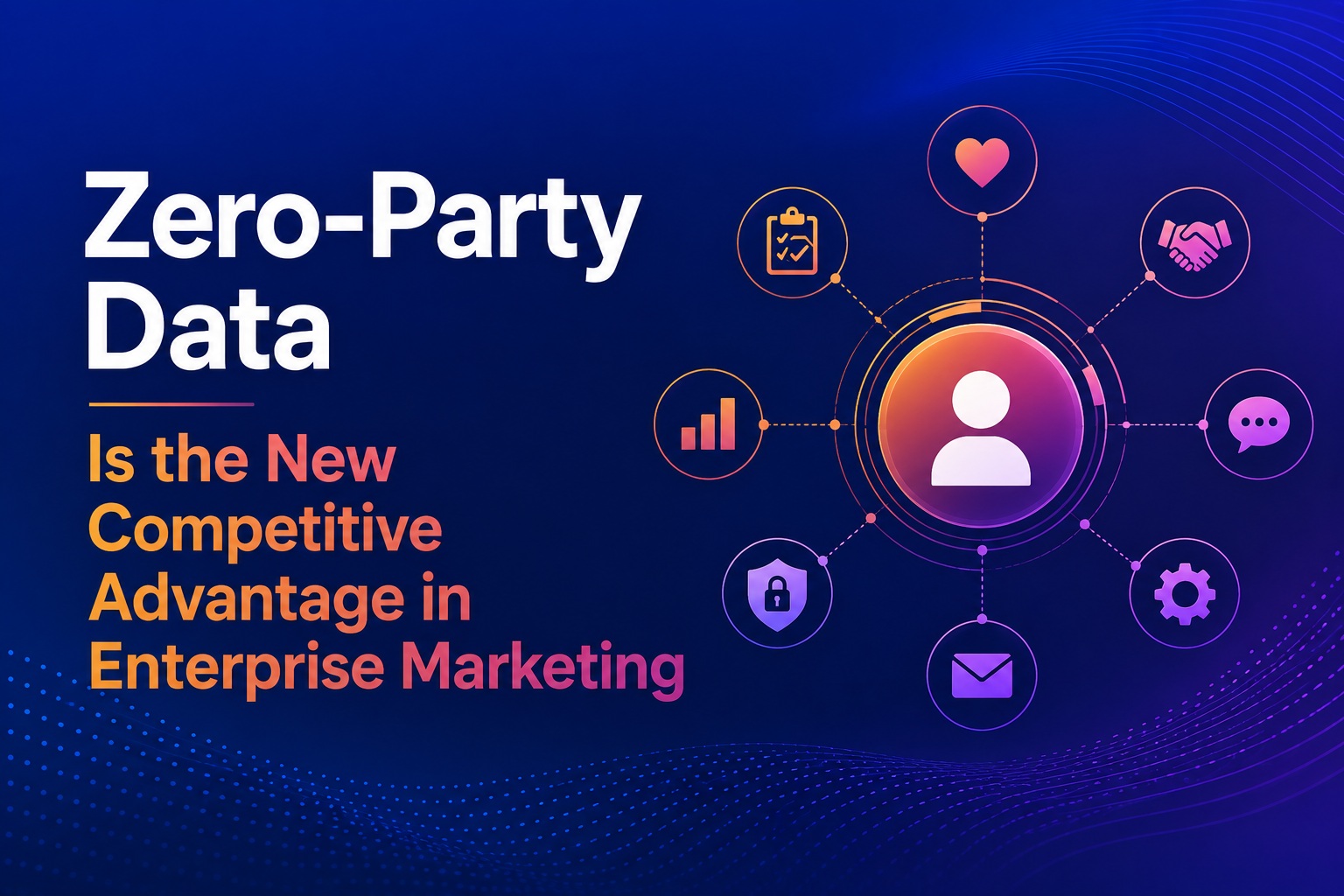
This shift has accelerated the rise of Zero-Party Data in Enterprise Marketing, a strategy that is rapidly redefining how B2B organizations create personalized customer experiences. Instead of relying on inferred customer behavior, businesses are embracing customer-declared intelligence to deliver AI-powered marketing experiences that respect privacy while driving stronger engagement and long-term growth.
What Is Zero-Party Data in Enterprise Marketing?
Unlike first-party data, which is observed through customer interactions, or third-party data, which is acquired from external providers, zero-party data consists of information that customers intentionally and proactively share with an organization. This includes business priorities, purchasing timelines, product preferences, technology environments, budget expectations, communication preferences, implementation challenges, future investment plans, and strategic objectives that buyers willingly disclose because they expect meaningful value in return.
Rather than inferring customer intent through behavioral analysis, organizations receive direct insights from customers themselves. In today’s privacy-first marketing environment, this approach has become one of the most valuable assets for enterprise businesses seeking to build trust while delivering highly personalized customer experiences.
In the B2B environment, where purchasing decisions involve multiple stakeholders, extended buying cycles, and significant financial commitments, this transparency creates a fundamentally stronger foundation for relationship building. Instead of relying on assumptions generated by algorithms, enterprise marketers gain access to explicit customer intelligence that enables more relevant engagement while simultaneously strengthening confidence in the brand.
” Zero-Party Data in Enterprise Marketing sta trasformando il modo in cui le aziende B2B creano esperienze personalizzate, basate sulla fiducia e sulla trasparenza. Grazie ai dati condivisi volontariamente dai clienti, le imprese possono migliorare la personalizzazione, rafforzare le relazioni con i clienti e sviluppare strategie di marketing più efficaci senza dipendere dal tracciamento di terze parti.”
Why Modern B2B Buyers Prefer Privacy-First Marketing –
The growing importance of zero-party data is closely connected to the transformation of enterprise buying behavior. Modern B2B buyers conduct extensive independent research before engaging with vendors. Decision-makers consume analyst reports, compare software platforms, evaluate peer recommendations, interact with AI-powered search engines, attend webinars, explore product demonstrations, and consult professional communities long before submitting an inquiry.
During this process, buyers expect organizations to respect their privacy while still delivering highly personalized experiences. This creates a significant challenge for marketers who can no longer depend on extensive third-party tracking to understand customer interests.
Zero-party data provides a practical solution by encouraging organizations to create valuable interactions that motivate buyers to voluntarily share information. Every preference submitted through an assessment, every strategic objective discussed during a consultation, and every technology requirement shared through an interactive experience becomes a trusted data point that supports future engagement without compromising customer confidence.
How AI-Powered Marketing Maximizes the Value of Zero-Party Data –
Artificial intelligence is significantly accelerating the value of zero-party data by transforming isolated customer inputs into dynamic enterprise intelligence. Historically, organizations collected customer preferences through static forms, surveys, or registration pages that were rarely updated after initial submission.
Today, AI continuously enriches this information by identifying relationships between customer responses, previous interactions, industry trends, organizational characteristics, product usage patterns, and buying signals. Rather than treating each customer input as an isolated record, intelligent systems build evolving customer profiles that improve with every interaction.
| Data Type | How It Is Collected | Marketing Value |
|---|---|---|
| Zero-Party Data | Customers voluntarily share preferences, goals, and needs | Enables personalized, trust-based marketing |
| First-Party Data | Collected from customer interactions and behaviors | Helps understand customer engagement |
| Third-Party Data | Purchased from external data providers | Provides broader audience insights but faces privacy limitations |
Interactive Digital Experiences That Collect High-Quality Zero-Party Data –
The emergence of interactive digital experiences has significantly expanded opportunities for collecting meaningful zero-party data. Traditional lead generation strategies often relied on downloadable whitepapers or gated reports that captured only basic contact information while providing minimal insight into buyer intent.
Modern enterprise marketing is increasingly centered around value-driven interactions such as maturity assessments, technology readiness evaluations, ROI calculators, benchmarking tools, diagnostic questionnaires, implementation planners, interactive product configurators, and AI-powered advisory experiences.
Improving Marketing Attribution with Zero-Party Data –
Another significant advantage of zero-party data lies in improving marketing measurement and attribution. One of the greatest challenges facing enterprise marketers has been accurately determining which activities genuinely influence purchasing decisions. As privacy regulations reduce visibility into customer behavior across multiple digital channels, attribution models have become increasingly complex and often less reliable.
Zero-party data introduces an alternative perspective by allowing organizations to measure marketing effectiveness based on directly communicated customer intentions rather than purely behavioral observations. Understanding why buyers engage with content, which business challenges they are attempting to solve, and what outcomes they prioritize provides richer insights than simply tracking clicks, page views, or downloads.
Enhancing Customer Experience with Customer-Declared Data-
Customer experience improves substantially when organizations prioritize zero-party data strategies. One of the most common frustrations among enterprise buyers is receiving generic communications that fail to reflect their actual needs despite multiple interactions with a vendor. This disconnect often results from fragmented behavioral data that provides only limited context regarding customer intent.
Building Customer Trust Through Privacy-First Marketing –
The growing importance of zero-party data is encouraging enterprises to rethink the role of trust as a strategic business asset. Privacy has evolved from being a legal compliance requirement into a competitive differentiator that directly influences customer relationships and brand loyalty.
Organizations that clearly explain how customer information will be collected, stored, and used—and consistently deliver value in exchange for that information—establish stronger long-term credibility. Buyers increasingly reward businesses that demonstrate transparency while delivering personalized experiences based on consent rather than surveillance.
Customer Data Platforms (CDPs): Powering Enterprise Customer Data Strategy –
Technology platforms are evolving rapidly to support the transition toward customer-declared intelligence. Modern Customer Data Platforms (CDPs) are no longer designed solely to consolidate behavioral information from multiple systems. Instead, they function as intelligent preference management ecosystems that continuously organize, validate, update, and activate zero-party data across marketing, sales, customer success, and service operations.
Conclusion:
Looking ahead, Zero-Party Data in Enterprise Marketing is poised to become one of the most valuable strategic assets for organizations embracing AI-powered marketing and digital transformation. The businesses that succeed in the years ahead will not necessarily be those with the largest customer databases or the most sophisticated tracking technologies. Instead, competitive advantage will belong to organizations that consistently create enough value for customers to willingly share meaningful information, transforming every interaction into an opportunity for deeper understanding and stronger collaboration.
Ultimately, Zero-Party Data in Enterprise Marketing represents far more than a response to changing regulations—it marks a fundamental shift toward trust-based customer engagement. Organizations that prioritize transparency, mutual value creation, and AI-driven personalization will be best positioned to strengthen customer relationships, improve business outcomes, and achieve sustainable growth in the rapidly evolving digital economy.