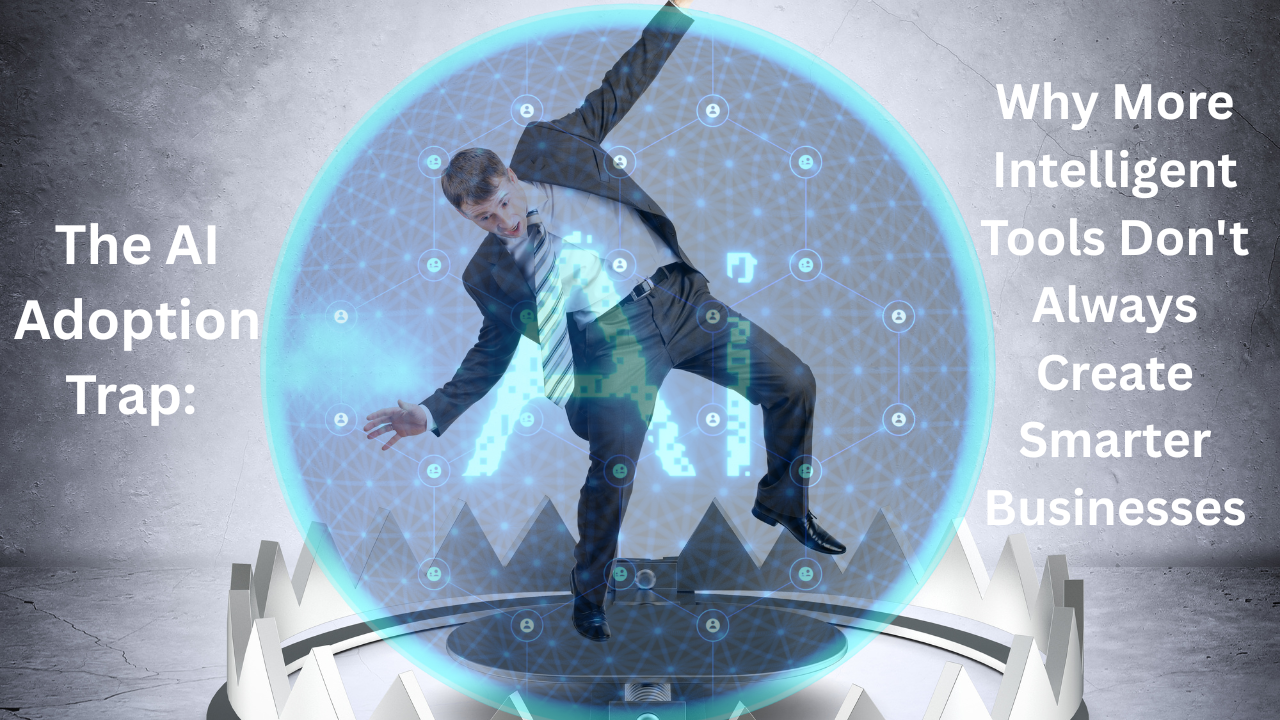
AI adoption trap is a growing challenge for businesses investing in artificial intelligence without achieving meaningful improvements in productivity, decision-making, or profitability. As organizations across industries embrace AI-powered applications, the temptation to automate more tasks and deploy more advanced models continues to grow. Yet, access to better technology does not automatically translate into better business performance.Understanding the AI adoption trap is essential for businesses that want to turn technology investments into measurable improvements in operational efficiency and long-term competitiveness.
Artificial intelligence has become one of the most discussed business investments of the decade, with organizations across industries exploring how intelligent tools can improve productivity, accelerate decisions, reduce repetitive work, and create new opportunities for growth. From generating marketing content and analysing customer data to automating administrative tasks and supporting complex operational workflows, AI is increasingly being introduced into everyday business activities.
The appeal is understandable: when a technology can complete in minutes what previously took hours, it seems reasonable to expect that adopting more of it will automatically make an organization more efficient and competitive. Yet, a growing challenge is emerging as businesses move from experimenting with individual tools to integrating AI into their wider operations. Companies may have access to more advanced models, larger technology budgets, and an expanding collection of AI-powered applications without experiencing a corresponding improvement in business performance.
Employees may generate reports faster while spending additional time verifying their accuracy, marketing teams may produce more content without attracting more qualified buyers, and sales teams may automate prospect research without improving conversion rates. The technology is working in the narrow sense that it performs the tasks assigned to it, but the organization is not necessarily becoming more effective.
This reveals an important distinction that businesses need to recognize before expanding their AI investments: adopting artificial intelligence is not the same as building an intelligent business. The real advantage comes from understanding where AI can improve the way work gets done, how its output connects to meaningful decisions, and what needs to change across the organization for its capabilities to produce measurable results.
How to Avoid the AI Adoption Trap by Redesigning Business Processes
One of the main reasons AI adoption fails to deliver its expected value is that businesses often introduce new tools into existing processes without questioning whether those processes should exist in their current form. An organization might use AI to prepare reports more quickly, for example, while continuing to collect unnecessary information, follow outdated approval procedures, and distribute reports that few people actually use.
The report is now generated faster, but the underlying process remains inefficient. Similarly, a marketing team might use AI to produce several versions of every campaign asset while retaining an approval structure that delays publication for weeks. A sales team might automate the preparation of prospect lists while continuing to target companies that are unlikely to need its services. In each case, AI increases the speed or volume of activity without addressing the problem that limits performance. This is what makes technology adoption deceptively attractive: visible improvements in individual tasks can create the impression of transformation even when the wider workflow remains unchanged.
Businesses need to look beyond the task being automated and examine the complete journey from the initial requirement to the final outcome. Before introducing AI, leaders should ask why a task is performed, who depends on its output, which steps create value, where delays occur, and whether some activities could be eliminated altogether. Sometimes the most effective application of AI is not to make an inefficient process faster, but to help redesign that process so that unnecessary work disappears. Technology becomes valuable when it improves the operating model rather than simply adding another layer to it.
Escape the AI Adoption Trap by Measuring Business Value
Another challenge is that organizations frequently measure AI adoption through usage rather than business impact. The number of employees using an AI assistant, the number of tasks automated, the quantity of content generated, and the hours reportedly saved can all be useful indicators of activity. However, none of them independently proves that the investment has improved business performance. A company may have hundreds of employees using AI every week while still struggling with delayed decisions, inconsistent customer experiences, or rising operational costs.
A content team might double its publishing output without improving the relevance of its material, while an analytics team might generate more dashboards without helping leadership make better decisions. The problem arises when the presence of technology becomes the measure of success instead of the outcomes the technology was intended to improve. Businesses should begin every significant AI initiative with a clearly defined operational or commercial objective. If the purpose is to improve customer support, the organization should examine resolution quality, response times, repeat complaints, and customer satisfaction.
If the objective is to support sales, it should measure whether the system improves account prioritization, the quality of conversations, or progression through the sales pipeline. If AI is intended to improve internal productivity, leaders should evaluate the time required to complete work, the amount of rework generated, and whether employees can devote more attention to valuable responsibilities. These measures provide a more meaningful picture of success than adoption statistics alone. The central question should always be whether the business is performing better because AI has been introduced, not simply whether more employees are using it.
Data quality presents another significant barrier because intelligent tools can only produce useful results when they have access to information that is relevant, sufficiently accurate, and appropriate for the task. Many organizations have accumulated years of data across disconnected systems, spreadsheets, customer relationship management platforms, shared drives, enterprise applications, and individual employee records.
Information may be duplicated, outdated, inconsistently labelled, or stored in formats that make it difficult to interpret. Different departments may even maintain conflicting versions of the same business information because they have developed separate processes and systems. When AI is introduced into this environment, it does not automatically resolve those inconsistencies. Instead, it may retrieve information from several sources and produce an answer that appears coherent while relying on records that should not be treated as equally reliable.
An AI-powered sales assistant, for instance, may recommend contacting an account based on an old opportunity record, while a customer support tool may generate an answer using a document that no longer reflects the current policy. These problems are especially difficult to detect because AI-generated output can appear polished and confident even when the underlying information is incomplete. Businesses therefore need to treat data readiness as an essential part of AI adoption rather than an unrelated technical project.
This includes identifying authoritative information sources, assigning responsibility for maintaining important records, improving consistency across systems, and establishing rules for handling missing or conflicting information. It also requires recognizing that not every AI initiative needs access to every available dataset. A focused application built around reliable, relevant information may deliver better results than a more sophisticated system connected to a large but poorly managed collection of data.Poor data governance can deepen the AI adoption trap by producing unreliable outputs that undermine employee confidence and weaken business decisions.
The human element is equally important, yet it is often underestimated when companies introduce AI into the workplace. Leaders may assume that employees will naturally adopt a new tool because it promises to make their jobs easier, but the reality is more complicated. Some employees may not understand how to use the technology effectively, others may distrust its output, and some may feel uncertain about how their responsibilities will change.
Even enthusiastic users can struggle when an AI tool is introduced without clear guidance on which tasks it should handle, when its recommendations should be questioned, or how its output should be incorporated into existing workflows. A salesperson who uses AI to prepare an account summary still needs to know how to evaluate the quality of the research. A marketer who generates campaign content must understand the audience, brand positioning, and commercial objective well enough to recognize when the output is generic or inaccurate. An analyst who receives an AI-generated recommendation needs the judgment to examine its assumptions before presenting it to leadership.
Without these capabilities, employees may either accept the technology’s output too readily or avoid using it for tasks where it could be genuinely helpful. Effective adoption requires more than access to software. Employees need practical training, clear expectations, opportunities to experiment, and an understanding of the limits of the systems they are using. Organizations should also involve employees in the design of AI-enabled workflows because the people who perform a task every day often understand its exceptions, dependencies, and practical challenges better than anyone else. When employees help shape the process, AI is more likely to become a useful part of their work rather than another disconnected tool they are expected to accommodate.
The problem becomes even more pronounced when departments adopt AI independently. Marketing may select one platform for content creation, sales may implement another for prospect research, customer support may introduce an automated assistant, and IT may develop internal tools for technical operations. Each initiative might solve a legitimate problem, but without coordination, the organization can end up with overlapping subscriptions, inconsistent security practices, disconnected information, and several systems attempting to perform similar functions.
Employees may need to switch between applications, manually transfer information, and verify outputs because the tools do not share a consistent understanding of the business. Instead of simplifying operations, the expanding technology environment can introduce new forms of complexity. This does not mean every organization needs to centralize every AI decision or restrict departments from testing new solutions. Different teams have different requirements, and local experimentation can reveal opportunities that a central technology team might overlook. However, businesses need shared principles for evaluating tools, protecting information, managing access, and measuring outcomes.
They should understand which AI applications are already available, where capabilities overlap, how information moves between systems, and who is accountable for each implementation. A coordinated approach can help organizations reuse successful solutions, avoid unnecessary expenditure, and maintain visibility over the risks associated with AI. The objective is to create an environment where departments can innovate without creating a collection of disconnected systems that undermine the very efficiency they were meant to improve.
There is also a tendency to treat AI as a universal solution when different business problems require different approaches. Some tasks involve interpreting unstructured information, recognizing patterns, generating language, or working with complex and changing inputs. These are areas where AI may offer meaningful advantages. Other tasks follow stable rules, involve predictable calculations, or require the consistent execution of a predefined sequence.
For those activities, conventional software, database queries, or straightforward automation may be more reliable, easier to maintain, and less expensive. A business that introduces a large language model into every workflow may increase complexity without gaining much additional capability. For example, a simple process that routes invoices according to fixed criteria may not need a generative AI system, whereas reviewing an unstructured supplier document for unusual clauses might benefit from AI-assisted analysis combined with human review. The appropriate solution depends on the nature of the task, the consequences of an error, the quality of the available information, and the resources required to maintain the system. This is why technology selection should follow problem definition rather than precede it.
Instead of asking which AI tool the company should purchase next, leaders should ask which business constraint they are trying to remove and which approach is best suited to removing it. Sometimes the answer will be AI, sometimes it will be better data or a redesigned workflow, and sometimes it will be a combination of technologies and human expertise. The ability to make that distinction is itself an important part of becoming a more intelligent organization.Businesses can avoid the AI adoption trap by selecting technology according to the task, the desired business outcome, and the risks associated with errors.
How Businesses Can Overcome the AI Adoption Trap
Responsible AI adoption also requires businesses to understand the difference between faster output and better decisions. AI can summarize large amounts of information, identify patterns that might otherwise go unnoticed, and generate recommendations that help employees evaluate possible courses of action. However, the usefulness of a recommendation depends on the quality of its assumptions, the context in which it is applied, and the consequences of acting on it. An AI system may identify a promising sales opportunity based on historical patterns without recognizing a recent change in the customer’s business.
It may recommend a marketing approach that performed well in the past but no longer reflects the audience’s expectations. It may produce an operational forecast that appears reasonable while overlooking a significant change in market conditions. These limitations make human judgment and accountability essential, particularly when decisions affect finances, customers, employees, or long-term strategy. Businesses should establish clear boundaries around what AI systems can do independently, which outputs require verification, and which decisions must remain under human authority. They should also test AI systems against realistic scenarios, monitor performance after deployment, and create a process for correcting errors when they occur.
Trust should be built through evidence of consistent performance rather than assumptions that an advanced model must be reliable because it appears intelligent. The most effective organizations will not necessarily be those that allow AI to make the greatest number of decisions independently. They will be those that understand where automation is appropriate, where oversight creates value, and how to combine machine capabilities with human expertise.
Ultimately, overcoming the AI adoption trap requires businesses to rethink how they evaluate technological progress and connect artificial intelligence investments with measurable business outcomes. The objective should not be to introduce the largest number of tools, automate the highest percentage of tasks, or generate the greatest volume of output. It should be to create an organization that can use information more effectively, make better decisions, respond to customers more intelligently, and improve its performance without introducing unnecessary complexity or risk.
Achieving this requires leaders to define clear business objectives, evaluate existing processes before automating them, improve the quality of relevant data, prepare employees for changing responsibilities, and establish a consistent way to measure results. It also requires a willingness to stop or redesign initiatives that do not deliver the expected value, even when the technology itself appears impressive. Businesses that approach AI as a collection of products may find themselves continually chasing new capabilities without developing a sustainable advantage.
Those that approach it as an opportunity to rethink how work gets done can build systems that are more useful, accountable, and commercially effective. AI adoption should therefore be viewed as an ongoing organizational capability rather than a one-time technology purchase. The businesses that benefit most from AI will not simply be the ones with the smartest tools. They will be the ones that know how to turn those tools into better work, stronger decisions, and measurable business outcomes.