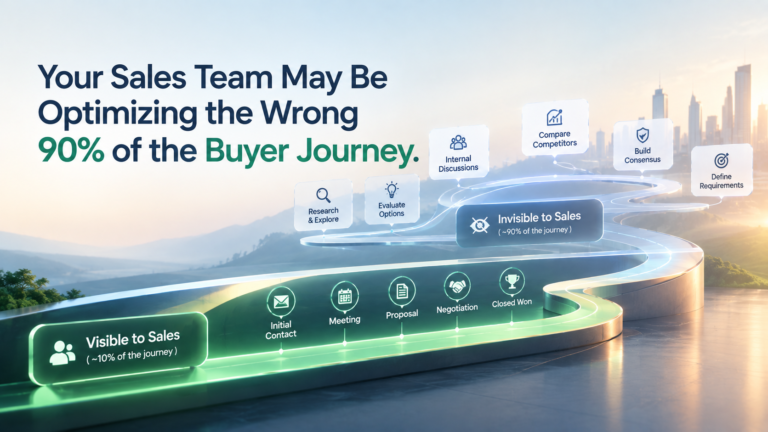


B2B invisible research is changing how companies understand the modern buying journey. For years, B2B organizations have relied on visible indicators of buyer intent: an e-book download, contact-form submission, pricing-page visit, webinar registration, or product demonstration. These actions are easy to capture, score, and transfer from marketing to sales.
But an increasing amount of B2B research now happens outside those measurable touchpoints. Buyers compare vendors privately, consult colleagues, read customer experiences, watch demonstrations, participate in industry conversations, and use AI tools to answer questions before they ever identify themselves to a company.
The result is a growing gap between what businesses can see and what potential buyers are actually doing. A prospect can become highly informed without becoming highly visible. By the time that prospect finally enters a CRM, much of the difficult evaluation may already be complete.
What Is B2B Invisible Research?
B2B invisible research refers to the research and evaluation activity buyers conduct without directly identifying themselves to a vendor or generating conventional marketing signals.
A buyer might spend weeks investigating a technology category, discussing potential solutions internally, asking peers for recommendations, reviewing customer experiences, or using AI to understand competing approaches. None of these activities necessarily produces a form submission or identifiable website session.
By the time the buyer contacts a vendor, the conversation may already be well advanced. They may already understand:
- The business problem they are trying to solve
- The technology categories available to them
- The vendors they want to evaluate
- The questions they need answered
- The implementation challenges they need to consider
- The internal justification required to move forward
From the seller’s perspective, the prospect may appear to have arrived suddenly. From the buyer’s perspective, the interaction may be the result of weeks or months of research.
The B2B Buyer Journey Is Becoming Less Visible –
The traditional B2B funnel is built around observable actions. A prospect visits a website, downloads content, submits a form, speaks with sales, and eventually becomes an opportunity.
Modern buying behavior is more complicated.
Buyers can now gather information through LinkedIn, industry newsletters, Reddit discussions, analyst research, YouTube, podcasts, private communities, peer networks, customer reviews, and AI-powered tools. Much of this activity occurs outside a vendor’s owned channels.
This means a company’s CRM may capture only a fraction of the buyer’s actual journey.
The implications are significant:
- A known lead may already be far along in its evaluation.
- An apparently inactive account may already be researching a solution.
- A content download does not necessarily indicate purchase readiness.
- A website visit does not reveal everything that influenced the buyer beforehand.
The measurable journey is therefore not necessarily the complete journey.
AI Is Accelerating Invisible B2B Research –
AI is adding another layer to this shift.
Instead of manually searching dozens of websites, buyers can ask AI systems to explain unfamiliar technologies, summarize competing approaches, identify implementation challenges, generate questions for vendors, or organize information about potential solutions.
This can compress a significant amount of traditional research into a much shorter period.
More importantly, it can happen before the buyer ever interacts with a vendor.
Imagine a technology buyer evaluating an enterprise platform. Before speaking with sales, they might use AI to understand the category, identify common integration issues, compare approaches, and create a shortlist of questions.
When that buyer eventually requests a meeting, the salesperson is not starting the education process from zero. The buyer may already have a framework for evaluating the solution.
That changes the role of the sales conversation.
Attribution Is Becoming Increasingly Incomplete –
Invisible research creates a difficult attribution problem.
Suppose a prospect researches a technology solution for six weeks and contacts a vendor in week seven. What caused the inquiry?
It could have been:
- A recommendation from a colleague
- An industry expert’s post
- A customer review
- An external comparison
- An AI-generated explanation
- A conversation with another vendor
- A piece of content published months earlier
There may be no single answer.
B2B buying decisions are often cumulative. Multiple pieces of information gradually reduce uncertainty until the buyer becomes comfortable taking the next step.
Traditional attribution systems are useful for understanding measurable interactions, but they cannot necessarily capture everything that influenced a buyer before the buyer became identifiable.
That distinction matters because organizations can otherwise overestimate the importance of easily measurable channels while underestimating activities that influence demand outside their owned properties.
Buyer Intent Signals Need More Context –
Visible engagement can be useful, but engagement is not synonymous with readiness.
An account that downloads several assets may simply be exploring a topic. Another account that shows little measurable activity may already have a project approved internally and could be researching through channels the vendor cannot see.
The more useful question is therefore not simply:
“What did the prospect do?”
It is:
“What might this activity mean in context?”
Contextual signals can make behavioral information more meaningful. For example, organizations may consider whether there have been relevant changes such as:
- A new executive joining the company
- Business expansion
- A technology transformation
- A strategic announcement
- A change in hiring patterns
- A new regulatory requirement
- Multiple employees from the same account becoming active
The objective is not to create a perfect prediction from every signal. It is to understand patterns that may indicate a developing business need.
B2B Content Must Support Research, Not Just Lead Generation –
B2B invisible research also changes the role of content.
If buyers are researching independently before speaking with sales, content needs to support much more than lead capture. It needs to help buyers understand problems, evaluate approaches, identify risks, compare alternatives, and build an internal business case.
Promotional content alone cannot perform all of these jobs.
Effective B2B content can address questions such as:
- What problem does this technology actually solve?
- What are the available approaches?
- What are the trade-offs?
- What implementation challenges should buyers anticipate?
- Which organizational requirements need to be considered?
- How should different solutions be evaluated?
- What questions should a buying team ask vendors?
This is particularly important in enterprise technology, where buyers often need substantial information before they are comfortable engaging with sales.
The Real Buyer Is Often a Buying Committee –
Complex B2B purchases rarely involve only one person.
A technical stakeholder may investigate integration requirements. A finance stakeholder may evaluate the investment. An operations leader may focus on workflow and adoption. A senior executive may consider strategic implications.
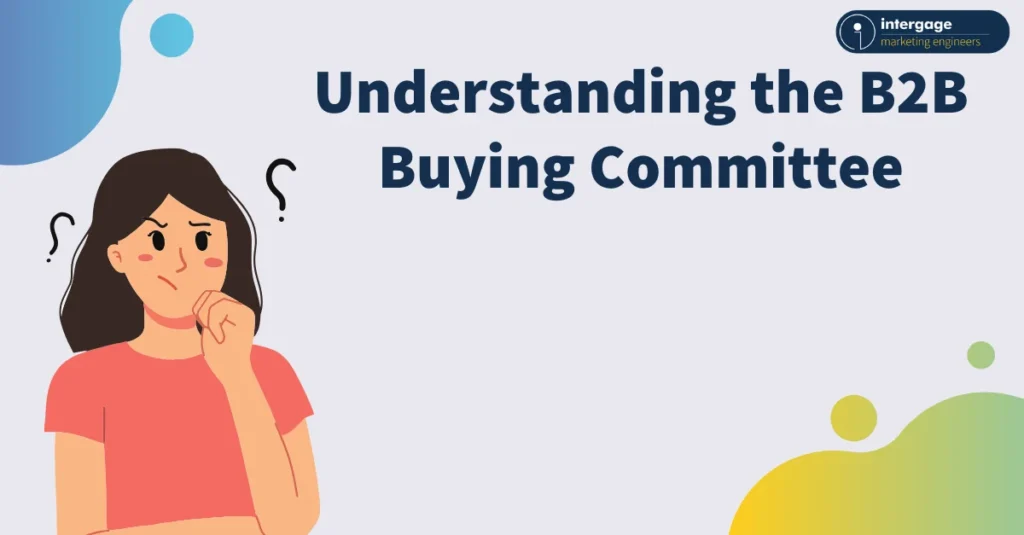
Every Buyer Journey Has Multiple Stakeholders
The person answering the call may not be the person making the decision. AI helps you understand the broader buying group and keep every interaction moving.
Each stakeholder can conduct research independently.
That means the marketing team may see one person while the actual buying group includes several people whose research remains invisible.
B2B content therefore needs to serve the broader buying group.
For example:
Technical stakeholders :
They may need implementation details, architecture information, security considerations, integrations, and technical requirements.
Financial stakeholders :
They may need information that helps them understand costs, business value, risk, and investment justification.
Business leaders :
They may care about strategic implications, operational impact, scalability, and organizational outcomes.
Operations teams :
They may focus on workflows, adoption, deployment, and how a solution fits into existing processes.
When content addresses these different perspectives, it becomes easier for buyers to evaluate a solution internally and communicate its value to other stakeholders.
Salespeople Need to Become Research Interpreters –
Invisible research is also changing the role of sales.
The salesperson may enter the buying journey after the prospect has already consumed significant amounts of information. Repeating basic product information is therefore unlikely to be enough.
The salesperson’s value can increasingly come from providing context and judgment.
That might involve:
- Explaining how a solution works in real-world situations
- Clarifying trade-offs between different approaches
- Discussing implementation realities
- Identifying questions the buying team may have overlooked
- Sharing relevant patterns from similar business situations
- Helping buyers understand which considerations actually matter
In an environment where information is abundant, useful judgment can become more valuable than simply providing more information.
Why “No Lead” Does Not Always Mean “No Demand”
The concept of a lead has traditionally been tied to an identifiable action.
Someone fills out a form. Someone downloads an asset. Someone books a meeting.
But demand can exist before any of these events.
A company may have a significant business need while having no identifiable contact in the CRM. Several employees may be researching the same problem without completing a form. The buying committee may even be discussing the issue internally before visiting a vendor’s website.
This does not mean businesses should attempt to track every anonymous visitor or treat every interaction as buying intent.
That approach can create enormous amounts of data without meaningful insight.
The more useful strategy is to identify relevant patterns and combine behavioral information with business context.
From Activity-Based Thinking to Signal-Based Thinking –
One of the biggest strategic shifts for B2B organizations is moving from activity-based thinking toward signal-based thinking.
Activity-based thinking asks:
“What did the prospect do?”
Signal-based thinking asks:
“What might this behavior mean?”
The difference is important.
A hundred content downloads from unrelated organizations may have limited commercial relevance. A smaller cluster of relevant activity from an account experiencing a significant business change could provide more meaningful context.
The objective is not to abandon metrics. It is to interpret metrics more intelligently.
Website behavior provides another example.
A prospect visiting a pricing page may indicate interest. But so might someone who repeatedly returns to implementation content, explores industry-specific case studies, and spends time evaluating technical information.
Different behaviors can represent different stages of thinking.
The challenge is to understand those patterns without pretending that every action can be translated into a precise buying score.
Brand Credibility Matters More When Research Happens Privately –
Invisible research is not only a measurement problem. It is also a brand challenge.
When buyers conduct research independently, they encounter a company across many different environments.
They might find:
- An executive’s LinkedIn post
- An industry discussion
- A customer interview
- An external review
- A technical article
- A podcast appearance
- An older piece of company content
- A recommendation from a peer
The website is no longer the entire storefront.
The broader digital footprint becomes part of the buying experience.
Consistency therefore matters. If a company presents sophisticated ideas on its website but provides shallow information elsewhere, buyers may notice the difference. Similarly, unsupported claims can create uncertainty for research-oriented buyers looking for evidence.
Customer stories, practical explanations, technical resources, and credible perspectives can help buyers evaluate whether a company deserves to remain on their shortlist.
What B2B Companies Should Do Next –
The rise of invisible research does not mean companies should abandon lead generation, attribution, or CRM systems. Those tools remain important.
Instead, organizations should recognize that visible activity represents only one part of the buying journey.
A more complete B2B sales and marketing approach can focus on several areas:
- Create research-first content: Answer the difficult questions buyers investigate before contacting sales.
- Support multiple stakeholders: Build resources for technical, financial, operational, and executive audiences.
- Use contextual signals: Interpret engagement alongside relevant business events and account-level changes.
- Strengthen the digital footprint: Treat external channels and third-party conversations as part of the broader buying experience.
- Equip sales with context: Give sales teams information and insights that help them understand where buyers may already be in their evaluation.
- Measure what is measurable without assuming it is everything: CRM and analytics data remain valuable, but their limitations should be understood.
- Build credibility before the sales conversation: Make useful, evidence-based information available before a buyer becomes identifiable.
The goal is not to make the invisible visible at any cost.
The goal is to become useful during the invisible part of the journey.
The Future of B2B Sales Is Less About Capturing Every Buyer –
The traditional B2B model often assumes that the primary objective is to identify prospects as early as possible.
But modern buyers increasingly prefer to learn before they engage.
They want to understand the problem before discussing solutions. They want to compare options before speaking with vendors. They want to validate their assumptions before entering a sales conversation.
AI is accelerating this behavior by making independent research faster and easier.
As a result, the first visible interaction with a buyer may happen much later in the decision process than it once did.
That means B2B companies need to rethink what happens before the lead.
The question is no longer simply whether a company can generate a measurable interaction. It is whether the company has provided enough value, evidence, context, and expertise to remain relevant when the buyer finally becomes visible.
Conclusion –
B2B invisible research is changing the relationship between buyers, marketers, and sales teams.
The most important part of a buying journey may happen before a prospect submits a form, books a meeting, or enters a CRM. Buyers can research independently, consult peers, compare solutions, consume content, and use AI to build knowledge without directly revealing themselves to the vendors they are evaluating.
For B2B organizations, this means visible engagement should not be treated as the complete picture of demand. The stronger approach is to combine observable behavior with business context, create content that supports genuine research, address the needs of entire buying committees, and equip sales teams to provide insight rather than simply repeat information.
Frequently Asked Questions
B2B invisible research refers to research activity that buyers conduct without directly identifying themselves to a vendor. This can include peer conversations, online discussions, customer reviews, industry content, private communities, and AI-assisted research.
It highlights a gap between measurable engagement and actual buyer activity. A prospect may conduct extensive research before becoming visible to a sales or marketing team, meaning the first recorded interaction may occur much later in the buying journey.
AI can help buyers understand unfamiliar technologies, compare approaches, identify implementation challenges, and prepare questions for vendors. This can make independent research faster and potentially reduce the amount of direct vendor interaction during the early stages of evaluation.
No. Attribution tools can still provide useful information about measurable interactions. However, they may not capture every influence that shaped a buyer’s decision before the buyer became identifiable.
Useful signals can include patterns of engagement, activity from multiple employees at an account, and relevant business events such as organizational changes, strategic initiatives, expansion, or technology changes. Individual actions should be interpreted in context rather than treated as definitive proof of buying intent.