The B2B competitive landscape has traditionally been relatively easy to define. Companies know which vendors appear in the same RFPs, target similar accounts, compete for the same budgets, and rank for similar keywords. Marketing teams build competitive matrices, sales teams study competitor positioning, and leadership teams monitor changes in market share and brand perception.
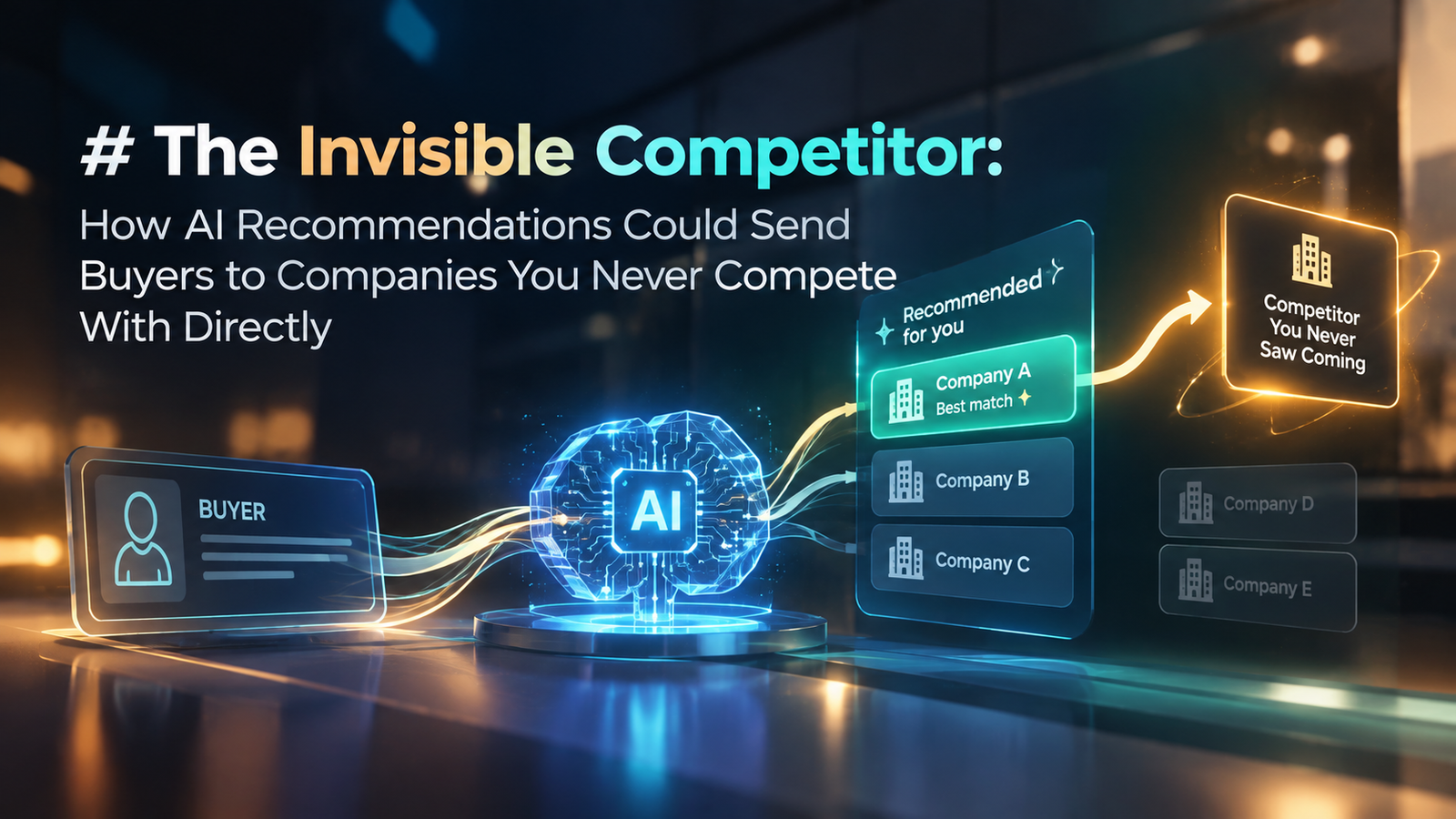
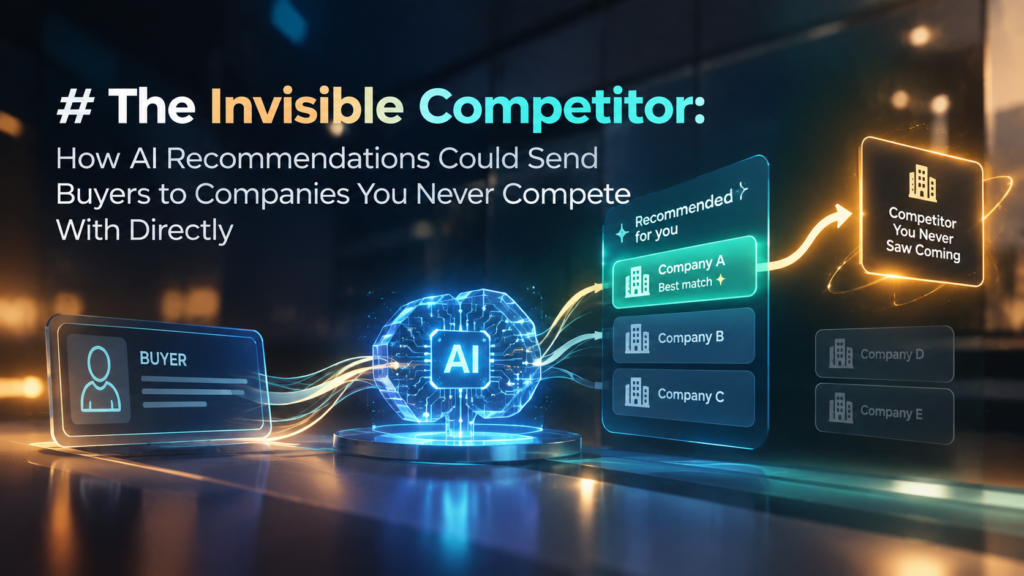
But AI recommendations are introducing a different kind of competitor—one that may not appear in any conventional competitor report. The next company that takes a potential customer away may not be a business you have ever considered a direct competitor. It may be a company an AI system recommends because its product, expertise, customer evidence, pricing, integrations, or digital presence appears to better match the buyer’s requirements.
This is the rise of the invisible competitor: a company that enters the buying journey not because it directly challenged your brand, but because an intelligent system determined that it was relevant enough to put in front of the buyer. As AI becomes increasingly involved in B2B discovery, companies need to reconsider not only who they compete against, but also how competitors enter the consideration set in the first place.
How AI Recommendations Are Changing B2B Discovery –
For years, the digital B2B buying journey followed a relatively predictable pattern. A buyer identified a problem, entered a query into a search engine, reviewed websites and articles, compared vendors, and eventually contacted a shortlist of companies.
This model shaped modern B2B marketing. Companies optimized websites and content around keywords, search rankings, clicks, impressions, and conversions. Visibility largely meant appearing where buyers were searching.
AI recommendations change the discovery layer.
Instead of manually reviewing dozens of websites, a buyer can increasingly describe a business problem to an AI system and ask it to identify appropriate solutions. The question may include company size, technology requirements, industry, compliance considerations, budget constraints, implementation timelines, or integration needs.
The resulting recommendation is fundamentally different from a traditional search result. Rather than simply providing links, an AI system can interpret the request and synthesize information about potential providers.
For B2B companies, this means visibility is no longer limited to ranking on a search engine.
It increasingly involves becoming a company that intelligent systems can understand, evaluate, and recommend.
The shift from search visibility to recommendation visibility :
Traditional digital marketing has emphasized metrics such as:
- Search rankings and organic traffic
- Website visits and content engagement
- Paid advertising impressions and clicks
- Form submissions and marketing-qualified leads
- Brand awareness and direct searches
AI-mediated discovery introduces another question:
Does the information available about your company make it easy for an AI system to recognize when your business is relevant?
That is a different optimization problem.
The Invisible Competitor May Not Look Like a Traditional Competitor –
One of the biggest implications of AI-driven recommendations is that the competitive set can expand beyond the companies a business normally monitors.
Imagine an enterprise software company that has spent years tracking five established competitors. Its marketing team follows their campaigns, product launches, pricing changes, and positioning.
Then a prospective customer asks an AI system for the best solution for a very specific business problem.
The AI recommends a sixth company.
That company might be:
- Smaller than the established vendors
- Newer to the market
- Positioned in an adjacent technology category
- Specialized in a particular use case
- Better integrated with the buyer’s existing technology
- More aligned with the buyer’s implementation requirements
- Better suited to the buyer’s specific business context
From the perspective of the company’s traditional competitive analysis, that sixth vendor may have been invisible.

From the buyer relevance. It was invisible because the organization had been using a narrow platform may add marketing automation, analytics, and AI capabilities. A cybersecurity provider may expand into identity management and compliance. A data platform may introduce workflow automation.
The competitor was not necessarily invisible because the company lacked competitive relevance. It was invisible because the organization had been using a narrow definition of competition.
AI Recommendations Can Blur Traditional Technology Categories –
This shift becomes particularly important as technology categories continue to overlap.
Modern technology companies increasingly offer capabilities that extend beyond their original categories. A CRM platform may add marketing automation, analytics, and AI capabilities. A cybersecurity provider may expand into identity management and compliance. A data platform may introduce workflow automation. A consulting organization may develop proprietary software.
As these boundaries become less rigid, AI systems can potentially evaluate providers based on the business problem they solve rather than the category companies use to describe themselves.
That creates a fundamental change in B2B competition.
Instead of asking:
Who sells the same product?
The buyer—or the AI helping the buyer—may effectively ask:
Who can solve this problem most effectively?
Problem-centric positioning becomes more important :
Consider a company that describes itself primarily as a demand-generation provider.
Its prospective customer, however, may not think in terms of “demand generation.” The actual problem might be:
- Improving qualified pipeline
- Increasing account engagement
- Reducing inefficient outreach
- Improving sales productivity
- Converting more target accounts
If another company describes its capabilities using these business outcomes more clearly, an AI system may find it easier to connect that provider with the buyer’s question.
The underlying services may be similar, but the may feel more comfortable adding it to a shortlist. Familiarity can reduce perceived uncertainty and digital positioning may not be.
That is why companies need to examine whether their digital identity reflects the terminology they use internally—or the problems their customers are actually trying to solve.
AI Recommendations Could Change the Role of Brand Awareness –
Brand recognition has traditionally played an important role in B2B consideration.
A buyer who recognizes a major enterprise technology brand may feel more comfortable adding it to a shortlist. Familiarity can reduce perceived uncertainty and make a vendor easier to consider.
AI systems, however, can evaluate information according to the context of a specific request.
A lesser-known company may become relevant when it provides particularly strong evidence for a specific use case. This does not make brand awareness irrelevant. Instead, it changes what digital brand strength can mean.
In an AI-mediated buying environment, a strong brand may increasingly need to be:
- Easy to understand
- Clearly differentiated
- Consistently represented online
- Supported by credible customer evidence
- Relevant to specific business problems
- Backed by accessible product and technical information
Being well known can create awareness.
Being understandable and verifiable can help create consideration.
Digital Information Quality Could Become a Competitive Advantage –
Many B2B companies have information distributed across a large digital ecosystem.
Product information might exist on the corporate website. Technical details may appear in documentation. Customer outcomes may live in case studies. Pricing information might be available only through sales. Reviews exist on third-party platforms, while older product descriptions remain on previously published pages.
This fragmentation can create problems.
A company may describe the same product differently across multiple pages. Product capabilities may change while older content remains online. Case studies may describe positive outcomes without providing enough context to understand the use case.
Human buyers can often resolve these inconsistencies by speaking with a salesperson.
AI systems do not have that same conversational relationship with every company’s internal team.
If information about a company is difficult to interpret, inconsistent, outdated, or incomplete, the organization may become harder to evaluate against another provider with clearer information.
Information consistency matters :
B2B organizations should therefore examine whether their digital information clearly communicates:
- What the company actually provides
- Which problems its products or services solve
- Who the ideal customer is
- Which industries or use cases it serves
- What integrations and technical capabilities exist
- What customer evidence supports its claims
- Where its solution may not be the right fit
This is not about publishing more content simply for the sake of increasing volume.
It is about making valuable information clear, credible, specific, and useful.
The Attribution Problem Behind AI-Mediated Buying –
There is another challenge that B2B marketing teams need to consider: attribution.
Traditional digital journeys generate measurable interactions. A buyer sees an advertisement, clicks a result, visits a website, downloads an asset, fills out a form, or contacts sales.

The buyer may simply arrive at a sales conversation already aware of the company.
There may be no identifiable campaign interaction that explains why the company entered the consideration set.
This creates a potential attribution blind spot.
Marketing teams could continue optimizing around measurable clicks and conversions while an increasingly important part of discovery happens through an intermediary they cannot directly observe.
AI Recommendations Make Competition More Contextual –
Another important characteristic of AI-mediated discovery is context.
Two buyers can ask essentially the same question and potentially receive different recommendations because their requirements are different.
One organization might prioritize integration with an existing enterprise platform. Another may prioritize implementation speed. A third might have specific data-residency requirements. Another could place greater emphasis on cost.
The relevant vendor set therefore changes with the problem.This makes the question “Who are our competitors?” more complicated.There may not be one universal competitive set.Instead, companies may need to understand their competitive position across multiple buyer contexts.
Competitive intelligence needs a broader lens –
For sales and marketing teams, this means competitive intelligence may need to move beyond tracking known competitors.
Organizations should also ask:
- Which companies appear relevant to our target use cases?
- Which adjacent categories could solve the same customer problem?
- What capabilities make those providers attractive?
- Where is our own positioning unclear?
- What customer evidence supports our relevance?
- What information might prevent buyers from understanding our differentiation?
The goal is not to monitor every company in the market.
It is to understand how the definition of competition changes when the buyer begins with a problem rather than a predefined vendor category.
AI Recommendations Could Create New Opportunities for Challenger Brands –
The rise of AI recommendations is not necessarily bad news for smaller companies.
Historically, challenger brands have faced significant disadvantages against larger enterprises. Established companies may have greater brand awareness, advertising resources, sales coverage, and market recognition.
AI-driven discovery could create another path into the consideration set.
A specialized company does not necessarily need to dominate an entire category. It needs to demonstrate why it is particularly relevant to a specific problem.
A smaller technology provider with:
- Deep expertise in a narrow use case
- Strong customer evidence
- Clear product information
- Specific technical documentation
- Well-defined positioning
- Consistent digital information
may have an opportunity to become relevant when a buyer asks a highly specific question.
This suggests that specificity can become strategically valuable.
Instead of trying to be everything to everyone, companies can make it easier for buyers—and the systems assisting them—to understand precisely where they provide value.
More AI Content Does Not Automatically Mean More Visibility –
There is, however, an important warning for marketers.
If companies respond to AI search by generating enormous quantities of generic content, they may simply add more noise to an already crowded information environment.
Publishing hundreds of articles about broad topics such as AI transformation, digital transformation, productivity, or the future of technology does not necessarily create meaningful differentiation.
What can be more valuable is information that provides genuine evidence and helps distinguish one provider from another.
That can include:
- Detailed customer use cases
- Specific implementation guidance do not need to abandon traditional SEO
- Technical documentation
- Original insights
- Clear product capabilities
- Transparent limitations
- Evidence-backed customer stories
- Practical explanations of integrations and workflows
The strategic objective should not be more content at any cost.
It should be more useful information that establishes relevance and credibility.
The Future of B2B Competition May Begin Before the Buyer Finds You –
The most important implication of AI recommendations is that competition may increasingly happen before a buyer visits a company’s website, speaks to sales, or recognizes a brand.
In the traditional model, companies competed for human attention. In an AI-mediated model, companies may increasingly compete for inclusion in machine-generated consideration sets.
That creates a new strategic question:
Will the systems helping your buyers make decisions understand why your company deserves to be considered?
This question matters because AI can potentially compress the discovery process. A buyer who previously spent significant time researching vendors may receive a much shorter consideration set from an intelligent system.
If your company is absent from that set, the opportunity may disappear before a marketing campaign, SDR sequence, or sales representative has a chance to influence the buyer.
Conclusion –
The invisible competitor represents more than another change in digital marketing. It reflects a deeper shift in how B2B markets can be discovered and evaluated.
A company can lose an opportunity to a business it never monitored, never targeted, and never considered a competitor—not because that company directly attacked its market position, but because an AI system determined that it was relevant to the buyer’s problem.
That makes AI recommendations strategically important for B2B organizations.
The companies best positioned for an AI-mediated buying environment will not necessarily be those producing the most content or claiming the broadest capabilities. They will be the companies that make their expertise, customer evidence, products, use cases, integrations, and differentiation clear and verifiable across their digital ecosystem.
The competitive question is therefore evolving from “Who are we competing against?” to “Who could be recommended instead of us—and why?”
As AI becomes increasingly involved in B2B discovery, market visibility may depend not only on winning attention from buyers, but also on becoming understandable to the systems that increasingly help buyers decide where to look.
The invisible competitor is already changing the definition of competition. The organizations that recognize that shift early will have a better opportunity to shape how they are discovered, evaluated, and considered in the next generation of B2B buying.
Frequently Asked Questions –
AI recommendations are suggestions generated by AI systems in response to a buyer’s specific requirements, business problems, or purchasing criteria. Instead of simply returning search results, an AI system can help identify and compare potentially relevant companies or solutions.
An invisible competitor is a company that may not appear in an organization’s traditional competitor analysis but can still enter a buyer’s consideration set through AI-driven discovery. It may operate in an adjacent category, specialize in a particular use case, or offer capabilities that better match the buyer’s requirements.
AI recommendations can broaden competition beyond traditional product categories and known vendors. A buyer may describe a business problem rather than specify a technology category, allowing AI to identify companies that conventional competitive analysis might overlook.
AI systems need information to understand a company’s products, capabilities, customers, and relevance. Clear and consistent digital information can make it easier for intelligent systems to interpret what a company offers and determine where it may be relevant.
Potentially, yes. Specialized companies with clear positioning, strong expertise, customer evidence, and useful technical information may become relevant for highly specific buyer requirements even when they have less overall brand recognition than larger competitors.