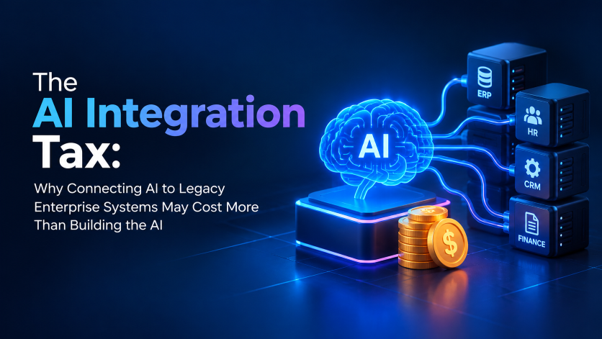
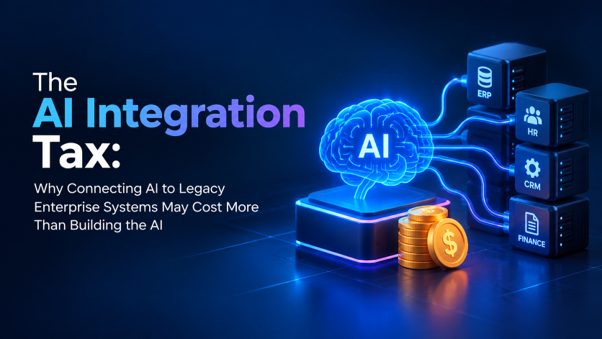
The AI integration tax is becoming one of the most important—and least discussed—costs of enterprise artificial intelligence. Organizations can access increasingly capable AI models that reason, analyze information, generate content, support employees, and automate complex tasks. Yet getting those capabilities to work reliably inside a real enterprise can be considerably harder than demonstrating what the model can do.
The challenge is rarely the AI model alone. Large organizations operate across decades of technology investments, including legacy databases, ERP and CRM platforms, custom applications, proprietary APIs, fragmented data environments, spreadsheets, and highly customized workflows. Connecting modern AI to this ecosystem can require substantial engineering, security, governance, testing, and process redesign.
This is where the AI integration tax emerges. The cost of enterprise AI is not determined only by the price of a model or platform. It is also shaped by the complexity of the environment into which that intelligence must be introduced. For many organizations, the journey from an impressive AI demonstration to a dependable production capability is ultimately an integration and architecture challenge.
What Is the AI Integration Tax?
The AI integration tax refers to the additional cost, complexity, engineering effort, and organizational change required to connect AI capabilities with existing enterprise systems and workflows.
An AI model may be powerful in isolation, but enterprise value depends on context. A sales AI, for example, may be capable of recommending an action for a customer account. To make that recommendation useful, however, it may need access to CRM activity, contract information, customer interactions, billing records, and other relevant business data.
Similarly, an AI agent designed to support procurement may need to interact with supplier information, inventory systems, approval workflows, and financial constraints.
The basic challenge can be summarized as follows:
- AI provides intelligence.
- Enterprise systems provide context.
- Integration connects intelligence to business operations.
- Governance determines what AI is allowed to do.
Without that surrounding architecture, an AI system can remain an impressive interface rather than becoming a dependable operational capability.
1. Legacy Systems Turn AI Integration Into an Engineering Challenge
Many enterprise applications were designed long before autonomous AI systems existed. Their architecture often assumes that a human employee will initiate an action, enter information, verify a result, and move the workflow forward.
AI agents challenge that operating model.
An autonomous system can potentially interact with multiple applications continuously and at machine speed. But the underlying enterprise environment may depend on limited APIs, proprietary formats, batch processing, manual approvals, or outdated interfaces.
This creates a fundamental mismatch between modern AI capabilities and legacy operating models.
For example, an AI system may be able to process a large volume of information almost instantly while the application it needs to update only supports slower or more constrained interactions. The AI itself is not necessarily the bottleneck. The surrounding architecture is.
For enterprises, this can create several challenges:
- Limited or outdated APIs
- Proprietary data formats
- Batch-oriented processing
- Manual workflow dependencies
- Applications designed around human-paced operations
- Custom systems with limited integration capabilities
The result can be an extremely intelligent AI layer sitting on top of an architecture that was never designed to support it. This is where the AI integration tax becomes particularly visible. The more dependent an AI application is on outdated interfaces and manual processes, the more engineering effort is required to make that application reliable in production.
2. Data Fragmentation Increases the Cost of Enterprise AI
Data is another major component of the AI integration tax.
Enterprises frequently assume that if information exists somewhere within their technology environment, AI should be able to use it. In practice, data availability does not automatically mean data accessibility, consistency, or usability. For this reason, data fragmentation is a major contributor to the AI integration tax. Organizations may need additional data pipelines, transformation layers, governance processes, and validation mechanisms before AI can reliably use information across the enterprise.
The same customer, product, or business metric can be represented differently across multiple systems. Historical information may be incomplete. Different departments may maintain different definitions for the same term.
Consider a customer record spread across a CRM, billing platform, support application, and data warehouse. An AI system attempting to reason across those sources may encounter conflicting information.
Humans often compensate for these inconsistencies through experience. Employees learn which system is authoritative, which records require interpretation, and which exceptions matter.
AI does not automatically possess that institutional understanding.
Effective enterprise AI therefore requires more than simply connecting models to databases. Organizations must establish a reliable information environment in which AI can understand the meaning, source, and relevance of the information it receives.
Important foundations include:
- Data standardization
- Clear ownership of business data
- Consistent definitions
- Reliable system-of-record design
- Controlled access to enterprise information
- Processes for identifying and resolving inconsistencies
The quality of AI reasoning is closely connected to the quality and structure of the enterprise context surrounding it.
3. Security and Permissions Become More Complicated With AI Agents
Security becomes significantly more important when AI moves from providing information to taking action.
A traditional chatbot that generates an incorrect answer may create a quality issue. An AI agent capable of modifying records, initiating workflows, or performing business operations introduces a different level of risk.
Enterprise environments already contain complex permission structures. Employees, applications, departments, and systems may all have different levels of access. Some information may be available for internal analysis but restricted from external transmission. Some systems may permit reading information but prohibit automated changes.
AI integration must therefore address two separate questions: As AI systems become capable of taking actions rather than simply generating responses, the AI integration tax increasingly includes identity management, authorization, auditing, and risk controls.
- What information can the AI access?
- What actions is the AI permitted to perform?
This distinction becomes critical as enterprises move toward more autonomous workflows.
An effective architecture may need to establish controls around:
- Identity and authentication
- Data access
- Application permissions
- Action-level authorization
- Human approval requirements
- Sensitive information
- Automated changes to business systems
The more capable an AI agent becomes, the more carefully its permissions need to be designed.
4. Multiple AI Models Create an Orchestration Problem
Enterprises are unlikely to rely on a single AI system for every business task.
Different models or AI services may be appropriate for different requirements. One system might support customer interactions, another document analysis, another software development, and another internal workflow automation.
This creates another dimension of the AI integration tax: orchestration. In a large enterprise, AI integration tax can increase rapidly when every AI application develops its own connectors, data flows, authentication mechanisms, and orchestration logic.
The enterprise must determine how AI systems interact with one another and with traditional applications. It must also establish how information moves between systems, how outputs are validated, and what happens when one component fails.
As more AI capabilities are introduced, enterprise architecture can begin to resemble a network of intelligent services rather than a collection of conventional applications.
That introduces questions such as:
- Which AI system handles each task?
- How is context transferred between systems?
- Which system validates the output?
- How are failures detected?
- Where is human intervention required?
- Who owns and governs each AI capability?
Without a coherent architecture, organizations can end up with multiple assistants that overlap, produce inconsistent results, or create duplicated functionality.
5. AI Introduces a New Maintenance and Observability Burden
Traditional enterprise software already requires continuous maintenance. APIs change, databases evolve, applications are upgraded, and business processes are redesigned.
AI adds another variable: the behavior of the intelligence itself.
Models can be updated. Providers can introduce new versions. Pricing structures can change. Output behavior can evolve. As a result, an integration that performs reliably at one point in time may require additional monitoring and evaluation later.
This means enterprise AI operations need to look beyond conventional infrastructure monitoring.
Organizations may need to evaluate:
- Whether integrations remain available
- Whether AI outputs remain acceptable
- Whether workflows continue to behave as expected
- Whether model changes affect downstream processes
- Whether AI responses meet defined quality requirements
- Whether unexpected behavior is detected quickly
AI therefore introduces a different kind of software maintenance problem: enterprises are operating systems whose behavior is not entirely deterministic.
Testing, evaluation, observability, and quality assurance become essential parts of the architecture rather than optional additions. These ongoing requirements are an often-overlooked component of the AI integration tax because they continue after the initial implementation is complete.
6. AI Costs Can Increase With Workflow Scale
The economics of AI can also change significantly between a pilot and a production deployment.
A small proof of concept may involve a limited number of interactions. A production workflow can operate across a much larger volume of transactions and may require repeated retrieval, reasoning, context processing, and tool usage.
For an AI agent connected to several enterprise systems, a single business transaction may involve multiple system interactions before a task is completed.
That means organizations need to evaluate the economics of the entire workflow rather than focusing only on the cost of the underlying AI model.
A useful enterprise assessment should consider:
- AI usage
- Data retrieval
- Number of system interactions
- Workflow complexity
- Processing volume
- Monitoring and evaluation
- Integration maintenance
- Infrastructure requirements
An AI workflow that appears inexpensive during a limited pilot can have very different operational economics once it becomes part of a high-volume business process.
The AI integration tax therefore includes both initial implementation costs and ongoing operating costs. Understanding the AI integration tax at production scale is therefore essential when calculating the true return on investment of an enterprise AI initiative.
7. AI Can Add Technical Debt Instead of Removing It
One of the most important strategic risks is that organizations may add AI on top of existing technical debt without addressing the architectural problems underneath.
A company might deploy multiple AI assistants, each connected to different applications and datasets. Individually, each project may appear successful.
Collectively, however, the organization may end up with:
- Multiple disconnected AI systems
- Inconsistent outputs
- Duplicate capabilities
- Unclear data ownership
- Overlapping workflows
- Fragmented governance
- Increasing maintenance requirements
This can be thought of as a form of intelligence debt: complexity created when AI capabilities are repeatedly added without a coherent architecture for the surrounding enterprise.
The problem is not that organizations are adopting AI too quickly. The problem is adopting AI without considering how individual implementations fit into the broader technology environment.
AI strategy is increasingly becoming architecture strategy. Without that architectural discipline, the AI integration tax can compound over time as every new AI capability adds another dependency to an already complex technology environment.
Should Enterprises Integrate AI or Rebuild Legacy Systems?
The AI integration tax creates an important strategic question for CIOs and CTOs: Should an organization integrate AI into existing systems or use AI adoption as an opportunity to rebuild those systems?
Neither option is universally correct.
A complete rebuild can create a cleaner architecture, but it can also involve significant migration work, investment, organizational disruption, and operational risk.
Continuing to integrate with legacy systems may allow organizations to move faster initially, but repeated integrations can increase long-term complexity.
For many enterprises, a hybrid architecture can provide a practical path forward. Critical legacy systems can remain authoritative systems of record while a modern AI layer operates above them.
However, that approach requires clear architectural boundaries.
Organizations should establish:
- Which system owns each category of data
- Which system is authoritative
- Which AI systems can access specific information
- Which systems are allowed to make changes
- Which decisions require human approval
- How information moves between systems
- How AI actions are monitored and evaluated
Without these boundaries, AI can become another layer of technical debt placed on top of existing technical debt.
Why Integration Architecture Matters for B2B Organizations
The AI integration tax is especially relevant to B2B companies because many B2B workflows depend on multiple interconnected platforms.
A demand-generation organization, for example, may use marketing platforms, CRM systems, enrichment databases, email infrastructure, verification tools, analytics platforms, and client reporting systems.
Improving one part of the workflow with AI can affect everything downstream.
Consider a few examples:
- AI-driven lead qualification could increase throughput while creating additional pressure on downstream sales processes.
- AI-generated campaign content could increase production capacity while creating new quality-control requirements.
- Automated reporting could improve efficiency while exposing inconsistencies between operational and client-facing data.
- AI workflow automation could reduce manual work while requiring more sophisticated approval and monitoring controls.
The lesson is important: AI does not operate in isolation.
Every automated improvement changes the flow of work around it.
That means B2B organizations should evaluate AI projects not only by the task being automated, but also by the systems, teams, data, and processes affected by the automation.
The Organizational Cost of AI Integration
The AI integration tax is not exclusively a technology problem.
Enterprise workflows often contain undocumented knowledge that exists primarily in the experience of employees. A formal process may describe the standard workflow, while experienced employees know how to handle the exceptions.
Those exceptions can become critical when an organization attempts to automate the process.
For example, a workflow may appear straightforward under normal conditions but contain numerous special cases that employees resolve manually. If AI is trained or configured around only the documented process, it may perform well under ordinary circumstances while failing when those exceptions appear.
Successful AI integration therefore requires collaboration between technology and business teams.
Organizations need to understand:
- How the official process works
- Where exceptions occur
- Which decisions employees make manually
- Which rules are undocumented
- Which steps require human judgment
- Which responsibilities should remain with people
AI integration can consequently become an exercise in organizational knowledge capture, not simply software development.
How Enterprises Can Reduce the AI Integration Tax
Reducing the AI integration tax does not necessarily mean replacing every legacy application before adopting AI.
A more practical approach is to identify the systems and data that are most strategically important and establish controlled interfaces through which AI can interact with them. The goal is not to eliminate the AI integration tax completely. Instead, enterprises should make it predictable, measurable, and strategically manageable by investing in the architectural foundations that AI depends on.
Several architectural capabilities can help:
Modernize Critical APIs
Identify high-value legacy systems and provide modern, controlled interfaces for AI and other applications to access them.
Standardize Important Data
Create consistent definitions and structures for the information AI relies on most heavily.
Strengthen Identity and Access Management
Design permissions around both information access and the actions AI systems are allowed to perform.
Introduce Workflow Orchestration
Define how AI systems, enterprise applications, and human employees interact across business processes.
Build Observability Into AI Systems
Monitor not only whether an integration works, but whether the AI continues to produce acceptable results.
Establish Clear Governance
Define ownership, approval requirements, system authority, and accountability before expanding autonomous AI workflows.
The objective is not to eliminate every legacy dependency immediately. It is to create an architecture in which those dependencies can be managed deliberately.
The More Autonomous AI Becomes, the More Important Architecture Becomes
There is an important paradox at the center of enterprise AI.
The more capable AI becomes, the more integration it may require.
A basic chatbot can operate relatively independently because its responsibilities and consequences are limited. A highly capable AI agent designed to make decisions and execute actions requires deeper access to enterprise data, applications, permissions, and workflows.
In other words, greater intelligence does not eliminate architecture requirements.
It intensifies them.
The path from AI experimentation to AI autonomy is therefore also an infrastructure and architecture journey.
Enterprises that understand this distinction can focus less on accumulating AI tools and more on building an environment where those tools can operate safely and effectively.
What CIOs and CTOs Should Ask Before Scaling Enterprise AI
Before moving an AI initiative from pilot to production, technology leaders should examine the surrounding environment rather than evaluating the AI capability in isolation.
Key questions include:
- Which systems contain the information the AI needs?
- Which systems are authoritative?
- Is the required data consistent and accessible?
- What can the AI read?
- What can the AI change?
- Which decisions require human approval?
- How will AI outputs be evaluated?
- What happens when a connected system fails?
- How will model or provider changes be managed?
- What will the workflow cost at production scale?
- Which business processes need to change?
- Who owns the AI capability after deployment?
These questions shift the conversation from “Which AI should we buy?” toward a more strategic question:
“What must our enterprise become so that AI can actually work here?”
That is the question that can determine whether AI becomes another expensive software layer or a foundation for meaningful business transformation.
Conclusion
The AI integration tax reveals an uncomfortable reality about enterprise transformation: the hardest part of adopting a new technology is often everything that already exists around it.
AI models can generate impressive capabilities, but those capabilities still need to operate within the architecture of the real business. Legacy applications, fragmented data, complex permissions, undocumented workflows, multiple AI systems, maintenance requirements, and organizational processes can all add complexity between an AI demonstration and measurable business value.
For enterprise leaders, the answer is not necessarily to rebuild everything or stop adopting AI. The better approach is to treat integration architecture as a strategic component of the AI roadmap.
Clean data, modern interfaces, strong identity controls, workflow orchestration, observability, and clear governance may not be as visible as a new AI assistant. Yet they can determine whether that assistant actually delivers value.
The organizations most likely to succeed will not necessarily be those with the largest number of AI tools. They will be the organizations that create an environment where AI can operate safely, reliably, and meaningfully.
The future of enterprise AI may therefore depend less on finding the smartest model and more on building the enterprise architecture capable of putting that intelligence to work.
Frequently Asked Questions
1. What is the AI integration tax?
The AI integration tax is the additional engineering, infrastructure, security, governance, maintenance, and organizational effort required to connect AI capabilities with existing enterprise systems and workflows.
2. Why are legacy systems a challenge for enterprise AI?
Many legacy systems were designed around human-driven processes and may use limited APIs, proprietary formats, batch processing, or manual steps. These characteristics can make integration with modern AI systems more complex.
3. Is AI integration more expensive than building an AI model?
It can be. Enterprise AI costs are not limited to developing or accessing the model. Connecting AI to business data, applications, workflows, permissions, monitoring systems, and operational processes can create substantial additional complexity.
4. How does data fragmentation affect AI integration?
Data fragmentation can make it difficult for AI systems to determine which information is accurate and authoritative. Differences in customer records, product identifiers, historical data, and business definitions can affect the reliability of AI-generated outputs.
5. Why does AI security require more than traditional access controls?
AI agents may not only read information but also perform actions. Enterprises therefore need to control both what information an AI system can access and which actions it is authorized to perform.
6. What is intelligence debt?
Intelligence debt describes the complexity that can accumulate when organizations deploy multiple AI capabilities without establishing a coherent architecture, governance model, data strategy, and ownership structure.
7. Should companies replace legacy systems before adopting AI?
Not necessarily. A hybrid approach can allow critical legacy systems to remain systems of record while a modern AI layer operates above them. The important requirement is to clearly define data ownership, system authority, permissions, and workflows.
8. How can companies reduce the AI integration tax?
Organizations can reduce integration complexity by modernizing important APIs, standardizing data, strengthening identity and access management, introducing workflow orchestration, implementing AI observability, and establishing clear governance.
9. Why is AI integration particularly important for B2B companies?
B2B operations often depend on interconnected systems such as CRM, marketing, analytics, enrichment, verification, reporting, and operational platforms. Automating one process can affect multiple downstream workflows, making integration and governance especially important.
10. Does more capable AI reduce the need for enterprise architecture?
No. Greater AI autonomy can increase the need for strong architecture because autonomous systems require deeper access to enterprise data, applications, permissions, workflows, and governance controls.