AI Judgment is becoming one of the most important skills in the modern enterprise. For the past several years, businesses have encouraged employees to learn artificial intelligence, adopt enterprise AI platforms, improve their prompts, and experiment with generative AI tools. The message has been straightforward: organizations and employees that know how to use AI will be better positioned to compete.
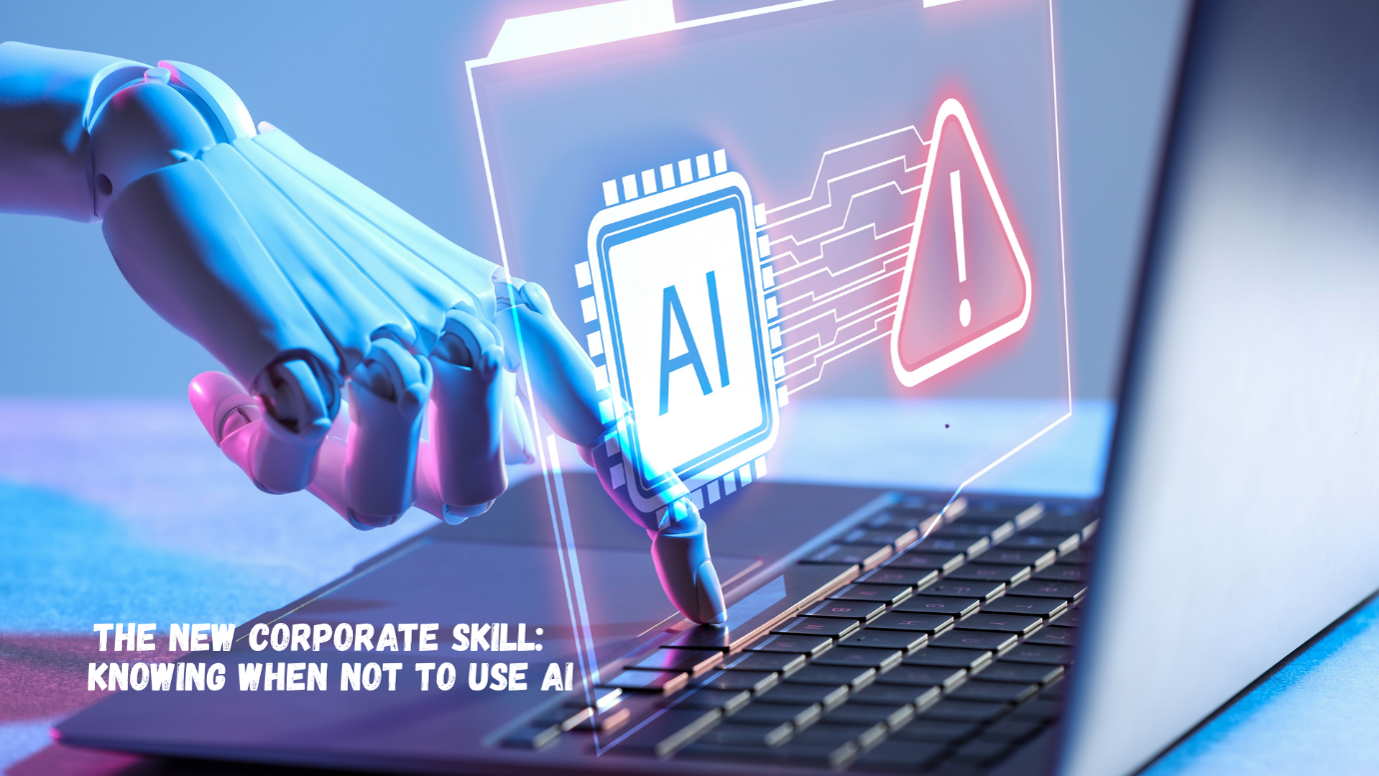
But as AI becomes increasingly embedded in everyday business operations, another capability is becoming equally important—and considerably harder to teach: knowing when not to use AI. The next phase of enterprise AI will not simply be determined by how many activities organizations can automate. It will depend on whether employees and leaders can distinguish between tasks that should be automated, tasks that should be augmented, and decisions that should remain fundamentally human.
AI can analyze large datasets, summarize complex documents, identify patterns, draft communications, evaluate alternatives, and make recommendations at remarkable speed. AI agents can go further by executing multi-step workflows and interacting with enterprise systems. Yet capability does not automatically mean appropriateness. The critical question is no longer simply, “Can AI do this?” It is “Should AI do this?”
1. AI Judgment Is Becoming the Next Stage of AI Literacy
For much of the early AI adoption cycle, AI literacy was closely associated with prompt literacy. Employees learned how to structure instructions, communicate effectively with AI systems, and improve the quality of generated outputs. Those capabilities remain useful, but they represent only one layer of effective AI adoption.
As AI moves deeper into enterprise workflows, employees also need to understand its limitations. An AI-generated response can sound authoritative while being incorrect. Important context may be missing, data may be incomplete, and a recommendation that appears statistically plausible may still be commercially inappropriate.
That means the next generation of corporate AI training needs to focus increasingly on AI Judgment.
Employees need to understand:
- When AI can be trusted for a low-risk task.
- When an AI output requires human verification.
- When an AI recommendation could create significant consequences.
- When confidential, customer, intellectual property, or sensitive business information should not be exposed.
- When human accountability must remain part of the decision.
The distinction becomes particularly important when the same technology is used across different business functions. An AI system generating marketing headline variations operates in a very different risk environment from one being used to evaluate employee performance. Similarly, AI explaining an IT error message presents a different risk from an autonomous system modifying production infrastructure.
The technology may be similar. The consequences are not. Developing AI Judgment helps employees understand not only how to use AI, but also when AI should not be used.
2. AI Judgment: Knowing When Not to Use AI Can Become a Competitive Capability
Organizations often create an implicit incentive to use AI whenever possible. Employees who embrace AI can be viewed as innovative and productive, while hesitation can sometimes be interpreted as resistance to technological change.
Mature AI adoption requires a different culture. Strong AI Judgment allows employees to evaluate whether a task should be automated, assisted by AI, or handled entirely by a human.
Employees should be able to say, “This is not an appropriate task for autonomous AI,” without being perceived as technologically behind. In fact, that decision can represent strong AI maturity.
Consider several enterprise scenarios:
- A sales manager uses AI for account research but keeps executive outreach under human control.
- An HR leader uses AI to organize employee feedback but does not allow an algorithm to independently determine promotions.
- An IT team uses AI to diagnose routine infrastructure issues but requires human approval for major production changes.
- A marketing team uses generative AI to explore ideas but keeps strategic positioning and brand direction under human ownership.
These organizations are not failing to adopt AI. They are determining where AI creates leverage and where human accountability matters more.
Every automated decision introduces some degree of risk. The objective is not to eliminate all risk—which is unrealistic—but to consciously determine where the organization is willing to accept it.
3. HR Can Become a Guardian of AI Judgment
AI-driven workforce transformation gives HR a role that extends well beyond traditional administration. As organizations redesign jobs around AI, HR leaders will increasingly influence how human judgment is preserved.
They will need to understand how AI changes roles, how employees are evaluated, which skills become more valuable, and which decisions require human oversight. They will also need to communicate AI transformation in ways that build employee trust rather than fear.
Performance management provides a useful example.
AI can potentially analyze productivity metrics, project outcomes, employee feedback, and other information to identify patterns. Those insights may help managers understand where employees need support. But converting those patterns directly into performance judgments can be problematic.
Productivity data rarely captures the full context of an employee’s contribution. Someone spending significant time mentoring colleagues may generate fewer measurable outputs while creating considerable organizational value. Similarly, an employee managing a difficult customer account may appear less productive than someone handling routine work.
AI can identify patterns. Managers still need to understand what those patterns mean.
Recruitment presents a similar challenge. AI can help recruiters process large numbers of applications and identify candidates whose qualifications appear relevant. However, recruitment involves more than pattern matching. Experience, potential, communication, motivation, and context can all influence a hiring decision.
The more consequential the decision, the more important human accountability becomes. AI Judgment is particularly important in HR because many workforce decisions require context, empathy, and human accountability.
4. Sales Should Know When the Human Touch Matters More
AI Judgment helps sales teams decide which activities should be automated and which customer interactions require a personal human approach.
Sales is one of the functions where AI can deliver significant operational leverage. AI can support prospect research, account summaries, meeting preparation, follow-up drafting, and pipeline analysis.
But complex B2B sales remains fundamentally human.
Trust, empathy, negotiation, relationship-building, and contextual understanding are particularly important when transactions involve substantial financial or operational consequences.
A sales organization that automates every customer interaction may discover that efficiency comes at the expense of differentiation. If every vendor uses AI to create outreach based on the same publicly available information, messages can quickly become indistinguishable.
Similarly, if every salesperson enters a meeting with identical AI-generated talking points, conversations can become formulaic. Optimizing negotiations around measurable variables alone can also overlook relationship dynamics that influence enterprise deals.
The better strategy is often to use AI to create more room for human interaction.
AI can:
- Research an account before a meeting.
- Prepare summaries so salespeople spend less time on administration.
- Identify potential customer objections.
- Analyze pipeline patterns.
- Help sales managers identify areas where coaching is needed.
The objective is not to remove humanity from sales. It is to remove unnecessary administrative work so human interaction becomes more valuable.
5. Marketing Needs to Resist the AI Content Factory
Marketing faces a different version of the same challenge. Generative AI makes it possible to produce articles, emails, social posts, landing pages, reports, and other content at dramatically greater speed. For marketing leaders, AI Judgment means knowing when AI should accelerate content production and when original human thinking should lead the process.
The danger is equating content volume with marketing productivity.
When every organization can produce more content, producing more content becomes less differentiating. The marketer’s value therefore moves increasingly toward judgment.
Marketing leaders must determine:
- Which customer problem deserves attention?
- Which market development actually matters?
- Which insight is worth publishing?
- Which claims can the company credibly own?
- Which stories should the brand tell?
- Which audiences deserve investment?
AI can help explore these questions, but it should not automatically determine the strategic answer.
Human originality becomes increasingly important as AI-generated content becomes more common. If businesses primarily use AI to remix existing information, B2B marketing risks becoming filled with polished but predictable language around transformation, innovation, agility, customer-centricity, and automation.
The brands that stand out will be those with genuine points of view, proprietary insights, original research, and authentic customer experiences.
AI can amplify those assets. It cannot create organizational credibility simply by generating more words.
6. IT Must Define Clear Boundaries for AI Autonomy
For IT teams, knowing when not to use AI becomes both a security and operational issue. AI Judgment helps IT teams determine the appropriate level of autonomy for each AI-powered workflow.
Autonomous systems can potentially monitor infrastructure, investigate incidents, write code, configure environments, and perform routine remediation. These capabilities can improve efficiency, but incorrect actions can have very different consequences depending on where they occur.
An incorrect change in a development environment may cause a temporary inconvenience. An incorrect change in production could result in downtime, data loss, or security exposure.
This is why organizations need graduated levels of AI autonomy.
Some AI systems can operate independently within tightly defined boundaries. Others should recommend actions but require human approval. Some should remain limited to analysis and information retrieval.
The key principle is simple:
AI autonomy should be deliberately designed—not granted simply because a platform makes it technically possible.
The same principle applies to cybersecurity. AI can help analyze logs, identify suspicious behavior, and detect potential threats. But security decisions can have cascading consequences.
Enterprise AI systems therefore need:
- Clearly defined permissions.
- Human escalation paths.
- Appropriate monitoring.
- Auditability.
- Clearly assigned accountability.
- Boundaries around access to critical systems.
An AI agent operating inside an enterprise should not become an invisible employee with unrestricted access.
7. AI Maturity Should Be Measured by AI Judgment, Not Just Adoption
Many organizations measure AI maturity by looking at adoption.
They ask how many employees use AI, how many departments have AI tools, how many workflows have been automated, or how much time has been saved. These measurements can be useful, but they do not tell the entire story.
An organization can have extremely high AI adoption and still have poor AI maturity if employees do not understand when automation creates unacceptable risk.
A more mature approach asks questions such as:
- Does the organization know which processes should be automated?
- Are employees trained to validate AI outputs?
- Are high-impact decisions subject to human review?
- Are AI systems monitored after deployment?
- Can the organization explain why an AI system produced a recommendation?
- Can employees challenge automated decisions?
- Does leadership understand where AI creates value and where it introduces risk?
These questions reveal whether AI has become an organizational capability rather than simply another software category.
The goal of enterprise AI should therefore not be to maximize the percentage of work performed by machines. The goal should be to create a better business.
Sometimes that means full automation. Sometimes it means an AI assistant. And sometimes it means keeping a human firmly in control. Organizations with strong AI Judgment do not simply ask how much AI they can deploy; they ask where AI creates genuine business value.
AI Judgment Will Define the Future Employee
The workplace skills that matter most will evolve as AI becomes more capable.
Employees will continue to need domain expertise, communication skills, and problem-solving ability. But they will also need AI Judgment: the ability to collaborate effectively with AI without surrendering responsibility to it. AI Judgment will become increasingly important as employees work alongside AI systems that can generate recommendations and take actions.
An employee with strong AI Judgment knows when to:
- Delegate a task to AI.
- Verify an AI-generated result.
- Question a recommendation.
- Stop an automated process when the circumstances demand human intervention.
They understand that an AI answer is not automatically a correct answer. They know that speed is not always synonymous with quality. They recognize when a decision requires context that an AI system may not possess.
This capability applies across virtually every B2B function.
A salesperson needs to know when to automate prospect research and when to personally investigate an important account. A marketer needs to know when AI should accelerate production and when original thinking must come first. An HR professional needs to recognize when AI can support workforce analysis and when a sensitive employee situation requires a human conversation.
An IT professional needs to understand when an autonomous system can safely resolve an incident and when a human engineer needs to take control.
Strategic Restraint Can Make Companies Faster
There is an important paradox in enterprise automation: more automation does not necessarily mean more agility.
Every autonomous workflow can introduce additional monitoring, governance, exception handling, security controls, and maintenance requirements. If a company automates a process without understanding its edge cases, employees may eventually spend more time managing failures than they previously spent performing the task manually.
Strategic restraint can therefore become a form of speed.
When organizations clearly define which decisions AI can make and which require humans, implementation becomes easier to manage. Employees understand their responsibilities. IT knows what permissions are necessary. HR understands how roles are changing. Leadership knows where accountability sits.
Customers also receive clearer experiences.
The objective should not be maximum autonomy.
It should be appropriate autonomy.
From AI Adoption to AI Governance
This shift makes AI governance increasingly important. Governance should not be viewed simply as a collection of restrictions designed to slow innovation.
Good governance creates the conditions under which innovation can scale responsibly.
Employees are more likely to experiment when they understand the boundaries. Business leaders are more likely to approve automation when accountability is clear. IT teams are more likely to support AI initiatives when systems have appropriate security and access controls.
Governance must also evolve as AI systems evolve.
An AI capability that is appropriate for a low-risk workflow today may become unsuitable as its capabilities expand. An assistant initially designed to summarize information could eventually gain the ability to take action. A marketing tool may move from drafting content to publishing it. A sales assistant may move from researching prospects to communicating directly with customers.
Every increase in capability should trigger a corresponding review of:
- Permissions.
- Monitoring.
- Security.
- Human oversight.
- Accountability.
- Business risk.
Organizations should therefore treat AI systems as evolving business capabilities rather than static software installations. Effective AI governance should give employees clear guidance on when AI Judgment and human oversight are required.
The Human Advantage Is Not Going Away
There is a tendency to assume that as AI becomes more capable, human skills become less important. The opposite may prove true.
As machines become better at generating information, humans become more valuable at determining what information matters. As AI becomes better at identifying patterns, humans become more important in interpreting context. As machines become better at executing workflows, humans become more important in deciding which workflows should exist in the first place.
This is especially relevant in B2B environments, where decisions frequently involve ambiguity.
A customer may not fully understand the problem it needs to solve. An employee may be dealing with circumstances that cannot be captured in a dataset. A negotiation may depend on trust built over years. A strategic decision may require taking a risk that historical data cannot fully justify.
These are situations where judgment matters because the answer cannot simply be extracted from existing information.
AI can support that judgment by providing alternatives, surfacing patterns, identifying risks, and accelerating analysis.
But support is not the same as ownership.
The Most Advanced Companies Will Know Where Humans Must Stay
The future of enterprise AI will not necessarily belong to the companies that automate the most.
It will belong to organizations that understand the boundary between machine capability and human responsibility.
These organizations will use AI aggressively where it creates measurable value while establishing clear limits where human judgment, accountability, empathy, or strategic context is essential. They will train employees not only to use AI but also to challenge it.
They will measure more than productivity gains. They will examine decision quality.
For different business functions, this means different priorities:
- HR: Lead human-AI workforce design and preserve meaningful human judgment in people decisions.
- Sales: Use automation to create better customer interactions rather than simply increasing outreach volume.
- Marketing: Use AI to amplify original thinking rather than building an endless content factory.
- IT: Establish secure, observable systems with clearly defined levels of autonomy.
- Leadership: Recognize that AI transformation is ultimately organizational transformation.
The most valuable employee of the future may not be the person who knows how to use every AI tool.
It may be the person who knows when the tool should be used, when its answer needs to be challenged, and when the decision should remain human.
That is the next stage of AI literacy.
Conclusion
AI Judgment is becoming a critical part of enterprise AI maturity. Organizations need employees who can use AI effectively while recognizing its limitations. The first wave of enterprise AI taught employees how to ask AI for answers. The next wave will require organizations to teach employees how to evaluate those answers—and when not to act on them.
AI adoption should not be measured simply by how many tasks organizations automate. True AI maturity requires judgment: understanding where AI creates leverage, where human oversight is necessary, and where automation could introduce more risk than value.
For HR, sales, marketing, IT, and business leadership, the challenge is increasingly the same. AI should remove unnecessary work, accelerate analysis, surface useful insights, and support better decisions. But responsibility for consequential decisions cannot simply be delegated because a technology makes delegation possible.
The companies that master this distinction will be better positioned to capture the productivity benefits of AI while preserving the judgment, accountability, resilience, and human connection that make a business trustworthy.
The future of enterprise AI is not maximum automation. It is intelligent, deliberate, and appropriate automation.
Frequently Asked Questions
1. What is AI Judgment?
AI Judgment is the ability to understand when AI should be used, when its outputs need to be verified, and when a decision should remain under human control. It goes beyond knowing how to operate AI tools and focuses on responsible decision-making.
2. Why is knowing when not to use AI important?
AI capability does not automatically mean that a task is appropriate for automation. High-impact decisions involving employees, customers, contracts, security, or production systems can require context and accountability that should remain with humans.
3. How is AI Judgment different from AI literacy?
Traditional AI literacy often focuses on understanding and using AI tools, including effective prompting. AI Judgment adds another layer: understanding limitations, evaluating outputs, assessing risk, and deciding when human intervention is necessary.
4. How can HR use AI while preserving human judgment?
HR can use AI for activities such as organizing information, analyzing patterns, and supporting workforce analysis. However, sensitive decisions involving performance, recruitment, promotions, or employee circumstances should receive appropriate human review and accountability.
5. Should sales teams automate customer interactions?
AI can effectively automate or accelerate research, summaries, follow-ups, and administrative tasks. However, complex B2B sales often depend on trust, empathy, negotiation, and relationship-building, making human interaction particularly valuable.
6. How should IT teams manage AI autonomy?
IT organizations should establish graduated levels of autonomy. Some AI systems can work independently within defined boundaries, while others should only make recommendations or operate with human approval, particularly when production infrastructure or security is involved.
7. What does AI maturity mean for an enterprise?
AI maturity is not simply the number of AI tools deployed or workflows automated. A mature organization understands where AI creates value, validates outputs, manages risk, monitors systems, establishes accountability, and knows which decisions require human oversight.
8. Will human skills become less important as AI improves?
Not necessarily. As AI becomes better at generating information and executing workflows, human capabilities such as contextual interpretation, strategic thinking, empathy, accountability, and judgment can become more important.
9. What is appropriate autonomy in enterprise AI?
Appropriate autonomy means giving AI only the level of independence that is suitable for the task and its associated risks. Low-risk activities may be automated, while consequential decisions may require recommendations, approval, or direct human control.
10. Why is AI governance important?
AI governance establishes the boundaries, permissions, monitoring, oversight, and accountability needed to deploy AI responsibly. Effective governance can help organizations scale AI while maintaining appropriate control as AI capabilities evolve.