Enterprise technology is usually purchased with a simple promise: make the business faster, smarter, more efficient, more connected, or easier to operate. A new CRM improves customer visibility. A marketing platform automates campaigns. An ERP connects finance and operations. A collaboration platform accelerates communication. AI tools automate analysis and content creation. Cloud systems make infrastructure more flexible. Each implementation appears to remove friction from a specific business process. But as organizations accumulate technology, another phenomenon quietly develops beneath the surface.
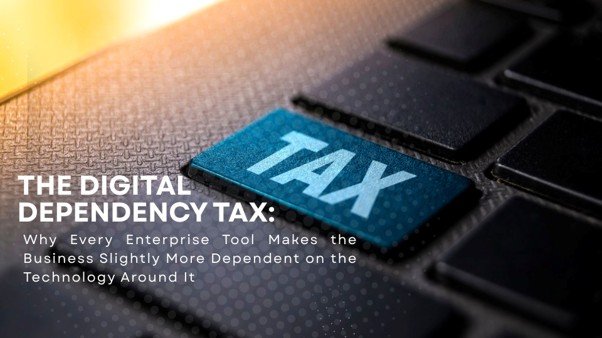
Every new system creates connections, integrations, data flows, permissions, processes, vendor relationships, employee expertise, and operational assumptions that the business eventually depends on. The technology may have solved the original problem, but it also becomes part of the infrastructure required to keep the solution working. This creates what can be called the Digital Dependency Tax: the hidden operational, financial, organizational, and strategic cost that accumulates as businesses become increasingly dependent on the technology ecosystem they have built around themselves. The Digital Dependency Tax is becoming an important consideration for enterprises as technology becomes increasingly embedded in everyday business operations.
What Is the Digital Dependency Tax?
The problem is not technology itself. Modern enterprises could not operate at scale without sophisticated digital infrastructure. The issue is that organizations often measure the value of technology at the moment of adoption while measuring dependency only when something goes wrong. A company calculates the efficiency gained from implementing a new platform but rarely calculates what it will cost to replace that platform five years later.
It celebrates the automation created by an integration but may not account for the engineering effort required to maintain that integration. It measures employee productivity after introducing a tool but may not consider how much institutional knowledge becomes embedded inside that tool. The benefits are visible immediately. The dependencies accumulate quietly.
This creates an asymmetry in technology decision-making. The value of a new system is usually expressed in terms of what it enables. The risk is often expressed in terms of what might happen if it fails. But dependency is neither a benefit nor a traditional failure. It is the growing condition in which the organization becomes less capable of operating without the technology. A business may start by using a platform because it is convenient and eventually reach a point where it cannot realistically function without it. The difference between those two states can be difficult to identify because dependency grows incrementally.
How Enterprise Technology Creates Dependency
Consider something as ordinary as a CRM. At first, it is simply a system for tracking leads and customer information. Over time, marketing automation connects to it. Sales forecasting depends on its data. Customer-success teams build workflows around it. Finance uses information from it for revenue planning. Management dashboards pull from it. AI systems use its data for recommendations. Employees develop processes that assume the CRM is available.
Eventually, replacing the CRM is no longer a software migration. It becomes an organizational transformation project. The original technology decision has created a network of dependencies that extend far beyond the software itself. This example shows how the Digital Dependency Tax can grow gradually as more business functions become connected to a single platform.
This is why the real unit of technology adoption is increasingly not the application but the dependency network around the application. Every system sits inside a web of other systems and processes. A marketing platform depends on customer data. Customer data depends on CRM accuracy. CRM accuracy depends on employee behaviour. Employee behaviour depends on workflow design. Workflow design may depend on integrations with other systems. Each connection creates another point where change becomes difficult. A company may believe it owns a collection of independent tools when it actually operates a tightly interconnected technology ecosystem.
How SaaS Increases Digital Dependency
The rise of SaaS has made this particularly common. Cloud software dramatically lowered the barrier to adopting new technology. Teams can subscribe to tools without building infrastructure themselves, and organizations can experiment quickly. But the ease of adoption can hide the long-term accumulation of software dependencies. A department adds one tool for analytics, another for communication, another for automation, another for project management, another for customer engagement, and another for AI. Individually, each purchase may appear inexpensive. Collectively, the organization creates a complex operating environment that requires constant maintenance.
The rise of SaaS has made the Digital Dependency Tax particularly common. Cloud software dramatically lowered the barrier to adopting new technology. Technology stacks tend to grow faster than they shrink because adding a tool is usually easier than removing one. A new system can be justified through a specific business case, but removing an old system requires identifying everything that depends on it. The organization may discover that an application is still connected to multiple workflows, reports, automations, employee habits, and downstream processes. As a result, obsolete technology survives because the cost of disentangling it appears higher than the cost of continuing to pay for it.
Over time, this creates a form of digital inertia. The company knows that some systems are outdated, but changing them feels dangerous because nobody has a complete map of the consequences. The technology remains not because it is necessarily good, but because it is deeply embedded. This is one of the most expensive forms of enterprise dependency because it limits the organization’s ability to change direction quickly.
AI is likely to intensify the Digital Dependency Tax. AI systems are increasingly being connected to business applications, internal knowledge bases, customer information, communication platforms, analytics systems, and operational workflows. AI systems are increasingly being connected to business applications, internal knowledge bases, customer information, communication platforms, analytics systems, and operational workflows.
As AI agents begin performing actions rather than simply generating recommendations, their dependencies become even more significant. An AI agent that can update a CRM, trigger an email, create a report, route a customer issue, or initiate a workflow becomes part of the operational chain. If the agent is unavailable, the organization may not simply lose a productivity tool; it may lose an automated layer of business execution.
Tool Dependency vs. Process Dependency
This creates an important distinction between tool dependency and process dependency. Tool dependency means employees prefer a particular system. Process dependency means the business has designed the way work happens around that system. The second is far more consequential. If employees prefer a particular note-taking application, replacing it may be annoying. If customer on boarding, compliance checks, billing, reporting, and support workflows all depend on a particular platform, replacing it can become a major organizational event.
Data creates another layer of dependency. The more systems an organization adopts, the more valuable integrated data becomes. But integration can also make data harder to separate. Information moves between platforms, is transformed by workflows, enriched by external sources, and consumed by downstream applications. After years of operation, the organization may not know exactly where a particular data element originated, which systems rely on it, or what will break if it stops flowing. This creates what could be called data entanglement. The company owns the information but may not have complete control over the pathways through which that information moves. Data entanglement is one of the less visible components of the Digital Dependency Tax.
The human layer is equally important. Every enterprise system creates employees who know how to use it, administer it, troubleshoot it, customize it, and work around its limitations. Some of this expertise is documented. Much of it is not. Over time, organizations develop specialists who understand the system’s history and hidden behaviour. When those employees leave, the company can discover that its technology dependency includes a knowledge dependency. The software is still available, but the people who understood how it actually works are gone.
Technology Vendor Lock-In and Switching Costs
This is why vendor management is becoming a strategic capability rather than simply a procurement function. Managing the Digital Dependency Tax requires organizations to understand how difficult it would be to stop using each critical technology. Companies need to understand not only what they are buying but how difficult it would be to stop buying it.
What data would need to be migrated? Which integrations would need to be rebuilt? Which workflows would have to change? How many employees would require retraining? Which customers would notice? Which compliance processes would be affected? How long could the business operate during a transition? These questions reveal the organization’s switching cost architecture. These switching costs are a major part of the Digital Dependency Tax because they determine how difficult it is for an enterprise to change technology providers.
The goal should not be to eliminate all dependencies. That would be unrealistic and, in many cases, counterproductive. Specialization creates value precisely because organizations do not need to build everything themselves. The goal is to understand which dependencies are strategic, which are manageable, and which are dangerous. A company may intentionally become deeply dependent on a core platform because the benefits outweigh the switching cost. But that should be a conscious decision rather than an accidental consequence of years of technology accumulation.
The Digital Dependency Tax creates a new principle for technology procurement: reversibility should be treated as an economic variable. A cheaper platform that creates extreme lock-in may be more expensive over its lifetime than a slightly more expensive platform that allows easier migration. Similarly, an AI system that produces impressive results but cannot export its data or integrate with alternative models may create strategic dependency. Organizations should therefore evaluate not only what a technology can do but how difficult it would be to stop using it.
AI Vendor Lock-In and Enterprise Technology Risk
The concept becomes particularly important during periods of rapid technological change. AI is evolving quickly, and today’s leading platform may not remain dominant indefinitely. Enterprises that embed AI deeply into their operations need to think carefully about portability. If workflows are designed around one model, one provider, or one ecosystem, what happens when a better technology emerges? If changing providers requires rebuilding the entire operating process, the company may hesitate to adopt superior technology simply because its existing dependency is too expensive to unwind.
This is where architecture matters in reducing the Digital Dependency Tax. Modular technology environments can reduce dependency because systems can be replaced without rebuilding the entire business. Modular technology environments can reduce dependency because systems can be replaced without rebuilding the entire business. Standardized data structures, APIs, portable knowledge bases, clear ownership, and documented workflows can create flexibility. The objective is not to avoid integration. It is to avoid irreversible integrationwherever possible. A highly connected system can still be strategically flexible if its connections are designed with substitution in mind.
Leadership also needs to change how technology success is evaluated. Most technology business cases focus on adoption, efficiency, productivity, revenue, cost savings, or user satisfaction. Future technology governance will need an additional metric: dependency exposure. How critical is the system? How many processes rely on it? How many alternative solutions exist? How quickly could it be replaced? How concentrated is the organization’s dependence on one vendor? How much institutional knowledge is embedded inside the platform? These questions reveal strategic risk that traditional ROI models overlook.
The Digital Dependency Tax also changes how organizations should think about innovation. A company with a highly fragmented technology environment may appear innovative because it continuously adopts new tools. But if every innovation increases the difficulty of changing the underlying architecture, the organization may become less adaptable over time. The paradox is that technological progress can sometimes reduce strategic flexibility. More tools can create more capabilities while simultaneously increasing the cost of changing direction.
Digital Dependency and Business Continuity
This is particularly relevant for executives because technology dependency eventually becomes a business continuity issue. If a critical platform experiences an outage, changes its pricing, modifies its terms, suffers a security incident, or discontinues a feature, the organization may have limited alternatives. The risk is not hypothetical. The more business processes depend on external technology providers, the more external decisions can affect internal operations.
The strongest technology organizations will therefore begin treating dependency as something that must be designed, measured, and governed. They will maintain architecture maps, understand critical dependencies, document fall-back processes, preserve data portability, and periodically test whether important systems can actually be replaced. They will ask not only, “What does this technology enable?” but also, “What will the business become dependent on if we adopt it?”
The Future of Enterprise Technology Is Adaptability
Ultimately, the Digital Dependency Tax is not an argument against digital transformation. Managing the Digital Dependency Tax should therefore become part of long-term enterprise technology strategy. It is an argument for more mature digital transformation. Technology should make organizations more capable without making them unknowingly fragile. The objective is not to minimize the number of tools, integrations, or platforms. It is to ensure that the organization’s technology ecosystem remains understandable, governable, and adaptable as it grows.
The next competitive advantage in enterprise technology may not be having more digital capabilities. It may be having the ability to change those capabilities without destabilizing the business. The smartest organizations will not ask only how much a technology can automate, accelerate, or improve. They will also ask a harder question: “If we build our business around this, how difficult will it be to walk away?”