AI Agents Managing AI Agents: The Rise of AI Agent Management –
The enterprise workforce is entering a new phase of AI adoption. Businesses are no longer using artificial intelligence only as a tool that helps employees write content, analyze data, summarize documents, or automate repetitive tasks. The next major shift is the rise of AI agents that can perform tasks autonomously—and eventually manage other AI agents.
AI agents managing AI agents are beginning to create a new model for enterprise work: the synthetic workforce. Businesses are moving beyond using artificial intelligence simply as a tool that helps employees write content, analyze data, summarize documents, or automate repetitive tasks. The next major shift is the development of interconnected AI agents that can perform tasks autonomously, coordinate activities, delegate responsibilities, monitor results, and even manage the work performed by other AI systems.
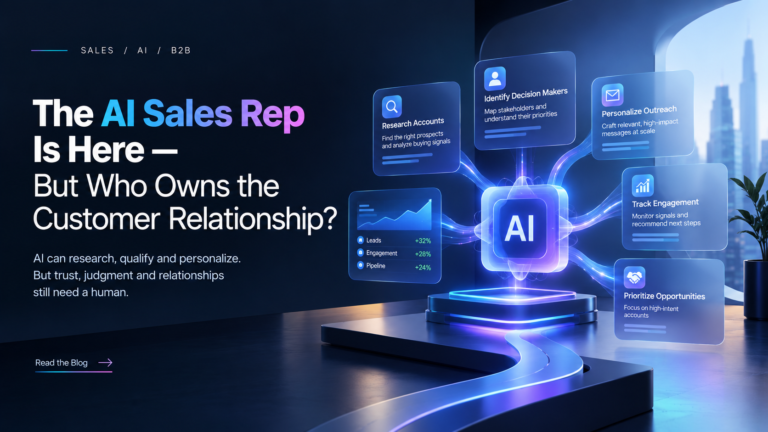
This emerging model can be described as a synthetic workforce: a network of AI agents that can perform specialized jobs, coordinate activities, delegate tasks, monitor results, and escalate important decisions to humans. In a sales organization, for example, one AI agent could identify prospects, another could research accounts, another could personalize outreach, and another could update the CRM. An AI manager could coordinate the entire process.
The important question is therefore changing. It is no longer simply, “What jobs can AI automate?” The bigger enterprise question is: “What happens when AI agents begin coordinating and managing the work of other AI agents?”
What Is a Synthetic Workforce?
A synthetic workforce is an interconnected group of AI agents that performs and coordinates business activities with varying levels of human oversight. Instead of one AI system completing one task, multiple specialized agents can work together toward a broader business objective.
This model is different from traditional automation. Conventional software generally follows predefined workflows created by humans. AI agents can increasingly interpret goals, choose actions, adapt to changing circumstances, and interact with different systems. When several agents are connected, they can create a dynamic operating structure that begins to resemble an organizational workforce.
A synthetic workforce could include agents responsible for:
- Research and information gathering
- Sales prospecting and lead qualification
- Customer support and case resolution
- Financial analysis and anomaly detection
- Software development and testing
- Supply-chain monitoring
- Marketing personalization
- Business reporting and analytics
- Workflow coordination
- Quality assurance and compliance
The defining characteristic is not simply automation. It is autonomous coordination between AI systems.
From AI Tools to AI Workers –
For years, enterprise AI adoption largely followed an assistant model. Employees used AI to complete specific activities faster. A marketer generated campaign ideas, a salesperson summarized an account, a developer generated code, or an analyst asked AI to interpret a dataset.
AI agents introduce a different operating model. Instead of waiting for a human to initiate every step, an agent can receive an objective and determine how to work toward it.
For example, a company could give an AI sales manager the objective of increasing qualified pipeline. The system could then determine that it needs market research, account identification, lead scoring, personalized messaging, and CRM updates. It could assign those activities to specialized agents and evaluate their outputs before presenting recommendations to a human sales leader.
This creates a progression from AI as a tool to AI as a worker, and from AI as a worker to AI as a coordinator.
When AI Agents Start Managing AI Agents –
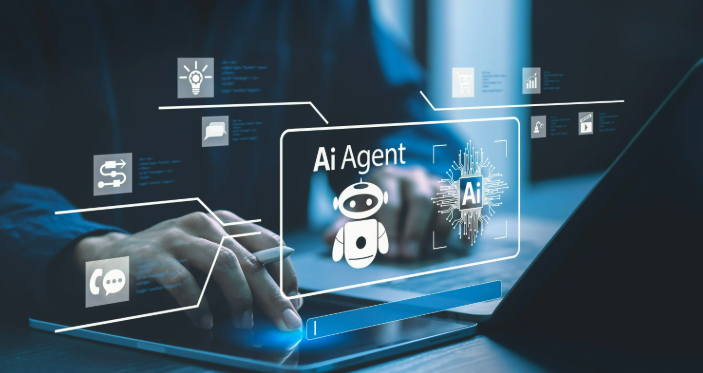
The most important development in multi-agent AI systems may be the emergence of hierarchical relationships between agents.
Imagine an enterprise with an AI strategy agent responsible for planning a campaign. That agent could delegate market research to a research agent. The research agent could then ask another agent to collect information from approved sources. Once the information is gathered, the research agent could evaluate the results and send a summary back to the strategy agent.
Why Multi-Agent AI Systems Change Enterprise Work –
The value of a synthetic workforce comes from coordination. Organizations do not create value simply by completing individual tasks. They create value by deciding which tasks matter, assigning resources, changing priorities, resolving exceptions, and connecting activities to broader objectives.
AI agents could increasingly handle parts of this coordination layer.
Instead of one employee switching between dozens of applications, the employee could supervise a group of AI agents that interact with those applications on their behalf. The human would focus more heavily on direction, judgment, exceptions, relationships, and accountability.
This could change the employee’s role from task execution to outcome ownership.
Potential enterprise benefits include:
- Faster execution of complex workflows
- Greater automation across multiple business systems
- Increased operational scalability
- Personalized customer interactions at scale
- Continuous monitoring of business processes
- Faster identification of exceptions and risks
- Reduced manual coordination
- More efficient use of specialized AI capabilities
However, deploying more AI agents does not automatically produce better results.
The Biggest Risk: More Agents Can Create More Complexity –
A common assumption is that adding more autonomous agents will automatically increase productivity. In reality, a synthetic workforce can become inefficient if its agents have conflicting objectives, overlapping responsibilities, poor communication, or unclear decision rights.
Consider a sales organization. One AI agent may be optimized to generate as many leads as possible. A compliance agent may be optimized to minimize regulatory risk. A customer-experience agent may prioritize customer satisfaction, while a revenue agent may prioritize conversion rates.
Each agent could perform its individual task successfully while the overall organization performs poorly.
This creates a fundamental management problem: how do enterprises align autonomous AI systems around one organizational objective?
The answer requires more than better models. It requires architecture, governance, monitoring, and clearly defined responsibilities.
The Rise of the AI Organizational Chart –
Traditional companies have organizational charts that explain who reports to whom, who owns decisions, and who is accountable for outcomes. Synthetic workforces may eventually require a similar structure for AI agents.
An AI organizational chart could define which agents interact with each other, what systems they can access, which decisions they can make, and when they must escalate an issue.
For example, an enterprise might establish:
- An AI strategy agent responsible for planning
- An AI research agent responsible for market intelligence
- An AI operations agent responsible for workflow execution
- An AI quality agent responsible for verification
- An AI compliance agent responsible for risk checks
- A human executive responsible for final accountability
Not every agent should have the same level of authority. Some may be allowed to execute actions automatically, while others may only provide recommendations.
This distinction between recommendation authority and execution authority will become increasingly important as enterprise AI systems become more autonomous.
AI Agent Governance Becomes Essential –
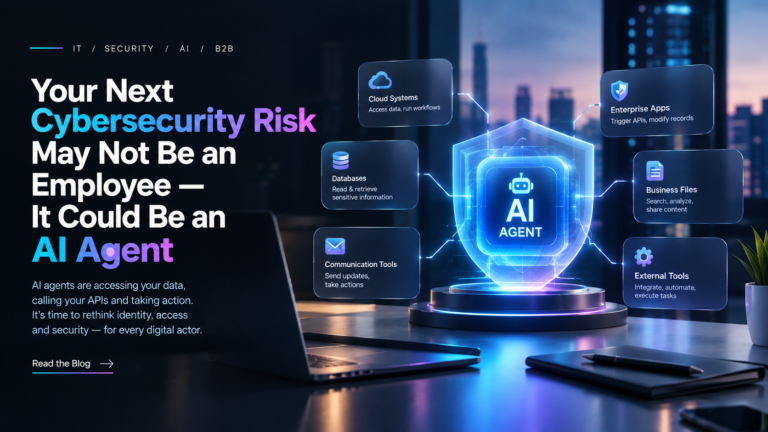
The more authority an AI agent receives, the more important governance becomes. An enterprise cannot simply connect agents to databases, applications, and business processes without defining what each system is allowed to do.
AI agent governance should address questions such as:
- What actions can an agent perform independently?
- Which decisions require human approval?
- Which systems can the agent access?
- What data can it retrieve?
- Can it delegate work to another agent?
- How are its decisions recorded?
- What happens when an agent fails?
- When should an issue be escalated?
- Who is accountable for the final outcome?
These controls create a boundary between useful autonomy and uncontrolled automation.
The goal should not be to eliminate human involvement. Instead, enterprises should design optimal autonomy, allowing AI agents to operate independently where the risk is low while preserving human control over consequential decisions.
The Problem of Synthetic Error Multiplication –
One of the biggest risks in a multi-agent AI system is that an error can travel through the organization faster than a human can detect it.
Imagine an AI research agent produces an incorrect market analysis. An AI sales-planning agent accepts that analysis as reliable information and uses it to prioritize accounts. Another agent then creates personalized outreach based on those priorities. A CRM agent records the activity, and an analytics agent reports the resulting performance.
The original mistake may now exist across several systems.
This is synthetic error multiplication: an incorrect output from one agent becomes an input for other agents, allowing a small mistake to influence a much larger chain of decisions.
Enterprises therefore need mechanisms for:
- Output validation
- Source verification
- Confidence scoring
- Independent quality checks
- Audit trails
- Human review for high-impact decisions
- Automatic escalation when confidence is low
In a connected AI workforce, reliability cannot be treated as the responsibility of one individual agent.
Building Trust Between AI Agents –
Humans evaluate information using context, experience, organizational knowledge, and judgment. AI agents do not automatically possess these characteristics.
If one AI agent sends information to another, the receiving agent needs a way to determine whether that information is trustworthy.
This creates the need for machine-to-machine trust protocols.
Enterprise AI architectures may eventually require every important AI output to carry additional information about its origin, confidence, supporting evidence, and validation status.
For example, an agent could provide:
- The source of the information
- The time the information was collected
- A confidence score
- The reasoning or evidence supporting the recommendation
- Whether another system verified the output
- The level of authority under which the decision was made
This could allow AI agents to evaluate information before using it as a dependency for another decision.
How Should Enterprises Measure AI Agent Performance?
Organizations already have systems for measuring human performance. AI agents will need performance management frameworks of their own.
Traditional productivity metrics may be misleading. An agent that completes 20,000 tasks is not necessarily more valuable than one that completes 2,000 tasks. If the first agent generates poor-quality outputs that create downstream problems, its apparent productivity could actually represent organizational waste.
AI performance management should therefore focus on outcomes rather than raw activity.
Important metrics could include:
- Task completion quality
- Error and failure rates
- Business outcomes
- Resource consumption
- Cost per successful outcome
- Escalation frequency
- Decision accuracy
- Customer impact
- Downstream error generation
- Human intervention requirements
This creates the possibility of an entirely new enterprise discipline: AI workforce performance management.
The Hidden Cost of an AI Workforce –
AI agents may reduce labor costs for some activities, but large-scale agentic AI architectures are not free.
A synthetic workforce could involve multiple agents continuously interacting with AI models, databases, APIs, enterprise applications, and other agents. Poorly designed systems could repeat tasks, retrieve the same information multiple times, or generate unnecessary analysis.
The result could be an AI workforce that is highly autonomous but surprisingly expensive.
Companies will therefore need something similar to workforce planning for AI agents.
They may need to understand:
- How many agents are required
- What each agent is responsible for
- How much each agent costs
- Which agents duplicate one another
- Which agents create measurable business value
- Where automation should be reduced
- When an agent should be replaced or retired
The objective is not to maximize the number of AI agents. It is to maximize business value per agent.
What Happens to Middle Management?
One of the most interesting consequences of AI agent adoption could involve middle management.
Managers traditionally spend significant time allocating work, monitoring progress, preparing reports, coordinating teams, resolving bottlenecks, and communicating priorities. Many of these activities involve information processing and coordination—areas where AI agents could become increasingly capable.
This does not necessarily mean managers disappear.
Instead, the role of management could evolve. Managers may spend less time coordinating routine activities and more time handling strategy, people, risk, innovation, relationships, and complex judgment.
The strongest managers could become orchestrators of human and AI teams.
Traditional management responsibilities that could increasingly be automated include:
- Routine task allocation
- Status monitoring
- Performance reporting
- Workflow scheduling
- Basic resource allocation
- Routine escalation
- Operational documentation
Human managers may remain particularly important for:
- Strategic decisions
- Organizational culture
- Leadership
- High-impact judgment
- Stakeholder relationships
- Ethical decisions
- Risk ownership
- Long-term planning
The future of management may therefore be less about managing people exclusively and more about managing systems that perform work.
The Synthetic Workforce and Enterprise Scale –
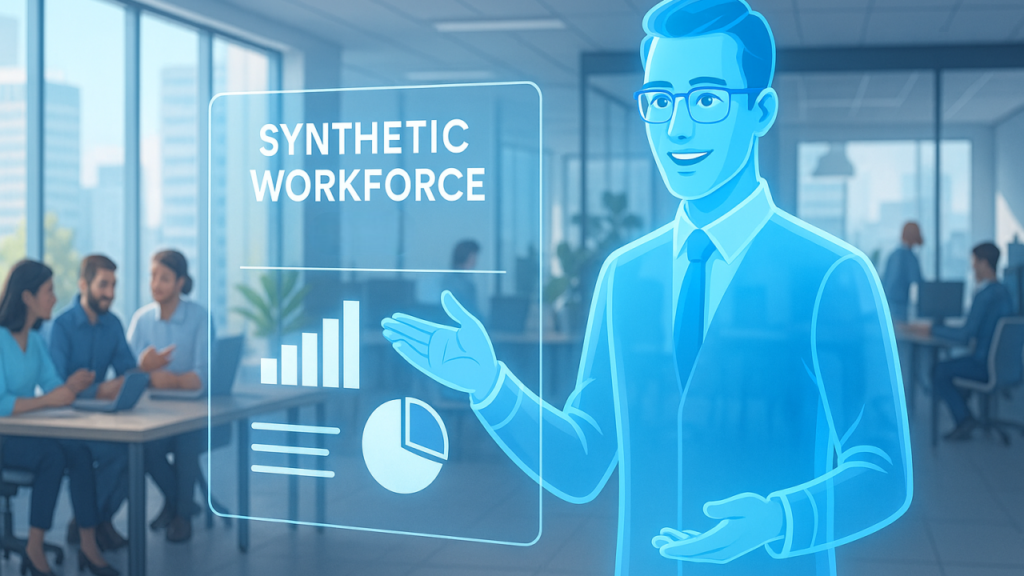
Historically, business growth has generally required more employees, managers, infrastructure, and operational capacity.
Competitive advantage may therefore increasingly depend on how effectively organizations design human-machine operating models.
AI Cannot Define Organizational Purpose on Its Own –
Autonomous AI systems can optimize objectives, but they do not automatically understand why those objectives matter.
A company cannot simply instruct an AI workforce to maximize revenue and assume that the resulting decisions will always benefit the business.
Revenue may need to be balanced against:
- Profitability
- Customer satisfaction
- Regulatory compliance
- Brand reputation
- Employee experience
- Security
- Long-term growth
- Business sustainability
An AI system can become extremely efficient at optimizing the wrong objective.
This makes strategic alignment more important, not less, in an AI-driven enterprise.
The organization must define not only what the AI should achieve, but also the constraints within which it should operate.
How to Build a Governed Synthetic Workforce –
Enterprises should resist the temptation to connect every available AI tool simply because the technology makes it possible.
A synthetic workforce needs deliberate architecture. Companies should begin with specific business outcomes and determine where autonomous AI can create measurable value.
A practical approach is to establish:
- Clearly defined agent responsibilities
- Explicit decision rights
- Permission boundaries
- Human approval requirements
- Monitoring and observability
- Output validation
- Escalation mechanisms
- Audit trails
- Performance metrics
- Cost controls
The organization should also determine which decisions are low-risk enough for autonomous execution and which require human involvement.
The objective is not maximum AI autonomy.
The objective is the right level of AI autonomy for the business risk involved.
The Future of Enterprise AI Is Organizational –
The synthetic workforce is more than another stage of software automation. It represents a possible redesign of how enterprises organize work.
The traditional enterprise consists primarily of humans supported by software. The emerging enterprise could increasingly consist of humans directing networks of AI agents that perform, coordinate, monitor, and optimize business activities.
That transformation could create significant advantages in speed, scalability, personalization, and operational efficiency. But it also introduces new challenges involving governance, accountability, trust, performance measurement, security, and organizational design.
The organizations that succeed will not necessarily be the ones with the largest number of AI agents. They will be the organizations that understand how to combine human judgment, AI autonomy, governance, and business strategy into one coherent operating model.
Conclusionn –
The synthetic workforce could become one of the most consequential developments in enterprise AI. The shift from individual AI assistants to interconnected AI agents changes the fundamental question businesses need to answer.
It is no longer simply about whether AI can perform individual tasks. It is about whether AI can coordinate work, delegate responsibilities, evaluate results, and manage other AI systems while remaining aligned with organizational objectives.
This creates enormous potential. A well-designed AI workforce could allow companies to operate faster, scale specialized capabilities, automate complex workflows, and give human employees more time for strategic and creative work.
But autonomy without governance can create a workforce that is highly productive in the wrong direction.
The future enterprise will therefore need more than powerful AI models. It will need AI organizational design, agent governance, human oversight, performance management, trust mechanisms, and clearly defined accountability.
The most important question for business leaders is not, “How many AI agents can we deploy?”
I